The letter sat on Eisenhower’s desk in the winter of 1945, and it was unlike anything the Supreme Commander had ever written. It was addressed to the Combined Chiefs of Staff, and its message was simple: either Bernard Montgomery went, or Dwight Eisenhower went. The patience that had held the Western Alliance together for three years had finally snapped. Eisenhower, the man the world knew as the model of restraint, had reached the end of what he could endure from the British field marshal.
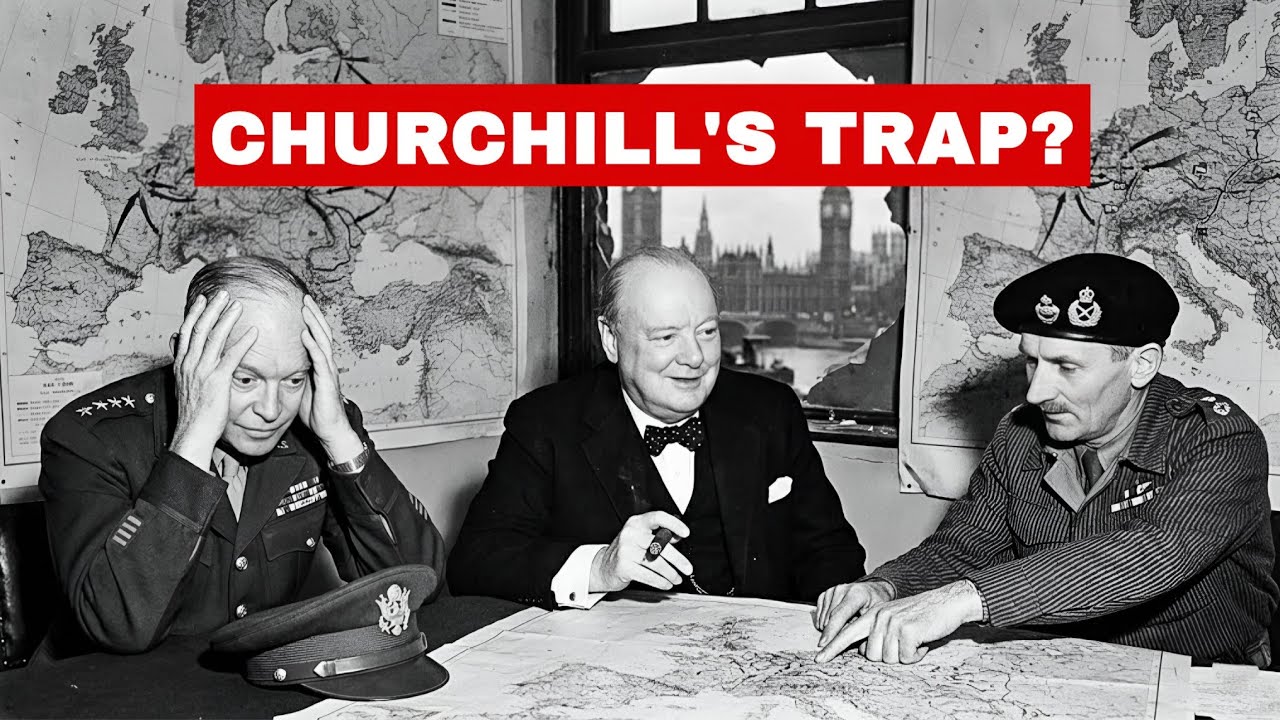
The immediate cause was a press conference Montgomery had given on January 7th, a performance so arrogant, so nakedly self-serving, that it had pushed the American high command to the verge of mutiny. Generals Omar Bradley and George Patton were already threatening to resign rather than serve under Montgomery again. And now Eisenhower himself was prepared to force the issue to its final conclusion. The question that hung over SHAEF headquarters was whether the alliance itself could survive the answer.
To understand how the most powerful military coalition in history had come to this, one had to step back to August 1944. The liberation of Paris had ignited a flicker of hope across a scorched Europe. Behind the closed doors of 10 Downing Street, however, Winston Churchill confronted a far darker reality than the cheering crowds suggested. While Eisenhower and Montgomery commanded the greatest armada ever assembled, a secret war for post-war dominance threatened to shatter the Allied command from within.
The transition of power in the mid-20th century was not a sudden collapse of the old order. It was a slow, agonizing realization that played out in the map rooms of London and Washington. By that summer, the industrial juggernaut of the United States had effectively eclipsed the British Empire. Britain had been transformed from the world’s primary creditor into a nation surviving on the lifeline of lend-lease.
For Churchill, whose very soul was intertwined with the survival of British global status, this shift carried a profound existential dread. He understood that the winner of the war would not simply be the one who defeated Hitler. The real prize would go to the power that dictated the terms of the peace. To ensure Britain maintained a decisive voice at that table, Churchill needed a British hero to strike the final, killing blow against the Third Reich.
That hero was Field Marshal Bernard Law Montgomery. Montgomery was a product of the Great War, a commander who viewed soldiers not as expendable assets but as a finite resource that Britain could no longer afford to waste. His victory at El Alamein had transformed him into a living symbol of British resilience, a face Churchill used to bolster national morale. But as Eisenhower began to exert his authority as Supreme Allied Commander, the friction between American and British strategy became the focal point of a much larger geopolitical struggle.
Eisenhower favored a steady, methodical advance across the entire European theater, a broad front designed to grind the German Wehrmacht into dust. Montgomery demanded the opposite: a concentrated lightning strike through the Ruhr, spearheaded by British forces, to end the war by Christmas and secure British glory before American manpower completely dominated the theater. The declassified personal diaries of Field Marshal Alan Brooke, the Chief of the Imperial General Staff, revealed the harrowing pressure Churchill exerted behind the scenes to maintain this delicate balance. Churchill did not merely mediate these disputes.
He weaponized them. He recognized that Eisenhower’s greatest weakness was his need for Allied unity, a vulnerability the Prime Minister exploited by framing Montgomery’s frequent insubordination as a necessary byproduct of military brilliance. When Eisenhower threatened to relieve Montgomery of command after a series of heated confrontations over the pace of the advance, Churchill stepped in. Not as a superior, but as a manipulative architect of prestige.
He whispered in Eisenhower’s ear about the fragility of British public opinion while simultaneously encouraging Montgomery to stand his ground against what he labeled as American tactical naivety. The psychological landscape of the Allied High Command was a minefield of insecurities and nationalistic pride. Montgomery’s disdain for Eisenhower’s lack of combat experience was well documented. He often referred to the Supreme Commander as a nice chap, but a hopeless general.
Churchill fed this fire. He needed Montgomery to remain relevant because a Montgomery victory was a British victory, and a British victory was the only currency London had left to spend at the international bargaining table. The Prime Minister’s strategy was clear. If the Americans provided the steel, the British must provide the genius.
This thinking led to the approval of one of the most controversial operations of the war, a gamble born more from political desperation than tactical soundness. Operation Market Garden, launched in September 1944, was the physical manifestation of Churchill’s manipulation. It was a plan that violated every principle of Montgomery’s usual caution: a daring airborne assault to seize the bridges of the Netherlands and outflank the Siegfried Line. History often records it as a failure of intelligence or logistics.
Through the lens of statecraft, it was Churchill’s last-ditch effort to keep the British flag at the front of the race to Berlin. He pressured Eisenhower to divert precious fuel and supplies away from George S. Patton’s charging Third Army and toward Montgomery’s northern sector. The broad front was momentarily sacrificed on the altar of British prestige, a decision that would have catastrophic consequences for the thousands of paratroopers dropped into the bridge too far at Arnhem.
As the smoke cleared from the Dutch polders and the scale of the Market Garden disaster became apparent, the tension between SHAEF headquarters and the British 21st Army Group reached a boiling point. Eisenhower was furious, yet Churchill’s defense of Montgomery remained resolute. The Prime Minister masterfully pivoted the narrative, using declassified cables to suggest that the failure was not in the plan itself, but in the lack of American support for a concentrated effort. By blaming the failure on the very broad front strategy he sought to undermine, Churchill ensured that Montgomery remained indispensable.
He portrayed the British commander as the only man capable of preventing a stalemate, a narrative that resonated with a British public weary of five years of total war. The logistical friction was never merely about trucks and gasoline. It was about the future of the British Empire. Every American division that landed in France was another nail in the coffin of British influence.
Churchill knew that by 1945, the ratio of American to British troops would be four to one. If the war followed Eisenhower’s methodical pace, the American weight of numbers would inevitably sideline British contributions. Therefore, Churchill’s support for Montgomery’s arrogance was a calculated risk. He allowed Montgomery to insult American generals and demand total control over ground forces because it kept the British way of war at the center of the conversation.
It was a high-stakes game of political chess, played with the lives of young men and the maps of a dying empire. The declassified reports from the National Archives highlight the intense internal political pressure Churchill faced from his own cabinet and the House of Commons. They demanded results that justified the immense sacrifices of the British people. Churchill used this domestic pressure as a shield when dealing with Roosevelt and Eisenhower.
He presented himself as a man caught between a brilliant but difficult general and a demanding public, masking his own hand in orchestrating the very friction he lamented. This created a dynamic where Eisenhower often felt he had to appease Montgomery just to keep Churchill’s government stable, unknowingly granting the Prime Minister the very leverage he sought to preserve British hegemony. Consider the what-if of this era. Had Churchill acted as a true neutral mediator, Montgomery might have been sidelined as early as August 1944 in favor of a more cooperative British commander like Alexander.
The Allied advance might have been more cohesive, potentially ending the war months earlier. But for Churchill, a swift American victory was a double-edged sword. A victory achieved solely by American industrial might would leave Britain as a secondary power in the new world order. He chose the path of friction, believing that a fractured command was a small price to pay for a seat at the head of the table.
Montgomery’s ego was the perfect tool for this objective. His refusal to wear the standard uniform, his insistence on his own press corps, and his habit of lecturing Eisenhower like a schoolboy were all traits that Churchill tolerated and even encouraged in private. The Prime Minister recognized that Montgomery’s larger-than-life persona was a necessary counterbalance to the quiet, unassuming efficiency of Eisenhower. In the theater of global politics, optics were everything.
As long as Montgomery was making headlines, Britain was still a superpower in the eyes of the world, even as its gold reserves dwindled to nothing. Internal memos from the British Foreign Office during this period show a deep concern regarding the Americanization of the war effort. There was a palpable fear that the United States would seek a separate peace or dictate a post-war map that ignored British interests in the Mediterranean and Southeast Asia. Churchill’s manipulation of the Ike-Monty rivalry was his primary defense mechanism against this outcome.
By keeping the military command in a state of creative tension, he ensured that no major decision could be made without his personal intervention, effectively making himself the indispensable mediator of the Western Alliance. This manipulation reached a fever pitch during the preparations for the crossing of the Rhine. Montgomery demanded that he lead the primary assault, requiring an enormous concentration of resources that once again threatened to stall the American armies to the south. Eisenhower, fearing another Market Garden, was hesitant.
Churchill launched a diplomatic offensive, framing the Rhine crossing as the symbolic heart of the British contribution to the defeat of Nazism. He used the prestige of the British monarchy, even arranging for King George VI to visit Montgomery’s headquarters, to signal that this was not just a military operation but a matter of national honor. The cost of this prestige-driven strategy was often measured in time and blood. The delay in the southern advance allowed German forces to regroup and contributed to the onset of the Battle of the Bulge.
Yet even in the midst of that crisis, Churchill found an opportunity. When Eisenhower was forced to put American troops under Montgomery’s command to stabilize the northern flank of the Bulge, Churchill saw it as a supreme triumph of British generalship. He ignored the tactical reality that American soldiers were doing the bulk of the fighting and focused entirely on the fact that a British field marshal was now saving the American line. The declassified transcripts of Churchill’s phone calls with Roosevelt show a man walking a razor’s edge.
He had to appear as a loyal ally while secretly undermining the very strategy Roosevelt endorsed. He used Montgomery as a stalking horse, allowing the general to take the heat for unreasonable demands while Churchill maintained his grand alliance statesman persona. It was a masterclass in Machiavellian leadership where personal animosities were transformed into pillars of statecraft. The winter of 1944 did more than freeze the ground of the Ardennes.
It froze the relationship between the Allied commanders in a state of permanent distrust. As the German counteroffensive in the Battle of the Bulge began to collapse, the internal war within the Allied High Command reached its most dangerous phase. Churchill, watching from the London war rooms, realized that the end of the war was in sight, and with it, the end of his ability to influence the Americans through military necessity. He had to double down on Montgomery even as the field marshal prepared to commit his most egregious act of vanity, an act that would nearly lead to his dismissal and the total rupture of the Anglo-American alliance.
On January 7th, 1945, Montgomery held a press conference that would live in infamy. Seeking to claim credit for the Allied recovery in the Bulge, he suggested that it was his intervention that had spared the Americans from total disaster. He portrayed the American soldier as valiant but leaderless, needing the steady hand of British experience to guide them. The reaction from Eisenhower’s headquarters was one of pure, unadulterated rage.
And it was this rage that drove Eisenhower to draft that letter to the Combined Chiefs of Staff, the one demanding that either he or Montgomery had to go. Churchill’s response was a masterpiece of political damage control. He knew that if Montgomery were sacked, Britain’s primary claim to military parity would vanish. He immediately contacted Eisenhower, not to defend Montgomery’s words, but to diminish them as the eccentricities of a tired soldier.
Simultaneously, he leaned on Montgomery to issue a humiliating apology, something the field marshal was loath to do. Churchill’s intervention was not motivated by friendship. It was driven by the cold calculation that a disgraced Montgomery meant a marginalized Britain. He forced the two men back into a working relationship through sheer force of will, preserving the appearance of unity while the underlying resentment simmered.
The tactical nuance of this period is often lost in the broader narrative of victory. While the world watched the map icons move toward the Rhine, Churchill was obsessively analyzing unit war diaries and logistical reports. He noticed that as the American industrial base reached its peak, British divisions were being consolidated due to a lack of replacements. Britain was running out of men.
This biological reality fueled Churchill’s urgency. If Montgomery didn’t capture the major German ports and the industrial heartland of the Ruhr soon, Britain would have no physical stake in the ground when the surrender was signed. He pushed Montgomery to move faster even as he publicly supported the general’s methodical approach to Eisenhower. The psychological weight of this era on Eisenhower cannot be overstated.
He was not just fighting the Germans. He was fighting a three-front war: one against the Wehrmacht, one against the Soviet Union’s looming shadow, and one against his own allies. Churchill exploited this by presenting himself as the only bridge between the impossible Montgomery and the rightfully aggrieved Americans. This allowed Churchill to insert himself into every major strategic meeting, ensuring that the British viewpoint, and more importantly British interests in the Mediterranean and the Balkans, remained on the agenda.
As the Allies crossed the Rhine in March 1945, the race for Berlin became the final flashpoint. Eisenhower, citing the political nature of the city and the heavy casualties expected, decided to leave Berlin to the Soviets. Churchill was horrified. To him, Berlin was the ultimate prize of prestige.
He pleaded with Eisenhower to allow Montgomery to bolt for the German capital. In a declassified letter to Eisenhower, Churchill argued that the fall of Berlin to the Soviets would lead to a grave misunderstanding of the British and American contribution to the war. He wasn’t just worried about the Cold War. He was worried that if the Red Army took Berlin alone, the Allied victory would be seen as a Soviet-American triumph with Britain as a mere footnote.
The internal friction between the leaders was now a matter of global survival. Churchill’s insistence on a British presence in Berlin was a desperate attempt to maintain the Big Three status. He knew that the moment the guns fell silent, the economic reality of Britain’s bankruptcy would become impossible to hide. The military prestige had to be so overwhelming that it compensated for the financial ruin.
Montgomery, sensing Churchill’s desperation, became even more demanding, further alienating the American commanders who were already looking toward the Pacific theater. Consider the alternate reality. Had Eisenhower allowed Montgomery to race for Berlin, the result might have been a direct military confrontation with the Soviet Union in 1945. Churchill was willing to risk this, an operation he called Unthinkable, because he believed a Third World War was preferable to a world where the British Empire was irrelevant.
The friction he fostered between his generals was a prelude to the friction he anticipated between the East and the West. Montgomery was the shield Churchill used to deflect American accusations of warmongering, framing his own geopolitical fears as the strategic concerns of his top commander. The leadership flow of the final months of the war was characterized by a series of tense summits and frantic cables. Churchill, despite his failing health, traveled to the front lines repeatedly, often appearing in photographs with Montgomery to project an image of British strength.
He was a master of the visual narrative, ensuring that even if American tanks were doing the heavy lifting, a British cigar and a British beret were always in the frame. This was the birth of the modern special relationship, a term Churchill coined to mask the reality of British dependency by framing it as a partnership of equals. Primary sources, such as the private memoirs of Churchill’s doctor, Lord Moran, paint a picture of a prime minister who was increasingly exhausted but remained mentally sharp in his manipulation. He would spend hours preparing for meetings with Eisenhower, anticipating the Americans’ objections, and coaching Montgomery on how to play the part of the aggrieved but loyal subordinate.
It was a performance that lasted until the very day of the German surrender at Lüneburg Heath, where Montgomery, under Churchill’s explicit instruction, ensured that he was the one to accept the surrender of German forces in northern Germany, denying the Americans a clean sweep of the headlines. The final Allied victory was a triumph of logistics and bravery, but the peace that followed was a carefully constructed illusion maintained by Churchill’s manipulation. By using the Ike-Monty rivalry as a tool of statecraft, he successfully navigated the transition of Britain from a global hegemon to a regional power without losing its seat at the table of the great powers. He saved the idea of Britain even if he could not save its empire.
The declassified National Archive reports now show that many of the command disputes once thought to be purely tactical were in fact orchestrated or amplified by 10 Downing Street. Churchill’s grand strategy was never just about defeating Hitler. It was about managing the decline of an empire in the shadow of two emerging superpowers. He used the personal animosities of his generals as a smokescreen for the maneuvers of a state that was running out of time.
The history of World War II is not just a story of battles, but a story of the fragile egos that commanded them. Eisenhower’s patience and Montgomery’s arrogance were the raw materials that Churchill used to forge a postwar world where Britain still mattered. The friction between them was not a flaw in the machine. It was the fuel that Churchill used to keep the British engine running long after it should have stalled.
The existential question that remains is whether this manipulation was a necessary evil or a tragic distraction. Did Churchill’s focus on prestige prolong the suffering of Europe by distracting from a unified Allied strategy? Or did his insistence on British relevance provide the necessary balance to prevent a total Soviet-American partition of the continent? History, as always, is written by those who survived the struggle.
Churchill’s survival, and the survival of British influence, is a testament to his skill as a manipulator of men. The declassified transcripts and soldiers’ memoirs provide the evidence, but the judgment belongs to us. Three giants of history, locked in a dance of duty and ambition, choreographed by a man who refused to let the sun set on his empire without one final defiant stand. The Eisenhower-Montgomery rivalry was not just a clash of generals.
It was the final act of the British Empire, played out on the stage of the world’s most terrible war.






