In July of 1912, on the south wall of the Merced River Canyon just below Yosemite, a crew of loggers pushed a flat car loaded with sugar pine to the edge of a ridge. There was a track in front of it. The track did not curve and it did not level off. It went straight down the mountain, 8,100 feet of it, and at the top it fell away at 78 percent.
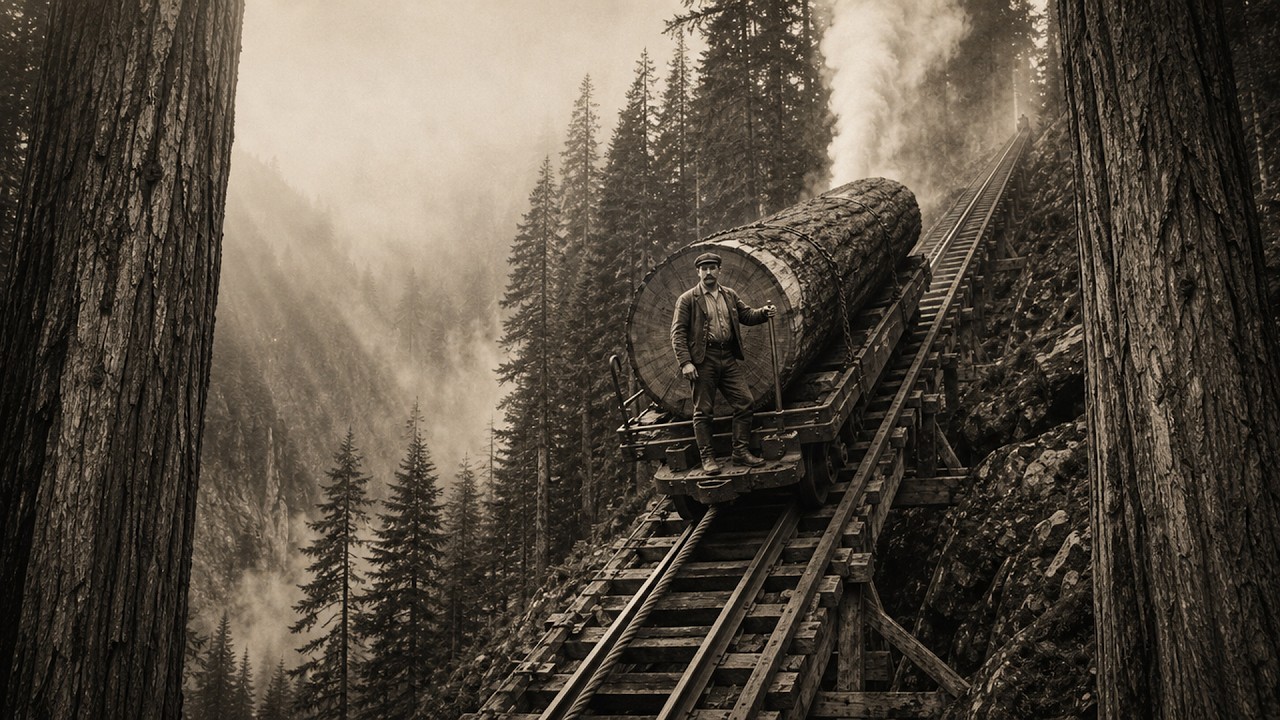
A steel cable an inch and a half thick ran from the back of the car up to a steam hoist on the ridge. Then the hoist took up the strain, and the car went over the edge. At the bottom, 3,000 feet below, was a railroad. At the far end of that railroad, a new mill was waiting for its first logs.
And here is the question almost nobody asks: how do you get a load of trees down a grade so steep that no train ever built could have climbed it? The answer is a machine that most people have never heard of, on a slope that most visitors to Yosemite drive past without looking up. And it starts with a problem of simple geometry. In 1910, a group of investors formed the Yosemite Lumber Company and bought 10,000 acres of timber on the south side of the Merced River, directly across from the town of El Portal.
It was some of the finest sugar pine in the Sierra Nevada. The sugar pine is the largest pine on Earth, and the logs it produced were enormous, straight, and clear. There was already a railroad below it. The Yosemite Valley Railroad had opened in 1907, running from the town of Merced up the river canyon to El Portal at the gate of the park.
It carried tourists, and it could carry logs down to a mill. The problem was the 3,000 feet between the timber and the track. The forest stood on top of the canyon wall. The railroad ran along the river at the bottom, and the wall between them was about as steep as a mountainside gets and still holds trees.
Here is what that meant for a locomotive. The steepest logging railroads in America were climbed by geared engines called Shays. At Cass in West Virginia, a Shay line climbed Cheat Mountain on grades that reached 11 percent—11 feet of rise for every 100 feet of track. That was already several times what a main line would ever attempt.
To gain its 2,400 feet, the Cass line needed 11 miles of track. Now run the same arithmetic at El Portal. To climb 3,000 feet at 11 percent, the absolute limit of a Shay, you need more than 5 miles of track at full grade without a single foot of level ground. On a canyon wall, that means switchbacks.
A switchback line climbs one leg of track to a dead end, stops, throws a switch, and backs up the next leg in the opposite direction, zigzagging up the face of the mountain one leg at a time. Every leg has to be cut and blasted into the rock, and every one of them has to be finished before the first log can come down. And every trip up and down means stopping and reversing at every single one. The Yosemite Lumber Company looked at that and decided not to climb the wall with locomotives at all.
They built a track straight up the mountain instead and ran the cars on a cable. The loggers had a name for that kind of track. They called it an incline. By 1912, the incline was an old and well-tried idea on the Pacific coast.
Up in the redwood country, eight lumber companies ran 28 inclines in Humboldt County alone. South of Scotia, there were eight of them between 3,200 and 6,700 feet long. At Bear Harbor, one incline climbed 600 feet in 1,900 feet of track at 31 percent. In Oregon and Washington, crews ran inclines at 60 and 70 percent.
And on anything steeper than 35 percent, they chained the logs down so they would not slide off the cars. On the Mendocino Coast, the Caspar Lumber Company ran four of them, which the crews called Bowton’s tramway. A photograph from 1904 shows the one at Hare Creek with a load of logs on the cable descending toward the landing. On those lines, the loaded flat cars went down by gravity.
The empties came back up behind a stationary locomotive or a donkey engine at the top. Farther north, the California Barrel Company ran an incline 5,400 feet long across the summit near Lord Ellis, where Highway 299 crosses today. The principle was always the same. Gravity did the work of bringing the logs down.
The cable did the work of holding them back. And every crew knew what happened when the cable lost. One local history of those lines puts it about as plainly as it can be put: a broken line sent logs and men flying through the air. The Yosemite incline took that principle as far as it would go.
The line ran 8,100 feet from the river at El Portal to the top of Hennessy Ridge. It was not one grade, but several. The bottom started at 48 percent. For a few hundred feet, it steepened to 52.
Then it eased to 45 as far as the middle of the incline. And the last 2,500 feet up to the summit were the steepest on the entire line, at 78 percent. Put that next to the Shay. Eleven percent was the kind of grade that made a Shay line famous.
The top of the Yosemite incline was seven times steeper than that. Seventy-eight percent means 78 feet of rise for every 100 feet forward. It is a slope of about 38 degrees—steeper than most staircases. A man could not walk up it upright.
He would climb it with his hands. And on that slope, the company laid ordinary standard-gauge railroad track with ties and rails, and ran full-sized railroad cars on it. Along the way, the line crossed four trestles where the slope fell away beneath it. It passed under two overhead hold-downs that kept the line in its place, and between the rails the whole way down ran row after row of rollers.
The cable rode on those rollers so that it stayed in line with the cars and never dragged in the dirt. The cable itself was 8,600 feet of wire rope an inch and a half across. At the top of the ridge, it wound onto a big steam-powered hoist built by the Willamette Ironworks of Portland, Oregon. The car was tied to the cable at its uphill end.
That detail matters more than it sounds. Everything in the system pulled from above. The car hung from the rope the way a bucket hangs from a well. Now think about what that rope was holding.
On level track, a loaded log car needs a push to move and a brake to stop. On a 78 percent grade, a little more than 60 percent of that car’s whole weight is trying to roll it down the hill at every moment. All of it hung on the cable and on the hoist at the top the whole way down. The trick that made it work was balance.
The incline was double-tracked, and the cars ran in pairs. As a loaded car went down one track, it pulled an empty car up the other. The weight of the logs coming down lifted the empty car going up. The hoist did not have to haul a loaded car against gravity.
It only had to control the difference and keep the pair moving at the speed the operator chose. And the difference was never constant. The grade changed at least four times along the line. When the loaded car started down from the top, it was hanging on the steepest part of the whole incline, at 78 percent, while the empty car at the bottom was still sitting on 48.
As they passed each other in the middle, the grades evened out. Then the balance flipped, and the loaded car rolled out onto the gentle bottom section while the empty car was being hauled up the steepest stretch. Every single trip, the man at the hoist was managing a load that shifted under him from one end of the cable to the other. The speed was fast.
The line ran at up to 1,300 feet a minute, around 15 miles an hour, down a slope steeper than a staircase. At that pace, a car could cover the whole 8,000 feet in about six minutes. Allow for hooking and unhooking at both ends, and the incline could handle about six cars an hour over a ten-hour shift. That is roughly 60 cars of sugar pine coming off the ridge, one pair at a time, every day of the season.
At the bottom, the car rolled across a bridge over the Merced River and onto the main line of the Yosemite Valley Railroad. The logs never left the car. The same standard-gauge bulkhead flat cars that the Shays brought out of the woods on top went straight down the incline. They were coupled into trains and hauled down the canyon to the new mill at Merced Falls.
That mill had been started in the summer of 1911, a year before the first log arrived. Nine hundred and forty-five tons of machinery came up to it by train, including a 600-horsepower electric plant. In its first year, the company claimed 35 million feet of lumber. The whole thing was spectacular enough that it became an attraction in its own right.
By 1913, the Yosemite Valley Railroad was running excursion trips out to the mill so that visitors could see for themselves where all that sugar pine was going. And up on the ridge, the company did run locomotives, because the incline only solved the wall. The timber stretched back for miles across the high country behind it. In 1912, a small two-truck Shay went up there.
A bigger three-truck followed in 1913. By 1919, the logging railroad on top reached Empire Meadow, about 15 miles back from the head of the incline. The company tried a Climax locomotive that year and sent it back because it could not keep up its steam. They bought another Shay instead.
The Shays grew with the operation. The first weighed 84,000 pounds. The last, bought in 1925, weighed nearly 175,000. So the whole system worked in three pieces: Shays on the gentle grades on top, the cable on the wall, and a common-carrier railroad along the river at the bottom.
An incline like this one was built by men and run by men, and some of them did not treat it the way the company intended. In its first year, the Yosemite Lumber Company claimed nearly 600 employees. The work in the camps was seasonal. Snow closed the high country every winter, so the logging ran from April to November and then stopped.
Down at Merced Falls, the mill town was dry. Alcohol could not be sold inside the city. So several saloons opened just across the line in Mariposa County. In 1918, with the mill cutting on a government contract for the war, a petition went around asking for those saloons to be closed.
And a carpenter in the camp named Louis Farr looked at 8,000 feet of straight steel track falling 3,000 feet to the river and saw a sled run. He built one. It was six feet long, with cleats on it and a curved metal bar that rode the rail. At the front was a handle.
Pulling the handle pressed the cleats against the rail, and the friction was the only brake he had. On that sled, men rode the incline from the top of Hennessy Ridge to the bottom in about two and a half minutes. They were doing better than 35 miles an hour down a slope that nobody could stand up on. It did not last.
At those speeds, the sled would jump the track, and the men on it were hurt. The company put a stop to it. The real work of the incline was less dramatic, and it was paid for in the ordinary way. For two years, the company recorded no fatal accidents at all.
In July of 1914, it had its first two. A local paper ran the second under the plain headline: “Second death at logging camp. ” Every autumn, the local papers marked the end of the season the same way. In November of 1918, the Mariposa Gazette reported the Yosemite lumber camp closing for the winter.
In April of 1919, the Merced County Sun reported the mills about to start again. By the 1920s, the operation had grown into something enormous. The mill at Merced Falls could cut 40 to 50 million feet of lumber in a season with 250 to 300 men. At its peak, there were 500 men at the mill and 500 more in the camps, with a daily payroll of $5,500.
In 1921, the company cut 60 million board feet. It added 15 new log cars to keep up. That September, a fire went through the camp and damaged the bakery and the dining room, which in a logging camp was no small thing. By 1923, the company had 700 workers.
It built new housing for them and cut more than 70 million board feet—another record. And then it ran out of timber on the south side of the canyon. The answer was to do the whole thing again on the other wall. In October of 1922, the Mariposa Gazette reported that the Yosemite Lumber Company was going to build a new tramway.
In 1923, the company raised $5 million in bonds and moved its operations to the north side of the Merced. Two hundred men worked around the clock to have the new line ready for the 1924 season. The north incline was 8,300 feet long, 200 feet longer than the first. It cost nearly a million dollars.
Its steepest grade was 68 percent. It needed more than 400 rollers to carry the cable. The upper half was double-tracked, and the descent at the bottom ran on single track. And this time the hoist was not steam.
It was an electrically operated double-drum machine that weighed 320,000 pounds. Above it, the company built a second incline to reach timber that the first could not. It paid for a while. In 1924, the company cut 60 million board feet.
In 1925, it cut 85 million—the biggest year it would ever have. To meet its bond payments, the mill ran seven days a week, ten hours a day. But the forest it was cutting sat inside and alongside one of the most famous parks in the country, and people had begun to notice. The logging had been allowed by two special acts of Congress, and on paper it was limited to timber that was dead and decaying.
The allowance ran to 200 million board feet. Over 30 years, the company would average 55 million feet a year. In 1917, it had even traded land along the Wawona Road to the government in exchange for timber in parts of the forest where fewer visitors would see the cutting. In the middle of the 1920s, a naturalist named Willard Gibbs Van Name published a pamphlet titled “The Yosemite National Park, How Its Boundaries Have Been Trimmed and Its Forests Logged Off.
” It drew little public attention at the time. In 1927, the company shut down without warning. The rumor around the mill was that White and Friant, a big lumber firm, had issued an ultimatum over the purchase of more land. In 1929, the Sugar Pine Lumber Company of Pinedale bought the mill and everything with it for $6 million.
A year later, the Depression closed it again, and Merced Falls was being called a ghost city. In 1935, it came back one more time. John Ball, the president of White and Friant, reopened the mill in July as the Yosemite Sugar Pine Lumber Company. A federal depression-relief loan of $400,000 paid to refurbish the incline.
New 400-horsepower motors went onto the hoist, with new wire rope, and the hoist ran 12 percent faster than before. All five Shays went back into service. The first logs of the new company reached the mill that September, and before the snow closed the camps, the crews had cut about 13 million feet. By 1936, the operation had settled back at 60 million board feet a year, and the incline was running as hard as it ever had.
It did not last long. In 1937, Eleanor Roosevelt and the Secretary of the Interior, Harold Ickes, visited, and the public pressure to get the loggers out of Yosemite became impossible to ignore. The government forced the purchase of 7,200 acres of sugar pine and added them to the park. In 1939, it bought the Carl Inn tract, another 7,200 acres, for $1,495,500.
Congress had found the money in a deficiency bill—$2,500,000 set aside to buy the sugar pine out of the loggers’ hands. By then, the company had already started building roads for trucks. The last train of logs arrived at Merced Falls on the 15th of November, 1942. The Shays were sold off the next year to a buyer called the Davidson Company, and most of them were cut up for scrap in 1947.
Engine number one had already been half destroyed by a fire in 1940 and rebuilt as number six. Number five, which had come secondhand from the Mount Shasta Power Company, went on to haul redwood on the north coast until it was scrapped in 1957. One of them survived. Engine number four went to a tourist railroad in Utah in 1971.
The Yosemite Valley Railroad made its last scheduled run on the 24th of August, 1945, and was torn up shortly after. What is left is mostly the ground. The spot at the bottom of the first incline became a small place on the map called Incline, California, with a post office that opened in 1924 and closed in 1953. The old railroad grade along the river is a road to a campground.
In the summer of 2018, the Ferguson fire burned nearly 97,000 acres of these mountains and came within five miles of the old incline. Up on the ridge, some of the logging railroad beds became the streets of a little mountain subdivision called Yosemite West, and the rest went back to forest. The mill at Merced Falls is gone. The town is a historical marker and a couple of houses.
And the wall is still there. Drive the canyon road below Yosemite and look up at the south side, and the slope is still there. Far too steep for any railroad, and far too steep for a man to stand on. For 30 years, the timber came down those walls anyway.
It came one car at a time, with an empty car climbing past it on the other track, on an inch and a half of steel rope.






