The drugstore spinner rack turns, a hundred identical plastic tubes clicking past, and a twelve-year-old reaches for the one that will define her for the next two decades of her life. It costs a dollar and a half. It does not have a sleek cap or a luxury price tag. It smells like a soda she was not supposed to drink before dinner, and somehow, it will become the first beauty product millions of American women ever consciously chose for themselves.
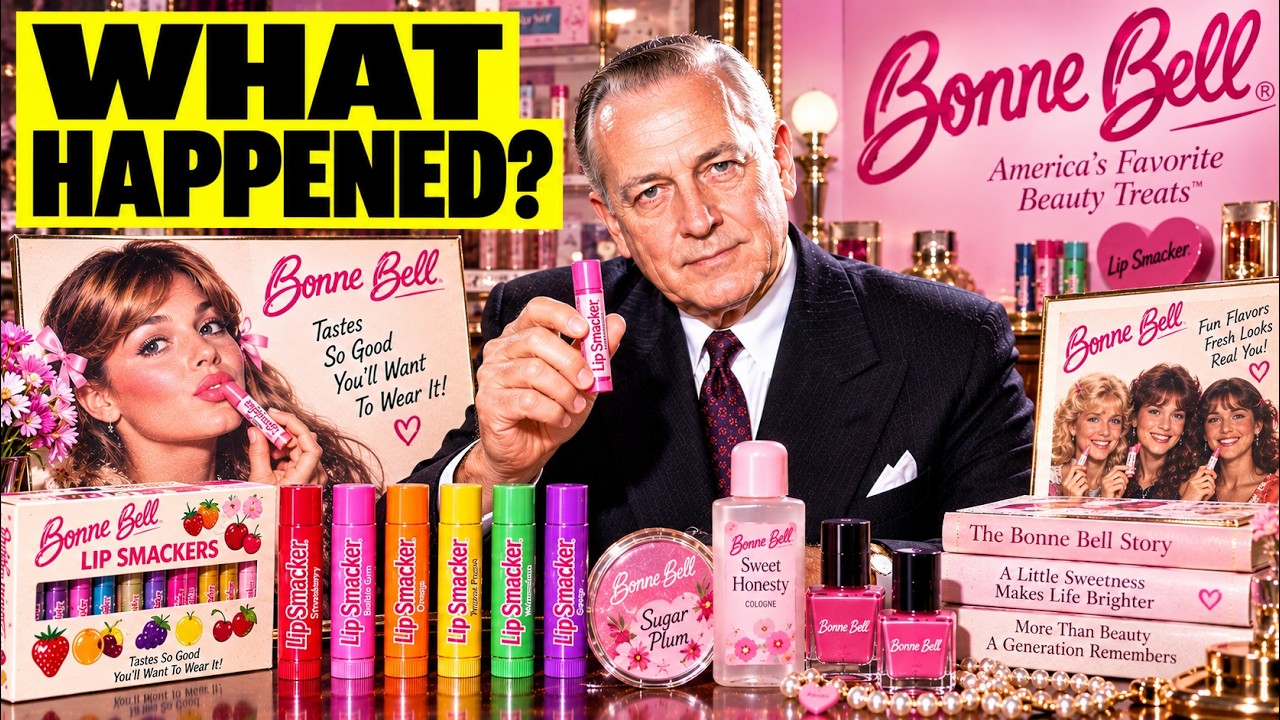
The brand behind that tube had survived the Great Depression, invented women’s athletic sponsorship before Nike existed, and pulled off what is reportedly the first brand partnership in cosmetics history. Then, nearly ninety years after it started, it closed a factory in Ohio and laid off ninety-one people. This is the story of Bonne Bell. It begins in 1927, and the beginning is genuinely strange.
A man named Jesse Grover Bell had moved from Kansas to Lakewood, Ohio, and he was making cosmetics on a hot plate in his basement. Not in a factory. Not in a lab. His basement.
During the Depression, he sold them door-to-door, and he built a beauty company from scratch in one of the worst economic periods in American history. It survived. This is not a myth; it is documented in the Encyclopedia of Cleveland History. The detail almost no one knows is the name.
Jesse Bell named the company after his daughter, a fact that gets repeated. What does not get repeated is where the daughter’s name came from. Jesse and his wife Maime loved a character named Bonnie Bell Wright from Emerson Hough’s 1917 novel *The Man Next Door*, a story about a tough, spirited young woman from Wyoming who loved hard and held her own. They named their daughter after that character, and Jesse named his company after his daughter.
The beauty brand that would end up in every drugstore in America traced its identity back to a fictional frontier girl in a novel almost no one had read since the 1920s. There was one more wrinkle. People mispronounced the name constantly. The “Bon” is French, meant to be pronounced “Bonnie,” and customers had to be corrected for decades.
The company that would eventually reach 94 percent consumer name recognition started life with a name people could not get right. The early skin care line centered on one product that became genuinely important: 10-0-6 lotion, that amber-colored bottle. If you grew up in the 1970s or ’80s, you either owned it or your mother did. It was an astringent.
You soaked a cotton ball and swept it across your face, and it left your skin feeling like it had been thoroughly dealt with. The formula had its origins in the 1930s, purchased from a Cleveland research chemist who had compounded it for a dermatologist. Originally marketed as an all-purpose freshener, it became the serious, no-nonsense face of Bonne Bell. This gave the brand a dual identity no competitor had.
The girl buying the strawberry-scented lip balm and the mother reaching for the amber astringent were buying from the exact same family. Bonne Bell lived in two completely different beauty worlds at once, and the company did not treat that as a contradiction; it treated it as a range. 10-0-6 was discontinued in 1998, and the outcry, by documented accounts, was immense. It was later relaunched as Formula 10.
0. 6 and it still exists, developed by Bell’s fourth-generation granddaughters, Hadley and Payton Bell, who are trying to revive their great-grandfather’s original skin care brand. Consumer reviews are full of people discovering the relaunch and writing with visible shock: “I didn’t know this was the Bonne Bell 10-0-6 from when I was in eighth grade. ”
That is real product loyalty, not brand marketing.
Women who used it as teenagers in the ’70s and ’80s describe the same specificity that people use for first perfumes or childhood kitchens: the slightly sharp clean smell, the way the cotton ball went amber, the cooling sensation that felt like your pores were physically snapping shut in protest and cooperation at the same time. It is not nostalgia for a product. It is nostalgia for a version of yourself, the girl standing at the bathroom mirror at 11:00 p. m.
convinced she was fighting acne and winning. In 1959, the story shifts. The man who took over the company was not going to keep making astringents and selling them politely. Jess Bell, son of the founder, was an ex-paratrooper.
He walked into the family cosmetics business and made a decision everyone around him thought was insane. He aimed the entire brand at outdoor sports, specifically skiing. He developed sunblocking creams as an alternative to the pasty zinc oxide skiers were using. He made anti-chap preparations, after-ski pomades, tanning stains.
He called the whole line ski. In 1971, he assembled what became known as the Bonne Bell ski team, a group that earned a full *Sports Illustrated* feature. Real female athletes, not models, deployed in star-spangled red, white, and blue outfits to ski resorts and college campuses across the country. The requirement was actual skiing ability.
Some ski shop owners reportedly would not place an order until they had watched the teen girls ski first. The implied demand was simple: you want to sell cosmetics in my shop, prove you belong on the mountain. The team motto was even simpler: a Bonne Bell girl doesn’t say, “It’s cold. I’m going inside.
”
This is a cosmetics brand talking about toughness in 1971, before Lululemon, before Nike Women, before “strong is the new beautiful” became a marketing phrase. The tagline Jess Bell built the whole brand around during this era was four words: “Be fit, look good. ” In 1960, the dominant message in women’s cosmetics advertising was almost entirely passive: be beautiful, be seen, be chosen. Bonne Bell was saying something different.
Go do something and look good while you’re doing it. The cosmetics followed the activity, not the other way around. Every major athletic beauty brand that exists today traces a line, consciously or not, back to that philosophy from a basement cosmetics company in Ohio. Olympic silver medalist Billy Kidd appeared in Bonne Bell’s men’s outdoor cosmetics campaign.
The brand became the official cosmetic of the US ski team. Then, in the mid-1970s, the ski team was disbanded once it had done its job. The brand had established itself in the outdoor market. Mission accomplished, team retired.
It is the kind of corporate decision that feels cold in hindsight, but the women who served on that team carried the identity with them for the rest of their lives. One former member was quoted in *Skiing History* magazine shortly before she passed in 2021: “I’m proud to still be called a Bonne Bell girl, especially at my age. ”
It was on those cold slopes that the next act was quietly beginning. The outdoor cosmetics line included a functional lip pomade, a protective formula for chapped, windburned lips.
It worked fine. It just did not taste like anything. Then Jess Bell and his chemists made a decision: what if it tasted like something? In 1973, Lip Smacker launched, the world’s first flavored lip balm.
Three flavors: strawberry, lemon, and green apple, aimed at skiers. That original plan did not stay aimed at skiers for long. Preteen and teenage girls discovered the product and claimed it entirely. The company did not chase them; they came.
What they found was a product that did something no lip balm had ever done before. It made wearing something on your lips fun. Think about what the beauty landscape actually looked like for a twelve-year-old in 1974. Lipstick was adult.
Eyeshadow was adult. Foundation was adult. Anything with real color read as grown-up and therefore forbidden or, at minimum, anxiety-inducing. You did not know if you were allowed, did not know if you would do it right, did not know if your mother would say something.
Lip Smacker sat right on the edge of cosmetics and candy. It went on clear or barely-there shiny. It tasted like fruit. It made your lips feel taken care of.
Nobody could accuse you of wearing makeup, because it was practically just a snack. That gap between allowed and grown-up, Lip Smacker lived in it perfectly, and Bonne Bell did not even plan it that way. The chemistry behind it sounds deceptively simple, but it is not. When Markwins eventually acquired the brand, their product development manager described spending three days a week smelling and tasting flavor formulas, more than 400 actively produced flavors at peak.
When they developed the soda flavors, they used gas chromatographs and mass spectrometers to analyze the actual beverages and isolate their flavor profiles. Making the Barq’s Root Beer version feel like root beer and not like cherry candy takes real science. Strawberry shortcake was notoriously difficult because there is no natural strawberry essential oil; the team had to build the scent from component molecules. These tubes that lived in pencil cases were the result of actual laboratory work.
Two years after Lip Smacker launched, Bonne Bell did something that had never been done in cosmetics before. In 1975, they partnered with Dr. Pepper, what is now described as the first major brand flavor partnership in cosmetics history. A carbonated drink and a tube of flavored lip balm.
That deal changed how beauty marketing thought about licensed flavors. The template for every celebrity collab, every limited edition candy collab, every “tastes like your favorite snack” beauty moment that has happened since started in Ohio in a factory that smelled like strawberry candy. The Coca-Cola partnership that followed became its own chapter. Bonne Bell became so important to Coca-Cola’s licensing business that the company was named Coca-Cola’s licensee of the year.
A lip balm company from Ohio, named licensee of the year by one of the largest consumer brands on the planet. The flavors that came from that partnership, cherry coke, vanilla coke, Sprite, Barq’s root beer, were genuinely precise. Dr. Pepper became the most beloved flavor in the entire Lip Smacker lineup.
That is not marketing opinion. It shows up in fan rankings, cultural retrospectives, and panic-buying behavior. There is a chapter of Bonne Bell’s story that almost no one tells, and it may be the most surprising one. Starting in 1976, Bonne Bell began sponsoring one of the first women’s-only 10K races in America.
Not one race. Races in New York, Aspen, Boston, Cleveland, and Atlanta simultaneously in the first year alone. In 1977, the Boston edition launched, then called the Bonne Bell Mini Marathon. In 1981, more than 7,300 women ran along the Charles River in that race.
Contemporary coverage described it as the largest women’s athletic event in the world at that time. At the 1977 race, Bonne Bell handed a Lip Smacker to every finisher at the finish line, causing an actual backup in the finisher shoot because thousands of women all wanted their flavored lip balm. That detail is documented. It happened.
The Boston race still runs, renamed the Boston 10K for women. Bonne Bell’s name has been removed, but the race has run for nearly fifty years, one of the oldest women’s races in the country, and the cosmetics brand that funded its first decade is not in the story anymore. A brand your mother might have written off as just candy lip gloss was also, simultaneously, funding women’s road racing before most of the country thought women’s road racing mattered. Bonne Bell was doing this while Title IX was barely off the ground, while women were still arguing for the right to run in major marathons at all.
They were not doing it from cultural progressivism. They were doing it because their entire identity was built around women being active, athletic, and outside. The ski team, the running races, the lip pomade designed to protect your face in cold wind. It all connects.
And then it was completely overshadowed by the Dr. Pepper lip balm in everyone’s pencil case, and the connection was forgotten. The last official Bonne Bell run was held in 1993. That same decade, the 1990s, was the Lip Smacker era in a way nothing before or since can match.
The flavors expanded beyond fruit into cultural artifacts: cotton candy, pink lemonade, bubble gum, Starburst and Skittles partnerships. The Biggy, the 0. 6 oz tube worn on a string around your neck, became the prestige object. *Gilmore Girls* referenced this.
Lorelai Gilmore lists wearing a Bonne Bell Lip Smacker around her neck as one of her actual bad girl moments. A flavored lip balm on a string was the signal of a specific kind of teenage wildness in the 1980s. Not dangerous. Just free.
There was a flavor hierarchy, and everyone knew it. Dr. Pepper at the top, then the fruit flavors, then cotton candy, and somewhere in the middle, the weird ones nobody wanted but everybody bought. You traded them.
They went in gift bags at Bat Mitzvahs. They were the thing you packed for sleepaway camp alongside multiple multi-pack sets, even though you only brought one bottle of shampoo. If you had a Biggy, you were serious. If you had multiple Biggies in rotation, people knew you.
The rarest flavors were currency. You did not just use them; you showed them. You let a friend smell yours like you were sharing something intimate. Eleven-year-olds made alliances in middle school hallways over whether watermelon or strawberry banana was objectively better.
Those arguments were real. The loyalty was real. They lived in backpack pockets and pencil cases and stuck to the bottom of your bag, and you found them months later and the smell still worked. There is a neurological reason for that.
Smell is the sense most directly connected to memory in the brain. When you find an old strawberry Lip Smacker and get hit with something that feels like being twelve years old, that is a genuine response. Bonne Bell accidentally engineered product that became a timestamp. The flavor range got increasingly surreal at peak.
The Cosmic Lip Smacker line had planetary-inspired flavors with space facts printed inside each tube. The jewel line had flavors like sapphire berry and butterscotch topaz. There were SPF versions with key ring caps so you could attach them to a sports bag. In 2014, Swarovski partnered with Lip Smacker to produce three Biggies covered in over 500 crystals each, reportedly priced at $250.
A product that started at $1. 50 ended up more expensive than Lancôme. The blushing gel deserves its own moment. An ’80s product applied as a gel dried to what multiple nostalgic accounts describe as something between a blush and a Kool-Aid stain.
It was weird. It was not very good technically. When it was discontinued, letters were apparently sent. A 2015 piece in the Into The Gloss archives mentions that the loudest complaints from the writer’s own mother about Bonne Bell’s closure were specifically about the blushing gel.
A product that went on orange and dried to a slightly alarming stain broke hearts. In 2007, the company largely relocated to Australia. VP of ideation Hillary Bell pushed for globalization of the Smackers brand, and the company moved significant operations to an Australia Pacific base. By 2009, it had returned to the United States.
A complete round trip in two years, with no major public explanation. In hindsight, the detour tells its own story. By 2007, Sephora had opened its American stores. YouTube beauty was emerging.
The teen market had fragmented into a dozen micro identities. Bonne Bell’s core demographic, the preteen girl who needed her first lip product and had $2, was now being targeted by every mass market brand that had watched Lip Smacker build that pipeline for thirty years. The globalization push was an attempt to find new audiences in markets where the nostalgia did not yet exist. It did not work, or at least it did not work fast enough.
By 2009, they were back in Ohio, and the question of what came next was still unanswered. It would stay unanswered until 2015. The 40th anniversary came and went in 2013, marked by limited edition flavors, a new e-commerce website, and celebrations. What nobody in those celebrations was saying publicly was that the company was already in its final chapter.
On January 29, 2015, Bonne Bell Company announced it would permanently close its Westlake, Ohio operations. Ninety-one employees were laid off. A family-run business that had been operating continuously since 1927, through the Depression, through two World Wars, through every trend cycle in American beauty, was closing its manufacturing facility. The Bell family had run it for three generations.
Jesse G. Bell made products on a hot plate. His son, Jess Bell, put women on skis and handed them lip balm at the finish line of history-making races. His son, Buddy Bell, ran a company with 94 percent consumer recognition.
Then the building in Westlake, Ohio went silent. Markwins International in California acquired both the Lip Smacker and Bonne Bell brand names. Markwins also owns Wet n Wild and Physicians Formula. The Bell family renamed the remaining entity Bell Family Brands and kept Formula 10.
0. 6. The granddaughters kept the skin care going. Lip Smacker technically survived.
The internet did not take this calmly. “We grieved for Delia’s, but this one really hurts” was a real published response. Popular Dr. Pepper tubes jumped from $2.
95 to $60 on Amazon the day the news broke. Five years after the sale to Markwins, in 2020, Dr. Pepper Lip Smacker was quietly discontinued. The flavor that was supposed to outlive us all lasted five years after the acquisition.
Lip Smacker has since passed its 50th anniversary under Markwins ownership. The commemorative vault collection, 50 lip balms in a giant strawberry Lip Smacker tube shaped to wear as a purse or backpack, sells for $100. There are Crayola flavors, unicorn frappuccino, Hello Kitty, Disney characters. The licensing machine is running.
The product still works as a lip balm. It is a perfectly competent product, and it is not the same thing as what it was, because what it was required the family in that building in Ohio. Jesse Bell read a novel about a fictional girl named Bonnie Bell Wright, a character defined by toughness, by loving hard, by holding her own in a world that did not always make space for her. He loved that character so much that he named his daughter after her and his company after his daughter.
The company he built survived decades of economic catastrophe, invented athletic marketing for women before the sports industry was interested, launched what is reportedly the first brand partnership in cosmetics history, handed lip balm to thousands of women crossing finish lines on crisp fall mornings in Boston, and filled a hundred million backpacks with something that smelled like candy and somehow made twelve-year-olds feel chosen. That story did not end when the factory closed. It ended up in every person who still remembers exactly which flavor they kept in their pencil case and what year they finally threw the last tube away. The Dr.
Pepper is gone. The building is gone. The family is not in it anymore. But whoever you were the first time you picked your own lip balm off a drugstore spinner rack, that version of you still has a Lip Smacker.
It is in a drawer somewhere, and it still smells exactly like that year.






