The four-year-old boy smiles for the studio portrait, as children do when a photographer asks them to hold still. The image preserves a moment of complete innocence: Istvan Reiner, bright-eyed, dressed neatly, unaware that he is posing for what will become one of the most haunting photographs of the Holocaust. Within a short time, the child would be murdered at Auschwitz. The picture survives as the record of a life that had barely begun, captured in its final days of joy.
The story of that photograph is one among dozens, snapshots of history’s darkest and most remarkable moments. Each image holds a narrative that stretches far beyond the frame, and taken together they form a gallery of the twentieth century in all its cruelty, endurance, and occasional grace. On August 30th, 1963, a young man attacked the Horace Baker family. The Bakers were the first African-American family to move into the predominantly white Delmar Village neighborhood in Folcroft, Pennsylvania.
Their arrival in the quiet suburb marked a challenge to the racial boundaries that divided so many American communities in the early 1960s, and it was met with violence. Decades earlier, in the 1860s, another kind of violence was built into everyday objects. A device known as a window lock or safety device was designed to prevent enslaved people from escaping through small openings like windows. The metal restraint was a simple piece of hardware with a sinister purpose: to keep human beings from fleeing through the same openings that let air into their quarters.
The first photograph taken of Chernobyl’s reactor 4 shows the devastation after the 1986 nuclear disaster. The image was captured soon after the explosion that caused the radiation leak, making it one of history’s worst nuclear accidents. The twisted remains of the reactor stand as a monument to the failure that spread radioactive contamination across Europe. On June 19th, 1944, a pilot celebrated the shooting down of six Japanese planes during the Battle of the Philippine Sea.
American aviators so dominated the engagement that it became known as the Great Marianas Turkey Shoot. The pilot’s grin in the photograph reflects the triumph of a day when the U. S. Navy effectively destroyed Japanese naval aviation.
An anti-fascist militia fighter during the Spanish Revolution of 1936 wears a battle uniform and a determined expression. The combatant symbolizes the struggle against Francisco Franco’s fascist forces, a conflict that tore Spain apart and drew volunteers from around the world. Children with Down syndrome are shown at the Schizophrenic Hospital near Dachau, Germany on February 16th, 1934. The image reflects the inhumane treatment and cruel policies of Nazi Germany, which would soon mark such children for systematic murder under the guise of medical care.
An aerial photo of a French gas attack on the Somme around 1917 shows the devastation caused by chemical weapons during World War I. Poison gas had become a standard military tactic, and the photograph documents the clouds of death that drifted across the battlefield. During a protest against a Ku Klux Klan rally in Gainesville, Georgia in 1992, a boy approaches a black state trooper while the officer holds his shield on the ground. The encounter between the child and the officer, caught in a single frame, speaks to the changing face of the South.
In 1956 in Nashville, Tennessee, a sign reads: “Southern whites are the Negroes’ best friend, but no integration. ” The contradiction in the message captured the mood of a region struggling against the tide of civil rights. The airplane warning antenna at the World Trade Center, surrounded by ground zero debris, was photographed on September 13th, 2001. Two days after the attacks, the wreckage still smoldered, and the antenna that had guided planes away from the towers lay twisted among the ruins.
Christmas packages meant for soldiers who were killed or reported missing in action awaited return-to-sender stamps in New York in 1944. The parcels, filled with gifts that would never reach their intended recipients, sat in a post office as the war ground on. Graffiti on a Vietnam War helmet from 1967 reads: “War is good business, invest your son. ” The phrase reflects cynicism and criticism of US involvement in the conflict, suggesting the war profited those in power at the expense of ordinary families.
A US Marine in Vietnam made a statement about his Commander-in-Chief, Lyndon Baines Johnson, in 1967. The image captures a soldier’s frustration and disillusionment with US political leadership during the Vietnam War, a sentiment that spread through the ranks as the conflict dragged on. A 1945 warning sign for Manhattan Project workers reminds them of the project’s extreme confidentiality and secrecy. The men and women who built the atomic bomb worked in the shadows, forbidden from speaking of their labor even to their families.
A member of an extremist group shields himself from counter-protesters behind a black police officer during a rally in Austin, Texas in 1983. The photograph catches the irony of a man who preached hatred seeking protection from the very officer he would have despised. A Chinese sailor survived alone adrift on a lifeboat for 133 days before being rescued in 1943 off the coast of Brazil. The photo captures the dramatic, awe-inspiring moment of extreme endurance and survival.
For more than four months, the sailor had faced the open ocean alone, and when rescue came, he had become a legend of human resilience. A soldier stands beside his M60 machine gun mounted on the US Capitol steps to stop protesters from entering the building during the unrest following Martin Luther King Jr. ‘s assassination. The capital, the seat of American democracy, had become an armed camp.
Benito Mussolini is depicted with a bandaged nose after being shot by Violet Gibson in 1926. Gibson, an Irish woman, had attempted to assassinate the Italian dictator at a public event in Rome. The bullet grazed his nose, and the dictator survived, his wound a reminder of the enemies he had made. A curious girl wearing roller skates watches a military patrol during the Battle of the Bogside in Northern Ireland in 1969.
The image captures the contrast between childhood innocence and the conflict’s violence gripping Derry’s streets. Even as the troubles erupted around her, the girl watched with the simple curiosity of youth. A patient at Surrey County Lunatic Asylum in 1852 exemplifies nineteenth-century mental health treatment, an era when psychiatric hospitals were often dark and isolated environments. The photograph offers a rare glimpse into the lives of those confined within those walls.
Hattie Tom, a young Chiricahua Apache, is pictured in 1899. The image captures her beauty and strength, reflecting the rich culture of Native American peoples. During this time, the Apache faced great challenges due to oppression, and Tom’s portrait stands as a testament to a people fighting to survive. Soldiers are hoisting an artillery piece to the top of a cliff in 1917.
The image shows the troop’s significant effort using ropes and improvised gear to transport the artillery, a feat of strength and ingenuity on the battlefield. Gheorghe Iory Muciutani, leader of the first Aromanian band in the Internal Macedonian Revolutionary Organization, IMRO, from 1903 to 1907, is depicted in a historic photograph. The revolutionary organization fought for Macedonian independence, and Muciutani led his men through years of guerrilla warfare. On March 19th, 1921, President Harding greets disabled World War I veterans.
In the foreground, a man without legs sits on a wheeled board. The image captures the human cost of the Great War as the nation’s leader met the men who had sacrificed their bodies in its service. A pile of German helmets celebrating victory sits in front of Grand Central Station, New York after World War II. The captured helmets, stacked like a mountain of conquest, marked the end of the Third Reich.
The photo, taken by Edward Curtis in 1909, shows the Arikara warrior known as Bears Belly in North Dakota, USA. Curtis, a renowned photographer, dedicated his career to capturing images of American Indian cultures in the early twentieth century, preserving a world that was rapidly disappearing. Two women in an opium den in New York, USA in 1902. During this time, opium use was a common practice in many parts of the world, including the United States.
The photograph documents a hidden corner of American urban life. Miles Davis is depicted at Jimi Hendrix’s funeral on October 1st. The image captures a significant loss for the music world, with Davis, a jazz legend, paying tribute to Hendrix, the rock icon. Two musical revolutions met in grief.
A scene from Deadwood, USA in 1876, a famed Wild West town. At the time, Deadwood was known as a lawless place filled with miners, outlaws, and historical figures like Wild Bill Hickok. The photograph captures a moment in the life of a town that would become legend. Chinese immigrants stand in Oregon, USA, possibly in the 1890s.
The image captures the moment of a family, like many Chinese immigrants, settling in the American West during a time of hardship and discrimination. Ishi, the last known member of the Yahi indigenous tribe, is depicted in the United States in the 1910s. After the deaths of his tribe’s other members, Ishi was found in 1911 living alone in the California mountains. He emerged from the wilderness as the final survivor of his people, and his photograph preserves the face of a vanished world.
North Korean players celebrate after defeating Italy in the 1966 World Cup. The historic win was a milestone for North Korean soccer as the team advanced to the tournament’s quarterfinals against all odds. The underdogs from the isolated nation had shocked the football world. In 2001, Egyptian police arrested 52 men on charges of homosexuality in a case known as the Queen Boat, named after the vessel where the arrests took place.
The raid on the floating nightclub marked one of the most notorious crackdowns on LGBTQ+ people in the Middle East. Lydia Litviak, known as the White Lily of Stalingrad, is pictured on the wing of her Yak-1B aircraft around 1942. Litviak was one of the Soviet Union’s most notable female pilots during World War II. She flew combat missions against the Luftwaffe and became a symbol of Soviet resistance.
Men stand inside a 45-ton steel tube section during Hoover Dam construction in 1935. The massive project tamed the Colorado River, and the photograph shows the scale of the undertaking as workers stood within the very metal that would hold back the waters. Alfred Hitchcock, the master of suspense, poses for an iconic photo with a woman dressed as a bride in front of the famous Psycho house. Hitchcock’s trademark expression and dramatic gestures capture the essence of his unique tension-building style.
The director who had terrified audiences with the shower scene now stood grinning before the same house where his most famous murder took place. An over-the-shoulder view of John F. Kennedy during his famous “Ich bin ein Berliner” speech in 1963 in West Berlin. Standing before a crowd, Kennedy expresses solidarity with Berliners during the Cold War.
The wall that divided the city had become the symbol of a divided world. The opening ceremony of the first Paralympic Games in Rome, 1960. The photo captures a historic moment as athletes with disabilities from around the world gathered to compete in an international event dedicated to adapted sports. What began as a small gathering would grow into one of the world’s largest sporting events.
A German officer is shown during World War I with his dog named Fuchs, meaning “little fox. ” The image was taken during his youth when Hitler was serving as a soldier in Germany. The photograph, showing a young soldier with his pet, is a reminder that history’s greatest monster was once an ordinary man. Cetshwayo, king of the Zulus, is depicted in 1878 after his victory over British forces at the Battle of Isandlwana.
The battle was a stunning defeat for the British Empire, and Cetshwayo’s portrait captures the dignity of the man who led his people to that triumph. The New York City blackout of 1977 was a massive power outage that lasted 25 hours. The photo captures the city amid chaos and darkness as the electricity failure affected millions of residents and businesses. Looting and arson swept through the streets, and the city that never sleeps went dark.
In 1975, Vietnamese orphans arrived in the United States, marking one of many humanitarian efforts following Saigon’s fall and the end of the Vietnam War. The children, evacuated in the final days of the war, carried the weight of a lost country. A negative taken about 160 years ago depicts a scene in Ohio. Although the original photograph was captured in a distant era, it still preserves rich historical details offering a unique view of what life was like in that region.
A woman walks across the frozen Mississippi River in St. Louis, Missouri in 1905. She wears period winter clothing including an elegant hat as she crosses the vast layer of ice covering the river. The river that had carried steamboats and commerce was now a solid highway.
Two Dutchmen are shown wearing traditional trousers around 1900. They wear typical period clothing, loose pants and button-up shirts common in rural and coastal areas of the Netherlands. The simple garments speak to a way of life that modernization would soon transform. Nikola Tesla sits in his Colorado Springs laboratory in December 1899 beside his high-voltage magnifying transmitter as he generates electrical discharges.
The inventor, who had revolutionized the world with alternating current, now played with forces that seemed almost magical. The Mothers of Invention and Jimi Hendrix pose during a photo session for the album “We’re Only in It for the Money” in 1967. The image captures an iconic moment in the 1960s music scene, featuring two rock revolutionaries whose experimental approaches would change music forever. A lamplighter lights a gas lamp on a street in Glasgow, Scotland in 1955.
The image captures the transition from old public lighting methods to city electrification modernization. For centuries, the lamplighter had been a familiar figure in European cities; now the job was fading into history. Members of the People’s Republic of China delegation are seen at the San Diego Zoo, California, USA in 1980. The image reflects a historic visit as Chinese representatives explored cultural and diplomatic exchanges with the United States, a sign of thawing relations between the two powers.
In 1938, during the 75th anniversary of the Battle of Gettysburg, a Union veteran tells stories to a group of Boy Scouts. The old soldier, who had fought in the war that decided America’s fate, now passed his memories to a new generation. The 1913 photo taken by Roland Reed shows members of the Blackfoot tribe in Glacier National Park, Montana, USA. The image captures the cultural richness and beauty of indigenous traditions with tribal members wearing traditional attire.
Emperor Hirohito of Japan, who reigned from 1926 to 1989, is pictured visiting Disneyland during an official United States visit in 1975. The man who had presided over Japan’s imperial expansion and defeat now walked through the happiest place on earth. A prototype spacesuit test for NASA’s Apollo lunar landing program was conducted in the Mojave Desert, California in 1960. The image captures the early stages of spacesuit development crucial for astronaut safety during moon missions.
Before men could walk on the moon, they had to learn to survive its environment. The USS Los Angeles airship, measuring 700 feet long, is buffeted by wind and swings half a rotation at the top of its 200-foot mooring mast in Lakehurst, New Jersey, USA in 1926. The giant airship, caught in a sudden gust, spun wildly before being brought under control. The photograph captures the fragility of the age of the great airships.
62,500 punch cards containing 4. 5 MB of data are stacked in the United States in 1955. At that time, punch cards were a primary means of data storage and processing, especially for large mainframe computers. The small stack of cards held a fraction of what a modern smartphone stores, but it represented the cutting edge of computing.
John F. Kennedy delivers a speech in Appalachia, USA in 1960. The photo captures the moment he addresses a region facing severe economic and social challenges, especially poverty and lack of infrastructure. The future president reached out to the forgotten corners of America.
An electric car is being charged at a private charging station in the United States in 1919. The image shows that the idea of electric vehicles was not new, even if the technology had yet to reach its modern potential. FIBA allowed professional basketball players to compete in the Olympics for the first time at the 1992 Games. The NBA’s top players joined to represent the US, forming the Dream Team.
Led by Michael Jordan, Magic Johnson, and Larry Bird, the team dominated the competition and transformed Olympic basketball forever. A soldier of the Polish Armed Forces in the West plays with a bear named Wojtek, the mascot of the Second Polish Corps during World War II. The bear, adopted by Polish soldiers, had been enlisted as a private and carried ammunition for the troops. The photograph captures a moment of humanity amid the horrors of war.
A traffic officer in New York stops traffic so a mother cat holding her kitten can cross the street safely around 1925. The scene reflects kindness and care for animals at a time when the city was still modernizing. For a moment, the busy streets of New York paused for a small act of compassion. The iconic Hollywoodland sign on Mount Lee stands with the San Fernando Valley in the background in 1920.
The sign, originally part of a real estate project, soon became a lasting symbol of the film industry. What began as an advertisement would become an enduring monument to the movies. Elton John is depicted wearing an extravagant outfit during one of his performances. The image shows the singer in a striking suit and elaborate hat, reflecting his unique and bold stage style.
The musician had made flamboyance part of his art. S&H Green Stamps were a popular US loyalty program from the 1930s to the 1980s. Shoppers received these stamps as rewards for purchases at participating stores. The stamps, collected in books and redeemed for merchandise, were a familiar part of American shopping for half a century.
The band Nirvana poses during the photo shoot for the album Nevermind. Members Kurt Cobain, Krist Novoselic, and Dave Grohl strike relaxed, genuine poses. The album would explode onto the music scene, changing rock forever. Jayne Mansfield walks the streets of New York in 1953 accompanied by her daughter Jayne Marie.
The image captures the actress’s light-hearted elegance. She was one of Hollywood’s biggest stars at the time. An American soldier shares a chocolate bar with a local Japanese woman in 1946. A year after the war ended, the occupation had begun, and small gestures of kindness marked the beginning of a new relationship between former enemies.
Gas-powered taxis are parked on a street in Birmingham, Britain in 1940. The gas bags mounted on the roofs were an improvised solution during the World War II fuel shortage. When petrol ran short, ingenuity filled the gap. In the scorching summer of 1929, a relentless heatwave struck the United States with temperatures exceeding 100°F.
The photo shows wax figures in a mall, likely warped by the intense heat. Even mannequins could not withstand the oppressive weather. A Tupperware party in 1958 in Sarasota, Florida. At these gatherings, women met to watch demonstrations of food storage products by the Tupperware brand, which would become a household convenience icon.
The parties turned a simple plastic container into a social phenomenon. A little French girl kisses an American soldier on Valentine’s Day in 1945. As the war in Europe neared its end, the people of France embraced the soldiers who had come to liberate them. A group of elderly ladies drink sherry in a pub in Glasgow’s Gorbals district in 1968.
The photograph captures a moment of quiet sociability in one of Scotland’s most famous neighborhoods. Japanese women pose before heading to the beach in 1946. The image reflects a period of social change in Japan after World War II. Defeated and occupied, the country was beginning to rebuild, and its people were adapting to a new era.
The photo taken in 1939 inside Krakow Castle in Poland shows the last veterans of the January Uprising of 1863. These aging veterans were commemorating and honoring the resistance movement against the Russian Empire. Seventy-six years after the rebellion, the last survivors gathered to remember a cause that had failed but was never forgotten. A tenant farmer takes a lunch break on his farm in a photograph by Dorothea Lange in 1937 near Clarksdale, Mississippi.
Lange, who documented the Great Depression, captured the exhaustion and dignity of rural America’s poorest workers. Ava Gardner and her first husband, Mickey Rooney, are pictured in the 1940s. The photo captures the young Hollywood couple at the height of their careers, two stars whose marriage would not last but whose images remain frozen in time. A new TV telephone is on display at the International Radio Exhibition in Stuttgart, West Germany in 1965.
The image captures a technological innovation of the era when communication devices began integrating multiple functions. The future of communication was on display. Lyndon B. Johnson is seen shouting at pilots to shut down their engines so that John F.
Kennedy can deliver his speech in Texas in 1960. The future president, then a senator, was making sure the man who would defeat him for the nomination could be heard. Mary Anne Trump, Donald Trump’s mother, is shown in 1930. Born in Scotland, she immigrated to the United States that year, settled there, and married Fred Trump, with whom she had five children, including Donald.
The photograph captures a young immigrant at the beginning of her American journey. Sister Mary Kenneth Keller, the first woman to earn a PhD in computer science in the United States, is pictured in 1965. Her achievement opened the door for generations of women in the field. A couple rides together on an Autoped, one of the first motor scooters invented in 1915, in New York around 1923.
The image captures the Autoped’s growing popularity during the 1920s, a glimpse of personal transportation’s future. Yuri Knorozov, the Russian linguist famed for deciphering the Maya hieroglyphic writing system, is pictured with his cat Asha in the 1980s. The brilliant scholar, who had unlocked the secrets of an ancient civilization, found companionship in a simple domestic animal. A frozen fountain in Detroit, likely in the winter of 1906.
The image captures the surreal beauty of a working fountain with ice formed by the low temperatures. Water that should have been flowing had been caught by the cold. Charles Bronson and his wife Jill Ireland walk hand in hand in 1971. The photo captures a relaxed moment with Bronson showing his muscular physique, and Ireland, a noted actress, displaying her era’s distinctive style.
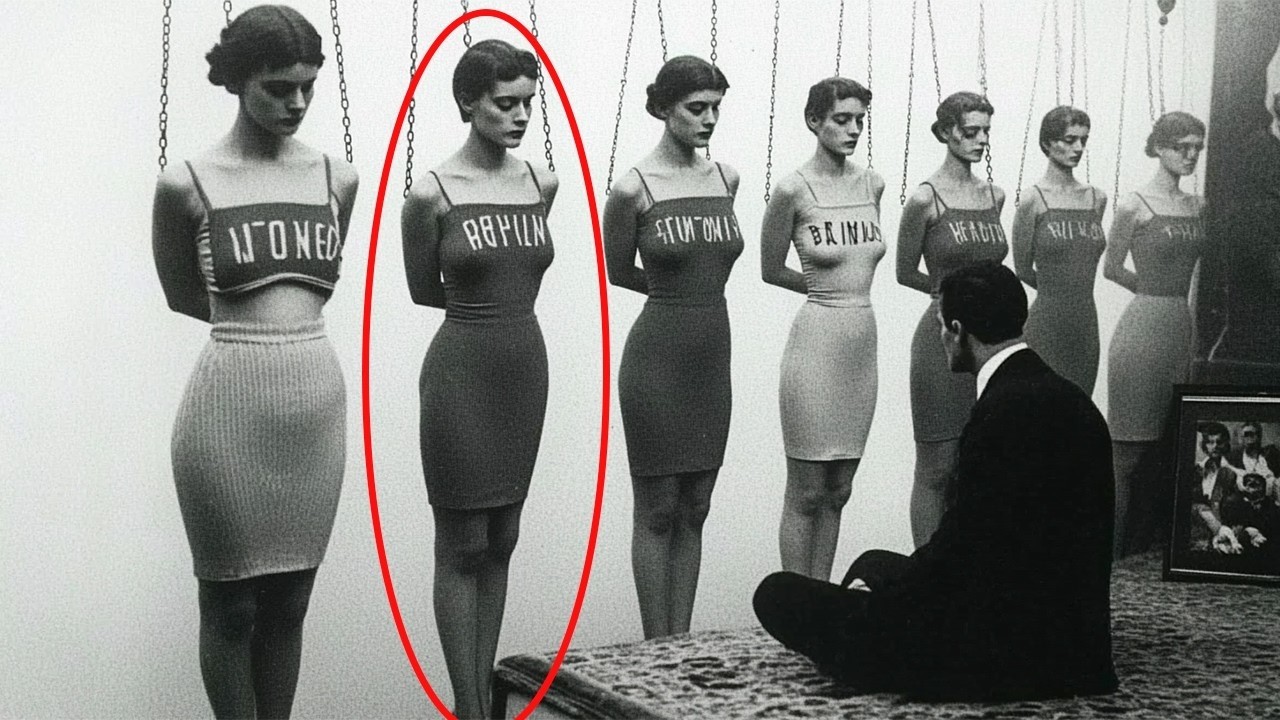
American model and actress Anita Colby poses with mannequins resembling her for a 1954 photo shoot. The photograph plays with the line between the real and the artificial, the star and her replicated images. A 1970s dining room features the period’s characteristic decor. In the foreground, a table set with dishes and glasses is surrounded by wooden chairs, reflecting the simple, functional style of the decade.
Tourists stand on the crown of the Statue of Liberty in New York in 1947. The image captures the unique experience of visiting one of America’s most iconic landmarks, a close encounter with the great monument. Gilbert Kerr, a member of the Scottish National Antarctic Expedition, plays bagpipes for a penguin in early March 1904. The absurdity of the scene, a man in heavy polar gear piping for a curious penguin, captures the strangeness of exploration in the far south.
A group of people eats breakfast on the National Mall in Washington, D. C. on July 19th, 1974. The setting is relaxed as participants enjoy an outdoor meal at one of the United States capital’s most iconic landmarks.
On that same day, the nation was consumed by the Watergate scandal, but here, people simply shared a meal. Emperor Hirohito of Japan plays shogi with his son, Prince Akihito, in 1955. The image captures an intimate family moment as father and son engage in the traditional Japanese board game. The man who had been worshiped as a living god now shared a quiet game with his heir.
Department store workers take their lunch break in Chattanooga, Tennessee in 1905. The photograph captures a moment of rest in the working life of the early twentieth century. On January 22nd, 1987, Pennsylvania Treasurer Budd Dwyer was at the center of a press conference where a tragic incident occurred. Dwyer had been convicted of a crime and was awaiting sentencing.
Before the assembled reporters and cameras, Dwyer took his own life, a moment caught on live television that shocked the nation. The photograph of that press conference remains among the most disturbing images in American political history.






