In the summer of 1908, a bridge worker stood on a timber bent one hundred and forty feet above the floor of Clearwater Canyon, driving a wooden pin through a pre-drilled hole in the girder overhead and seating it with a hammer in a motion he had repeated thousands of times since the crew had moved into this part of the canyon in the spring. The bent beneath him was Douglas fir cut from the forests of northern Idaho and hauled by wagon teams to the construction site on the canyon rim far above. The Clearwater River ran below, swift and green, carrying snowmelt from the Bitterroot Mountains sixty miles to the east. He could hear it but he could not see it from where he worked.
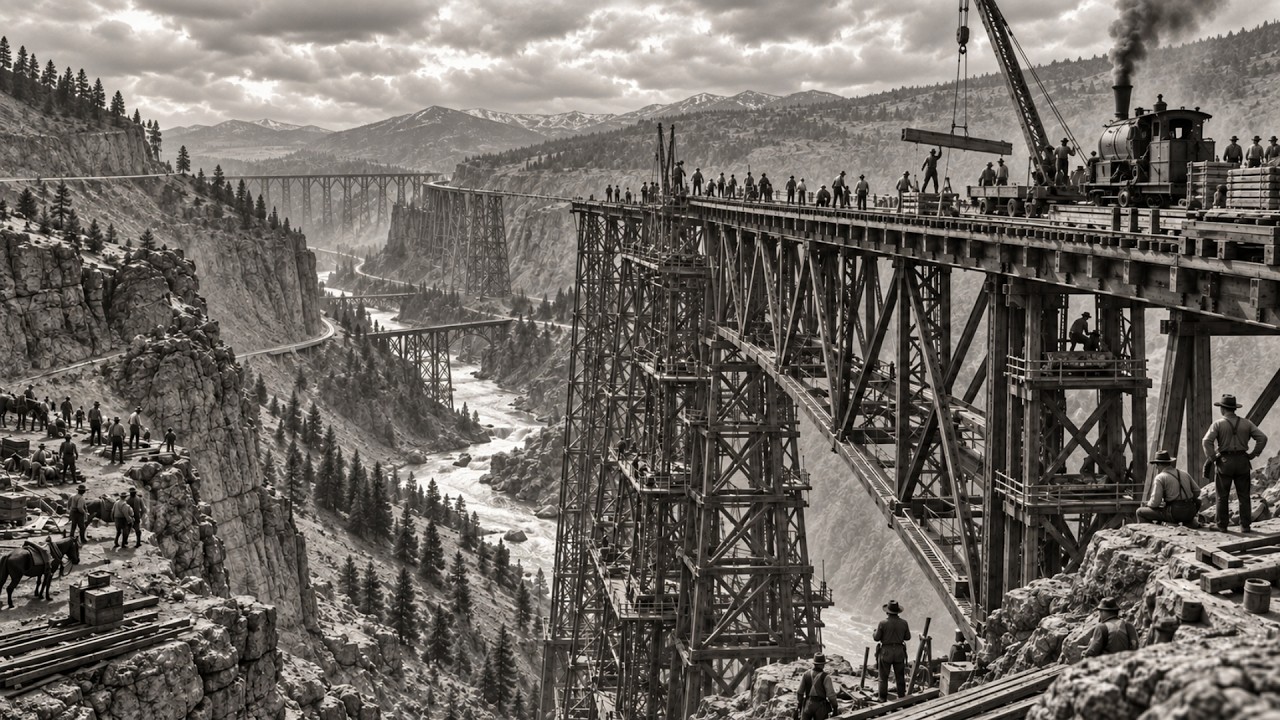
He would keep repeating that motion until the light failed in the canyon. In Clearwater Canyon during the summer of 1908, the light failed early. The canyon walls rose on both sides more than a thousand feet above the river. The sun cleared the eastern rim late in the morning and slid behind the western rim by mid-afternoon.
The workday in the canyon was shorter than the workday above it. The supervisor knew this and scheduled the work accordingly. The structure taking shape in Clearwater Canyon in the summer of 1908 was one of several timber trestles that the Camas Prairie Railroad was building on its line running from Lewiston, at the junction of the Snake and Clearwater rivers, up to the farming plateau of Camas Prairie, three thousand feet above and roughly forty miles to the southeast. The railroad was a joint venture between the Northern Pacific and the Union Pacific, the two largest railroads in the Pacific Northwest, which had together built what neither had wanted to build alone.
Their agreement on the structure of that joint ownership would have consequences for the timber trestles in Clearwater Canyon that the bridge worker seating pins in the summer of 1908 could not have foreseen. The trestle he was building would carry loaded grain trains down from Camas Prairie to Lewiston for decades to come. It would carry wheat and barley grown in some of the most productive dry-farm country in the American West across a canyon that no road had successfully bridged up to that point. The work would keep going, in the Douglas fir he was fastening with the wooden pins he drove with the hammer in his hand, until the structure was replaced or it failed.
Which of those outcomes would occur was tied to the ownership agreement between the Northern Pacific and the Union Pacific as much as it was to the structural properties of old-growth Douglas fir in the canyon climate of central Idaho. This is the story of how the Camas Prairie Railroad built its timber trestles across Clearwater Canyon during the construction years of 1906 to 1909. It is the story of a railroad built to serve one of the richest unserved farming regions in the American West, owned jointly by two competing railroads that had agreed to share construction costs and operating revenues but had not settled what that agreement meant when the structures they had built together required costly maintenance, so the question of who would pay became the question neither wanted to answer first. It is the story of the Italian, Greek, and Japanese workers who drove the piling, raised the bents, and laid the track in a canyon whose work season was dictated by the rock walls above them.
It is the story of the Nez Perce people, over whose ceded lands the railroad’s right-of-way passed, and who appear in the records of the Camas Prairie Railroad exactly as the landowners appear in the records of any American railroad driven across acquired land—as a legal condition settled before the construction crews arrived, not as participants in what the construction produced or beneficiaries of what it became. The names of the workers exist in the payroll records of the Camas Prairie Railroad to the extent that those records survive. The Nez Perce exist in the records of land cessions to the federal government that preceded the railroad’s right-of-way filing by a full generation. To understand why the Northern Pacific and the Union Pacific agreed to build a railroad they did not agree on how to maintain, you have to understand what Camas Prairie was and why it was valuable, and why both companies wanted access to it while neither wanted to grant the other access first.
Camas Prairie is a basalt plateau in north-central Idaho, lying between the Clearwater River to the north and the Salmon River to the south, bounded on the east by the Bitterroot Range and sloping west toward the Snake River country. The plateau surface rises to about 3,500 to 4,000 feet above sea level. The soil covering the basalt is deep wind-deposited loess, laid down over thousands of years from the same volcanic activity that produced the Columbia Plateau basalts across the Pacific Northwest. That soil, combined with the rainfall pattern of north-central Idaho—enough moisture to grow grain without saturating the fields—produced a farming region of exceptional fertility for wheat and barley.
By 1900, Camas Prairie had been farmed for two decades by settlers who had arrived after the Nez Perce War of 1877 opened former reservation land to settlement. The wheat they grew had to get off the plateau to reach markets. Leaving the plateau meant crossing one of the canyon systems that gashed its edges: the Clearwater canyon to the north, the Salmon River canyon to the south. These were river gorges cut by drainage water through basalt over millions of years.
The rims dropped from the plateau top to river level through sub-vertical rock walls eight hundred to two thousand feet high, reachable by wagon only over a limited number of switchback routes that turned impassable in mud season and were difficult in every season for loaded wagons. The farmers of Camas Prairie hauled their wheat to market over roads that the plateau-edge topography had been specifically designed to defeat. The cost of wagon freight to railheads at Lewiston or Grangeville was the difference between farming Camas Prairie profitably and farming it at bare subsistence. A railroad reaching the plateau would reduce the freight cost to whatever the railroad charged.
The railroad tariff might be higher in absolute value than owning a wagon, but it was lower in actual impact than the cost of moving a ton of wheat forty miles over a road that climbed three thousand feet in each direction through a canyon. The Northern Pacific had a main line through Lewiston, situated at the junction of the Clearwater and Snake rivers at 738 feet above sea level, at the bottom of the canyon system separating the river valleys from the plateau above. The Union Pacific had its own connections to the region from the south and east. Both companies recognized that the line reaching Camas Prairie would capture the grain traffic of one of the most productive and unserved farming regions in the Pacific Northwest.
The railroad that arrived first would control the region. The problem was the canyon. Climbing from Lewiston required raising the railroad from 738 feet at the river to about 3,500 feet at the plateau surface, over a horizontal distance that made the canyon geometry impossible to negotiate with a grade that ordinary steam locomotives could handle without helper operations that added cost to every trip. Clearwater Canyon on the ascent from Lewiston was not a canyon you could build a railroad through by following the valley floor.
The valley floor was the river itself. The river ran fast and cold and filled the canyon bottom from wall to wall during flood season. The ascent route through the canyon required the railroad to cling to the canyon walls, to cross the side drainages on trestles, to hold a grade within locomotive capability, and to work within the constraints of a geologic formation that had been designed over millions of years to prevent precisely the kind of crossing the railroad was attempting. The men who organized the Camas Prairie Railroad solved the political problem before the engineering one.
The Northern Pacific and the Union Pacific agreed to establish a jointly owned subsidiary, the Camas Prairie Railroad, with each company holding a 50 percent share. Each would contribute half the construction costs. Each would receive half the operating revenues. The jointly owned company would be managed by a board of directors with equal representation from the two parent companies.
The agreement was designed to prevent either railroad from gaining an advantage over the other in access to Camas Prairie traffic, while ensuring that the construction costs that neither company wanted to bear alone were shared in a way acceptable to both. The structural result of this agreement—and it mattered for the timber trestles—was that any expenditure on the Camas Prairie Railroad required agreement between two parent companies whose commercial interests in the Pacific Northwest were competitive in other respects. The Northern Pacific and the Union Pacific competed for traffic throughout the region. Their agreement to cooperate on the Camas Prairie Railroad did not end that competition.
It suspended it for the purposes of this one line while preserving it in everything else. When the line was profitable, the 50-50 split worked. When the line required capital expenditure on deteriorating infrastructure, when the timber trestles in Clearwater Canyon required replacement or major maintenance, the 50-50 split produced negotiations between two companies that each preferred that the other pay first. The engineering work was assigned to the engineering staffs of the parent companies, in cooperation with construction work carried out under contract.
The main engineering challenge was the climb from Lewiston up the canyon wall to the plateau. The solution consisted of a series of switchbacks on the canyon wall, with timber trestles crossing the side drainages that fed the Clearwater River from the plateau above. The switchbacks allowed an acceptable grade to be maintained by running the track back and forth across the canyon wall, gaining elevation with each leg, but they required trains to stop, reverse direction, and proceed up each leg of the switchback. It was a slow, operationally expensive system, requiring extra crew and extended running times on every train movement.
It was also the only system the canyon topography permitted. The trestles at the side-drainage crossings were the structures that required the bridge workers in the canyon. A side-drainage crossing on a switchback railroad climbing a canyon wall is not a simple jump over a stream. The drainages cut their own way down from the plateau through smaller canyon systems of their own, steep and deep before they reach the main canyon.
The railroad track had to cross each side drainage at the elevation the track had reached at that point on the switchback ascent—which, on a route climbing from 738 feet toward 3,500 feet, could mean crossing the drainage one hundred or one hundred and forty feet or more above the drainage floor. There was no way to reduce those heights without changing the grade requirements imposed by the locomotives, and the locomotives imposed what they imposed. The defining material of the canyon trestles was Douglas fir, because northern Idaho supplied that timber in quantities sufficient to feed a large construction project and in dimensions sufficient to form the bents and girders that a trestle of this height required. The Douglas fir of northern Idaho in 1908 came from forests that had not yet been heavily logged.
The trees were old-growth, large in diameter, straight-grained, and structurally dense in the way that slow-grown timber from a mountain climate is dense. A Douglas fir trunk from the Idaho forests of 1908 was a tree that had taken two to three centuries to reach the dimensions the loggers harvested. The structural properties of that old-growth timber were not the same as the properties of second-growth Douglas fir, planted and harvested on a commercial cycle. The men who built the trestles did not discuss this distinction.
They worked with what the timber market delivered to the construction site, and what the market delivered in 1908 from the Idaho forests was timber of a quality that would not be available from the same source by the time the structures needed replacement. The timber had to be moved from the forest to the construction site in the canyon. The canyon had no roads suitable for moving heavy logs. The logs were moved through a combination of skid roads cut along the canyon wall, wagon teams where the terrain allowed, and, on some sections, gravity-fed log delivery systems that used the canyon’s own steepness to move material downhill to the work site without powered equipment the terrain could not accommodate.
Log skidding was controlled falling. The men handling the loads at the bottom of the slope were dealing with material that had descended several hundred feet of canyon wall under its own weight, and it was not moving slowly when it arrived. The bridge-building method used on the Camas Prairie Railroad’s canyon sections in 1908 was the method American railroads had adopted over sixty years of building timber trestles across the gorges and stream crossings of the western mountain lines. The foundation of each bent was a set of piles or structural legs depending on the nature of the ground and the height the bent had to reach.
For the lower portions of the tall trestles where the ground was accessible, wooden piles were driven with a pile driver. A weight was lifted and dropped through a guide frame powered by a steam engine. The force of each blow drove the pile a fraction of an inch into the ground. The number of blows required to sink a pile a given distance told the crew how much load-bearing capacity the soil had at that depth.
When the blows came down hard and the pile barely moved, the ground had taken the weight required of it. The pile driver at the canyon sites was a machine that had to be positioned on terrain never designed to accommodate machinery. The walls of Clearwater Canyon were not level platforms for equipment. They were rock, rubble, and talus at angles ranging from difficult to impassable.
The pile-driving crews worked from platforms built out from the canyon wall on timber framing, extending the work area out from the rock face to accommodate the equipment while the canyon dropped away below the platform edge. A pile-driving crew at a Clearwater Canyon bridge site in the summer of 1908 worked with heavy machinery on a platform built of the same material as the bridge itself, suspended from a rock wall above a river they could hear and sometimes see below them. Above the driven-pile sections, where the height made pile driving impractical and the ground could not take the piles deep enough to carry the load, the structures were built of heavy timber posts set on footings. The posts were Douglas fir, twelve by twelve inches in cross-section or larger, cut to the required height and connected by cross-bracing and sway bracing designed to hold the structure rigid against the lateral forces the canyon topography imposed: the wind coming up off the river below, the vibration of the pile drivers and later the trains, and the thermal expansion and contraction of the timber across the canyon’s seasons.
Each bent was capped with a cap, a heavy timber running horizontally across the top of the bent posts to carry the stringers. The stringers ran lengthwise along the trestle, transferring the load from the deck down to the bents below. The deck was made of timber ties carrying the rails, the same rail structure used on the main line, but carried here on ties instead of ballast. When a freight train crossed the timber trestle, the weight of the locomotive and cars passed from the rails to the ties, from the ties to the stringers, from the stringers to the bent caps, from the caps to the posts, from the posts to the pile heads or footings below, and from there to the canyon-wall ground.
The entire load path depended on the condition of every element in it. A stringer with rot at its bearing point on a bent cap transferred the load through sound wood on either side of the rot. If the sound wood was sufficient, the stringer carried the load. If it was not, the stringer failed under the weight.
A pile with rot at its head, hidden beneath the cap resting on it, transferred the load through whatever sound wood remained. A post that had split and cracked through the freeze-thaw cycles of an Idaho winter had its effective cross-section reduced to the uncracked portion. The sum of these individual material conditions represented the structural capacity of the trestle at any moment of its operating life. The capacity at construction was the capacity the designer had specified.
The capacity after twenty years of Clearwater Canyon climate was the capacity that the maintenance program had preserved. The men who built the Camas Prairie Railroad’s timber trestles in Clearwater Canyon came from the labor force that the Pacific Northwest railroad construction economy depended on in the first decade of the twentieth century. These were not the same workers who had built the Thomas Viaduct in 1834 or the Memphis bridge in 1891. The wave of Irish immigration that had supplied the labor for the canal and railroad building of the mid-nineteenth century had largely absorbed into the American industrial workforce by 1908.
The Pacific Northwest labor markets of the first decade of the twentieth century depended on different immigrant groups. Italian workers, arriving in the United States in large numbers between 1880 and 1915, formed a mobile labor force on western railroad projects, occupying a position comparable to the Irish in the mid-Atlantic construction economy of the 1830s. Labor contractors, the padroni, recruited men from the Italian-speaking regions of southern Italy and Sicily and assigned them to construction companies under arrangements that shared structural features with the labor-contracting systems of earlier eras. The padrone received a fee from the construction company for supplying a crew of the specified size, and he served as the intermediary between the company and the workers, giving him authority and influence over the men he recruited and employed.
The Italian workers who came to build the Camas Prairie Railroad worked through padrone arrangements under conditions the padrone negotiated and at rates the padrone accepted, in a system that deducted a portion of their wages as a fee for employment. Greek workers followed a similar path into western construction labor markets in the first decade of the twentieth century. Japanese workers had been present in Pacific Northwest railroad construction since the 1890s, when the Canadian Pacific, the Northern Pacific, and the Great Northern had relied on Japanese labor for track maintenance and new construction. The Chinese workers who had built the Central Pacific over the Sierra Nevada in the 1860s and the Canadian Pacific through British Columbia in the 1880s were present in declining numbers in western railroad construction by 1908, restricted by the Chinese Exclusion Act of 1882, which cut off the new immigration that had formerly replenished their numbers in the western labor market.
What these worker groups shared on the Camas Prairie construction was the working conditions on structures built in a canyon whose terrain gave no second chances for a lapse of attention. The canyon gave no second chance to a man who lost his balance on a timber bent sixty feet above the drainage floor. It gave no second chance to a man standing under a load being lifted by a gin derrick when the lifting gear failed. The gin derrick used in the canyon construction of 1908 was the same tool that had always been used.
A timber mast, a boom, a pulley system, and a horse winch at the bottom, in use since the building of the Thomas bridge in 1835, with improvements in detail but an identical principle. The four-horse winch in 1908, lifting a timber bent to working height above the canyon floor, was a machine that raised what it could raise and dropped what exceeded its capacity, and the men guiding the load at the top knew the difference between what the lifting equipment could handle and what it could not. Clearwater Canyon in the summer of 1908 was a heat trap for the crews working on the lower timber sections. The canyon walls absorbed the sun and held the heat above the river.
The ambient moisture from the river below—a river fed by Bitterroot snowmelt and running fast in July and August—held humidity in the canyon air at a higher level than on the exposed plateau above. The men working on the timber structures under direct sun over canyon rock in an Idaho summer worked in conditions unlike the crews working on the wind-swept prairie plateau. The water supply in the canyon during construction came from the same river that made the canyon hot. The distance from the work platform to the water was determined by the height the structure had reached.
The Idaho winter took the canyon from the other direction. The Clearwater River froze along its edges in hard winters. The canyon walls channeled the wind. A construction crew working on a timber bent in January in Clearwater Canyon worked on timber that had been below freezing since October and would not rise above it until April, on surfaces that had accumulated ice from condensation of the river air and seepage from the canyon walls, and on platforms where any misstep on ice-coated timber sixty feet above a frozen stream was a step with a known consequence that needed no elaboration.
The construction schedule for the canyon sections was governed from beginning to end by the weather, just as it had been for the men who built the Thomas piling in the Patapsco River seventy years earlier. What was built was built in the time windows the climate allowed. The construction injury records of the Camas Prairie Railroad for 1906 to 1909 are not complete in any form publicly available in the accounts on which this history is based. The labor law requirements governing the documentation of construction deaths in Idaho in 1908 were not the requirements of later eras.
What the records show is that the structures were built to the specified dimensions and that the line opened to traffic in 1909. What the records do not show, in detail, is the price the men who built the canyon trestles paid personally for that work. The Nez Perce people, over whose ceded lands parts of the Camas Prairie Railroad route passed, did not participate in the construction of the structures on their former land. The Clearwater River and the country above it had been Nez Perce land, a central part of their way of life and history, until the treaty reductions, the war of 1877, and the allotment policies of the following decades reduced their land base to a fraction of what had once been theirs, remaining as reservation land.
Camas Prairie took its name from the camas plant, a blue-flowered lily whose bulbs were a staple food harvested by the Nez Perce on the plateau for centuries. The dispute over camas grounds on Camas Prairie had been one of the direct causes of the Nez Perce War of 1877. The railroad that opened in 1909 to carry the wheat of settler farmers across the plateau named for the plant the Nez Perce had once harvested carried no camas. The Nez Perce, mentioned in the records of the Camas Prairie Railroad construction period, appear as they appear in the records of every American infrastructure project built on land acquired under a legal status settled before construction began, not as an entity benefiting from what that construction produced.
The opening of the Camas Prairie Railroad to traffic in 1909 confirmed the accuracy of what the canyon construction crews had built to specification. The first loaded grain trains, descending from the plateau to Lewiston, crossed the canyon trestles without incident. The bents held, the stringers carried the loads, the caps stayed seated on the posts without movement. The locomotives—Prairie-type and Consolidation-type engines of the sort that marked the early twentieth century, each heavier than a railroad man of 1850 could have imagined, hauling strings of loaded freight cars down a grade that the switchbacks had made operationally complex—crossed the structures the bridge workers had raised in the canyon in the summer of 1908, and the structures did not move in any way that indicated distress.
The wheat crops of Camas Prairie began to move. The farmers who had been hauling grain by wagon over the exhausting canyon roads got railroad freight rates that wagon roads could not compete with. The plateau towns—Craigmont, Nezperce, Cottonwood, Grangeville—gained rail connections to the larger commercial network of the Pacific Northwest. Grain elevators rose beside the station platforms in the plateau towns in the years after the railroad opened, built to handle volumes that only rail could move.
The Camas Prairie Railroad, jointly owned by two companies that had both wanted to be the one to reach the plateau first, carried the traffic that both had known the plateau would generate. The structural condition of the canyon trestles in the years after 1909 was the condition of any timber structure exposed to a high mountain river canyon climate. The canyon climate at Clearwater elevations delivered moisture in four forms: rain in spring and fall, snow in winter, the humidity the canyon air held from the river below, and the runoff from the plateau that passed through the side drainages every spring and fell as condensation on the timber surfaces year-round. Timber rots when it stays in contact with moisture.
The rate of rot depends on the species of wood, the dimensions of the structural members, the degree of protection given to exposed surfaces by paint or preservative treatments, and the extent to which water is drained away from load-bearing surfaces rather than collecting at the points where structural members meet their bearings. Douglas fir resists rot better than many other softwoods. Old-growth Douglas fir, with its dense, slow-grown cellular structure, resists rot better than Douglas fir grown in second-growth forests. The Clearwater Canyon trestles were built of old-growth Douglas fir from the Idaho forests of 1908.
That material had structural advantages that faded over time as the old-growth forests were cut, and that could not be substituted by the second-growth timber that replaced them. The trestles needed maintenance from their first year: painting and preservative treatment of exposed surfaces, inspection of pile heads and footing areas where moisture concentrated, and replacement of parts that had deteriorated past their load limits before the weight of a train exposed the failure in the worst possible way. The maintenance the canyon trestles required was not a secondary option. It was a necessity for the trestle to continue serving the purpose it was built for.
Who would perform that maintenance on the Camas Prairie Railroad was the question the joint ownership agreement between the Northern Pacific and the Union Pacific had not settled in a way that made the answer easy. The Northern Pacific, in the years after 1909, regarded the Camas Prairie Railroad as a revenue-producing asset and a cost center requiring capital expenditure. The Union Pacific regarded the same railroad the same way. Both railroads received 50 percent of the operating revenues.
Both railroads were committed to paying 50 percent of the capital expenditures required to maintain the line. The commitment was not the problem. The problem was the sequence of action. When a trestle in the canyon section required major maintenance expenditure, the question of who would initiate the spending request and who would approve it first entered the joint management structure of the subsidiary, and encountered the usual negotiation dynamics between two parties with equal votes and divergent underlying interests.
Each company preferred that the other party acknowledge the maintenance need first, because acknowledging it first carried an implicit burden of identifying a problem in infrastructure that both owned. The engineering staffs of each railroad assessed the condition of the trestles and reported to their parent company management. When the two assessments agreed, the spending process moved forward. When they differed—when Northern Pacific engineers classified a structure as needing immediate attention while Union Pacific engineers classified it as serviceable—the dispute had to be resolved through the joint board, whose equal representation meant that the dispute was resolved only by one party conceding a position it had already taken.
The timber trestles of Clearwater Canyon did not care about the organizational dynamics of the joint board. The canyon moisture kept working on the timber. The freeze-thaw cycles of the Idaho winters kept opening splits and checks in the structural members. The grain trains kept crossing.
Replacing the timber trestles with fills or steel structures was the ultimate solution to both the maintenance problem and the organizational problem. Earth fills require no maintenance beyond the track maintenance on their surface. Steel bridges deteriorate more slowly than timber and by different corrosion mechanisms. The capital cost of replacement was large, larger than the maintenance cost the timber structure required in any single year, but smaller than the cumulative maintenance costs over the remaining life of the timber structure the replacement would eliminate.
The railroad engineering staffs understood this arithmetic. So did the railroad financial officers. The question was always timing, and funding, and, in the case of the Camas Prairie Railroad, the additional question of who would pay their 50 percent first. The canyon trestle replacement program proceeded in stages through the second and third decades of the twentieth century.
Some structures were filled in with earth. Approach trestles where the track crossed a side drainage at a height that could be dealt with by fill, rather than requiring a permanent bridge, were filled. Other sites required steel replacement structures where the depth of the crossing made fill impractical. The timber trestles that were filled ceased to exist as structures when the fill covered them.
The timber of the bents and stringers remained inside the fill, rotting at the rate the buried moisture conditions dictated, but it was no longer a maintenance concern because it was no longer a structure. The fill was permanent. The men who had built the bents inside the fill were not. The Camas Prairie Railroad continued operating through the mid-twentieth century under the joint ownership structure established in the early twentieth century.
Its traffic changed as the agricultural economy of the plateau changed. Wheat remained the staple commodity. Lentils, which became an important crop on Camas Prairie in the mid-twentieth century, added to the agricultural tonnage. Timber from mills in the canyon and plateau communities moved over the line.
The switchback operation on the climb from Lewiston remained an operational efficiency bottleneck throughout the line’s service life. A train that stopped and reversed direction several times on the climb from the river to the plateau required more time and more crew hours than a train climbing on a continuous grade, and the operating cost of the switchbacks was a cost the railroad absorbed on every trip, in every season, for the life of the line. The Northern Pacific merged into the Burlington Northern in 1970. The Union Pacific remained the Union Pacific.
The Camas Prairie Railroad continued as a jointly owned subsidiary for a time after the corporate entity of the Northern Pacific ceased to exist, with the Burlington Northern inheriting the Northern Pacific’s 50 percent share. The line was eventually rationalized through the changes in the institutional structure of American railroading that the 1970s and 1980s produced, when mergers and line abandonments consolidated the system and eliminated routes whose traffic volumes no longer justified their maintenance costs. The timber trestles that the bridge workers built in Clearwater Canyon in the summer of 1908 were, by the time the operating history of the line reached the late twentieth century, no longer the timber trestles of 1908. They had been replaced piecemeal over the preceding decades.
First by fills, then by more durable structures. Each replacement was funded through the joint maintenance negotiations between the parent companies, each of which had a 50 percent obligation and each of which preferred that the other acknowledge it first. Some of the original timber remained inside the fills. Some of the original bents were dismantled when the structures were condemned and replaced.
The canyon that had required the trestles in 1908 remained unchanged. The canyon walls still rose more than a thousand feet above the Clearwater River. The river still ran swift and cold below. The side drainages still cut their way down from the plateau through their own smaller canyon systems to meet the main canyon at the points where the railroad track had been required to cross them.
If you drive south from Lewiston on Highway 12 and follow the Clearwater River upstream into the canyon, you are following the approximate route of the railroad that the Camas Prairie Railroad construction crews carved into the canyon wall in 1907 and 1908. The canyon is narrow. The highway runs along the river on one side, and the railroad right-of-way, where it still exists, runs along the other side or above it on the canyon wall. At the points where the original timber trestles crossed the side drainages, you can in some cases see the structures that replaced them, steel girder bridges or concrete structures carrying the track across the drainage at the elevation the switchback route required when it reached that point.
The canyon today is the canyon of 1908. The rock is the same, the river is the same, the gradient of the side drainages is the same, and the height above the drainage floor at which the railroad track holds the grade required to cross each crossing is the same number it was when the bridge workers seated the bents in the summer of 1908. The mathematics of canyon railroading does not change with the century. What changed was the material of the structures.
The Douglas fir that the bridge worker was pinning with wooden pins in the summer of 1908 is not present in the structures carrying the railroad track across the canyon today. The forest that produced that timber in the Idaho mountains above the construction site in 1908 is not the forest standing there now. It is not old-growth Douglas fir of the dimensions the construction required. The dimensions that had taken two to three centuries to produce were removed by logging in the following decades from the Idaho forests in a fraction of that time.
The Italian workers who came through the padrone contractors appear in the payroll records at the level that the contracting system recorded them: as numbers of men, as total crew counts, and as amounts paid to the contractor who employed them. Their individual names entered the records, in many cases, at the level preserved by padrone accounting, and padrone accounting was organized around his revenues, not around the identity of the men he employed. The Greek and Japanese workers appear in the records at whatever level of detail the Camas Prairie Railroad’s payroll accounting maintained for classes hired through labor contractors versus classes hired directly. The Nez Perce, over whose land the railroad crossed, who had been displaced from the camas grounds and the plateau the railroad served, are not in the payroll records of the Camas Prairie Railroad construction.
They are in the land cession records that preceded the settlement, which preceded the agricultural economy the railroad was built to serve. The sequence is clear in the records. What comes earlier is not in the records that come later. The National Register of Historic Places contains entries for structures associated with the Camas Prairie Railroad.
They name the railroad. They name the dates. They name the engineering significance. The bridge worker who drove the tree pins in the canyon in the summer of 1908 is not in those entries.
The contractor who hired the Italian crew he worked with is not in those entries. The Nez Perce whose plateau the railroad crossed are not in those entries. The payroll records of the Camas Prairie Railroad, to the extent they survive, are held in the archives of successor corporations and institutions that received railroad history collections from the Northern Pacific and the Union Pacific lines. Whether those records preserve the names of individual construction workers below the level of the labor contractor, and whether the bridge worker who framed the Clearwater Canyon trestles can be identified by name, is a question that the published histories of the Camas Prairie Railroad answer incompletely.
The canyon is still there. The river still runs below it. The grade the switchbacks climbed in 1908 is still cut into the canyon wall where the construction crews placed it. The timber trestles that required men to work at heights above the drainage floors are structures now built of different materials by different men in a different era.
But the drainage crossings are the same at the same elevations, requiring a bridge at the same level above the same canyon floor, where the same river runs that ran before any railroad, before any railroad engineer, before any bridge builder came to the canyon with a hammer and a wooden pin and a Douglas fir bent, to seat it in a structure he never named and would never be named by. The timber is gone. The men who cut it are gone.
The canyon keeps neither.






