John Adams sat down to a celebration dinner in Philadelphia in July of 1776 and ate turtle. Not steak, not roast chicken. Turtle, dressed and stewed and served in its own shell. The feast was the kind of affair that made the founders’ banquets legendary, a whole event built around a single enormous sea turtle shipped up from the Caribbean, or a fat snapper pulled from a local river.
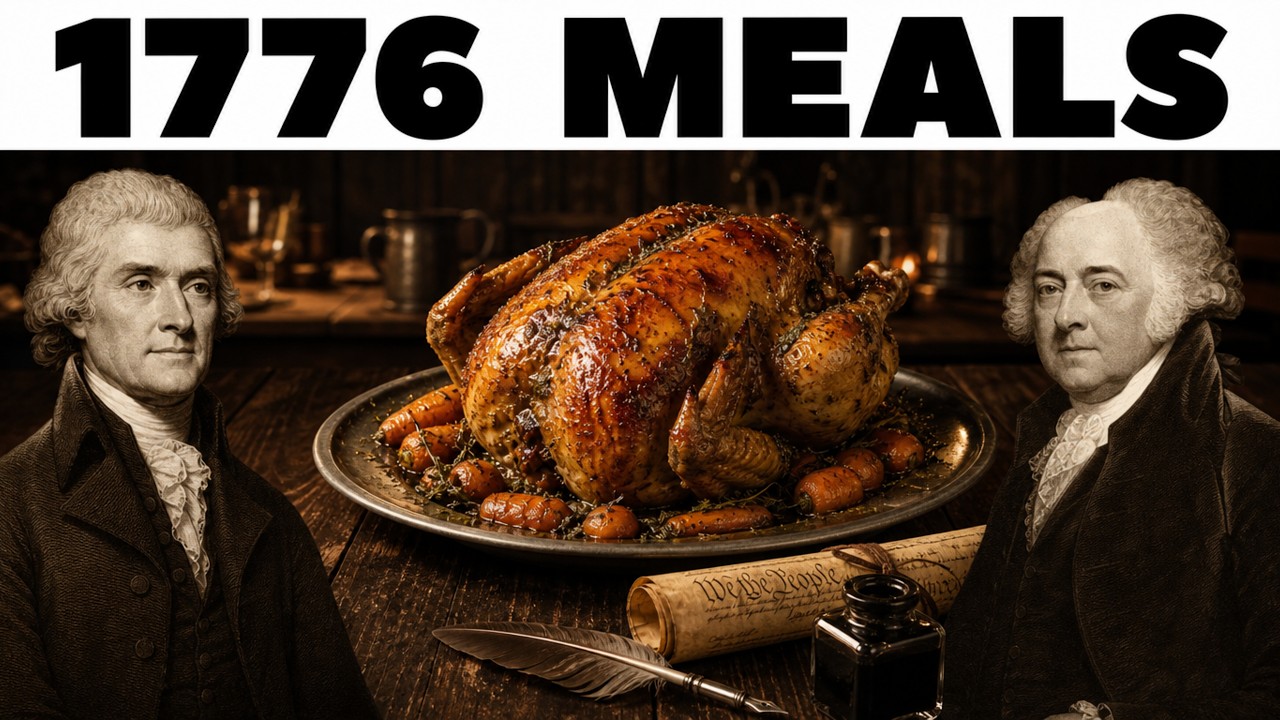
The cook dressed the creature, separated the different cuts of meat, each with its own texture, and simmered them for hours with Madeira wine, herbs, and spices into a deep, rich, almost beefy soup, often served right in the cleaned-out shell. It was labor of the most extravagant kind, and it signaled wealth the way a sports car does today. This was the dish Adams wrote home about from Philadelphia, the centerpiece of a founders’ banquet. As the new nation was being born, turtle soup was the single most fashionable thing a wealthy patriot could eat that summer.
Today, most Americans picture the founders eating burgers and apple pie under fireworks. The truth is far stranger. The foods that fueled the revolution were mostly humble, cheap, and utterly foreign to the modern American table. Some were so common that a family ate them three times a day, yet almost no living American has ever tasted them.
One was cooked using a technique modern chefs are paying a fortune to rediscover. These foods carried a country through its birth, then vanished the moment Americans could afford to forget them. Before there was a single restaurant in America, before there were diners or griddles or boxed mixes, there was the Johnnycake. Cornmeal, a pinch of salt, and boiling water stirred into a stiff batter, then dropped in spoonfuls onto a hot greased griddle or the blade of a flat hoe held over the coals.
That is where the other name, hoecake, came from. The cakes fried up crisp and golden at the edges, soft and steaming in the middle, and a working family ate them morning, noon, and night. Some called them journey cakes because they traveled well in a saddlebag and did not spoil. A peck of cornmeal cost a few pence and lasted a household a week.
There was no syrup, no butter most days, just a smear of lard or molasses if you were lucky. Plain as they were, Johnnycakes carried more colonial Americans through more mornings than any other food on the table. On the 4th of July in 1776, they were already an old friend. The name of another staple was a joke and a promise.
Hasty pudding was nothing more than cornmeal stirred slowly into a pot of boiling salted water until it thickened into a steaming yellow porridge. But the word hasty told you how a tired mother felt about making it for the hundredth time that month. You ate it hot in a wooden bowl with a well of molasses pressed into the center, or a splash of milk if the cow was giving. The song Yankee Doodle, sung by the very soldiers fighting that summer, mentions hasty pudding by name because everyone in America knew exactly what it was.
The leftovers were poured into a pan, left to set firm overnight, then sliced and fried in the morning until the edges crackled. One pot, one spoon, a full belly. Cornmeal cost almost nothing because corn grew where wheat would not, and that single fact fed the northern colonies through war and winter alike. In Massachusetts, they carved a wooden codfish and hung it in the State House, and they called it the sacred cod because the entire economy of New England floated on the back of that fish.
Cod was caught by the ton off the Grand Banks, split, and packed in salt until it turned hard and pale as a board. Properly cured, it lasted years without ice. Before a family could cook it, they soaked it overnight in fresh water, changing the water two or three times to draw the salt back out, then simmered it gently and flaked it into chowders, fish cakes, or a dish of cod and potatoes drowned in pork gravy. A poor family bought the cheapest grade, the broken bits called dunfish, for a few pence a pound.
The smell of soaking cod hung in half the kitchens in Boston. On Friday, on fast days, and on plenty of ordinary July evenings, salt cod was supper, and nobody apologized for it. Long before the first colonists stepped off a ship, the Narragansett people were making a dish they called msickquatash, and the settlers butchered the word into succotash and kept the recipe forever. It was the simplest kind of genius.
Corn and beans cooked together in one pot, often with a chunk of salt pork for depth, sometimes with chunks of pumpkin, or a handful of whatever was ready in the garden. The corn gave sweetness. The beans gave substance, and together they made a complete protein that kept a working body strong. Though no colonial cook knew the science, they only knew it filled you up and grew right outside the door.
In summer, when the corn came in milky and tender, succotash tasted like the whole season in a bowl. This was Native American wisdom feeding a brand new nation. And in July of 1776, fresh succotash was on tables from Connecticut to the Carolinas. The water in a colonial town could kill you, so almost everybody, including the children, drank something fermented instead.
One of the most common was spruce beer. You boiled fresh green spruce tips with molasses and water, let it ferment a few days, and ended up with a fizzy, piney, faintly sweet brew that was mild enough to drink all day. Here is the part nobody remembers: spruce beer was packed with vitamin C, and it quietly prevented scurvy in a world with no fresh fruit through the winter. The Continental Army marching that very summer was issued spruce beer as part of the standard ration for exactly that reason, though the generals only knew that it kept the men healthy, not why.
A barrel cost a few shillings and lasted a household for weeks. It tasted like a forest and a soda pop had a child, and to a colonial throat on a hot July afternoon, nothing was more refreshing. If you think of oysters as a luxury, you have the history exactly backwards. In 1776, oyster beds stretched for miles along every colonial harbor, so thick a man could rake up a bushel in an afternoon, and they were the cheapest protein in America.
Street vendors sold them by the dozen for pennies. Families shoveled them onto a bed of coals and let the shells pop open in the heat, then ate them straight off the fire, smoky and briny and hot with nothing but a bit of vinegar or pepper. In the coastal cities, oysters were poor man’s food, eaten by dockworkers and apprentices and anyone with a few coins. A wealthy household served them, too, stewed in cream or baked in pies.
But the beauty of the oyster in 1776 was that it belonged to everyone. We turned it into a forty-dollar appetizer. They turned it into Tuesday. Whole corn was tough as gravel, so colonial cooks borrowed another native technique to tame it.
They soaked dried corn kernels in water mixed with wood ash, which softened the hulls and slipped them right off, leaving plump, swollen kernels with a deep, earthy flavor. Cracked coarse, it was called samp and boiled into a thick pudding. Left whole and soft, it was hominy, simmered for hours with a little salt pork until it turned creamy and rich. A pot of samp could sit at the back of the hearth all day, asking nothing, slowly thickening into a meal that stuck to your ribs straight through a night of work.
The wood ash trick, which colonists learned from the people who had farmed the land for centuries, did more than soften the corn. It unlocked nutrients the body could finally use, which is why families who ate it stayed strong on almost nothing. Here is where the truth about 1776 cooking gets interesting. There was no stove, not one.
Every single dish was cooked over an open fire in a walk-in hearth, and the woman who ran that hearth was performing a daily feat of engineering we have completely forgotten. She managed three or four different heat zones at once, raking coals forward for a quick fry, swinging an iron crane loaded with a forty-pound pot over the flames, and burying a Dutch oven in embers with more coals piled on the lid to bake bread from the top and bottom at the same time. She judged temperature by holding her hand to the fire and counting. She did this in long skirts, inches from open flame, and house fires and burns were a leading cause of death for colonial women.
There were no thermometers, no timers, no dials. There was only skill passed mother to daughter, and the quiet daily heroism of feeding a family from a wall of fire. When the men were out cutting hay under a blazing July sun, somebody carried a jug of switchel to the field, and it was the original sports drink. The recipe was water, a glug of cider vinegar, a pour of molasses, and a knob of grated ginger, all stirred together.
If you were near a spring, set it in the cold water to chill. The vinegar and molasses replaced what sweat stole from a working body. The ginger settled the stomach, and the whole thing was sharp, sweet, and shockingly refreshing. They called it haymaker’s punch because it was the drink that got the hay in before the rain.
A jug cost almost nothing and quenched a thirst that plain water could not touch. Modern beverage companies are now selling this exact mixture in glass bottles as an artisanal wellness tonic for five dollars. A farmer in 1776 made a gallon for a few pennies and never once called it wellness. He called it getting the work done.
They did not spell it pumpkin, and they did not bake it into a spiced pie with whipped cream the way we do. They called it pompion, and it was survival food, the vegetable that grew enormous and stored for months in a cold cellar. The everyday way to eat it was to cut it into chunks and stew it down slowly in a pot, sometimes with a little vinegar and butter, until it collapsed into a thick, savory mash that went alongside meat or got stirred into succotash. When sweetened with molasses, the same pulp became the filling for a rough pie baked in a sturdy crust meant more for holding than eating.
There was even an old colonial verse complaining that the settlers ate so much pumpkin they feared they would turn into it. Cheap, huge, and endlessly stretchable, pumpkin was the workhorse of the colonial garden. And in midsummer, the early ones were just coming ripe. Wheat was a rich man’s grain in much of America, expensive and finicky to grow.
So the everyday loaf was something humbler and far more interesting. They mixed rye flour with cornmeal, sometimes a third of each with whatever else was on hand, and baked a dense, dark, slightly sweet brown bread that could anchor any meal. In New England, that loaf, steamed for hours and served with baked beans, became a Saturday night institution. It had a chew to it, a deep earthy flavor, and it kept for days without going stale.
A family ate this bread, or a close cousin of it, at practically every meal, which is exactly why almost no living American has tasted the real thing. We traded for soft white slices in a plastic bag. They built a country on a loaf that fought back a little when you bit it, and was all the better for it. Here is something the costume dramas never show you about the 4th of July in 1776.
Nobody was relaxing. The declaration was adopted on the 4th, but it was read aloud to the public for the first time on July 8th in Philadelphia. And the celebrations that followed were not picnics. They were bonfires, bells, musket volleys, and the tearing down of the king’s symbols.
The food that fed those crowds was not special occasion food. It was the same salt pork and cornbread and cider that fed them every other day, because a country at war does not stop to cook something fancy. Most of the men who would do the actual fighting were eating worse than that, surviving on hard biscuit, dried peas, and whatever a struggling supply line could carry. The feast we imagine, the groaning table of roasts and pies, belonged to a small wealthy few.
For everyone else, the taste of independence was the taste of making do, the same as it had always been. Saturday in New England had a rhythm you could set a clock by, and at the center of it sat a pot of beans. Dried navy or pea beans were soaked overnight, then layered in a heavy crock with a fist of salt pork, a generous pour of molasses, and a little dry mustard, and buried in the embers of the hearth to bake low and slow for the better part of a day. The molasses was not a flavor accident.
It came up cheap from the Caribbean trade, and it turned the beans dark, sweet, and sticky as they drank in the pork fat. The reason this became Saturday food is purer than you would guess. The Puritan Sabbath forbade work from Saturday sundown, so a dish that cooked itself all day and reheated for cold Sunday meals was a gift from heaven. A crock of beans cost pennies and fed a family two days.
Boston is still nicknamed Beantown, and that pot is the reason. You already know the rhyme without knowing you know it. Peas porridge hot, peas porridge cold, peas porridge in the pot nine days old. That nursery verse is a colonial recipe and a colonial reality, because this was the dish a family ate three times a day and rarely thought twice about.
Dried field peas, the gray-green split kind, were simmered for hours with a piece of salt pork until they fell apart into a thick, mild, sticking porridge. The pot genuinely did sit on the hearth for days with more peas and water added as it emptied, the flavor only deepening. It was cheap, beyond cheap, peas being one of the easiest crops to dry and store, and it delivered the protein that kept a laboring family upright. Plain, gray, and humble, peas porridge was the quiet backbone of the colonial diet, eaten so constantly that it became a joke, a song, and a thing almost no American alive has ever spooned up.
Before refrigeration, the only way to keep a slaughtered hog from rotting was to drown it in salt. And so the salt pork barrel in the cellar was the most important object in a colonial kitchen. Hanks of fatty pork belly and side were packed in coarse salt and brine, where they kept for a year or more. And from that barrel came the flavor of nearly everything else.
A slice of it started the beans, the succotash, the peas porridge, the chowder, rendering its fat and seasoning the whole pot for free. Fried crisp on its own, it was breakfast. A barrel of salt pork was wealth you could eat, the difference between a family that ate through the winter and one that did not. It was salty, fatty, and monotonous.
And it was also the single ingredient that made cheap, plain colonial food taste like something worth coming home to. Almost nothing in 1776 got cooked without it. Apples were everywhere, planted in every yard, and most of those apples were not sweet-eating apples at all. They were sour, mealy cider apples, and their whole purpose was to be ground and pressed and fermented into the drink that practically every colonial American, north and south, rich and poor, drank from morning to night.
Hard cider was safer than water, cheaper than beer, and strong enough to take the edge off a hard day. John Adams himself was said to begin each morning with a tankard of it, and he lived to ninety. A barrel cost a shilling or two, and an orchard refilled it every fall. On the 4th of July, the toasts that rang out across the colonies, the cheers to liberty and to a new nation, were very often raised with a mug of cloudy, homemade cider.
It was the everyday wine of the American Revolution, poured from a jug on the kitchen shelf. Now we climb up to the rich man’s table, and the first thing waiting there is a snapping turtle. In the cities, especially Philadelphia, the turtle frolic was a high society event, a whole feast built around a single enormous sea turtle shipped up from the Caribbean, or a fat snapper pulled from a local river. This was the very dish John Adams ate that July, and wrote home about.
Turtle soup was the lobster of its day, except more so: the most fashionable thing a wealthy patriot could eat in the summer of 1776. Dessert came in a glass, in one of the prettiest things the colonial kitchen ever produced. Syllabub was made by whisking sweet cream with sugar, lemon, and a good pour of wine or cider until it foamed up into a soft, boozy cloud, then spooning it into tall glasses where it slowly separated into a frothy top and a winy pool below. You ate the top with a spoon and drank the bottom.
The oldest country versions were even made by milking the cow directly into a bowl of cider, so the warm milk hit the alcohol and frothed on its own. It was sweet, light, faintly tipsy, and utterly charming, the kind of thing a hostess made to show off at a summer gathering. For a wealthy household marking the news of independence, a row of syllabub glasses glittering on the sideboard was exactly the sort of small luxury that said the occasion mattered. The American forest in 1776 was a grocery store that never closed, and the colonial table reflected it.
Deer were hunted for venison, roasted on a spit or stewed into rich, dark dishes that a European peasant could only dream of tasting. Wild turkey, far larger and gamier than the bird we know, turned slowly before the fire on a string. And then there was the passenger pigeon, a bird now extinct, but which in 1776 flew in flocks so vast they darkened the sky for hours and broke tree limbs with their weight when they roosted. They were so abundant that families knocked them down with poles and ate pigeon pie, pigeon stew, and roasted pigeon until they were sick of it.
Game that would cost a fortune today, or simply no longer exists, was free protein for anyone with a gun and a little skill. The wild bounty of the new country fed its people in a way the old world never could. Colonial gingerbread was not the architectural gingerbread of Christmas. It was a dense, dark, chewy cake made cheap and sturdy with molasses and ginger, and it had a special role in the life of 1776.
On muster day and training day, when the local militia drilled on the town green, vendors and goodwives sold thick squares of gingerbread to the watching crowd. The smell of ginger and molasses meant something exciting was happening. Soldiers carried it because it kept for weeks and gave a quick hit of energy on the march. Children begged for it.
It was spicy, sweet, and just hard enough to travel, the closest thing the average family had to a treat. In the summer of 1776, with militias drilling on greens across every colony, gingerbread was the taste of the war effort itself, sold by the slice to crowds gathering to watch their neighbors prepare to fight. Here is what gets lost when we picture powdered wigs and elegant banquets. The flavors of 1776 were built almost entirely on three imported things, and all three carried the weight of the times.
Salt, to preserve everything. Molasses, the cheap sweetener that came north from Caribbean sugar plantations. And rum, distilled from that same molasses. That trade was the engine of the colonial economy, and it was also tangled up in slavery, and in the very taxes the colonists were rebelling against.
The Sugar Act and the molasses tax were among the grievances that lit the fire. So when a patriot poured molasses over his cornbread or raised a glass of rum punch to toast independence, he was tasting the exact trade he was fighting a king over. The food was never just food. It was economics, politics, and a hard moral knot served at every meal.
And the people eating it knew it better than we ever will. Some celebrations called for more than Johnnycakes, and the grandest cake the colonial home produced was the election cake. Also called the great cake, it was an enormous yeast-raised fruitcake, leavened slowly like bread rather than quickly like a modern cake, and stuffed with dried fruit, spices, and a heavy splash of wine or brandy. Making one was a two-day affair that took pounds of butter, sugar, and flour, ingredients so costly that the cake itself was a statement of both wealth and community pride.
As the name suggests, it was baked for election days and town gatherings, sliced and shared when the whole community came together. In the charged summer of 1776, with towns assembling constantly to read news, choose committees, and rally support, a great spiced cake on the table was a sign that this gathering was important. It was the showpiece dessert of American democracy in its very first months. The apple deserves its own place because no fruit shaped the colonial year more completely.
The fall harvest was preserved a dozen ways to last until spring. Apples were sliced and strung on threads to hang and dry by the fire, then stewed back to life all winter. They were boiled down for days with cider into thick, dark apple butter that spread on bread like a sweet. They were baked into early pies, layered into pan dowdy, and buried in dumplings.
By July, the previous year’s dried apples and apple butter were still carrying a family through while the new crop ripened on the trees outside. The orchard was a colonial family’s pantry, savings account, and medicine cabinet in one. So while the spiced apple pie we crown as the most American food on Earth did not look quite the same in 1776, the apple absolutely ruled the table, exactly as the saying promises. For a wealthy household marking a day as momentous as independence, nothing announced the occasion like a great joint of meat turning on a spit before a roaring fire.
A side of beef, a leg of mutton, or a whole suckling pig was skewered on an iron rod and rotated slowly for hours, sometimes by a child, sometimes by a clever clockwork jack, while the cook basted it with its own dripping fat and caught the rest in a pan below for gravy. The skin crackled, the fat hissed into the coals, and the smell carried down the whole street. The English so prized this dish that the colonists, even while fighting England, proudly claimed roast beef as their own. On a celebratory fourth, a spit-roasted joint was the king of the table, the dish that turned an ordinary meal into a feast, reserved for those who could afford the meat and the wood to cook it.
You cannot understand the first fourth of July without understanding the toast, and you cannot understand the toast without two drinks. Madeira, a fortified wine from a Portuguese island, survived the long ocean voyage better than any other wine, and actually improved from the heat and motion of the journey, which made it the prestige drink of wealthy patriots. The signers of the Declaration toasted with Madeira. And in Philadelphia, the gentlemen’s clubs ladled out a fearsome rum punch, the famous fish house punch among them, mixing rum, brandy, citrus, and sugar into a bowl strong enough to flatten a grown man.
When the news of independence spread and the bonfires were lit, the celebrations were lubricated by exactly these drinks, raised in toast after toast to the new United States. The revolution was argued over in taverns, financed by the rum trade, and celebrated with a punch bowl. These were the glasses that toasted a country into being. Here is the dish cooked with a technique that high-end restaurants now charge a premium to bring back.
Every spring, the shad ran up the rivers of the colonies in numbers almost impossible to imagine, and it was the first great fresh catch after a long salted winter, so cheap that families ate it for weeks. The genius was in the cooking. A whole split shad was nailed to a thick oak plank and propped up at an angle beside the open fire, so the wood slowly roasted the fish while smoke and the flavor of the heated oak soaked into the flesh. Shad is bony, but cooked this slow way, the meat came off rich and tender, and the prized roe was a delicacy all its own.
That plank cooking method, fish or meat roasted on a slab of seasoned hardwood, has been rediscovered by modern chefs and sold as rustic artisanal cuisine. A colonial family did it on a riverbank in 1776 because it was simply the best way to cook the fish in front of them. Indian pudding was the dessert of the common people, the sweet ending a family could actually afford, and it tasted like the whole northern colony in a bowl. Cornmeal was stirred into scalded milk, then sweetened heavily with molasses and spiced with ginger and cinnamon, and the whole thing was baked low and slow for hours until it set into a dark, dense, custard-like pudding with a deep, almost smoky sweetness.
The long gentle baking was the secret, letting the cornmeal and molasses melt together into something far greater than the cheap ingredients suggested. It came out of the oven warm and was spooned into bowls, sometimes with a pour of cream on top if there was any to spare. While the rich ate their syllabubs and trifles, this was the pudding that ordinary families lingered over, the affordable sweet that turned a plain supper into a small celebration. On a warm 4th of July night, this was as good as dessert got for most of America.
At the very top of the list sits not a recipe, but a single ingredient. The one without which there would have been no celebration, no army, no country at all. Maize, Indian corn, was the gift the native peoples of this land handed to a struggling group of newcomers, and it became the absolute foundation of the American diet. It grew where European wheat failed, in poor soil, in hard weather, with little care.
It fed people and livestock alike, and it became almost everything else on this list: the Johnnycakes, the hasty pudding, the succotash, the samp, the Indian pudding, the cornbread that crumbled into a bowl of beans. A bushel of corn was the safety net every colonial family lived on, the difference between survival and starvation through every lean winter of the war. When the soldiers of 1776 marched, they marched on corn. When the families they left behind ate, they ate corn.
The American Revolution was, in the most literal sense, fueled by a grain that the first Americans were generous enough to teach the rest how to grow. That is the food we should remember most, because it fed the birth of a nation.






