The barn doors were still chained shut when the flames climbed into the sky, yet nobody trapped inside could tell who had fastened them. For seven nights after, the master sat upright amid the charred ruin of the house, his eye sockets burning like coals that would not go out, and the villagers came to understand that gazing too long meant your own eyes would never shut again. The tale they passed around to make sense of it had begun long before the fire, back when the plantation still stood whole and the name Esther had never been entered in any ledger. Nowhere in the master’s books did her name appear.
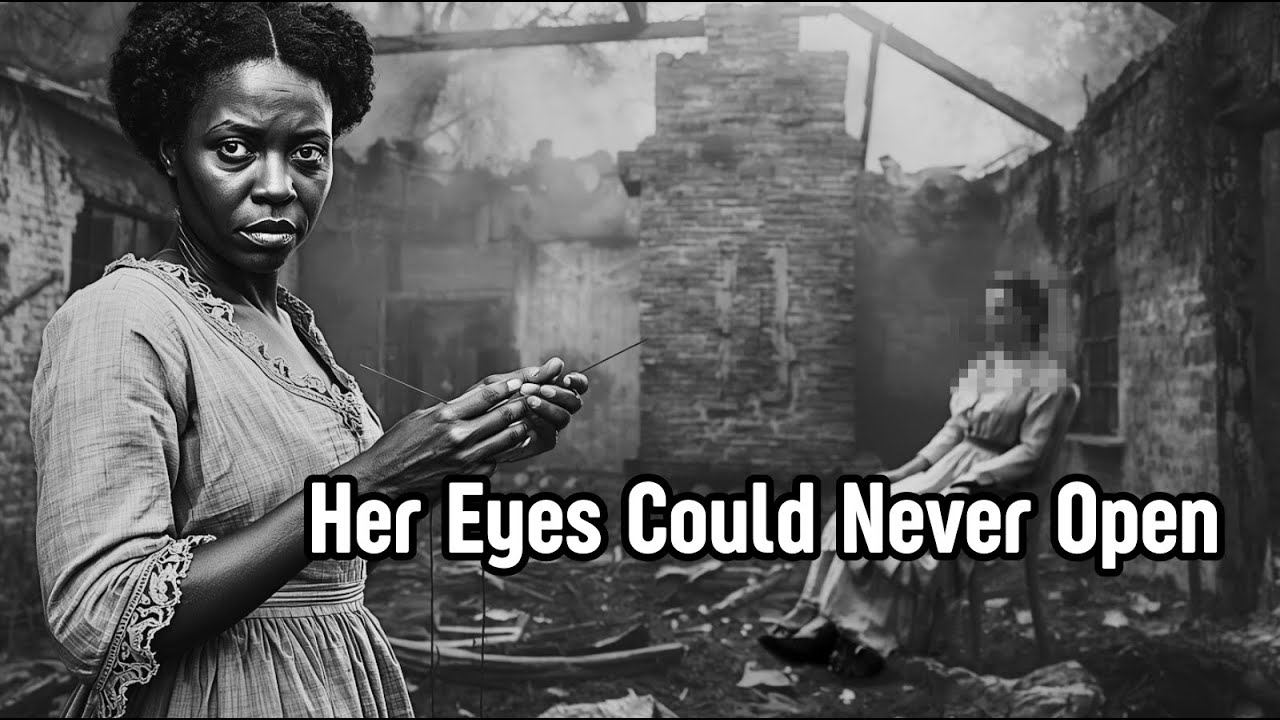
The ledgers were meticulous in both ink and brutality, setting down bodies as figures, souls as chattel, hands as implements, yet across every one of those pages the name Esther was absent. The land, however, held it. At night the ground thrummed with those syllables, low and cautionary, as though the earth itself were straining to tell those walking over it who lay buried beneath. People said she wore silence the way others wore scars, and that her silence was never hollow.
It weighed, it bruised, it strangled the tongue. Anyone who spoke her name felt their mouth clamp shut, their teeth clench, their lips deaden until the syllables came out like blood instead of breath. The old women claimed she had been born under a blood moon, and that her first cry was no louder than a moth’s wings brushing a lantern. Even then the fire shrank, as if unwilling to challenge her breath.
In the quarters, the stories were never told whole. Mothers shushed their children the moment questions rose to their lips, because the telling itself carried danger, as if Esther’s life were less a story than a curse being called up. Some swore something older than scripture had touched her, that when the lashes fell she did not bleed, that through the nights of hunger she did not starve, that her shadow walked half a step behind her, slow and deliberate, waiting for her to halt so it could take her place. The overseer once lashed her wrists to the post and lifted the whip, grinning through yellowed teeth, but when the lash came down it hung limp in his grip as though the leather itself had refused.
His arm shook until the bone broke like glass, hanging useless from his shoulder. After that no man laid a hand on her, no woman dared look too long, and still every shadow in that place leaned toward her, not in worship, not in dread, but in inevitability. An old man in the dark once rasped, “Do not say her name. Names are thread, and thread binds what you call.
” His eyes clouded, his lips dry as if sewn shut by unseen hands, and when he died that night, they swore his mouth held no tongue at all. Even so the whispers spread, because silence itself had grown unbearable. Esther became a legend woven into the marrow of the living and the dead, unwritten, uninked, yet carried like a splinter under the skin. The house and the fields recalled her step, and those who pass near the ruin today say they see her, not as flesh, not as bone, but as a shadow stitched into the air, head bowed, hands folded, lips moving without sound.
If you watch the movement closely, the words sharpen, not a prayer, not a curse, but a sewing song, slow and steady, the sort sung to keep time while mending cloth. Only what she sews now is darker, the needle lost, the thread unseen, and still the air draws taut, the world itself puckering like fabric beneath her hands. On the night the needle first appeared, the air was thick and swollen, humming as if the fields themselves were holding their breath. The torches in the yard guttered and spat, and the whip cracked, but never landed, for in Esther’s hand glinted a blackened sliver, a needle that moved as though it chose its own path.
An old woman with white cataract eyes fixed on her from the corner of the quarters and whispered, “Thread follows needle. Needle follows night.” The children heard the chant, and though they did not grasp it, they rocked in time to it, heads bowed, lips quivering, as if the words had already bound them. Esther’s hand did not tremble.
Her fingers pinched a thread dark and wet, too thick to have been spun from flax, too warm to have come from any loom. And when the needle pierced the first strip of cloth, the sound was not fabric tearing but skin yielding, breath halting in a throat. They said the overseer’s eyes bulged when she lifted the cloth so neatly, so cruelly, that his lips would never part again, the stitches clean and perfect yet slick with a wetness that was not his saliva. But that was only the start.
The needle did not sleep. It hummed in her palm, pulled against her fingers, urging her hand toward every mouth that laughed, every eye that dared not close, every throat that ordered others into silence. Someone whispered in the dark that it sang, and so it did, a faint metallic hymn rising each time it was raised, sinking into silence only when driven through flesh. They tried to bless it once.
The priest set the needle upon the altar, murmured prayers, sprinkled holy water that hissed and boiled on its surface until he pulled back his hand, blistered. The water turned black, and the cross above the altar split in two. From that day no man of faith dared touch it. It belonged to Esther, and Esther belonged to the night.
The slaves living in the shadow of that house often woke to find her sewing, but not by firelight, not with lamp or candle. The needle itself glowed faint and fevered red, like a coal at the edge of a dying flame, throwing shadows that did not match the bodies casting them, shadows stitched together at the edges, shadows that moved as though tethered one to another by unseen thread. When she sewed, the world went quiet. The crickets fell silent, the owls stilled, even the wind paused at the seams of the trees, as if waiting to see what she would bind next.
The masters whispered too late of what they had done, that their cruelty had summoned her, that their hunger for obedience had birthed a seamstress whose needle could unravel their world. But it was not fear that bound them. It was the needle. They could not close their eyes.
Come morning they discovered the master sitting bolt upright in his chair, eyes stretched wide, held open by stitches finer than spider silk, fixed forever on the ashes of the hearth, the needle still warm in Esther’s hand. His eyes had reddened like lantern glass, yet they would not shut. The lids shivered, the lashes trembled, but the stitches drew them apart, a harsh diadem of thread glinting weakly in the firelight, and with every hour of staring the madness crawling behind his gaze sank deeper. He pleaded for sleep, but sleep would not come, not while the stitches denied him, not while the fire itself seemed to claim his sight as tribute.
The other servants passed the tale along in whispers, of how Esther drifted soundless through the house that night, her bare feet raising no whisper from the wooden boards, of how the needle steered her hand, jerking at her wrist like a living thing, and of how she leaned low over the master’s face, the thread slick and black between her fingers, piercing flesh as softly as one might hem a garment. He had screamed when the first stitch drew tight, a thin cry, high and ragged, but it broke apart as the needle went in again and again, looping his eyelids, hauling the flesh back, fastening them open until the orb of his eye swelled outward, wet, gleaming, raw. “Look,” Esther whispered, her voice scarcely more than the hiss of breath. “You will look until the fire takes you whole.
“
The house itself appeared to listen. The rafters groaned, the shutters banged though no wind pushed them, and the portraits on the walls seemed to lean forward, their painted eyes shining as though they shared his curse. He sat in the great chair before the hearth, held not by rope but by terror, the thread in his skin drawing tighter with every struggle until each twitch tore the wound wider. Every moment without blinking packed his sockets with dust, with ash, with the memory of flame.
His prayers broke apart into groans, the Lord’s name snagging on his tongue as though the stitches had bound his throat as well. He wept, but the tears ran free, rolling down into the stitches where they stung, gathering in the blackened thread until it gleamed like veins of oil. Those who saw him swore he watched not only the fire but something inside it, shapes shifting in the flames, faces without mouths, eyes that blinked in perfect unison, all staring back at him. The longer he gazed, the more the fire bent to his vision, the flames climbing and twisting into forms that mocked his features, as though the hearth itself had swallowed him and was chewing on his soul before the body had even cooled.
By the third night his voice had gone, leaving only a rasp, a ragged scraping of air that begged without words. Esther gave no answer. She passed like shadow through the halls, and when the servants listened, they swore she was humming that same sewing song, a lullaby for the damned. The master’s children hid their faces.
The mistress tore at her rosary until the beads split and scattered across the floor. But no prayer could undo the stitches, for the thread was not twine, not cotton, but something older, blacker, wet as blood, strong as oath. At dawn his eyes no longer blinked at all. The sockets dry, cracked, bleeding, yet still the stitches held them wide, forcing him to witness the birth of something only he could see in the flames.
A child hiding in the corner whispered, “Do you see it? Do you see what he sees?” But no one answered, for the fire was burning strange that night, blue at its heart, white at its tips, and in its dance were not flames but figures, tall, silent, reaching, their arms stitched together, their mouths sewn closed, their eyes wide and burning. The master’s body convulsed, but his eyes did not move, and as his head lolled against the chair, the fire flared one final time, casting his shadow long across the wall.
Only it was not his shadow at all, but Esther’s, needle in hand, stitching, stitching, forever working, never finished. At dawn, when the fire had cooled to ash, the servants found not one voice in the house willing to speak. Their lips parted, their throats strained, yet no sound emerged, as though every tongue had been sewn in the night by an invisible hand. The night did not begin with silence, but with the groaning of beams and the restless shift of air, as though the barn itself were a living thing breathing in dread.
Those who bore witness lost their voices one by one, until the barn was filled with mouths moving in silence, a choir sewn shut. The first to fall mute was the boy who had followed his father out into the hayfields, his laughter once loud enough to stir crows from the fence posts, now reduced to a clutching throat and frantic eyes. He had been whispering a hymn, only to discover the words would not climb out. They had knotted themselves like thread wound too tightly to release.
Then the women followed, their mouths still shaping curses, prayers, bargains to any god that would listen, but no sound emerged, only the ripple of lips against teeth, as though the barn walls drank everything whole. The elders tried to speak commands to steady the trembling younger ones, but their tongues faltered, not from age but from a force that plucked sound away like wool sheared from a lamb, leaving their mouths open, quivering, empty. The silence itself began to pulse, a thick weight pressing on the chest, heavier than the scent of straw, heavier than the musk of sweat, heavier even than the copper tang that had begun to spread unseen across the wooden floor. The master, proud, arrogant, trembling behind the mask of command, clutched at his throat as though his voice had been stolen mid-order.
His lips flapped open, mouthing syllables of rage that no longer carried, his words falling apart in the air, dying before birth. The overseer hissed beside him, “Speak, man,” yet even his whisper came out mangled, eaten by the thick and dark, his jaw moving soundlessly, his eyes widening in disbelief. The barn doors rattled but did not yield, the chains outside holding them firm, and the flames of the lanterns bent strangely, refusing to cast shadows where they ought, pooling instead against the rafters where swaying shapes had begun to appear. They were not bodies at first, only impressions, the outline of mouths straining open, hanging like masks in the gloom, each one an oval wound, each one dripping thread that shimmered faintly like wet silk.
Then the shapes deepened into faces, pale and sagging and slack, every lip sewn shut with a stitch too coarse, a stitch meant not for cloth but for punishment. Below, the witnesses shrank back, crowding against one another, their voiceless mouths still working in frantic desperation, like a choir rehearsing a song in utter silence. The master dug at his own lips as if to prove his mouth still answered to him, yet the skin parted beneath his nails and blood trickled down his chin in dark rivulets. Nothing came out.
His eyes swelled with horror, and within that swelling he understood: the barn had turned into an altar, and he and his kin were the offering. One of the younger women strained to scream, but only a choked hiss escaped her nose, her mouth nothing but an opening with no purpose left. The rafters shifted once more, the faces leaned in nearer, mouths sewn shut, and still they were not silent. A hum started to rise, low and guttural, like bees seething inside an empty skull, a vibration that reached the ribs before it reached the ears.
The hum swelled, braiding itself into a dreadful harmony, a song without words, a hymn without blessing, the song of those refused a voice yet still compelled to sing. The witnesses, jaws hanging uselessly open, felt the pull to join in, their lips shaping notes that never left them, the sounds snatched away and woven into the choir overhead, their own breath drawn from their lungs to swell the song. One after another they dropped to their knees, rocking as though strings had been fastened to their heads and jerked by unseen hands. The master fought against it, his body refusing the tug, but his eyes showed the terror of a man who knows resistance only postpones, and does not save.
The overseer lunged for the lantern to shatter it, to end the barn in fire, but his hand stopped halfway, every tendon locking as though threaded tight. His mouth worked wildly, yet nothing emerged, his face twisting until his lips split at the corners, blood running black beneath the wavering light. The song climbed higher, still wordless, still heavy, and the rafters seemed to bend inward, dragged down by the weight of the choir, the faces swaying, mouths sewn, eyes weeping thin streams of wax and tears. The barn walls groaned, the floorboards complained, the very air shivered like skin pricked with needles.
And in the heart of that smothering silence, the last cruelty showed itself, for each of the living began to see his own reflection in the rafters overhead, his own face stitched, his own lips sealed, his own eyes rolling upward into the dark, until the choir was no longer only the dead but the living as well, caught between breath and burial. The master dropped to his knees, eyes wild, lips quivering with words that would never get out, his body shaking as though the song were stitching him from within. Then the lantern flame went out without smoke, dropping the barn into a silence so complete it seemed to erase time itself, but the faces still glimmered faintly above, swaying like drowned things, and their song, though wordless, still rattled the beams, as if the barn itself had begun to sing, cradling every throat in its belly, waiting to take more. The first flame was born not in the straw, nor in the oil-soaked timbers, but in the breath of something older, something that had waited centuries to speak in tongues of fire.
The blaze spread like a scripture rewritten in smoke, and the heavens themselves seemed to blister beneath its verses. It started with a single crack, a sound too sharp, too alive, the kind that made every living thing in the fields stop, as though the night itself had been pierced. Then the crack grew teeth, splitting beam after beam, until the barn groaned like a dying animal. The flame did not crawl.
It leapt. It sang. It devoured. Its voice louder than a hundred choirs sewn shut, louder than the silence that had choked the night only moments before, louder even than the thoughts of those who watched helpless, unable to breathe, unable to pray.
The rafters were already flame, and the faces stitched in silence seemed to twist inside it, their wax and eyes melting into rivulets, their sewn mouths stretching forever into grotesque smiles as the fire licked the threads, snapping them one by one, each snap like a violin string plucked too tight. Still no cry came, for the fire consumed sound as hungrily as it consumed timber. The witnesses fell back, pressed against the locked doors, their bodies rattling against the chains that held them prisoner, and though their lips moved in wild, frantic harmony, the silence held until the fire itself began to roar with their stolen voices. The fire sang now, a hymn of heat, its verses a scripture no priest would dare to read, the words blistering across the sky in smoke that coiled like serpents around the stars.
The master staggered forward, face slick with sweat and blood, mouth torn but still voiceless. He lifted his arms as though ordering the fire to obey him, but the flames bent away from him in mockery. “Open the doors,” his lips shaped, but only the fire spoke, only the fire answered, licking the walls in red tongues, spitting sparks that dropped like curses into the straw at their feet. The overseer hammered the chains with his fists until his skin split, but the iron drank his blows without flinching, the soundless thud of flesh against metal swallowed whole.
The fire climbed, swallowing beams, swallowing air, swallowing heaven itself. The sky outside turned red, not from the sun, not from the moon, but from the scripture of the blaze, its letters vast, stretching across clouds like wounds, the constellations themselves swallowed, their cold light erased, rewritten in ash. One of the women whispered, though her whisper was not heard, only seen, her lips curling the words, her eyes glazed with horror, for she smelled not wood, nor hay, nor tar, but flesh, faint, distant, but rising. The rafters gave way one by one, and the choir fell with them, faces still sewn, mouths still working, yet no scream, no moan, no plea, only the silence of their descent into flame, their features blistering as they landed, their mouths bursting into blackened holes that swallowed the fire itself.
The witnesses crumpled, some clutching their throats, others clawing at the doors, the chains, the dirt floor beneath them, as if the earth itself would open and deliver them from the furnace. But earth did not answer. The master’s eyes rolled back, his mouth trembling, his tongue swollen and dark, his voice gone forever, and yet his lips still formed one word, over and over, a prayer without breath, a curse without sound: mercy. The fire gave none.
The blaze climbed even higher, its backbone snapping against the heavens, shattering the stars like glass, and sparks spilled from the fractures as if the firmament itself were bleeding. The barn was no longer timber, no longer stone, no longer a place at all. It had turned into a mouth, open, boundless, its tongue of flame lapping at the very vault of the sky, consuming the stars one after another. Those within sank lower, their faces washed in a red glow, their lips still shaping silent words, still part of the choir that now had no rafters, no beams, nothing but fire.
The overseer finally wrenched a beam loose, swinging it like a weapon, hammering the doors until splinters lodged in his arms and blood ran unchecked, yet the doors held fast. Then the sky replied, a low rumble, not thunder, not storm, but something deeper, more ancient, as if the fire had roused a hunger above it. The clouds tore apart, not with rain but with light, blinding, searing, white as bone bleached in the sun, and for an instant the flames seemed small beneath it. Still, the fire would not die.
It reached upward, fusing with the light, feeding it, and together they spun a scripture no eye could endure reading, lines of flame and radiance scorching across the firmament, rewriting the night itself. The master dropped to his knees, arms lifted, lips still shaping soundless prayer, eyes wide with the mirror of a sky now burning not with stars but with words inscribed in fire. Then the chains on the barn doors started to glow, not red but white, their links melting as though the blaze outside had reached them too. The doors trembled, their wood blistering, their hinges screaming without a sound.
The doors were opening, but not outward, not toward the fields, not toward safety. They were opening upward, into the scripture itself, into the fire that devoured the sky. It was not the fire that haunted the survivors afterward, nor the ashes that scattered like dark snow over the fields, but the sound that followed: the slow, deliberate clink of chains in the grass, always at midnight, never sooner. Long after the house was gone, the fields empty but for skeletal chimneys and the charred ribs of beams, the sound went on, metallic, measured, cruel, drifting through the scorched cotton rows like the footsteps of something hauling eternity behind it.
The living swore they saw nothing, yet they quickened their pace when the hour arrived, clutching their children to their chests, whispering prayers that turned to ash in their throats. Old men spat tobacco into the dirt and declared it wasn’t any ghost, it was the land remembering, but even they would not remain in the fields when the bells struck midnight. The sound was too precise, too heavy, the scrape of iron against bone, the ring of links pulled taut and then released again, as if unseen hands strained against them, as if wrists and ankles still burned where iron once bit. Sometimes, only sometimes, the links did not sound alone.
Sometimes a groan rose so faint it could be taken for the sigh of wind, but sharper, wetter, like a throat raw from centuries of silence forcing through its wound. Children who dared one another to listen swore the chains grew louder if you stood still, that the sound crept nearer with every breath you drew, and when you turned to run, the first step always sank into earth too soft, as though graves had opened beneath the cotton roots. Esther’s name was whispered on those nights, never permitted, never whole, just a hiss of consonants, unfinished, as if the fire had stolen the final syllable. Those who tried to say it fully found their jaws stiffening, their tongues pressing against their teeth as though stitched there.
A preacher once stayed past midnight, standing in the blackened rows with his lantern lifted, calling on Christ to bind the devil and silence his works. But when the hour came, the lantern flickered, the flame shrank thin, and the chains answered him in rhythm, circling him unseen, one ring, then another, then another, drawing tight like a snare, until he fell to his knees and begged for mercy in a voice that cracked like a child’s. When dawn came, they found his lantern smothered in the dirt, the glass cracked from within, the handle bent into a twisted loop, and his hat lying far from where he had fled. The preacher himself was gone, leaving only a shallow groove in the soil, the kind that iron drags make when pulled by many hands.
After that the field workers learned not to name him, not even in whispers, for whenever his memory stirred, the chains grew restless, ringing faster and sharper, as though pleased to be recalled, as though eager for another voice to claim. Those who plowed the earth spoke of tools breaking too often, handles splitting for no reason, blades bending against roots that had not been there a moment before, roots that rang when struck, roots that were no wood at all but rusted chain buried deep, woven through the soil like veins. Sometimes when a man cut too deep into that hidden lattice, blood welled up, not from his skin, not from the ground itself, but from the iron, thick, black, slow, the kind that smokes when it meets the air. The oldest among them whispered that Esther had bound him, sewed his eyes to the fire, sewed his voice to silence, and bound his soul to the earth link by link.
But when they spoke, they never looked at the fields, never looked at the sky, never even looked at one another. They stared at the ground beneath their feet, as though afraid the chains would hear. On the seventh year of the fire, when the ashes had long sunk into the soil and new growth struggled to rise, the chains grew louder, so loud that even the deaf felt them rattling in their bones, tugging at their teeth, shaking the nails loose from door frames and shutters as though the whole world were bound in the links. Then the sound stopped, not fading, not drifting into distance, but stopping all at once, leaving the night hollow, leaving the silence unbearable, leaving hearts hammering in the echo of what had been.
The villagers pressed their palms to their ears, desperate for the clinking to return, because silence meant something worse. Silence meant the chains no longer lay in the fields. Silence meant the chains were moving elsewhere. As the moon split the sky, white and pitiless, the first door hinges shrieked open in the village though no hand touched them, the first lock rattled in its cradle though no key turned it, and the first baby cried out though no one had stirred the air.
The chains had left the fields behind. Now they crept through doorways and settled beneath rooftops. And far out among the cotton rows, in a stretch where no cotton ever grew, a lone strand of blackened twine lay curled upon the dirt, throbbing softly, as if eager to sew once more. Folks said the fire had eaten him whole, but the reality was crueler by far, for the fire had not cleaned its plate.
It abandoned him there, only partly consumed, a smoldering shell amid the ashes, his eye sockets burning as though the blaze had made a nest inside his skull. Those sockets glowed among the embers for seven nights, and whoever stared too long found their own eyes would not shut afterward. It started the very next morning, while ash still lifted in gentle veils off the fields, sifting like black snow into the mouths of children, into the cracked lips of the exhausted, into the wells whose water soured overnight. At the center of that wreckage he still sat upright, his flesh flaking away yet motionless, his head cocked at a slight angle, as though he were watching, forever watching.
At first the villagers kept their distance, convinced he was nothing but cinder and shade, yet curiosity wore them down, for the glow refused to dim, not by day, not by night, not even beneath the weight of storms that arrived heavy with thunder and rain. The embers lodged within him were no ordinary flame. They throbbed, steady as a pulse, now fading, now surging, as though answering the breath of anyone who came close. The first man bold enough to look upon him swore it was not empty sockets he beheld but something immense, something deeper than skull and bone, a void so black it warped the air surrounding it.
When he stumbled away, face ashen, voice stolen, he murmured that the master’s gaze had crawled inside him, that it now sat behind his own eyes. That night his wife woke screaming, seizing him by the shoulders, pleading with him to sleep, but his lids would not shut, however hard she pressed her fingers against them. However raw his eyes grew from the endless staring, he stayed fixed wide, unblinking until dawn, when blood at last leaked from the corners, running down his cheeks like tears. By the third night others had succumbed to the same affliction, each guilty of gazing too long into the glow, each stripped of sleep, their eyes glassy, their bodies shaking with fatigue, their tongues weighed down by silence.
They crowded into the church, the air thick with the smell of wax and dread, and the preacher lifted his voice above the storm raging outside, shouting, “Turn away! Do not look upon him! That fire belongs to the devil himself.” Yet even as he spoke, his gaze wandered toward the windows, toward the blackened ruin where the master still sat, and when he stumbled mid-prayer, the congregation understood that he too had looked too long, for his eyes gleamed in the candlelight, mirroring the glow from across the fields, twin reflections of that hollow fire.
The mothers drew their children tight against them, whispering hymns that cracked like dry timber, while the men crossed themselves, though their hands shook. On the fifth night the watchers began to speak, not with words of their own but in murmurs that belonged to him, their lips forming syllables no language claimed, their throats working in time with the pulse of the embers, until the sound flooded the village like a swarm of flies, droning, ceaseless, gnawing at the bones of every living soul who heard it. One woman cried, “Stop your mouths!” striking her husband as he whispered in his sleep, but his lips would not quiet, the words spilling out unbidden even as he bled from biting his own tongue.
The elders said this was no haunting, no restless spirit, but a bargain left unsettled, that the fire had promised him eternity so long as he kept his vigil, so long as he collected eyes to join his own, and that every villager who fell sleepless fed him, filling the sockets with borrowed sight. By the seventh night the village was itself a hollow, houses lit by the white eyes of the cursed, faces gaunt, lips split, all staring endlessly toward the fields, toward the ruin where the master sat glowing still, his jaw hanging loose, his skull burned bare, yet his presence heavier than any living man’s. On the stroke of midnight the watchers rose as one. No bell had rung, no summons had been given, but their bodies lifted from beds and benches, their feet dragging, their eyes unblinking, walking out into the fields through the ash, into the skeleton of the house that had burned, drawn to the hollow light like moths, drawn to the sockets that demanded more.
The children wailed after their parents, pulling at skirts, clutching at sleeves, but nobody turned, nobody answered, and the children themselves soon went quiet, for they too began to sway, their small eyes widening, glazing over, and one by one their hands slipped loose from their siblings’ grasp. Only one girl stayed awake, small and shivering, hidden beneath the pew of the ruined chapel, and she pressed her palms against her eyes so hard that blood vessels burst, red trickles staining her cheeks. Yet she did not look, she did not follow. She watched through her fingers as the others gathered around him, kneeling in the ash, faces tilted up toward his, eyes faintly glowing with the reflection, mouths opening in unison.
Yet no sound came, only the pulse, only the steady beat of ember light. Then the master’s head turned, not quickly, not with the snap of bone, but with the grinding creak of charred wood bending in the wind, his jaw stretching wider, wider until the glow poured out of it, spilling across their faces, searing into their eyes, branding them with his hollow watch. The girl screamed, but no sound escaped her throat, for the fire swallowed it whole. As she stumbled back into the chapel, the crucifix above the altar split, falling face first into the dirt, its carved eyes gouged out, its sockets hollow, glowing faintly.
When she looked again toward the fields, the master was gone, but the villagers remained, their sockets smoking, their lids torn open by unseen stitches, their gaze fixed forever on the heavens, as though awaiting a fire yet to fall. The fields never healed. However many seasons passed, however many new owners forced hands into the soil, the row where she walked stayed barren, dry as a salted wound. They called her Esther, though her true name was older, whispered only among the enslaved, carved into hushed prayer and night-sung lament.
Her shadow stayed fastened to the cotton rows well after her body was carried off, well after the ropes had worn thin and dropped away. Not a single blade of grass sprouted where she had staggered, no cotton stalk dared bloom in the furrow that held her final steps, and so a bare lane sliced through the plantation like a wound that would not knit shut. Come dusk, the quiet there turned wrong. Birds would not swoop low, and even the insects fell still, as though waiting for something to climb up out of the ground, as though dreading a rhythm older than the wind.
The elders insisted she was still in motion, her shape rocking in the spot where nothing ever grew, her arms bent as if forever reaching, her fingers quivering like they were drawing a thread no living hand could cut. When moonlight washed across the fields, keen as a honed blade, some swore they caught her drifting among the empty rows, her form taller than memory, leaner than hunger, her eyes two pits, her mouth always opening as though about to speak yet never letting out a sound. The overseers jeered at the tales at first, laughed through teeth stained yellow by whiskey, but the laughter turned brittle when the first of them came back from the fields with threads snarled in his lashes, his lips stitched into silence with no needle, no spool, nothing to explain it. He clawed at himself until his mouth tore open and bled, ripping the skin, yet the stitches closed again in the shape of a woman’s hand.
That was when they started to whisper, to one another and to the soil itself, that Esther had not let go of her anger, that she had discovered a way to keep sewing even after the fire had eaten her body. In the quarters, mothers warned their children away from the bare row, not even in broad daylight, because once a child had trailed the shifting shadow there, and when they found her again she was clutching a scrap of old muslin, woven not from cotton but from strands of her own hair, torn out until her scalp shone red and bare. Some said the cloth smelled of smoke and scorch, as if it held the heat of Esther’s final breath. Others swore it carried patterns, crooked diamonds and spirals no living seamstress could have cut.
The master tried to give the order to plow the barren strip under, damning it as wasted ground, but every man sent into that furrow came back pale, mute, and unwilling to touch food or water. One of them muttered, his voice cracked like old timber, “Something moves there. Not above the ground, but beneath it, her thread pulling through the soil like roots.”
And still the harvest carried on around that wound, bales stacked high, wagons loaded heavy, yet all the wealth felt lighter somehow, cursed, for no cotton from that plantation ever sold without whispers of Esther woven into its fibers.
The women in town started refusing dresses made from that cloth, saying that when candlelight struck it just right, you could make out her hands in the fabric reaching out. At night the sound arrived soft at first, then nearer, the delicate pull of thread through skin, the sigh of a needle sliding home, always in threes: stitch, pull, knot, stitch, pull, knot, a rhythm as old as grief. Those who dared watch too long swore they saw her figure bent among the rows, hands working without rest, stitching at the very air, her fingertips glistening red though no wound showed. She did not look at them, not straight on, but her shadow did, a long black reach stretching wider than the body it came from, gliding toward them over the earth, winding around their feet until they could not move.
The whisper came not from her lips but from the empty rows themselves: “Do you wish to be sewn shut? Do you wish to be part of the cloth?” One man answered, half crazed from drink, bloated with cruelty, and the following morning they found him tangled in the fence, his skin embroidered with looping thread, as though Esther had stitched him into the world itself. No scissors could cut him loose, no flame could burn the thread, for it was made neither of cotton nor wool but of something darker, something that hummed when touched, like the string of an instrument that played only for the dead.
From that night on, nobody dared speak her name aloud after dark. They called her only the seamstress in the rows, though in their hearts they knew she was Esther still. The cotton stood tall and white and trembling, but the barren strip stayed untouched, the hollow path of a woman who walked on after fire, after rope, after silence. On certain nights, when the moon burned brightest and the wind hissed low through the branches, they swore they could see her at the row’s end, head bowed, lips parted, as if humming a lullaby no ear should hear, and if a person watched too long, their own fingers began to twitch, curling, pinching, pulling, as though something deep inside them remembered the needle too.
One evening the overseer’s daughter trailed the sound of humming into the fields, the lantern swinging low in her hand, her white dress brushing the barren earth. When the sun came up, the lantern was found broken, its flame gone cold, the dress gone as well. But in the empty row lay a new strip of cloth folded neatly, stitched with threads of pale blonde hair, still warm to the touch, and above it the shadow swayed, stirring as though Esther herself were searching for the next stitch. They say the chapel rotted from within long before its walls gave way, that something had crept into the prayers whispered there, and when the stones finally sank into moss, the ruin felt less like a collapse and more like a confession.
Yet the Bible remained. It sat on the altar even when the roof caved in, even when rain and rot gnawed the pews to splinters, its pages swollen with damp, its spine cracked and shaking, as though every verse inside it fought against closing. No wind dared turn the leaves, yet now and then the book fell open on its own, as if pulled toward a particular passage. Pressed within its pages, kept like a relic and a curse at once, lay the needle, rusted, yes, but wet, as though it had only just pierced flesh.
The townsfolk did not speak of it in daylight, but at night, when the bells of memory rang out across the fields, the whispers came back. Some swore the needle had been Esther’s, the seamstress who stitched shadows in the cotton rows. Others claimed it had passed down through generations of suffering women, each one leaving a thread behind, each one binding something unseen in the margins of the holy text. The overseer’s widow once tried to take it out, lifting the Bible with a trembling hand, but when she drew the needle free, her own lips sealed shut, sewn without touch, stitched by nothing her eye could see.
Her cries tore at her own throat until she had clawed herself raw and bleeding, then crumpled where she stood, the open Bible still giving off a faint glow in her hands. From that moment, no one has dared pull it free. It stays wedged among verses of blood and judgment, the ink surrounding it smudged and blackened, as if the letters had strained to gulp it down and could not. Children dared one another to peek into the wreck, though none ever stepped across the threshold.
People said that at dusk you could make out the Bible shining weakly, throbbing like a pulse, the needle seizing the day’s last light, a slender gleam of red like a solitary tear. Now and then a voice trailed after them, soft as moth wings grazing their ears: “What will you sew? Whose name will you bind?” The chapel doors sagged crooked on their hinges, though nobody could recall the last time anyone had opened them.
The walls carried carvings that had not been there in the days when sermons still filled the air—scratches of figures doubled over, mouths gaping in soundless hymns, eyes stitched shut with shallow X’s. A traveling preacher came once, bold in his faith, declaring he would purge the ruin clean. His shouts rang up into the rafters until they wavered, stumbled, died. The congregation gathered outside waited for him to come back out.
But when they finally compelled themselves to enter, the Bible lay open once more, and a second needle was pressed into its pages, glistening wet like the first. The preacher was nowhere. From then on they said the Bible was choosing. It had started as a book of salvation, but something darker had inscribed itself in the gaps between the lines, something older than ink, welding prayers into curses, converting blessings into snares.
At night the pages would murmur if you listened closely, threads of voices trapped between the paper, whispering the names of the long dead, pleading not for pardon but to be remembered, to be stitched into the fabric of the living. The ruin became a place that no one tended yet everyone dreaded. Grass would not grow in its shadow. The bell that once hung above the chapel, cracked and useless, still tolled at midnight when no wind stirred—just once, a knell that rolled across the fields, making cattle low and children whimper in their sleep.
After the toll came the sound of a thread drawn through skin. The elders warned the young, “Do not answer it. Do not pray there. Do not read from that book, for once you see the needle, it will follow you home.
” Yet tales spread of those who dared. A man from the town, drunk on his own arrogance, stole into the chapel by moonlight. Hours later his wife woke to find him sitting upright in bed, the family Bible open across his lap, his eyes sewn shut with fine black threads. The needle was gone from the chapel that night.
When they brought it back, pressing it again into the ruin’s Bible, the stitches in his flesh loosened and dropped away, but the scars never healed—thin ridges forming words across his eyelids that no one dared read aloud. The ruin waits still. The book waits, open, patient, heavy with damp pages and darker promises. Each year another name seems to appear in the margins, not in ink but in thread, tiny letters stitched so finely they nearly disappear into the paper, yet once seen they cannot be unseen: a seamstress’s name, a preacher’s name, a child’s name, and always at the edge of the cloth, a space left empty, as if waiting for the next.
Now they say the needle has started to glisten more often, not only at dusk but even under a noon sun, damp and shining as though just used. The ruin feels less abandoned, more like a loom awaiting hands to return. And the Bible lies open, the needle glimmering within, patient, rusted, wet, as if eager for the reader’s skin.
