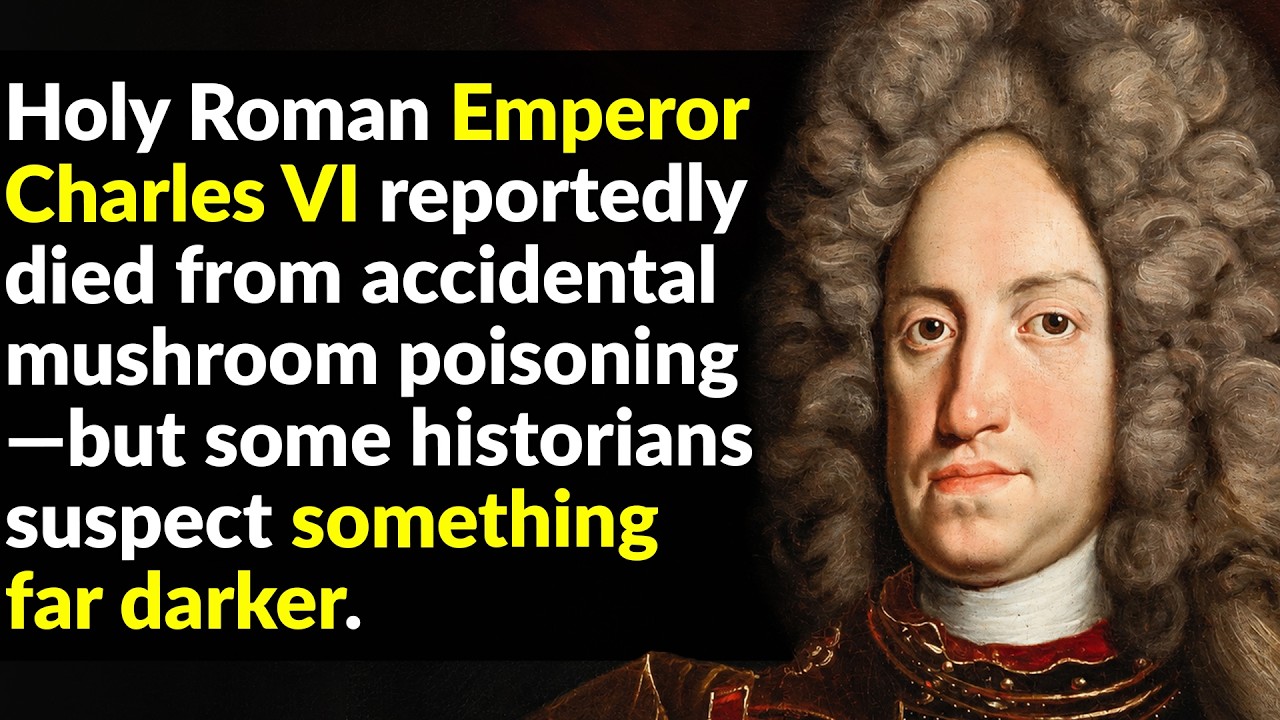
On the night of October 10, 1740, the Holy Roman Emperor lay in his country palace outside Vienna, vomiting without relief. His fever had spiked, his stomach convulsed with colic, and his attendants had already resorted to the harshest remedies their age could offer. Five days earlier, Charles VI had insisted on going duck hunting in the rain, against the warning of his own physicians, and he had returned soaked to the bone. Now, as the night wore on and the sickness would not break, the last male heir of the House of Habsburg was slipping away.
By the time the morning came, those around him knew they had to get him to the capital, and even then, they could not say what was killing him. The cause of his agony would be disputed for centuries, and the consequences of his death would unravel everything he had spent his reign building. Charles VI had been born on October 1, 1685, in the Hofburg Palace in Vienna, the second son of Emperor Leopold I and his third wife, Eleonore Magdalene of Neuburg. As a second son, he was never expected to inherit his father’s crown, but he had ambitions of his own.
In 1700, an opportunity presented itself when his cousin, King Charles II of Spain, died without male heirs. Claiming descent through the House of Habsburg, the young archduke boldly declared himself King of Spain, a move that ignited a fourteen-year conflict over the Spanish succession. His rival was Philip, Duke of Anjou, a grandson of the French king, and the two claimants tore Europe apart over which of them would sit on the Spanish throne. The Hapsburg upstart had powerful backers.
England, Ireland, Scotland, Portugal, most of Germany, the Dutch Republic, and the majority of the Holy Roman Empire all rallied behind his claim, making him a formidable candidate. Encouraged by this support, Charles finally moved to Spain in 1705 to claim his crown, where he remained for six years, bizarrely styling himself Charles III. But his actual control over the country was limited to the region of Catalonia, and he could not hold even that without securing his position further. His father and his father’s advisers arranged a marriage for him, choosing Elizabeth Christine of Brunswick-Wolfenbüttel, the eldest daughter of a powerful German duke.
They were wed in 1708, giving Spain a new queen at her young king’s side. At just twenty-three, Charles had risen far beyond what a second son might have expected. He had become a king, and his contemporaries noted that his beautiful bride far outshone her rather ordinary-looking husband. But even as Charles began to settle into his Catalan stronghold, an unforeseen loss called him home.
His father, Emperor Leopold I, had died in 1705, before he could see his son married, and the crown had passed to Charles’s elder brother, Joseph I. Joseph’s reign was brief. In 1711, he died unexpectedly, and Charles, the next in line, rushed back to Vienna to claim the imperial title. Upon his arrival, the King of Spain became Charles VI, Holy Roman Emperor and ruler of the Habsburg monarchy.
It was a dizzying ascent, and it did not sit well with everyone. The Kingdom of Great Britain, in particular, was alarmed at the prospect of Austria and Spain being united under a single ruler. They withdrew their support from the Austrian alliance, triggering another European conflict. Fortunately, this one was brief.
By 1713, the wars had produced three treaties: Utrecht, Rastatt, and Baden. The Treaty of Baden came with harsh terms for Charles. Most devastating was the recognition of Philip as King of Spain, forcing Charles to give up the crown he had fought so long to win. In compensation, he received vast territories formerly held by Spain: the Kingdom of Naples, the Duchy of Milan, the Austrian Netherlands, and the Kingdom of Sardinia were all ceded to the Austrian monarchy.
Despite these gains, Charles was bitter. He had grown attached to Spain during his years there, and losing it stung deeply. The new emperor was said to be furious at the loss of his first royal love. With his territories secured, Charles turned his attention to the future.
His brother’s death had left him in a unique and precarious position. He was now the last living male heir of the Habsburg line. If anything happened to him, the dynasty would face a succession crisis. So Charles and his empress, Elizabeth, set about producing heirs.
Over the course of their marriage, they had four children: a son, Archduke Leopold Johann, born in 1716, and three daughters, Maria Theresa in 1717, Maria Anna in 1718, and Maria Amalia in 1724. Tragedy struck the family repeatedly. Only two of the children survived infancy. Little Maria Amalia died at the age of six, and Leopold Johann, the long-hoped-for male heir, lived only about seven months.
The only comfort in the face of such loss came in the form of the two surviving girls. Both daughters grew into remarkable women in their own right. Maria Anna would become the governess of the Austrian Netherlands. Maria Theresa would go on to an extraordinary life as well.
But neither solved the problem of the missing male heir, and Charles was forced to take legislative action. The Habsburg domains were subject to Salic law, which meant women could not inherit in their own right. In anticipation of the failure of the male line, Charles issued the Pragmatic Sanction of 1713, abolishing male-only succession within the realms of the monarchy. With the stroke of a pen, he had secured the future of his daughters—and alienated many other monarchs in the process.
Since Charles was the last male heir, it seemed certain that a woman would be the next Habsburg ruler. But Charles wanted to ensure that his own line would continue. His late brother, Joseph I, had also left only daughters, and according to the earlier agreement, they had priority over Charles’s own daughters. While their father Leopold was still alive, he had recognized the impending succession crisis and made both his sons sign a mutual succession pact, guaranteeing the rights of Joseph’s daughters at the expense of Charles’s own.
Now that Leopold and Joseph were both dead, Charles reneged on that agreement. With the birth of his first daughter, Maria Theresa, he disinherited both of his brother’s daughters, guaranteeing that the succession after his death would not go smoothly at all. To shore up support for his daughter, Charles spent most of the remainder of his reign pressuring other European powers to help enforce the Pragmatic Sanction. He was in a weak position, and the other kingdoms knew it.
They did not particularly care which Habsburg woman would take the throne, so they demanded steep concessions from the desperate emperor. Britain, for one, pressed Austria to shut down the Ostend Company, a demand that pained Charles personally. In 1722, Charles had founded the Ostend Company, a licensed commercial enterprise meant to compete with the British, Dutch, and French East India companies, and it was a source of both pride and profit. But in his desperation to secure his daughter’s succession, he reluctantly agreed to close it in exchange for British support.
The others soon followed. The list of states that recognized the Pragmatic Sanction was impressive: Bavaria, Denmark and Norway, the councils of the Holy Roman Empire, the Dutch Republic, France, Great Britain, the Papal States, Prussia, Russia, Savoy-Sardinia, Saxony-Poland, Spain, and Venice. But the foundations of Charles’s European support began to crumble when his brother’s daughters married politically. One married a ruler in Saxony, the other a Bavarian nobleman.
In time, these rulers would reject their commitments to the imperial decree on succession. While his nieces were building their base of support, Charles was also expanding his footprint on the continent. He significantly enlarged the Habsburg monarchy during his reign, particularly after the successful Austro-Turkish War of 1716 to 1718. The Austrian victory brought the addition of the Banat region to Hungarian territory, along with the establishment of direct Austrian rule over Serbia and Oltenia, all the way down the lower Danube.
Even in settlements, Charles often came out victorious. After the conflict with Turkey came the War of the Quadruple Alliance from 1718 to 1720. The Austrian victory led to the Treaty of The Hague, which saw Charles trade Sardinia to the Duke of Savoy for the large, though hard to defend, island of Sicily. Charles had achieved many gains, but they were a prelude to a great loss.
Despite his success in securing European support for his daughter’s inheritance, the Pragmatic Sanction did not hold everywhere. In total, five European monarchies eventually backed out of the agreement: France, Spain, Prussia, and the two kingdoms where his nieces had married, Bavaria and Saxony-Poland. There were various reasons for these collapses, and some shook Europe to its core. After the Treaty of The Hague, Europe enjoyed a period of relative peace.
That peace was shattered in 1733 with the outbreak of the War of the Polish Succession. In the disputes over the throne, Charles lent Austria’s support to Stanisław Leszczyński. France took the opposite side, backing Augustus of Saxony. This proxy conflict between the two monarchies caused France to recant its previous commitment to Charles’s decree.
Charles VI had been a devout Catholic his entire life and sought to rebuild religion in Europe after the Reformation. Following the Treaty of Passarowitz in 1718, which saw territories liberated from the Ottoman Empire and annexed to Habsburg lands, Charles supported the re-establishment of Catholic ecclesiastical structures in these newly opened territories. He was far less tolerant of other faiths. He had little enthusiasm for other Christian denominations and strictly regulated the rights and freedoms of other religions within the empire.
But he softened slightly later in life, granting ancient privileges to his Orthodox subjects. Perhaps he felt he would not live long in this world and needed to atone for his misdeeds. He was not far off. Throughout his life, Charles was a passionate hunter, often embarking on long trips to pursue the sport.
In October 1740, he set out on a hunting expedition across the Hungarian border. The conditions were treacherous. That month was recorded as the wettest and coldest October in living memory. Those close to Charles tried to warn him.
The day he set out was cold and beset by heavy rain. By that point, the emperor was more fragile than he had once been, and his doctors warned him he was endangering his health by leaving in such a state. But Charles was eager to hunt duck. He brushed aside all warnings, a decision that proved fatal.
He returned from the hunt cold and drenched to the bone. While staying at his country palace at La Favorita, the emperor quickly developed a fever and began suffering from colic pains. But Charles remained stubborn in the face of illness, believing that a good meal would make him feel better. Despite his poor condition, he insisted that his cooks prepare one of his favorite dishes: a Catalan mushroom stew.
According to Voltaire’s memoirs, the cooks unwittingly prepared the meal with poisonous mushrooms. Whether that was true or not, Charles soon tasted it again when he threw it up. Whether it was the meal, the fever, or a deadly combination of the two, Charles was facing a difficult evening. His condition deteriorated markedly, and he spent the entire night between October 10 and 11 vomiting with little relief.
Adding insult to injury, his attendants applied the best medical practices of the time, which was not a good thing at all. In an unfortunate and ironic indication of how little medical practitioners knew then, some historians believe that Charles’s physicians may have treated him with the most deadly remedy of the age: arsenic. This dangerous substance was used to treat everything from fever to stomach pain, and many of Charles’s symptoms corresponded with arsenic poisoning, including the absence of signs of liver failure, which is common in mushroom poisoning. Whether they used arsenic or not, by the morning of the next day, things did not look good for Charles.
His attendants recognized that they needed better caretakers to ensure the emperor received the best possible care. They arranged for Charles to be transported to Vienna in a padded carriage. It was a long, slow journey, and ultimately it did no good. Though he barely made it back to Vienna, Charles VI succumbed to his illness nine days later, on October 20, 1740.
Tragically, he was only fifty-five years old. His early death might have been preventable, but his contemporaries could not even agree on the cause. While some historians believe that Charles’s death may have been hastened by accidental arsenic poisoning, most others considered the cold and the mushrooms to be the primary suspects. Many simply believed that the ailing emperor had spent too long in the harsh, rainy conditions of the Hungarian countryside, and his immune system had been unable to withstand it.
Others blamed the potentially poisonous mushrooms, and Charles sometimes appears on lists of famous fungal victims. In any case, after the emperor’s death, Europe exploded over the precarious state in which his succession had left the continent. At his death, the Pragmatic Sanction, the greatest achievement of his life, came into sharp dispute. An anti-sanction alliance formed within weeks of the emperor’s death, comprising Bavaria, France, Poland, Prussia, Saxony, and Spain, who all reneged on the agreement and began attacking the Austrian borders, sparking the costly War of the Austrian Succession.
Charles had left his daughter a kingdom and a chronic headache. After her father’s death, Maria Theresa was plagued by the conflict resulting from his succession for the next eight years. Given her capability as a leader, she eventually saved her crown and most of her territories, but it came at a heavy price, and she had to blame her father for part of it. His succession issue was not the only thing Charles left unfortified.
At the time of his death, the emperor left the Habsburg lands mired in debt, placing Maria in a difficult position. The Habsburg treasury inherited a mere 100,000 florins. Money was not the only thing she lacked. Charles VI also left his daughter an Austrian military in poor shape.
The scattered army was spread across the empire, stationed in small, mostly ineffective garrisons. As a result, morale was low among the soldiers and desertion was widespread. It was no wonder that Maria Theresa survived, especially after eight years. Still, her father’s legacy remained largely intact.
In the centuries after his death, Emperor Charles VI retained a place as a fixture on many collector’s coins and medals. Around 2006, Austria minted a commemorative coin for Göttweig Abbey, which features Charles’s portrait on the front of the coin’s reverse. It shows that despite the poor state in which he left the monarchy, the emperor still enjoyed the goodwill of his people’s descendants.






