For more than five centuries, the story of Richard III belonged to his conquerors. Struck down at the Battle of Bosworth Field in 1485, the last English king to die in combat was stripped, slung over a horse, paraded through the streets, and buried without ceremony in a hastily dug grave at a Leicester monastery. During the Reformation decades later, the monastery was destroyed, its stones carted away, and the ground paved over. The exact location of the king’s grave passed out of human memory.
What survived was a carefully engineered reputation. The Tudor dynasty, which seized the crown over Richard’s dead body, needed to legitimize its own shaky claim. It transformed the fallen king into a monster. Shakespeare gave the world the enduring image of a venomous, hunchbacked tyrant who murdered his nephews, the Princes in the Tower, to steal the throne.
For generations, that caricature stood as accepted history. Then modern science began to pull it apart. The search for the real Richard III began with the persistence of historian Philippa Langley. After years of overlaying medieval maps onto modern city grids, her research pointed to an unremarkable municipal parking lot in Leicester.
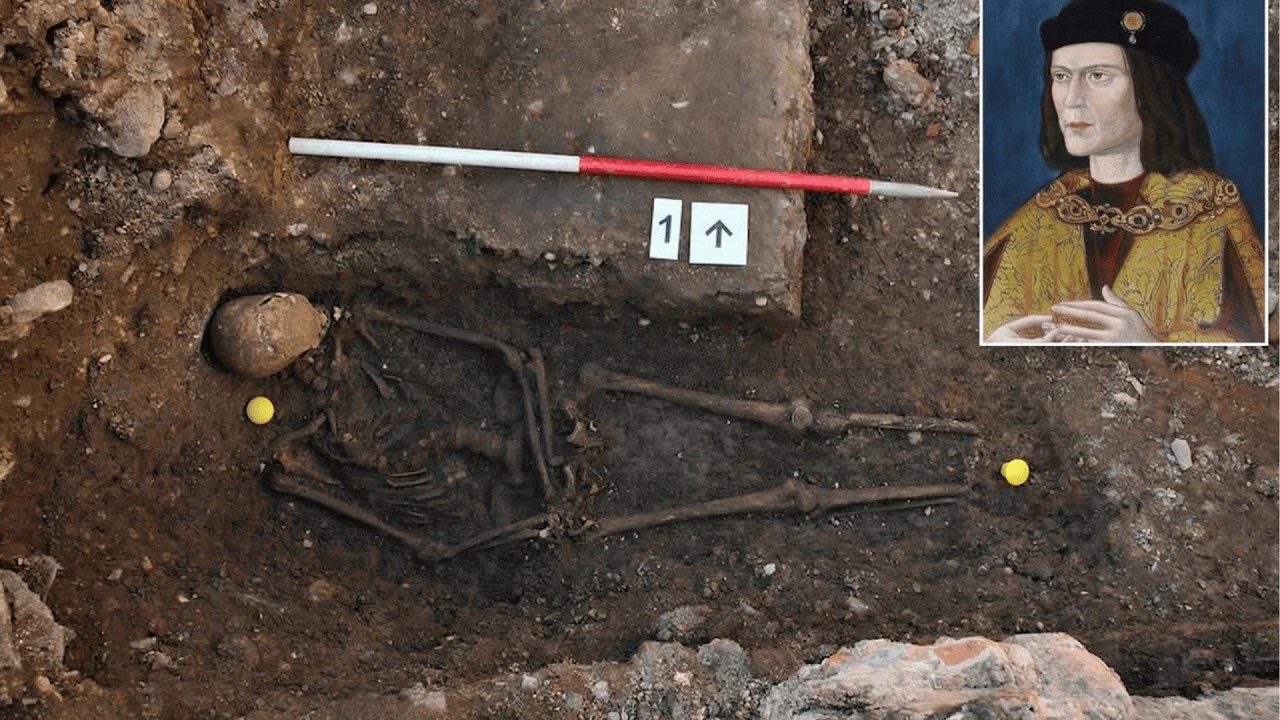
Academics dismissed the theory as fantasy. In August 2012, an archaeological team from the University of Leicester broke ground anyway. Using ground-penetrating radar and historical records, they cut a trench through the asphalt and into the dense clay below. On the first day, they hit human bone.
What emerged was a chilling scene. Skeleton one lay in a grave too short for the body. The head had been propped awkwardly against the dirt wall. The hands were crossed at the wrists, a position that strongly suggested they had been bound.
This was not the burial of an anointed monarch. It was the hasty disposal of a despised enemy. Forensic pathology painted a harsh picture of medieval combat. The skeleton belonged to a man in his early thirties, exactly matching Richard’s age of thirty-two.
The skull showed multiple battle wounds. The evidence suggested he had lost his helmet in the chaos of the fight and been swarmed by foot soldiers. But the feature that linked this battered skeleton to the legendary king was the spine. The vertebrae displayed a severe lateral curve, a textbook case of adolescent-onset scoliosis.
The curvature was so pronounced that his right shoulder would have sat noticeably higher than his left, placing real strain on his internal organs. The Tudor propaganda began to unravel. Shakespeare’s hunchbacked monster was a cruel exaggeration, but it was rooted in a genuine condition. Richard was not a deformed villain.
He was a man with a serious disability who nevertheless wore heavy plate armor, rode a warhorse, and fought until his death. Battle wounds and a curved spine, however, were only circumstantial evidence. To prove beyond doubt that this was the last Plantagenet king, scientists needed to extract a genetic fingerprint from bones that had soaked in wet clay for 527 years. That is a monumental challenge.
A single stray hair can ruin the sequence. The solution was mitochondrial DNA. This genetic signature passes exclusively from mother to child, creating an unbroken female line across generations. Richard III left no surviving legitimate heirs, but he had an older sister, Anne of York.
Genealogists traced her direct female line through seventeen generations, from mother to daughter, across five centuries of upheaval. Against long odds, they located a living descendant: Michael Ibsen, a Canadian-born furniture maker living in London. He provided a cheek swab. The laboratory sequenced his mitochondrial DNA and compared it to the fragmented ancient DNA from the skeleton.
The result was a perfect match. The shared sequence, haplogroup J1C2C, is extremely rare. The statistical probability of a random body in that exact location carrying that rare maternal signature, severe scoliosis, and matching battle wounds was close to zero. The scientific establishment announced it to the world.
The bones beneath the parking lot were King Richard III. The scientific method demands rigor, so researchers ran one final test to verify the royal line. They turned to the Y chromosome. Just as mitochondrial DNA tracks the maternal line, the Y chromosome passes from father to son.
For the Plantagenets, this paternal bloodline was everything. Their divine right to rule England, their justification for the Wars of the Roses, rested on an unbroken line stretching back from father to son. Geneticists extracted Richard’s ancient Y chromosome. They then found living male-line descendants of the Somerset family, who traced their lineage directly back to King Edward III, Richard’s great-great-grandfather.
Theoretically, Richard and these modern aristocrats shared the exact same paternal ancestor. Their Y chromosomes should have matched seamlessly. They did not. The result was a complete mismatch.
Somewhere in the nineteen generations separating them, the male line had been broken. In the language of genetics, it is called a false paternity event. In the language of history, it is called adultery, illegitimacy, and a colossal royal lie. At some point in this revered family tree, a queen or noblewoman bore an heir with a man who was not her husband.
That illegitimate heir was raised as a pure-blooded royal, and the false bloodline passed down through history as truth. The findings, published in Nature Communications in 2014, cast a long shadow over the British monarchy. The DNA cannot pinpoint where the break occurred, but the implications are enormous. If the break happened early in the line, then Richard III, his brother King Edward IV, and the famous Princes in the Tower were not biological Plantagenets.
The House of York fought a devastating civil war for a crown it had no genetic right to claim. The foundation of its power was built on a biological illusion. This revelation reshapes the most infamous mystery of Richard’s reign. History long claimed that Richard locked his nephews in the Tower of London and murdered them to secure his crown.
But Richard took the throne through a legal loophole, declaring his brother’s marriage invalid. The princes were already stripped of their royal rights. He did not necessarily need to eliminate them. The genetic data points elsewhere.
The man who actually won the war, Henry VII, founder of the Tudor dynasty, seized the crown by force. His blood claim was weak. To secure his position, he married the sister of the princes. If those two boys were still alive, everyone in England knew they had a stronger claim than he did.
Henry VII would lose everything if they survived. He had every reason to quietly remove them and launch a propaganda campaign blaming the dead king. History is a fragile construct, largely written by those who survived to hold the pen. For centuries, the world accepted the tale of the monstrous villain and the divinely pure-blooded kings.
But the bones beneath the parking lot proved that chromosomes do not care about political narratives. The DNA of Richard III solved his disappearance, humanized his physical suffering, and exposed the fraudulent structure of royal supremacy. The most earth-shattering secrets are not always hidden in castles or archives.
Sometimes they lie buried under ordinary ground, waiting for the science of the future to dig them up.






