The four men in the dugout canoe moved up the Umpqua River through gray morning water, the furs standing so thick on the bank they seemed to press down to the river’s edge. In the bow sat Jedediah Strong Smith, twenty-nine years old, the first American to reach California overland and the first known to cross the Sierra Nevada. He wore his hair long to hide the ear a grizzly had nearly torn from his head. A few miles downstream, eighteen of his men sat in camp with every pelt from a year of hard country.
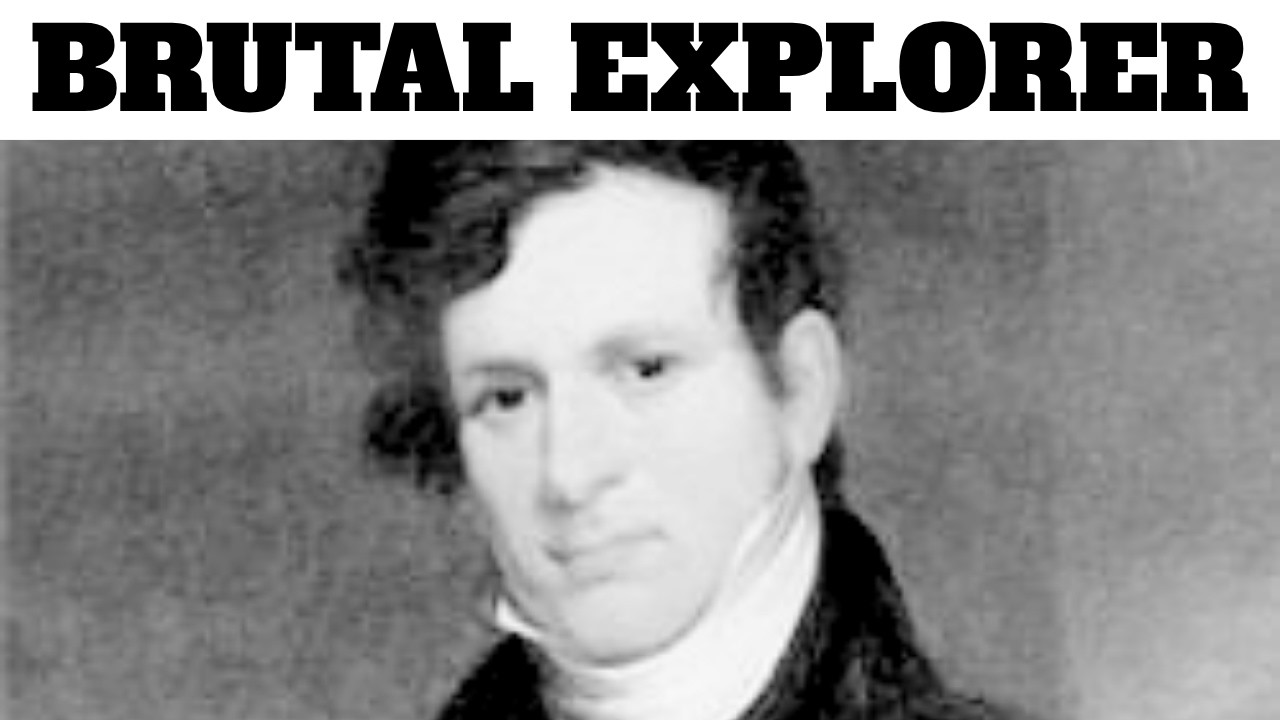
He did not know that camp had already been chosen. Before the sun was high, five years of maps and promises would come down to whatever four men could carry out of a forest. Smith was born on January 6th, 1799, in Jericho, a small settlement in Chenango County, New York, a town that would later be called Bainbridge. His father, also named Jedediah, kept a general store.
His mother was Sally Strong, and she would raise a crowd of children in houses that never stayed home for long. The Smiths were a moving family. Land in New York was crowded and expensive, so they went west to Erie County, Pennsylvania, where the woods came down to the lake. When that did not hold them, they went west again into north central Ohio a little before 1820.
Each move was a bet that the next county would be the one. Each time, the bet came up short. There was no drunkenness or cruelty in it, nothing in the record says so. It was the plain arithmetic of the early republic.
A family with too many mouths and too little cash bought cheap land and cleared it by hand, then found the debt waiting when the crop came in. Into that household came a doctor named Titus Gordon Vespasian Simons. He tended the family and took an interest in the boy. Simons taught him to read well, to write a clean hand, to keep accounts, and enough Latin to know what a learned man sounded like.
Those accounts would matter more than the Latin. Smith would spend his life writing down distances, rivers, and debts. There is a family tradition that Simons gave young Jedediah a copy of the journals of Lewis and Clark, the edition printed in 1814. Nobody can prove that book changed his life, but the tradition has lasted two hundred years because it fits: a poor boy in Ohio reading about men who walked to the Pacific and came back.
The family was Methodist, and Smith carried that faith further than most men carry anything. In a profession that would become famous for whiskey and knife fights, he would be remembered as a praying man. His letters home are full of God, of guilt, of worry for his parents. They read like a son who thought he owed them something he could never fully pay.
As a young man, he took work as a clerk on a freighter on Lake Erie. He counted barrels. He learned what goods cost in one place and what they sold for in another. It was dull work, and it was an education.
He was watching how money moved and who kept it. St. Louis in those years smelled of river mud, tanned hides, and coal smoke. The levee was crowded with keelboats and flatboats unloading furs, lead, and whiskey.
French was still spoken in the streets, a leftover of the old trading town. Men came in from the upper river bearded and burned, with money in their belts that would be gone in a week. By 1821, Smith was in St. Louis, the last real city before the wilderness.
He was twenty-two years old. He owned almost nothing. And the family he had left behind needed money he did not have. In February of 1822, a notice ran in the *Missouri Gazette and Public Advertiser*.
It was short. It asked for enterprising young men to go up the Missouri River to its source and to stay for one, two, or three years. The man who placed it was William Henry Ashley. The men who answered it would become the most famous generation of trappers in American history.
Jim Bridger answered it. Thomas Fitzpatrick answered it. Jedediah Smith answered it. The work was simple to describe and hard to survive.
Go up the river. Trap beaver in the cold streams of the mountains. Bring the pelts back down to be made into hats for gentlemen in New York and London. A good beaver hat in a city shop was a mark of standing.
Behind every one of them was a man standing to his thighs in ice water setting a steel trap at dawn. Smith went up in 1822 and wintered on the upper Missouri. He learned to set traps, to skin, to read sign, to keep powder dry. By the next spring, Ashley trusted him enough to send him on errands that mattered.
One of those errands led to a beach below the villages of the Arikara on the Missouri River, in what is now South Dakota. The Arikara lived in earth lodges behind a palisade of timber. They grew corn and traded with whoever came up the river. They had also learned that the traders coming up river were arming their enemies farther north.
They had reasons to be angry, and those reasons were real. Ashley came up in the spring of 1823 with two keelboats and about seventy men. He needed horses to send a party overland to the mountains. The Arikara had horses to trade.
So Ashley traded, and the horses were picketed on an open sandbar below the village, with about forty men camped there to guard them. The keelboats sat out in the current. At dawn on June 2nd, 1823, the Arikara opened fire from the palisade and the brush. The men on the beach had no cover.
Horses screamed and went down. Men tried to drag themselves toward the river and the boats. Some swam and were shot in the water. Some made the boats, and some did not.
When it was over, at least a dozen of Ashley’s men were dead, and the true number may have been closer to fifteen. Smith was on that beach. He made it out. Afterward, the men remembered a young man with a Bible praying over the dead.
That is how many of them first learned his name. Then he did something that told the older men what kind of man he was. Ashley needed help from his partner, Andrew Henry, hundreds of miles up river at the mouth of the Yellowstone. Someone had to carry the word through country where enemies might be waiting in any coulee.
Smith volunteered. He went with one companion, and he got through. Then the government came. Colonel Henry Leavenworth marched up from Fort Atkinson with soldiers of the 6th Infantry, artillery, and a large force of Sioux warriors, who had their own quarrel with the Arikara.
Trappers joined him, organized into companies. Smith was given command of one of them. For the trappers, this was the moment the law was supposed to arrive. It arrived, and it did not finish anything.
Leavenworth shelled the village, hesitated, and opened talks. He drew up a treaty whose terms called for the Arikara to return the property taken from Ashley. Then, in the night, the Arikara left their village and slipped away. Nothing was returned.
Leavenworth marched home. Joshua Pilcher of the Missouri Fur Company wrote to Leavenworth in a fury, accusing him of disgracing the country. Other traders agreed. But the lesson the trappers drew was quieter.
The army would come when called, make a treaty, and leave you exactly where it found you. That lesson stayed with them. It was never unlearned. That same summer, a trapper named Hugh Glass was mauled by a grizzly while hunting for the company.
Two men were paid to stay with him until he died and bury him. They took his rifle and left him alive. Hollywood would later turn Glass into a revenge picture. The truth was simpler.
In that country, the men you trusted sometimes walked away. That fall, it was Smith’s turn. Ashley sent him west overland with a small party of about a dozen men toward the mountains. They crossed the dry country west of the Missouri.
Water was so scarce that men were buried to their necks in damp sand to keep from dying of thirst. Then they came toward the southern edge of the Black Hills, into brushy river bottoms where the plum and the willow grew close. The exact place is still argued over. What happened there is not.
The men were leading horses single file through a thicket. Smith was walking near the front. A grizzly came out of the brush and went straight for him. It was not a warning.
It knocked him down and took his head in its jaws. The bear broke ribs. It tore open his scalp from his left eye back toward his right ear and laid the skin of his head open to the bone. It ripped his ear almost off.
Then it was gone or driven off. The men came running to find their captain on the ground, his head a mass of blood and hair. One of those men was James Clyman, and he is the reason we know any of this. Clyman wrote down the story decades later in his own plain words.
Nobody else in the party knew what to do. So Smith, lying there, told Clyman what to do. He told him to get water and wash the wounds. He told him to get a needle and thread out of the packs, and he told him to sew.
Clyman cut away the hair. He pulled the scalp back over the skull and stitched it as best he could. Then he told Smith there was nothing to be done about the ear. Smith told him to try anyway.
So Clyman sewed the ear back on. Smith felt it all through his own head, awake, telling the man where to put the next stitch. They made camp by water. Within days, Smith was riding again.
He wore his hair long for the rest of his life, down over the scar and the ear. Every portrait of him with that dark hair falling past his collar is a portrait of that day. Through the winter, the party pushed on into the Wind River country. The Crow people told them of a way across the mountains to the west.
By Clyman’s account, they laid it out for the trappers with sand and a buffalo robe. In early 1824, Smith and his men crossed the Continental Divide through a wide, gentle gap in the mountains called South Pass. The record needs saying plainly: Smith did not discover South Pass. Robert Stuart and a few men of the Astor company had crossed it eastbound in 1812, and their knowledge faded.
What Smith did was find it again, report it, and make it a road. Within a generation, wagons by the hundreds of thousands would roll through that gap toward Oregon and California. The Oregon Trail runs through the place a bear failed to stop him from reaching. He had been in the mountains two years.
He had walked off a killing beach and survived a grizzly with his head sewn shut. The trappers began to look at him differently. So did the man who had placed that notice in the newspaper. William Henry Ashley was not a mountain man.
He was a Virginian who had come west and done well in lead and saltpeter, the raw stuff of gunpowder. He was a brigadier general in the Missouri militia and the lieutenant governor of Missouri. He wore good coats. He had political plans, and he had nearly lost everything on the Arikara beach.
What Ashley saw in Smith was reliability. The young man kept accounts. He did not drink himself useless. He brought men back alive more often than not, and he brought furs back with them.
In a business where most men were either reckless or broke, Smith was steady. So in 1825, Ashley made him a partner. That same year, Ashley invented the thing that would define the fur trade for fifteen years. Instead of building forts, he would bring the supplies to the mountains once a year to a place agreed on ahead of time.
The trappers would come in from every direction with their furs. They would trade, drink, race horses, and buy what they needed for another year. It was called the rendezvous. The first one gathered on Henry Fork of the Green River in the summer of 1825.
Stand in one and you would see hundreds of men and lodges spread along a river bottom. Trappers came in with packs of beaver, pressed flat and tied with raw hide. Native families came to trade horses and robes. Mules arrived from St.
Louis carrying kegs, bolts of red cloth, steel traps, and coffee. For a few weeks, the loneliest men in America had a town. Then the town packed up and disappeared. In July of 1826, at the rendezvous in Cache Valley, Ashley sold out.
He sold the whole mountain business to three young men: Jedediah Smith, David Jackson, and William Sublette. Smith was twenty-seven years old. Four years earlier, he had answered a newspaper notice with almost nothing in his pockets. Now he owned a share of the largest American fur outfit in the Rocky Mountains.
It was real dignity, and it was on credit. The new partners owed Ashley for the business. Ashley would keep supplying them, hauling goods out from St. Louis and selling them at mountain prices.
He had taken his risk early, and now he would take his profit safely from a desk. That is not a crime. It is how the trade worked. But it meant the young men in the mountains carried the danger, and the man in St.
Louis carried the notes. Among the men Smith led, one stands out because he left his voice behind. His name was Harrison Rogers. He served as clerk on the journeys that came next, and he kept a daybook.
Rogers was a church-going man like Smith. He wrote down sermons he remembered, kindnesses done to the party, and the dead. When Smith wrote home, he wrote about duty. He told his brother Ralph that he endured what he endured so that he might help those who needed it.
He asked his family to pray for him. He did not tell them how often he needed it. He was about to take those men somewhere no American had gone overland. To get there, they would have to cross the borders of three powers, and every one of those powers had its own reasons to want them gone.
Stand at a rendezvous in 1826 and look east. St. Louis is more than a thousand miles away. Everything you own came from there on the backs of mules: your powder, your lead, your traps, your blankets, your coffee, your sugar, your knife.
Every one of those things was marked up, sometimes many times over, by the time it reached you. And you paid in beaver at a price set by the men who brought the goods. A trapper could work a full year, half frozen and in danger every day, and walk away from rendezvous owing money. Many did.
The goods were advanced on credit against next season. If you died, the debt died with you. If you lived, it was waiting. Behind all of it, in St.
Louis and New York, stood John Jacob Astor and his American Fur Company, the richest fur concern in the nation, squeezing every smaller outfit it could reach. Now look north and west. That country was claimed jointly by the United States and Great Britain under an agreement signed in 1818. In practice, it was run by one British company.
Its western headquarters was Fort Vancouver on the Columbia River under Dr. John McLoughlin, a tall man with white hair who governed a territory larger than most nations. Above him in the company councils sat Governor George Simpson, small, hard, and tireless, who counted every pelt. Simpson had a plan for the Americans.
He sent brigades under Peter Skene Ogden into the Snake River country with orders to trap it bare. Leave nothing. Turn the land between the British and the Americans into a fur desert so there would be no reason for Americans to come. It was a policy written down in company letters.
They meant to empty the rivers to keep a border. Now look south and west. That country belonged to the young republic of Mexico. Alta California was governed by Jose Maria de Echeandía from San Diego.
To Mexican law, an American trapper who walked in over the mountains without a passport was not an explorer. He was a trespasser and perhaps a spy. Debt to the east, a fur desert to the north, arrest to the south. In August of 1826, Smith chose south.
He left the country near the Great Salt Lake with about fifteen men. They went down through desert country no American had mapped, down the Virgin River and through red canyons. They reached the villages of the Mojave on the Colorado River. The Mojave received them peaceably and traded with them.
Then the party struck west across the Mojave Desert, the horses failing, the men chewing anything that held water. Smith wrote about the Mojave with real respect, describing their fields of corn, beans, pumpkins, and melons along the river watered by the floods. They were not wanderers but farmers settled on the one green ribbon in a land of rock. Every party crossing that country had to pass through them.
On November 27th, 1826, they walked into Mission San Gabriel, near where Los Angeles stands today. They were the first Americans known to reach California overland. Rogers wrote down what met them there. Father Jose Bernardo Sanchez fed them, housed them, gave them wine and clean linen, and treated them like guests.
The ragged trappers sat at a mission table with a priest. It was the kindest welcome they would ever get in that country. The governor was another matter. Smith was called to San Diego and held there while Echeandía decided what he was.
Weeks passed. American ship captains in port put their names to a statement vouching that he was a trader and not a spy. At last, Echeandía let him go on one condition: he must leave California by the same route he had come. Back the way he came, back past the Mojave.
Smith did leave the settled coast, but not the way the governor meant. He went over the mountains and turned north into the Great Central Valley. He trapped the rivers there through the spring of 1827. That was a stretching of the order, and the Mexican authorities saw it that way.
He was looking for a way home that did not run back through the desert. He found one at enormous cost. In May of 1827, he left most of his men camped on the Stanislaus River. With only two companions, Silas Gobel and Robert Evans, he crossed the Sierra Nevada in snow.
They are believed to be the first men of European descent to do it. Then they walked east across the Great Basin, a desert of salt flats and dry mountains in summer heat. The heat was so fierce that the men dug shallow holes in the sand and lay in them to cool their bodies. Smith wrote that even the hope of water seemed gone.
He kept writing anyway. Every spring, every ridge, every salt flat went into his notes. A man near death was still making the map. Horses died and were eaten.
Evans collapsed and had to be left behind while Smith went ahead to find water, then carried it back to him. They staggered into the rendezvous at Bear Lake in early July. Men fired off a small cannon in salute. They had given him up for dead.
Smith had crossed the Sierra and the Great Basin, the first known traverse by an American. That alone would have made him famous. But his men were still in California waiting by the Stanislaus. He had promised to come back for them.
And within days of reaching the rendezvous, he turned around to do it. In July of 1827, Smith left the rendezvous again with eighteen men and two native women who traveled with the party. He took the only route he knew for certain, down through the canyons, back to the Colorado River, back to the villages of the Mojave, the people who had traded with him in peace the year before. The Mojave received them again.
They traded again. For several days, nothing seemed wrong. Then the party began to cross the Colorado River on rafts made of cane and rushes. Some of the men and the goods were on the water.
Some were still on the bank. Smith himself was out on the river. That was when the Mojave attacked. The men still on the bank had no chance to form up.
They were clubbed and shot with arrows where they stood. Ten men were killed in a matter of minutes. Silas Gobel, who had crossed the Sierra in snow at Smith’s side two months before, died on that riverbank. The two women were taken.
The horses, the traps, and most of the supplies were lost. Smith and eight survivors were left with a handful of rifles and whatever they had on their backs. On the far bank, men with bows were gathering. Why did the Mojave turn?
The record does not settle it. Historians point to two causes. One is that Mexican officials, after Smith’s first visit, told the Mojave not to let Americans pass. The other is that the Mojave had fought another American trapping party in the months between and lost people to them.
Both may be true. Neither is proven beyond question. What is certain is this: the governor had ordered him to leave by that road. When he came back down it, the road was closed in blood.
No one was ever prosecuted for those ten men. No court in Mexico had any interest in Americans who were not supposed to be there. No court in the United States had any reach over a riverbank two thousand miles from Washington. The dead were not even counted by any government.
They were counted by Smith in his own hand in his journal. After that August, there was no road back. The way he had come was a graveyard now. The men waiting by the Stanislaus were still ahead of him.
And between him and them stood the Mojave Desert with no horses and very little water. The nine survivors did not run first. They could not. They pulled back from the river into a grove of cottonwood trees and made a stand.
They cut down small trees to make a breastwork. Some of the men had no rifles, so they tied butcher knives to the ends of light poles to make spears. Then they waited for the rush. Hundreds of Mojave gathered around the grove.
Smith ordered his men to hold their fire until they were sure of hitting. When the warriors came close enough, the few rifles fired. Two men fell dead. Another was wounded, and the gathered warriors pulled back.
It was enough. The trappers got out under cover of darkness. Then came the desert again. They walked for days across the Mojave, drinking from salt springs, chewing cactus.
They made it to the mountains and down to the settlements near San Gabriel. Smith gathered what he could and pushed north again to the camp on the Stanislaus. The men there had been waiting since May, half starved and losing hope. On the day Smith rode in, they wept.
Now he had to get them all out of California. In the spring of 1828, Smith led his combined party north through the Sacramento Valley. He had about twenty men and a large herd of horses and mules bought in the settlements to sell to the trappers in the mountains. They were looking for a way over to the coast and then north toward the Columbia River.
The country they entered was full of people who had never seen men like these. Rogers kept his daybook all the way. In it, and in Smith’s journal, you can read the friction grow. Horses found shot full of arrows.
Animals stolen in the night. Native people shot by the party in the brush and along the trail. Some of these were fights. Some were men shooting first at people they did not know.
The journals do not hide it. On the Colorado, the violence was a stand against slaughter. On the march north, it became something harder to name. Men who had been hunted began to act like men who expected to be hunted everywhere.
They fired more quickly. They trusted no one. They reached the Pacific coast and turned north. The country was brutal.
They crossed rivers swollen with spring melt. They pushed through redwood forests so dense the horses had to be cut a path. Animals fell off cliffs into the surf. Men went hungry.
By early summer of 1828, they crossed into what is now Oregon, and the country began to tilt toward the Umpqua River. To understand why they were there at all on that unmapped coast, go back to Monterey and to a piece of paper. In the fall of 1827, after the attack on the Colorado, Smith went to Monterey, the capital of Alta California. He came openly to explain himself and to get supplies for his men.
Governor Echeandía had him arrested and held. The man who had been told to leave by the Mojave Road and nearly died on it was now in a Mexican jail for coming back. Monterey was a small capital, a presidio of adobe walls, a customs house near the water, a few ships riding at anchor in the bay. Yankee traders came there for hides and tallow.
Smith sat in that town while his men waited in the valley eating whatever they could shoot. Echeandía did not seem to know what to do with him. At one point, Smith was to be sent to Mexico City to answer for himself. Then he was to leave by sea.
The terms changed and changed again. In the end, American residents and ship captains in Monterey put their names to a bond. They guaranteed that Smith would leave Mexican territory and behave himself while he went. It was the kind of paper that keeps a man out of prison.
Smith accepted it. And he kept the central term. He left California and he never came back. The record does not show a clean promise from Echeandía that was later broken.
Smith himself had stretched the first order a year before when he turned north instead of going home through the desert. The governor had reasons for his suspicion, and Mexican law was on his side. But look at what the paper did. It pushed Smith out of California with a herd of animals and twenty men.
The Mojave Road was closed to him in blood. The Sierra was a death march in winter. That left the long way north, up a coast no American had ever walked, toward a British fort that owed him nothing. It was not a route he would have chosen.
It was the only route the paper left him. Nothing was ever repaid to the men who died going that way. No government ever spoke of them. Mexico owed them nothing and gave them nothing.
July 13th, 1828. The day before the canoe. The party was camped among the Calawatset people on the lower Umpqua River. The Calawatset traded with them and guided them.
Then a Calawatset man took an axe from the camp. It was a small thing, and it was not small to men who could not replace anything. Smith’s men seized him. By the accounts that later reached the British at Fort Vancouver, the men put a cord around his neck and held him until the axe came back.
To the trappers, that was settling a theft. To the Calawatset, it was a humiliation done to one of their own on their own river by strangers. The British would later say this was the cause of what followed. Other accusations against the party were made too, and they are still disputed.
What is certain is that something broke in that camp on the 13th, and Smith may not have understood how badly. Smith had a standing order. No native people were to be allowed into camp in numbers. He had learned that much from the Colorado.
On the morning of July 14th, he gave the order again. Then he went upriver in the canoe to scout the route with John Turner, Richard Leland, and a Clatsop guide. The gray water, the furs to the bank, the long hair over the sewn ear. Behind him at the camp, the order was not kept.
Clatsop men came in the way they had on other days. Some of the trappers were cleaning rifles. Some were eating. Harrison Rogers, the clerk with the daybook full of sermons and kindnesses, was among them.
Then the attack came, all at once from every side. Men were struck down before they could reach their rifles. They were killed with axes and knives and clubs. Rogers died there in the camp with his book.
Fifteen men were killed in that clearing by the river in minutes while Smith was out on the water. One man got away. His name was Arthur Black. He was cleaning his rifle when three men came at him at once.
He was wounded, and he fought clear, and he ran into the timber. He did not look back. He did not know that anyone else was alive. Out on the river, the Clatsop guide in Smith’s canoe grabbed for a rifle and went over the side.
Shots came from the bank. Smith turned the canoe and saw enough to know what had happened downstream. He and Turner and Leland got to the far bank. They climbed a hill, and from there, by most accounts, they looked down at what was left of the camp and knew that nothing could be done.
Then three men walked north with almost nothing through country where everyone might want them dead. They had no horses. They had little powder. They kept to the hills where they could and moved carefully past villages they could not trust.
Every stream had to be crossed. Every night was cold and wet. They were following the coast toward the Columbia, toward the one place in that whole country with walls. Arthur Black reached the Tillamook people on the coast, and they helped him north to the Columbia.
On August 8th, 1828, he stumbled into Fort Vancouver and told Dr. McLoughlin he believed he was the only one left. Two days later, on August 10th, Smith walked in with Turner and Leland. Four men out of nineteen.
The furs, the horses, the journals, all lost. What happened next surprised everyone. McLoughlin decided to help him. He could have shut the gate.
He did not. He organized a party to go back to the Umpqua and recover what could be recovered. He put it under one of his best men, Alexander Roderick McLeod. In the fall of 1828, McLeod led a strong party south from the Columbia with Smith, Turner, and Black riding with him.
They went back down the trail into the country of the Umpqua. They found the camp. They found the dead, or what the weather and the animals had left of them. Smith stood in that clearing again among the bones of men he had promised to take home.
McLeod’s party buried what they could. There was no priest and no mission bell. There was a hole in the ground in a forest at the end of the world. Then McLeod went to work among the peoples of the river.
Through trade and through pressure, he recovered furs, horses, and a part of the journals. Some of the pages Rogers had written came back out of that forest. The man did not. McLoughlin bought the recovered furs from Smith and paid him for them.
In a story full of governments that did nothing, the rival company kept its word. McLoughlin was not a villain. Smith spent the winter at Fort Vancouver. George Simpson was there, the man whose fur desert policy had been written to keep him out.
They talked about the country. Simpson took careful notes. Each man was measuring the other for what he knew. Fort Vancouver was the grandest post west of the Rockies, a tall stockade of fir logs on a plain above the Columbia.
Inside stood warehouses, a trade shop, a blacksmith forge, and the house of the chief factor. Around it lay fields of wheat and peas and a young orchard. Men from Scotland, Quebec, Hawaii, and a dozen native nations worked there under one flag. For the first time in two years, Smith slept behind walls.
In March of 1829, Smith and Arthur Black left Fort Vancouver and went up the Columbia east toward the mountains. They found his partners that summer. Jackson and Sublette had been searching for him and had nearly given up hope. He had been gone two years.
Most of the men he had led away were dead. He stayed one more year in the mountains. In the summer of 1830, the partners did something new. They brought wagons all the way from St.
Louis to the Wind River. It was proof that wheels could reach the Rockies. Then, on August 4th, 1830, they sold out. They sold the business to a group of mountain men that included Tom Fitzpatrick and Jim Bridger.
Smith went home to St. Louis with money for the first time in his life. That October, he and his partners wrote a long letter to the Secretary of War, John Eaton. They told him about the British at Fort Vancouver and their reach into the Oregon country.
They described the route the wagons had taken. They urged the government to act. Washington filed the letter. The joint occupation of Oregon would go on for sixteen more years.
That winter, he did something few mountain men ever did. He sat down to put what he had seen on paper. He worked with a young man named Samuel Parkman to draw a great map of the West, marked with every river and pass he had walked. He spoke of writing a book.
He bought property in St. Louis. For a few months, the man who always went ahead stayed in one place. He had crossed more of the West than any American alive.
He had a fortune, a house, and his journals. He was thirty-one years old. He could have stopped. He did not stop.
In the spring of 1831, Smith went into the Santa Fe trade. It was supposed to be the easier road, wagons and mules on a known trail toward Mexico. He went with Jackson and Sublette and Tom Fitzpatrick. Two of his younger brothers came with him, Austin and Peter.
For once, he was going with family. The caravan rolled west out of Missouri with more than twenty wagons. Past the great bend of the Arkansas River, the trail split. One branch followed the river the long way around.
The other cut straight southwest across open plains toward the Cimarron River. It was shorter, and it was dry. Men called the worst of it the water scrape. Everyone on that trail knew who held the country beyond the Arkansas.
It belonged to the Comanche and their Kiowa allies. Traders had died on that ground before. The caravan doubled its guards at night, circled the wagons, and kept the mules close. Nobody walked far from the wagons alone.
Nobody except the men sent to find water. The caravan took the cutoff, and the dry year had been worse than anyone expected. The prairie lay flat and brown to every horizon. The buffalo trails crossed and recrossed going nowhere the men could follow.
The little water holes they counted on were dust. Day after day, the wagons crept on, the mules’ tongues out, the oxen bawling. Men started seeing water in the shimmer of the heat. It was never there.
By the third day without water, men were starting to break. The caravan was lost in the sense that matters out there. It did not know where the next water was, and a man who had crossed the Mojave Desert twice and the Great Basin once knew exactly what that meant. On May 27th, 1831, Jedediah Smith rode ahead to find water.
Fitzpatrick rode with him for a while, then Smith went on alone. He was riding toward a low dip in the land where a stream might run. He was a careful man, but he was also the man who went ahead. He always had been.
He found the Cimarron. The riverbed was dry sand on top. He began digging into it, the old trick, looking for water under the sand. Some accounts say he found it.
Others say he was still digging. Think of the place: a wide bed of pale sand between low banks, buffalo tracks dried hard into the mud, a tired horse with its head down, a man on his knees with a knife and his bare hands digging, the sun on his back, the hair long over that old scar. A party of Comanche hunters had come to the same place for the same reason. There were perhaps fifteen or twenty of them.
In a land that dry, every hole with water in it was claimed by whoever was strong enough to hold it. The Comanche were the strongest people on those plains. What happened next comes to us from the Comanche themselves, told later to Mexican traders and carried by the traders into Santa Fe. They said the white man turned to face them.
They said they frightened his horse and it wheeled. They said they drove a lance into him. And they said that before he died, he raised his rifle and killed their leader. That is all.
No last words come down to us. No grave was ever found. The body was left on the Cimarron, in the sand where he had been digging for water, and the plains took it. He was only thirty-two years old.
The caravan found water on its own and went on to Santa Fe. There, the Mexican traders came in with goods to sell. Among them were Smith’s rifle and his pistols. Austin Smith saw them.
He got them back. It was how the family learned the man was truly gone, not with a body but with his guns on a trader’s table in a Mexican town. The man who had survived the Arikara beach, the grizzly, the Mojave crossing, and the Umpqua had died alone. It was small and fast over a few cups of water.
It was not a battle. It was a dry riverbed. The men who shaped his road did not all come to quiet ends. Colonel Henry Leavenworth, whose treaty with the Arikara returned nothing, was promoted and kept his command.
In the summer of 1834, he led the Dragoon expedition onto the Southern Plains. Its purpose was to make peace with the Comanche. In July of that year, on the march through Indian territory, Leavenworth fell sick with fever and died. He never reached them.
William Henry Ashley went to Congress in 1831 and served three terms. He ran for governor of Missouri and lost. In March of 1838, he died of pneumonia. He was buried on a bluff above the Missouri River, looking down on the water his trappers once pulled up against the current.
The man who sold the mountains died in a featherbed. Governor Jose Maria de Echeandía lost his post in California. Others came and went in that office, quarreling and revolting. Echeandía went back to Mexico.
Alta California itself would not stay Mexican for long. Within fifteen years, American settlers were coming over the very passes Smith had first crossed. Dr. John McLoughlin kept helping Americans long after Smith was gone.
When settlers came down the Oregon Trail starving, he gave them food and credit against the wishes of his own company. The company forced him out in 1846. He moved to Oregon City and became an American citizen. Then an American land law passed in 1850 took his land claim away from him.
He died there in 1857. The British official who saved Jedediah Smith died cheated by the country Smith had opened. George Simpson was knighted by the crown and lived out his life a powerful man. His fur desert did not hold.
The rivers were trapped bare, and the Americans came anyway. David Jackson died of typhoid in Paris, Tennessee in 1837. William Sublette died in 1845. Tom Fitzpatrick became a government agent to the Plains tribes and died in Washington in 1854.
And James Clyman, the man who sewed Smith’s scalp back on, outlived nearly all of them. He went to California and died in Napa County in 1881, an old farmer with a story nobody quite believed. Some questions stay open. Exactly where on the Cimarron he died.
Whether Mexican officials really turned the Mojave. What truly happened in the camp on the Umpqua the night before. And the great map Smith drew of everything he had seen. The original has never been found.
So what was this in the end? It was not a story of a lone hero conquering a wilderness. It was a story about a system. The fur trade was a machine that ran on credit and sent young men into country three governments claimed and none would protect.
The profit flowed east, the risk stayed west. Mexico treated Smith as a trespasser and sent him down a road it may have closed. Britain built a policy of emptiness to keep him out, then rescued him because one decent man chose to. The United States sent an army that made a treaty and left, then filed his letter and did nothing.
Every institution in this story wanted what he found. None of them wanted the men who found it. No single villain wore him down. Ashley wore him down with credit.
Leavenworth wore him down with a treaty left half-finished. Echeandía wore him down with shifting terms. Simpson wore him down with a fur desert. Eaton wore him down with silence.
None of them killed him. Together, they built the road he died on. And Smith was not only a victim of that system; he was one of its best servants. He led men who shot people in the brush.
His men put a cord around a man’s neck over an axe. He carried those choices. He was failed, and he was responsible. He was brave, and his bravery killed most of the men who followed him.
That is the real Jedediah Smith, grittier than the legend, sadder, too. The people who rode with him remembered him in their own way. They did not build statues. They named things.
The Smith River in California, the Smith River in Oregon, flowing into the Umpqua near the place his men died. Trappers sitting by fires for years after told the story of the man who let himself be sewn up awake. They told of the camp on the Umpqua. His family remembered him in letters.
Austin wrote home to their father with the news from Santa Fe. The money Smith had earned went back to Ohio, to the parents and brothers and sisters he had always believed he owed. In death, he finally paid what he thought he owed. The Chemehuevi and the Mojave remembered him, too, but their memory of these years reaches us mostly through the records of other people.
The men in the canoes and the men on the riverbank each had their own story. Only one side kept the books. Even Clyman did not write down the grizzly until he was an old man. Most of what we know of Smith reached print only in the twentieth century when historians went hunting for his papers.
The trappers trusted each other, and they trusted the rendezvous. They did not trust the law because the law had never come for them when they needed it. The native nations of that country had even less reason to trust anyone who came over the mountains. In that whole vast West, trust was something you carried in your own hands or did not carry at all.
There are places you can go today. In Northern California, the redwoods of Jedediah Smith Redwood State Park stand along the river that bears his name. They are some of the tallest living things on Earth, in forest his men once cut through to save their horses. Families camp there every summer.
Most of them do not know about the cliffs and the hunger. Out on the high plains of southwest Kansas, near the town of Ulysses, there is a place called Wagon Bed Spring. It is a national historic landmark on the old Cimarron route of the Santa Fe Trail. A marker there tells visitors that Jedediah Smith died nearby looking for water.
Maybe he did. The exact spot is still argued over, and the land will not say. His great map was lost. But in 1953, researchers found a copy of an old government map drawn in the 1840s.
On it, a man named George Gibbs had carefully copied in Smith’s rivers, lakes, and trails in his own pen. So the West Smith saw survives traced through another man’s hand. The map came home. The man never did.
In 1823, Colonel Henry Leavenworth marched up the Missouri to bring the law to the plains. He made a treaty and came back with nothing. In 1831, Jedediah Smith rode ahead of his wagons alone into a dry riverbed the Comanche already held, looking for water. Three years later, Leavenworth rode out onto the southern plains to make peace with those same Comanche and died of fever before he reached them.
Two men, one riding to find the law, one riding to find water. Neither reached what he was riding for.






