She was bent over, pulling on her riding boot for a horse race, when her heart stopped. One heavy leather boot remained strapped to her calf. The other lay discarded on the cracked wooden floor of Birch Grove estate on a quiet spring morning. There was no blood, no struggle, only silence.
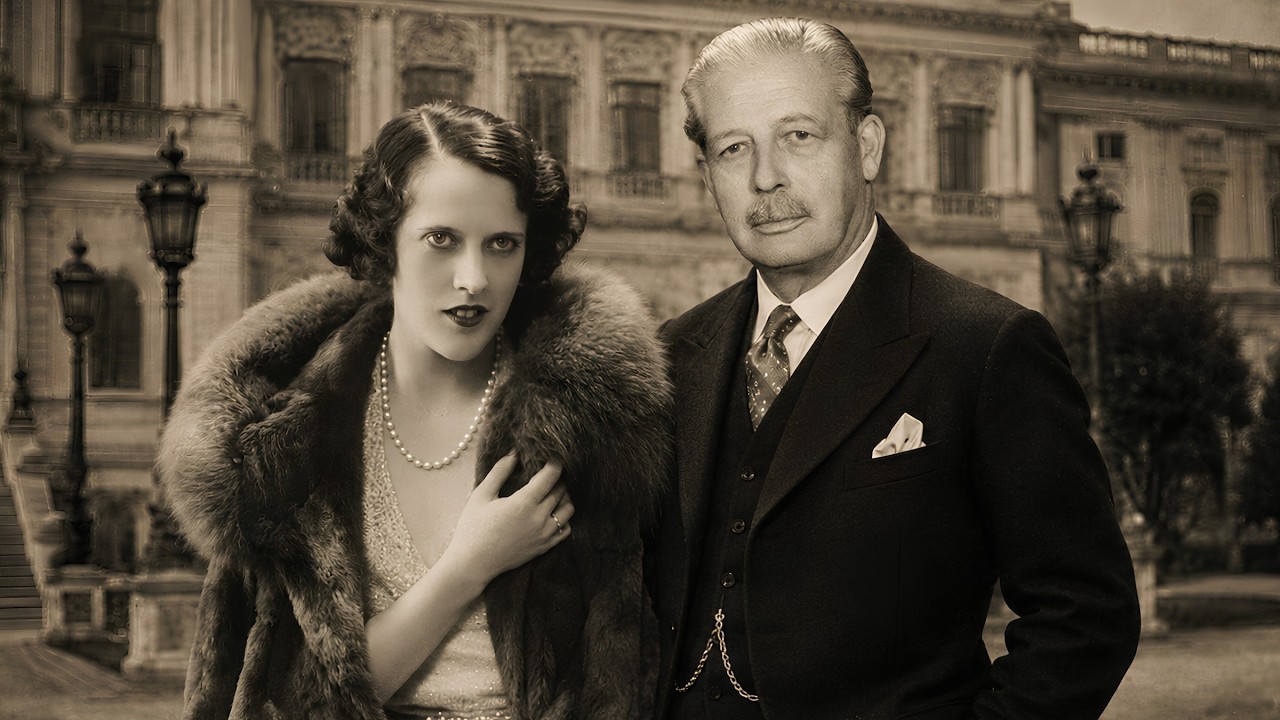
She did not die in a comfortable bed surrounded by weeping relatives. She died in motion, a restless spirit finally trapped at the house’s threshold. While the prime minister boldly declared to Britain that they had never had it so good, his wife had loved another man for nearly thirty years. He smiled victoriously from the podium while thousands cheered.
Behind that public triumph, his wife turned her back on him, staring silently out a foggy window. The nation reached peak prosperity under his guidance, yet his home was a frozen emotional tomb. The man capable of steering an empire through global storms was powerless to control his own marriage. Westminster knew the truth.
The press knew. He knew it perfectly well. Yet he never packed his bags. His wrinkled hand quietly picked up the discarded boot and placed it back in its original position, never to be moved again.
Dorothy Evelyn Cavendish did not own Chatsworth House. She was treated less as a private person than as another asset of the estate. Its gilded ceilings, oil paintings, private corridors, and vast grounds made any child born inside it feel small. The sheer scale of the estate, combined with the centuries-old weight of the Duke of Devonshire’s lineage, discouraged any individual ego or personal dreams.
She was trained to preserve the name, strengthen alliances, and pass the family’s position to the next generation. She was drilled in fluent French, precise German, aristocratic writing, and the art of absolute composure. Yet no one taught her what to do with emptiness. Hidden beneath the ivory exterior of a lady who always maintained stability was a restless, suffocating soul desperate for something real.
Dorothy lived inside a cage too large and too perfect. The boredom born from that perfection was dry ground waiting for a spark. That spark came in 1916, when a young officer stepped into the castle. Harold Macmillan was a wounded veteran of the Battle of the Somme, his right leg permanently damaged by shrapnel.
His limp contrasted sharply with the effortless movement around him. Despite an elite education at Balliol College and significant family wealth from publishing, he lacked a hereditary aristocratic title. He understood he could work inside those grand rooms but did not truly belong. For Harold, Dorothy represented the opposite of the psychological wounds he carried from war.
He stood mesmerized, watching her glide through the drawing room with effortless superiority. His quiet intellectualism and deep trauma collided with her brilliant unforced radiance. But his devotion extended beyond the woman herself. He worshiped the unyielding empire she balanced on her shoulders.
His affection for Dorothy intertwined completely with raw political ambition. She was not merely a beautiful companion; she was the ultimate passport guaranteeing his escape from outsider status. Their wedding was celebrated as the sensational event of the London season. Held at St Margaret’s Westminster, the congregation included royalty and the literary elite.
They merged ancient lineage with immense wealth, satisfying every standard for political advancement. On paper, it was calculated perfection. For nine years, Dorothy played the political wife with near flawless discipline. She campaigned, managed estates, and charmed voters.
But operating like a machine does not give a person the vitality to survive inside a suffocating cage. That perfectly oiled machine ran coldly until a disruptor arrived. Robert Boothby was not a calm man. He was loud, unrestrained, and unafraid.
His laughter dominated any room. He was a young member of Parliament, fiercely intelligent, and had served as private secretary to Winston Churchill. Many political observers hailed him as a guaranteed future prime minister. At a dinner party in Westminster in 1929, across a candlelit table, Dorothy’s quiet world was torn apart.
Their eyes locked. Boothby delivered a sharp, brazen joke that ignored every rule of polite society. For the first time, Dorothy encountered a man who saw straight through her boredom. She was drawn to the undisciplined energy her family had forbidden her from experiencing since birth.
That encounter opened a private confession. Dorothy asked Boothby why he had woken her up, and stated she never wanted to look at her family again. Boothby was not merely a convenient lover. He was a high-voltage shock that made her reject the obedient slumber of her designed existence.
They did not hide their connection in distant rooms. They transformed it into public display. Lingering glances passed between them at crowded weekend parties. They kept careful physical distance during walks, but that gap only revealed their intimacy more clearly.
Cabinet members, press hounds, and the Cavendish family all witnessed it. Harold saw through the facade almost immediately. His jaw muscle twitched as he stood nearby, holding a glass of wine while his wife smiled passionately at another man. He was never deceived.
His pain deepened precisely because he understood every detail. Yet he was bound by aristocratic dignity. He was forbidden from exploding in anger. He was forced to stand and watch his dignity stripped away in public.
Harold made a shocking, bitter choice. He decided he would never leave. He understood that in the ruthless environment of the Conservative Party, walking away meant signing his own political death warrant. His lawyer, Philip Frere, delivered the final blow.
In conservative Britain of the 1930s, a politician trapped in a public scandal involving his wife leaving with a colleague would be obliterated. In 1930, a fourth child named Sarah was born, bringing a cloud of toxic suspicion. She was conceived during the height of the public affair. Rumors that Robert Boothby might be Sarah’s biological father moved quietly through political and aristocratic circles.
Dorothy used this degrading suspicion as a weapon. During heated arguments, she did not soothe her husband. She weaponized the question of paternity to inflict severe psychological pain. Harold chose to block it out.
He buried the humiliation and the agonizing question deep within his chest, using administrative work to numb himself daily. The pressure found its way into his body. In 1931, his hands trembled so badly he could no longer hold a newspaper steady. He sank into an old armchair, trapped in severe physical exhaustion.
Decades later, when questioned about that dark period, he offered a chillingly brief response. He stated simply that it had physically drained him completely. From the ashes of that collapse, an armored politician was forged. Harold Macmillan’s famous unflappable persona was not a natural trait.
It was an iron mask cast from the humiliation endured in his private bedroom. Having lost his core dignity, he no longer feared any external pressure. But that armor could not shield him from the contempt of his wife’s family. At Chatsworth, Harold remained an unwanted guest.
The Cavendish family never respected his background. When the affair became public, they offered no support. They sneered at the climber who proved too weak to secure his wife’s affection. When home became inescapable, he sought refuge in war.
Amid the chaos of North Africa and Italy, Harold found a stage where his internal frost became a weapon. As resident minister, he handled chaotic negotiations under life-or-death pressure. His cold restraint made allies cautious and made enemies understand he would not break easily. A man already stripped of his heart could not be easily threatened.
In 1957, the black door of Number 10 Downing Street opened to welcome the victor. Before hundreds of flashing cameras, they transformed into the most powerful couple in the kingdom. Dorothy executed the role of first lady with flawless discipline. But the moment the door slammed shut, she yanked her arm away from her husband and walked toward the east wing, leaving Harold alone with slumped shoulders.
He held the authority to govern Britain, yet he was powerless to repair his own marriage. In July 1957, at a loud rally, he uttered a phrase that defined an era: most of our people have never had it so good. The nation entered a massive post-war consumer boom. He worked alongside President Kennedy and managed Cold War crises.
But the man uttering that promise lived in extreme emotional poverty. Millions enjoyed new luxury while their prime minister never experienced a single night of domestic happiness. In 1958, Harold signed a baffling decree. Without public outburst or visible jealousy, he recommended that the man long linked to Dorothy be raised to the House of Lords as Baron Boothby.
He justified it as recognition of long public service. Insiders understood the private layers beneath it. The scandal that finally weakened him came from another man’s secret. In 1963, Secretary of State for War John Profumo became entangled in an affair with Christine Keeler, raising security fears because of her connection to a Soviet naval attaché.
The core issue was the blatant lie told by a cabinet minister before Parliament. A man who had compressed his own secrets for three decades watched helplessly as his government fractured. In October 1963, Macmillan resigned amid a health scare and a collapsing political atmosphere. After leaving power, Harold withdrew into his study to write his memoirs.
Dorothy kept moving with frantic energy. On May 21, 1966, she busily prepared to attend a horse race. The 65-year-old woman bent over to force her foot into a tall riding boot. Her heart stopped at the moment she secured the first boot.
The second slipped from her grip and hit the floor. She collapsed, a motionless shadow stretched across the hallway before she could step through the open door. Harold displayed no shock upon his arrival. He stood rooted, staring at his wife lying cold on the floor.
She had managed the humiliation; her absence stripped away his defining purpose. He never remarried. For twenty years, those riding boots remained on the wooden floor. No servant was permitted to move them.
He preserved them because he never found a hole deep enough to bury the blind love threatening to swallow him every night. In 1970, the unresolved question around Sarah returned in the bleakest way. Sarah Macmillan died at forty after a troubled life, with alcoholism often linked by those close to her to the unresolved question of her parentage. Around 1975, two exhausted old men finally faced each other.
Harold, past eighty, looked at his lifelong enemy and quietly asked if Sarah was truly his biological daughter. According to later accounts, Boothby reassured him that she was. Whether this was truth or kindness remained part of the tragedy. In his memoirs, Harold revealed a chilling psychological truth.
He stated that when a man becomes prime minister, he must operate as an actor. His calculated artificiality was not cowardice. It was a survival skill. The mask he wore for decades eventually fused with his flesh, leaving only a freezing core.
He continued drifting like a ghost trapped entirely within a play he wrote and directed himself. Dorothy spent her life reaching for exits. She was abruptly awakened in 1929 and dedicated the next thirty-seven years to frantically avoiding the ruins she created. She died in the middle of preparing to leave.
Harold functioned as the permanent inmate, serving a lifelong sentence of staying behind. In the ruthless survival battle between blind love and personal pride, the victor suffers the most. The heavily dusted riding boots rested uselessly on the cracked wooden floor.






