On the morning of June 4, 1944, a 41-year-old engineer from Missouri named Albert David climbed down through the hatch of a dark, sinking German submarine. He carried a wrench and a flashlight, and he had less than five minutes before the U-boat—and everything inside it—would vanish forever into 3,000 meters of Atlantic water. What he found in the next four minutes helped end World War II. For the next thirty years, the most important part of what was recovered remained a secret.
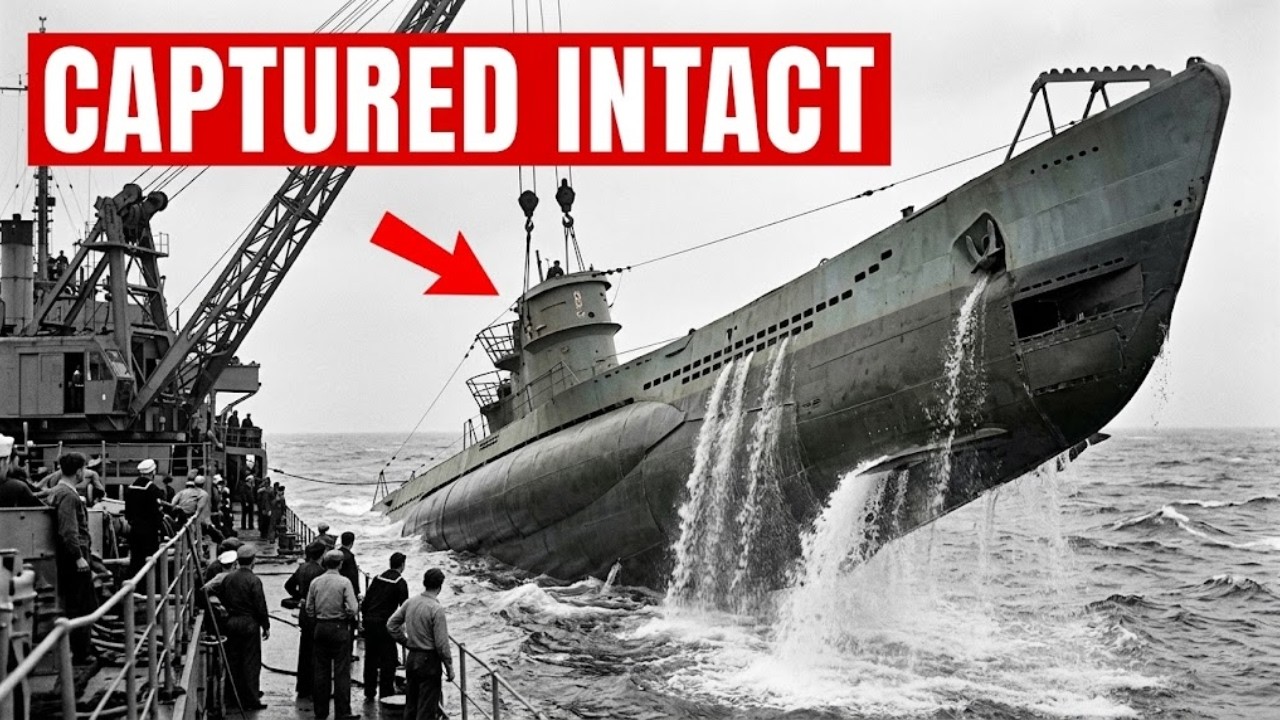
No American sailor had boarded and captured an enemy warship at sea since 1815, since the era of wooden ships and Andrew Jackson. This is the story of the only enemy warship the U. S. Navy captured at sea in the modern era, and the men who climbed aboard her, kept her afloat, and then went home and lied about it for the rest of their lives to save the invasion of Normandy.
Two months earlier, in April 1944, an American officer watched a German submarine sink in the North Atlantic and realized the U. S. Navy had been making the same mistake for 129 years. The officer was Captain Daniel Gallery, 42, commander of the escort carrier USS Guadalcanal.
On April 9, his task group cornered U-515, a U-boat commanded by Werner Henke, a captain who had sunk 25 Allied ships. Depth charges forced the submarine to the surface, where gunfire and rockets tore into her. Within minutes, she slid beneath the waves. Forty-four German sailors were pulled from the oil-stained water.
By any measure, it was a victory. But Gallery was not smiling. He had watched something: ten minutes. Ten minutes was how long U-515 floated on the surface before sinking.
Ten minutes in which the German crew opened sea valves, threw codebooks overboard, and set demolition charges. Ten minutes in which every secret aboard bled into the Atlantic. Gallery realized those ten minutes were more than enough—enough to board, enough to seize, enough to change the war. That night, in his cabin, he wrote in his private diary that the Allies had spent years trying to crack the German Navy’s codes.
One intact submarine could supply an Enigma machine, codebooks, settings, and technical drawings of acoustic torpedoes. It could decrypt every U-boat transmission in the Atlantic. It could save thousands of lives. And nobody was even trying.
There was a good reason why not. German submarine crews were trained to destroy their boats. From the moment a U-boat surfaced under attack, a captain had less than five minutes to complete a scuttling so thorough that nothing usable remained. Sea valves were opened, demolition charges set, codebooks weighted and thrown overboard, Enigma machines smashed.
The crew preferred drowning to letting their boat fall into enemy hands. In 1943 alone, German U-boats had sunk more than 300 Allied merchant ships. The Battle of the Atlantic still hung in the balance. Every American destroyer escort was built and drilled to one equation: find the submarine, destroy it, without hesitation.
Gallery was about to order his men to hesitate. The order went out to Task Group 22, three ships days from returning to Norfolk. Every ship in the group—Pillsbury, Flaherty, Chatelain, Jenks, Pope, every destroyer escort—would train boarding parties. They were to jump onto a captured enemy submarine and keep her from sinking.
They had six weeks. On USS Pillsbury, Lieutenant Commander George Casselman gathered his officers and explained what Gallery wanted. Silence. Then he asked for volunteers.
The man who stepped forward was an engineer, 41 years old, named Albert David. He had joined the Navy in 1919 and spent 25 years rising from enlisted seaman to lieutenant. He had never boarded an enemy ship or led men in combat. His specialty was engineering—pipes, valves, and how ships stay afloat despite desperate attempts to sink them.
Casselman chose eight more men, all technicians: torpedo specialists, a radioman who could read German operational codes, an engine mechanic who could identify a sea-water strainer valve in the dark. The boarding party began training on Pillsbury’s fantail days after leaving Norfolk. They practiced jumping from a whaleboat onto a deck moving at six knots. They memorized the internal layout of a U-boat from poor-quality intelligence photos and captured drawings.
They rehearsed the exact sequence for the first sixty seconds after dropping through the conning tower hatch. The challenges were immense. A German submarine surfaced under enemy fire would circle, her rudder jammed from depth-charge damage. The deck would be slick with fuel oil.
German sailors might still be aboard, armed and desperate. Somewhere below, in the dark, thirteen or more demolition charges would be ticking. David estimated they had three to five minutes from the moment they touched the hull until the submarine sank, taking them with her. Their tools were absurdly primitive: wrenches, flashlights, pistols.
That was all. Across the Atlantic, another man was preparing for the same confrontation without knowing it. His name was Harald Lange, 40, and he commanded a U-boat his crew called the jinxed boat. U-505 had been at war since 1941, a Type IXC long-range submarine 250 feet long.
She had sunk eight ships in her first patrols and earned a terrible reputation. After one attack shredded her pressure hull, her crew whispered and her officers scowled. Then came the night of October 24, 1943. Off West Africa, British aircraft depth-charged her for hours.
Inside, her captain, Peter Zschech, broke under the pressure of command. In front of his officers and crew, he drew his pistol, placed it to his head, and fired. He was 25 years old. No U-boat commander had ever done such a thing.
The executive officer brought U-505 back to Lorient. The crew was redistributed, new men came aboard, and Harald Lange took command of the boat everyone in the U-boat arm called the jinxed ship. On May 15, 1944, Task Group 22. 3 sailed from Norfolk on what was officially logged as a routine anti-submarine patrol.
Guadalcanal led the group, with Pillsbury, Chatelain, Flaherty, Jenks, and Pope. Albert David and his eight men drilled daily for six weeks, memorizing every valve, every hatch, every wire. Still, none of them knew if any of it would work. The group headed south toward the Cape Verde Islands.
Wildcat and Avenger aircraft flew continuous patrols; sonar operators listened. Days passed. The Atlantic gave up nothing. On the evening of June 3, Gallery received a fuel report.
Guadalcanal’s tanks were low, as were the destroyer escorts’. The group could not stay at sea longer without refueling. Gallery ordered a course change. They would cut the patrol short and head to Casablanca.
The mission was effectively over. That night, Albert David went to sleep in his cabin aboard Pillsbury, thinking the six weeks of training had come to nothing. He was wrong. 150 miles to the southeast, in the deep water off Cape Blanco, a German submarine was slowly making her way back to Lorient.
U-505. Her captain, Harald Lange, was in his bunk. Her radio operator was listening to shipping frequencies. Her hydrophone operator listened to the sea.
Dawn broke slowly on Sunday, June 4, 1944. The Atlantic was flat and gray. Cruising east now on Gallery’s new course, the task group was two days from Casablanca. The mission was nearly over.
Gallery drank his coffee and said little. He had made the decision to end the patrol himself. Yet something inside him would not settle. He had spent six weeks preparing his men for a moment that had never come.
At 11:09, the sonar operator on USS Chatelain reported a contact at 800 yards. Lieutenant Commander Dudley Knox did not hesitate. He turned hard to starboard and increased speed. Overhead, two FM-2 Wildcats from Guadalcanal spotted the dark shape moving beneath the surface.
They dove and opened fire, stitching a line of white spray directly at the U-boat below. Aboard U-505, the hydrophone operator heard the screws. He passed the report up the ladder. Thirty seconds decided everything.
Lange had two choices: dive deep, run silent, try to escape—or turn and fire torpedoes. He chose to dive. He gave the order. The boat began to sink.
It was too late. At 11:16, Chatelain dropped the first pattern of depth charges. The explosions rolled, one after another, each closer than the last. Lights went out.
Glass shattered in the control room. Sea water sprayed through a fractured bulkhead. The boat listed hard. The rudder jammed.
U-505 stopped responding to her helm, turning right on her own in a slow, uncontrolled circle while her depth gauge rose. Water leaked steadily. At 11:22, six and a half minutes after the first depth charge, Lange gave the order to blow all tanks and surface. U-505 broke the Atlantic 700 yards from Chatelain, bow first, gray and scarred with rust.
Lange climbed the ladder and opened the hatch. A machine-gun bullet from Chatelain struck him in the thigh. Another hit his side. He fell against the coaming, blood running across the deck plates.
He gave his last order as captain of U-505: abandon ship. Fifty-eight men poured through the conning tower hatch. Some helped Lange, pulling him toward the deck. Others ran for the deck gun, but American fire drove them back.
A German sailor fell dead trying to man the 20mm gun. The rest jumped over the side and swam away from the U-boat, away from the American ships, away from a war that had just ended for them. But not everyone came out. That was something the Americans did not yet know.
On Pillsbury, Casselman watched the German submarine turning in the water and gave the order he had waited six weeks to give: lower the whaleboat. David and his eight men were already at the rail, stationed there since the first depth charge fell. They jumped into the small wooden boat with their wrenches, flashlights, and pistols. The coxswain aimed directly at the circling submarine’s path.
David reached for the side, grabbed the rail, and pulled himself onto the deck of an enemy warship for the first time in his life. His men followed. A dead German sailor lay face-down near the conning tower hatch. David stepped over the body.
He climbed the hatch and looked down into darkness. Red emergency lights glowed somewhere below. He dropped through. The control room was tilted.
Water sprayed from a broken pipe, and somewhere below, in the engine rooms, he heard the low roar of the sea. The sea-water drainage valves were open. The Germans had done exactly what they were trained to do. Before they left, one of them had opened a sea-water strainer cover in the engine room.
A hole the size of a man’s fist. Sea water was pouring through it, and the boat was settling by the stern. The men spread out. Zenon Lukosius, a 25-year-old engine mechanic from Chicago, the son of Lithuanian immigrants, climbed down toward the engine room, wading through water up to his knees in dim red light.
He knew what a sea-water strainer looked like with its cover removed. He found it in under two minutes. The heavy brass cover, twenty pounds of machined metal, lay on the deck plates a few feet from the open pipe. The Germans had thrown it aside as they fled.
Lukosius picked it up, carried it back to the opening, seated it on the threads, and turned. Water sprayed over his hands and arms. The threads bit. The cover seated.
The water stopped. He stood in the dark, gasping, salt water running down his face, realizing that in that moment he had saved a submarine. While Lukosius worked, David swept through the rest of the boat with his flashlight, hunting demolition charges. The Germans had been thorough.
There were thirteen of them: in the forward torpedo room, the control room, the aft engine rooms, the radio room. Small charges wired to timers. Some timers were running. David and his men traced wires with their flashlights, pulled primers, cut leads, lifted charges from hidden corners, and piled them in the control room like unexploded ordnance.
Aboard U-505, a new danger was forming. The submarine was still moving. Her engines were dead. Her batteries were nearly exhausted.
But momentum carried her forward in that slow turn to starboard, her jammed rudder holding her course. Her path was taking her directly toward the American destroyer escort Pillsbury. Casselman saw the U-boat coming. He ordered engines ahead and a hard turn to port.
Pillsbury sheered aside, but not far enough. The bow of U-505 struck Pillsbury’s port side just aft of midships. The submarine’s hull, thick with steel and diesel, ground against the thin plates of the destroyer escort. Metal screamed.
Rivets popped. The wooden whaleboat that had carried David’s team was crushed between the two hulls and vanished. Three of Pillsbury’s compartments began flooding. Damage control parties rushed to their stations.
Casselman held his ship on course, refusing to abandon the moment, because David and his men were still aboard the submarine. Two minutes. Two minutes was all the time they had left. If the whaleboat had launched late, if the coxswain had missed the ship, if Lukosius had needed one more minute to find the strainer cover, they would have been trapped inside a sinking submarine in pitch darkness, and no one would have survived.
At 11:30, a second boarding party arrived from Guadalcanal, led by Lieutenant Earl Trosino, the carrier’s chief engineer. He climbed down into the control room, found David and his men still working, and passed them on his way to the engine rooms. The submarine was stable now—not sinking, but not floating. She was suspended between surface and depth, weighted by hundreds of tons of water already flooding the stern compartments.
Trosino worked for hours, crawling through flooded compartments on his hands and knees, tracing pipes by touch in black, oily floodwater. He identified the pumps that still worked, rigged temporary connections between compartments, and redirected water from where it would sink the boat to where it could be pumped out. On the surface, the rescue changed the entire group’s mission. Guadalcanal rigged a towline from her stern to the submarine’s bow.
An escort carrier, designed to launch aircraft, now tried to drag a captured enemy submarine across the Atlantic under her own power. The towline snapped twice. It was rigged again. Rescue parties shuttled between Guadalcanal and U-505 in whaleboats.
In the radio room, one of David’s men found the box. Wooden, latched, heavier than it looked. Inside, in a padded frame, sat an Enigma M4 cipher machine. Four rotors, fully assembled and ready for use.
The rotors were still set to the daily cipher key. Below it, in a drawer, lay codebooks, the short-signal book, the officer and petty officer lists, weather ciphers, and charts showing U-boat patrol areas across the entire Atlantic. Nine hundred pounds of secret German naval documents. In the forward torpedo room, when the boarding parties opened the racks, they found something else: two T5 acoustic torpedoes.
The Allies had heard rumors of these weapons for over a year. Torpedoes that needed no aiming. Torpedoes that listened. Torpedoes that tracked the sound of an Allied warship’s propeller cavitation, hunted the sound to its source, and exploded.
Escort ships had been dying to them for months. No one on the Allied side had ever seen one intact. Now the Americans had two. Then came the message from Washington.
Gallery received it on Guadalcanal’s flag bridge. He read it once, then twice, and handed it to his executive officer without a word. The plan had been Casablanca—tow the submarine to the nearest friendly port, get her out of sight. The message said no.
Not Casablanca. Bermuda, 2,500 miles across the open Atlantic. Gallery folded the message and looked at U-505, wallowing low by the stern. Because in 48 hours, 150,000 men would begin boarding landing craft off the coast of Normandy.
The invasion was scheduled for dawn the next day, June 5; bad weather in the Channel would delay it one day. If the Germans learned U-505 had been captured intact, they would change every code in the naval communications system within 48 hours. Every intercepted transmission would stop. Every convoy would lose its warning.
Every U-boat would vanish from the plotting boards at Bletchley Park, and the men landing on Normandy’s beaches would go in blind. Gallery issued three orders: no radio communications about the capture; no entries in ship logs; no man in Task Group 22 was to speak of U-505 by name, to anyone, for any reason. Three thousand American sailors had witnessed the impossible. Three thousand American sailors would spend the next year pretending nothing had happened.
The tow began that afternoon. Guadalcanal, still running on her own power, dragged U-505 through seas that grew heavier with each hour. The submarine rolled. Water seeped through her damaged compartments.
The towline snapped and was reconnected. For fifteen days the ships crawled north and west across the Atlantic, dragging a wounded enemy that refused to die. A fleet tug, USS Abnaki, eventually took over the tow. Storms threatened to sink the submarine.
Rescue parties remained aboard around the clock, watching leaks, running pumps, sleeping in bunks that until recently had belonged to a German crew. On June 19, 1944, Task Group 22 entered Port Royal Bay, Bermuda. U-505 was towed to a remote corner of the naval base, moved into a covered drydock, and American crews began painting over her German markings, giving her the cover name USS Nemo—nobody. The 58 German prisoners, including the wounded Harald Lange, were taken by train under cover of darkness to Camp Ruston in the pine forests of northern Louisiana.
Their barracks were isolated, the barbed wire doubled, the mail forbidden. When an International Red Cross delegation arrived that summer, they were denied entry. This had never happened before. The Geneva Convention was clear: every prisoner of war has the right to communicate with family through the Red Cross.
Germany’s Kriegsmarine sent letters to 58 families: your son is missing. Your husband is missing. Your father is missing, presumed drowned at sea. U-505’s last routine transmission had put her off West Africa; after June 4, contact was lost, and Admiral Karl Dönitz assumed she had gone down like so many others.
German widows lit candles for men eating American rations behind barbed wire in Louisiana. German children grew up believing their fathers were bones at the bottom of the sea. It continued until 1947, two years after the war ended, when the U. S.
government finally allowed the men of U-505 to write home. By then, some of the women who received those letters had remarried. Some children did not remember their fathers. Some fathers did not want to return.
Admiral Ernest King, Commander in Chief of the U. S. Fleet, read Gallery’s report once and sat in silence for a long time. The intelligence haul was exceptional: two intact Enigma machines, 900 pages of codebooks, two acoustic torpedoes.
It would go to OP-20-G, the Navy’s cryptologic center in Washington, and from there to Bletchley Park. It would decrypt German naval communications throughout the summer of 1944 and beyond. It would save ships. It would save lives.
But King also understood something else. The risk had been enormous. If the boarding had failed, if a single German prisoner had talked, if one careless American sailor had written home, the Kriegsmarine would have changed its codes within 48 hours, Bletchley Park would have gone dark, and the Normandy invasion, launched 48 hours after the capture, might have unfolded in ways no one wanted to imagine. In a private conversation that never appeared in any official record, King made his position clear: this would never happen again—not without permission, not without approval from the high command.
Daniel Gallery had captured a submarine and helped win a war, and his commander-in-chief told him he had nearly wrecked everything. Gallery accepted the Legion of Merit without complaint. He did not argue. He also did not apologize.
By autumn 1944, the intelligence from U-505 was flowing into the Allied war machine. At Bletchley Park, British codebreakers combined the captured German settings with their own decryption work to produce a picture of the Atlantic the Allies had never seen: U-boat patrol areas, rendezvous points, supply routes, planned convoy attacks days in advance. The German U-boat fleet began to wither. In the Naval Ordnance Laboratory in Washington, engineers disassembled the two T5 acoustic torpedoes, studied the hydrophones, analyzed the electronics, and understood for the first time precisely what the German weapon heard and how it heard it.
The Allies already had a countermeasure in use: a simple device of two steel bars mounted in a frame, towed hundreds of yards behind a warship. As the ship moved, the bars vibrated in the water, producing a loud grinding sound that drowned out the ship’s propeller noise. But the noisemakers had been built on guesswork and scattered intelligence. Now there was accuracy to match.
Within months, the noisemakers were refined and redistributed across the fleet. When a T5 came hunting for the loudest cavitation in the water, it found not the ship but the noisemaker, exploding in empty sea hundreds of yards off the stern. German torpedo officers reported failures at extraordinary rates. Dönitz never connected them to U-505.
In April 1945, in the last month of the war in Europe, Allied intelligence detected a group of German U-boats moving west across the North Atlantic, toward the American coast. Intentions unknown. One word began to circulate in Washington: rockets. V-1 flying bombs had killed thousands of British civilians in the summer of 1944.
V-2 ballistic missiles had killed thousands more. Rumors had spread for months of German plans to adapt these weapons for launch from submerged submarines. A U-boat could surface 160 kilometers off New York, fire a V-2, and vanish before the missile struck. American intelligence could not confirm the threat, and could not rule it out.
The Navy called the operation Operation Teardrop. Two barrier forces were formed. USS Frederick C. Davis, a destroyer escort of the same class as Pillsbury, was on patrol 650 miles northwest of the Azores on the morning of April 24, 1945.
At 8:29, the sonar operator reported a contact. At 8:39, an acoustic torpedo from U-546 struck her port side and exploded in her forward engine room. Frederick C. Davis broke in two.
Her bow section sank within minutes. As her stern went under, her own depth charges exploded beneath the sea, killing men who had just jumped into the water. Survivors clung to wreckage in shark-infested water for up to four hours before rescue ships arrived. 115 men died.
77 were pulled from the water alive. U-546 did not survive. Nine American ships surrounded the site, including Pillsbury. For ten hours they hunted the U-boat, dropping depth charges.
At 7:43 that evening, low on batteries and unable to escape, U-546 blew her tanks and surfaced. She fired two torpedoes at Flaherty, which missed. American guns opened fire, the German crew abandoned ship, and 33 survivors were pulled from the water, including her captain, Paul Just. Questioned for days, Just gave the answer the Americans did not want and did not believe: there were no rockets.
There never had been. The V-weapon threat that had driven Operation Teardrop, the fear that had kept the Roosevelt administration up at night, had never existed. The Germans had considered it, drawn plans, and never done it. Germany surrendered on May 8, 1945.
Pillsbury escorted U-858 from the mid-Atlantic to Cape May, New Jersey, with a prize crew aboard. The war in the Atlantic was over. Task Group 22 received the Presidential Unit Citation for the capture of U-505. Albert David’s boarding party earned two Navy Crosses and six Silver Stars.
Zenon Lukosius returned to Chicago and resumed such an ordinary life that his neighbors would not know for decades what he had done in the war. Albert David was awarded the Medal of Honor, the only one given to a sailor in the entire Atlantic Theater of World War II. He did not live to receive it. On September 17, 1945, three weeks before the White House ceremony, Lieutenant Albert Leroy David died of a heart attack.
He was 43 years old. His widow went to Washington in his place; President Harry Truman placed the medal in her hands. A destroyer escort, USS Albert David, was later commissioned in his honor and served from 1968 to 1990. U-505 was slated to be sunk as a target.
But Rear Admiral Daniel Gallery had a different idea. He contacted the Museum of Science and Industry in his hometown of Chicago and proposed bringing the submarine inland as a permanent memorial to the men who fought the Battle of the Atlantic. The museum agreed. In 1954, engineers floated U-505 along the Atlantic coast, across the Gulf of Mexico, up the Mississippi River, through the Great Lakes, and finally over the streets of Chicago on specially designed rollers, 750 tons of steel moving through American cities at walking speed.
On September 25, 1954, Admiral William Halsey dedicated U-505 as a permanent war memorial. She sat outdoors for fifty years, climbed through by millions of visitors. In 2004, she was moved into a climate-controlled underground exhibit hall where salt can no longer corrode her hull. Albert David’s Medal of Honor is displayed beside her, along with the Enigma machines, the codebooks, and the acoustic torpedoes.
She is the only German submarine on American soil. She is the only enemy warship captured by the U. S. Navy at sea since 1815.
And she rests in Chicago, more than 70 years now, while every day hundreds of visitors walk through her compartments, most not knowing that on the morning of June 4, 1944, she nearly carried all her secrets to the bottom of the Atlantic in two minutes. The men of Task Group 22 kept the secret because keeping it saved lives. Some carried it to their graves without ever telling their wives what they had seen. But the submarine still stands.
And sometimes, on a quiet weekday afternoon in Chicago, an old man in a windbreaker walks slowly through the exhibit hall, stops before a display case, and stands there a long time without touching anything or speaking a word. Then he leaves. He knows. He remembers.
That is why the story has endured: because ordinary men, on an ordinary Sunday morning in June, did something extraordinary, then went home and remained silent about it. The Atlantic never forgets.






