The tombs of England’s medieval kings were meant to be final, sacred resting places. Yet over the centuries, many were broken into, opened, and examined for reasons ranging from grave robbery to the search for historical truth. What lay inside the coffins was sometimes shocking. Rotten remains were found still wearing crowns.
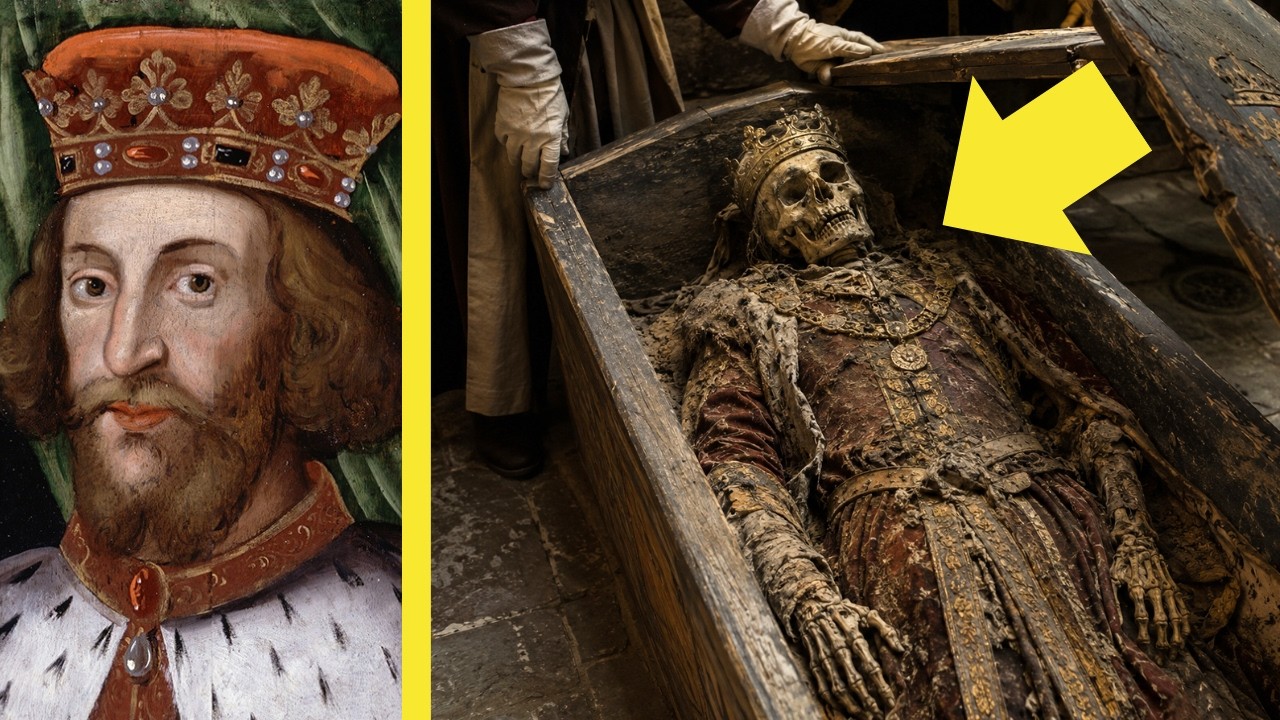
But the discoveries also answered questions that had haunted historians for centuries, revealing the brutal deaths of kings and the strange fates of their bodies after burial. Richard III was crowned on July 6, 1483, inside Westminster Abbey, at a time when the Wars of the Roses had torn England apart for decades. He was a king who had publicly denounced the Princes in the Tower. His nephews, one of whom was the rightful king, Edward V, had disappeared while held inside the Tower of London awaiting coronation.
Many believed Richard, who had seized the throne, was responsible for their murder. In August 1485, Henry Tudor met Richard III at the Battle of Bosworth, one of the final battles of the Wars of the Roses between the houses of York and Lancaster. Richard commanded a much larger army, but Lord Stanley, who led six thousand men, watched the battle from the sidelines. His support would change the course of English history.
Stanley withdrew his support from Richard and sided with his stepson, Henry Tudor, whose forces fought the final part of the battle. In the last minutes of the fighting, Richard III allegedly fought in the thickest ranks of his enemies and died a courageous death. His men smelled victory and wanted to end the battle by facing Henry Tudor himself. The king and a number of his men charged toward Henry, who was guarded by personal protectors.
Richard, a skilled military commander, cut his way through Henry’s guards and killed Tudor’s standard bearer with his own hand. He was fighting fiercely, but at some point, in a muddy, marshy field, Richard was knocked from his horse and became stuck. It was claimed he came within a sword’s stroke of his enemy, Henry Tudor. But then Richard found himself surrounded by the forces of Lord Stanley.
His horse was trapped in the mud, and it was said that a Welshman delivered the fatal blow with a war axe while Richard’s horse was stuck. The blow was so violent that the king’s helmet was driven into his skull. The man credited with killing Richard III was a Welshman named Rhys ap Thomas, who scraped part of the king’s skull when he struck him with his weapon. Richard reportedly fought with great valor, falling in the field with numerous fatal wounds, his head beaten until his brain came out with the blood.
They did not leave him until he was dead. After the battle, Richard’s body was stripped and paraded through the streets of Leicester, where it was displayed for several days. For Henry VII, it was important that the people of England saw the dead king’s body. But after the display, Richard’s remains were hastily buried inside the friary of the Franciscan monks in Leicester.
In 1495, Henry VII ordered a marble monument to mark Richard’s burial site, but the friary was later demolished during the dissolution of the monasteries. For centuries, rumors swirled about what happened to Richard’s remains, including a strong claim that they were thrown into the River Soar in Leicester. Plaques were even placed around the city marking the spots where his remains were supposedly thrown from bridges. That was not true.
In 2013, one of the discoveries of the century was made. The former site of the Franciscan friary was identified beneath a car park belonging to Leicester’s city council building. Astonishingly, a skeleton bearing battle wounds was found. DNA testing eventually confirmed that the skeleton belonged to King Richard III, more than five hundred years after his death.
The discovery revealed the violent death the king suffered on the battlefield and allowed historians to reconstruct the true story. Richard had suffered eleven wounds, eight of them to his skull. He was attacked by more than one person using different weapons. He had a V-shaped wound on the lower right of his jaw and a wound to his face from a knife or dagger.
His body was well protected by his armor, with few wounds to his torso, meaning he was wearing it when killed. The fatal wound was at the base of the skull, a massive injury caused by a very powerful weapon, such as a war axe or a long polearm, which hit Richard in the side of the head and shattered his neck vertebrae. It penetrated his brain and would have paralyzed him instantly. This was likely the blow delivered by the Welshman with his weapon.
After losing his horse and falling into the mud, Richard had become exposed. His enemies surrounded him, and the final strike killed him, ending the Plantagenet dynasty. Richard was buried in a simple coffin. Over the centuries, the coffin rotted away, and only his skeletal remains were left in the ground.
Richard’s death marked the beginning of the Tudor dynasty. Henry VII was not meant to become king. Born in 1457 at Pembroke Castle in Wales, he spent much of his youth in hiding or exile while the Wars of the Roses raged. When he took the throne from Richard III at Bosworth in 1485, Henry was the last remaining Lancastrian heir.
His victory ended decades of civil war. In the twenty-four years that followed, Henry rebuilt England from chaos. He restored order, strengthened royal authority, and reformed crown finances. He married Elizabeth of York, uniting the two warring families and creating an image of stability.
But that stability came at a personal cost. Henry remained cautious, secretive, and suspicious until the end. His reign was marked by strict control, heavy taxation, and distrust of those around him. Henry’s decline began in February 1503 when his beloved wife, Elizabeth of York, died shortly after giving birth to a daughter who also did not survive.
Elizabeth was the only person able to soften Henry’s coldness. Her death devastated him. According to one account, he shut himself away for days, refusing to eat or speak. After her death, Henry became a different man.
He withdrew from court life, lost interest in ceremonies, and grew increasingly ill and depressed. His health deteriorated, and his suspicious nature deepened. In his final years, he suffered from what historians called pulmonary consumption, likely tuberculosis or chronic bronchitis. He became thin, pale, and constantly exhausted.
He trusted only a few advisers and grew more paranoid about plots and betrayal. Even in illness, Henry never gave up his obsession with money and control, using agents like Edmund Dudley and Richard Empson to extract money from nobles and merchants. This earned him a reputation for greed. By early 1509, it was clear the king was failing.
He was fifty-two, considered old age in the early sixteenth century. He suffered from a chronic cough, loss of vision, and most of his teeth had blackened. He withdrew to Richmond Palace, his favorite residence by the Thames. In his last months, he was concerned with ensuring his son, the future Henry VIII, would inherit a stable crown.
He arranged his finances, reviewed his will, and ordered generous religious endowments for the salvation of his soul, hoping prayers would ease his passage through purgatory. He also released some prisoners and canceled some fines, showing his awareness of his sins. He made plans to be buried beside his wife Elizabeth in Westminster Abbey under a magnificent marble tomb commissioned from the Italian sculptor Pietro Torrigiano. On April 21, 1509, King Henry VII died peacefully in his bed at Richmond Palace, surrounded by clergy and servants.
He had confessed his sins and received the last rites. He had been unable to eat and struggled for breath, his mind fixed on the afterlife. Immediately after his death, royal physicians began the embalming of the first Tudor king. They opened his chest and removed his heart, liver, and other internal organs.
The organs were placed in a lead-lined container. His body was washed with perfumes and prepared in a lead-lined coffin, wrapped in a thick waxed cloth to protect the remains. Henry VII was buried in the royal vault in the Lady Chapel of Westminster Abbey beside his wife, Elizabeth of York. The vault was opened several times over the years.
After the death of the last Tudor monarch, Elizabeth I, her coffin was placed there for years before being moved. Later, the coffin of James I, the first Stuart king, was also placed inside the vault. The man who opened the vault claimed that the coffins were in very good condition, though a deadly cold filled the vault. Henry and Elizabeth’s coffins were lined with lead, and the wooden casing had been removed to fit James inside.
Given these conditions, it is highly likely that the remains of Henry VIII’s father were well preserved, and his body may still be intact today thanks to the lead-lined coffin and waxed cloth protecting them, five hundred years after his death. Edward I was born in 1239, the son of King Henry III and Eleanor of Provence. His character was shaped by wars, rebellions, and political conflict from an early age. He fought against his father’s enemies during the Barons’ War and gained a reputation for ruthlessness and determination.
When he became king in 1272, England was relatively calm, but Edward soon set about strengthening royal power, reforming the legal system, and expanding England’s dominion. His conquest of Wales between 1277 and 1283 was one of his greatest achievements, crushing the native Welsh princes and building massive stone castles to secure English control. After subduing Wales, Edward turned north to Scotland. His ambition to control all of Britain would eventually lead to his death.
The Scottish crisis began in 1290 when the death of the young queen Margaret left Scotland without a clear heir. The Scots asked Edward to arbitrate between the claimants to the throne, expecting a neutral judge. Instead, Edward declared himself overlord of Scotland and installed John Balliol as a compliant king. When Balliol rebelled, Edward invaded Scotland in 1296, seized Berwick, massacred its inhabitants, and took the Stone of Destiny, the ancient symbol of Scottish kingship, to Westminster Abbey.
But English dominance did not last. In 1297, the Scots rose again under William Wallace, whose stunning victory at Stirling Bridge humiliated Edward. Edward responded by crushing Wallace at Falkirk in 1298. Wallace was later captured and executed, but rebellion continued.
By the early fourteenth century, a new Scottish leader emerged: Robert the Bruce, who crowned himself king in 1306 after killing his rival John Comyn in a church. Edward was furious, declared Bruce an outlaw, and marched north again to destroy him. By 1306, Edward was sixty-seven, an advanced age for a medieval king who had spent his life on horseback and in military campaigns. In the spring of 1307, Edward set out from London, traveling slowly north.
His health was failing. He suffered from chronic dysentery and exhaustion, no longer able to ride his horse for long periods. His attendants had to help him into the saddle. But Edward refused to stop.
The chronicler Walter of Guisborough described how the old king burned with rage against the treacherous Scots and swore he would not return to England until he had destroyed Robert the Bruce. Edward even vowed that his bones would be carried into Scotland after his death so he could continue to terrify his enemies from beyond the grave. By early July 1307, Edward’s army reached Burgh by Sands, a small coastal village near Carlisle on the Scottish border. The king was gravely ill, barely able to eat, too weak to mount his horse.
On July 6, 1307, Edward I died at Burgh by Sands. The exact cause is uncertain, though most accounts point to dysentery. He was seventy years old. According to the chroniclers, the king was sitting upright in his tent trying to eat when he suddenly collapsed into the arms of his attendant.
His death came as his army prepared to invade Scotland. Legend says Edward’s final wish was that his heart be taken on a crusade to the Holy Land and his bones carried at the head of his army into Scotland, so that even in death he would be a terror to his enemies. Neither wish was fulfilled. When news of the king’s death reached Robert the Bruce, it was said he remarked with relief that the fox who had long sought to trap him was finally dead.
Edward’s body was taken south to Waltham Abbey in Essex before being moved to London. His funeral was held at Westminster Abbey on October 27, 1307, and he was buried in a simple Purbeck marble tomb under the inscription: “Edwardus Primus, Scottorum Malleus, pactum serva,” meaning “Edward I, Hammer of the Scots, keep the vow. ” Unlike many medieval kings, Edward’s tomb was left largely undecorated. He had ordered it to remain simple.
In 1774, more than four hundred years after his death, Edward I’s tomb was opened. What was found inside was remarkable. Those who opened the tomb claimed that when the lid was lifted, the royal body was found wrapped in thick, strong linen coated with wax on the inside. The body was still dressed in rich clothing.
The head and face were covered with a piece of crimson cloth folded into three layers. Above the waxed cloth was a robe of embroidered red silk, and over that a mantle of thick white fabric. The royal body was covered with rich crimson satin, fastened at the left shoulder with a magnificent gilded metal clasp decorated with gems and pearls. In the king’s right hand was a scepter with a cross, and in his left a rod topped with a dove.
On his head was a crown decorated with gilded metal plates. The body of Edward I had remained in astonishing condition more than four centuries after his death, so well preserved that his face was recognizable and skin remained on his face and body. The medieval embalming techniques had been remarkably effective. Today, Edward I still lies in Westminster Abbey in his relatively simple tomb.
No effigy was made for the king, but inside the tomb, the king remained intact for nearly five hundred years.






