She knew before she walked down the aisle that she was marrying the wrong man for the right reasons. The world would never understand that distinction, and in the autumn of 1968, it did not try to. The announcement that Jacqueline Kennedy, the most admired widow in America, the woman who had walked behind her husband’s casket with a composure that held an entire country together, was marrying Aristotle Socrates Onassis, a short, leathery sixty-two-year-old Greek shipping magnate who collected famous women the way he collected tankers, landed like a detonation. The response was immediate, specific, and almost uniformly negative.
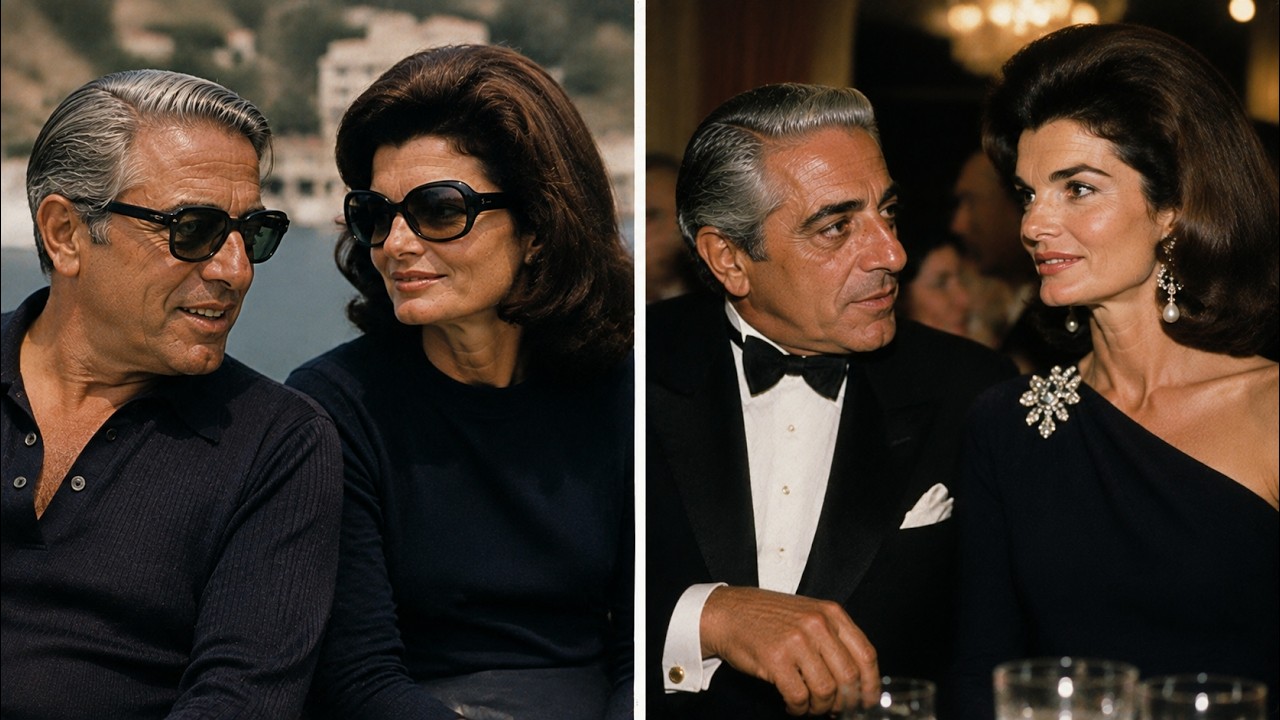
How could she? What was she doing? What had happened to the eternal widow, the keeper of the flame? What had happened was that she was thirty-nine years old and had been living in acute fear since June of 1968, when Robert Kennedy was shot dead in a Los Angeles hotel kitchen.
And Aristotle Onassis possessed something that nothing else in her life was providing: the specific and practical combination of limitless resources, a private island, a private security apparatus, and a complete remove from the American political world that had killed two people she loved. The marriage was not a love story in any conventional sense. It was something more complicated, more honest, and more interesting than the love story the world had wanted her to live. These are the facts of what the marriage actually was.
She had known him since the early 1960s. The public received the engagement as the product of that particular year’s circumstances, as if two strangers had been thrown together by the chaos of 1968. The reality was older and more layered. Onassis had moved in the orbit of the Kennedy social world for years, part of the network of wealthy and powerful figures who circulated through the same international spheres as the Kennedy political apparatus.
She had met him before Dallas. In the years after the assassination, both Jackie and her sister Lee Radziwill had spent time aboard the Christina, Onassis’s converted Canadian naval frigate that served as his private yacht. The closeness between Jackie and Onassis had developed quietly across those years, in the way she managed everything that was genuinely hers: privately. When the engagement was announced in October 1968, the world received him as a stranger because the relationship had been building for years in the dark.
The primary motivation for the marriage was fear, and she said so to the people she trusted most. Her private account was more direct and more honest than anything the marriage produced publicly. She was afraid, with the specific and rational fear of a woman who had watched two Kennedy brothers killed by gunfire in American public spaces within five years, who had been receiving death threats, who was raising two children she was terrified for in the country that had demonstrated its capacity to kill the people she loved. She told close friends that Bobby’s death had convinced her she needed to leave America.
The geography of the danger—the American political world, the American public space, the culture of political violence the 1960s had produced—was the geography she needed to remove herself and her children from. Onassis had Scorpios, a private Greek island he owned entirely, accessible only by water, with the security that isolation provided. He had a security apparatus organized around the protection of his own considerable assets. He had the complete remove from American political life that the danger required.
She married the man who could give her the island. The island was the point. The prenuptial agreement was more complicated than the public ever knew. The financial terms were established through an agreement negotiated before the October 1968 ceremony on Scorpios.
The specific figures have never been uniformly confirmed by any authoritative source, and the terms have been the subject of extensive speculation across the decades. What is established is that the agreement was substantial and negotiated with the attention to detail Onassis brought to every transaction of consequence. He had built one of the largest private fortunes in the world through the sustained application of commercial intelligence to every arrangement he entered, and this was not an exception. She had her own legal representation.
The negotiation was genuine. Whatever the precise numbers, the document protected both parties’ interests in the ways each had determined were necessary, and Jackie’s financial situation after the marriage was substantially more secure than it had been before. She had negotiated the terms. She was not naive about what she was entering, and the negotiation itself was evidence that both parties understood the marriage as something more complex than a romantic commitment.
The Kennedy family was furious, and she had expected the fury. The response behind closed doors was not the measured diplomatic reaction of a political family managing a complicated situation with public grace. It was fury. Ted Kennedy was dispatched to talk her out of it.
The conversation changed nothing. The Kennedy political apparatus understood, with the intelligence that organized the family’s management of its legacy, that the marriage would damage the public image of the Kennedy widow, one of the most powerful assets of the Kennedy legacy since Dallas. They were correct. The public reaction was the most negative response to anything Jackie had done since entering public life.
The Italian press called her “Jackie O” with a contempt the two letters communicated without additional comment. The American press was similarly hostile. The image of the composed eternal widow was shattered by the confounding reality of the wedding on Scorpios. She had made the decision knowing the fury would arrive, and had decided the fear she was managing was worse than the fury the decision would produce.
She decided correctly. The fury passed. The fear was the thing she had needed to address. The pursuit had been his.
The public framing tended to position Jackie as the one who had made the choice, but the dynamic was more reciprocal. Onassis pursued her with the sustained intentionality he brought to everything he decided he wanted. He had wanted her—not merely as a trophy, though the trophy dimension was present and Jackie understood it, but genuinely, as a man who had found something he valued and decided to pursue it with the resources available to him. Across the years between Dallas and the marriage announcement, his attention had the quality of a deliberate campaign.
She had been watching, assessing, and she arrived at the decision to marry him through her own evaluation of what the marriage offered and what it cost. But the opportunity for that evaluation had been created by his determined pursuit. He had wanted her. She had decided to want what he was offering.
Both things were true. The Christina was central to what he offered her, and she had loved it. The converted Canadian frigate, named for his daughter, was one of the most famous private yachts in history and one of the genuine pleasures of the Onassis relationship. She loved the water, had loved it since childhood.
The sea was her most restorative environment, the one context in which the composed public person was unnecessary and the private person could be most fully expressed. The Christina was the water at its most available and luxurious, the total quality of life at sea that only a yacht of that scale could provide. She had been aboard before the marriage and had experienced what it offered. When Onassis offered marriage, he was offering a life in which the sea was always available, in which the Christina was simply the vehicle of daily life rather than an occasional organized pleasure.
For a woman who loved the water as deeply as she did, the offer was real. The Christina gave her the sea on demand, and the sea had always been where she was most herself. The marriage was lonelier than she had expected. Between 1968 and his death in March 1975, the daily texture of being his wife was lonelier than the public image of the billionaire yacht and the private island suggested.
Onassis was not present in the way the marriage required. He was in Athens, in London, in the locations his business empire demanded. She was frequently in New York. The marriage was organized around two separate lives of two people who had each built independent lives before the marriage and had not fully integrated them.
He was also, across the marriage, conducting the relationship with the opera singer Maria Callas that had been the great romantic attachment of his adult life. The relationship had not ended with the marriage to Jackie. It continued in ways she was aware of, and she handled it—the same capacity for managing a husband’s affairs she had already demonstrated in the Kennedy marriage. She was not happy about it.
The loneliness was the specific loneliness of a woman who had entered an arrangement that served its practical purposes without providing the daily warmth and genuine company daily life requires. She had married for the island and the security. The island was beautiful. The security was real.
The marriage was lonely. He changed his will repeatedly, and she tracked the changes. Onassis used his will as an instrument of control, modifying it across the years of the marriage in response to its conflicts and reconciliations, understanding that Jackie’s awareness of the will’s current provisions was itself a form of management. She tracked the changes, using the legal and financial access the marriage provided with the practical intelligence of someone who understood that the financial dimension was not separate from the personal dimension but its specific expression.
The provisions of the various versions have been the subject of extensive analysis. What is established is that the final settlement she received after his death—twenty-six million dollars—was significantly below what various accounts suggest she had been positioned to receive under earlier versions of the will. She accepted the settlement. She decided it was sufficient, and that the additional legal battle for the larger amount was not worth the additional conflict.
She was right. Twenty-six million dollars in 1975 was sufficient. She used it to build the vineyard house and to fund the independent life that followed. His son Alexander’s death changed the marriage permanently.
On January 23, 1973, Alexander Onassis died in Athens from injuries sustained in a plane crash the previous year. He was twenty-four years old, the only son of Aristotle Onassis, and the person Onassis had most loved in the world. The death changed him in ways those around him described as total—the complete alteration of a man defined by extraordinary vitality and will, now diminished in ways the vitality and will had previously prevented. It changed the marriage too.
The marriage had never been primarily warm, but the warmth that existed was organized partly around Onassis’s engagement with life, his energy and appetite for living at the fullest possible level. After Alexander, the energy was different and the appetite damaged. Jackie had not caused the change and could not prevent it. She managed the altered marriage with the composure she brought to every altered situation, without complaint, without visible evidence of the managing.
She watched a man she had married partly for his vitality lose that vitality to the worst loss a parent can carry. The watching was its own grief, added to the grief she was already carrying. She was not with him when he died, and she had not been expected to be. Onassis died on March 15, 1975, at the American Hospital in Paris, from pneumonia and complications of myasthenia gravis.
Jackie was in New York. The marriage had long since become a legal and financial arrangement between two people who inhabited different geographies. His daughter Christina was at his bedside. Jackie learned of his death by telephone and flew to Paris to join the family.
She stayed at a different hotel from the Onassis family, attended the funeral, and was present through the aftermath. The man she had married for fear and security and the island was gone, and the marriage had already, in its practical form, ended years before. The settlement gave her what she had actually needed all along: financial independence. Despite being significantly below what she could have pursued through a more aggressive legal position, the twenty-six million dollars was the specific and practical outcome the marriage had been designed to produce.
For the first time in her adult life—genuinely, unconditionally, without the strings attached to the Kennedy Trust provisions or the managed access to Onassis resources during the marriage—she had money that was entirely hers, money she could use for whatever she decided she needed, without the permission of any institution or person. She had been financially dependent in different ways across her entire adult life. The Bouvier household had had money until it hadn’t. The Kennedy marriage had enormous resources organized around the Kennedy family apparatus rather than around her needs.
The Onassis marriage gave her access to extraordinary resources that were his, not hers. The settlement gave her hers. She built the vineyard house with it. She funded the Doubleday career that needed financial independence to be genuinely hers rather than financially necessary.
She funded the private life she had been trying to build since Dallas. The marriage had worked, not in the way the world expects marriages to work, but in the way she had needed it to work. She never spoke disparagingly about him publicly, even when she could. Not during the marriage, not after it, not in any account that entered the public record during her lifetime.
She had every reason to speak disparagingly: the loneliness, the continued relationship with Callas, the will changes that reduced her inheritance, the settlement significantly below what the marriage might have provided. She said none of it publicly. She managed the private account with the complete discretion she had always applied to the private accounts of her life. The discretion was not weakness.
It was the consistent expression of the principle that had organized her relationship with the public account of her private life since she was twelve years old. The private things were private, and the world’s interest in them did not change who they belonged to. The world was very interested in the Onassis marriage and what Jackie thought of it. She gave the world the composed, managed public version.
The private version she kept entirely to herself. The marriage freed her children from the specific vulnerability she had been managing. One of the practical consequences the public account never fully addressed was the effect of the marriage on the physical security of Caroline and John Kennedy Jr. Jackie had been afraid for her children with the rational fear of a mother whose husband had been assassinated and whose brother-in-law had subsequently been assassinated, who understood from direct experience what the American political world was capable of producing.
The Onassis marriage moved the children, at least partially and at least temporarily, into a different security context. The private island. The private yacht. The physical remove from the American political world that had been the source of the fear.
Scorpios was not America. The Christina was not American public space. The Greek world Onassis occupied was not the world in which the Kennedy family’s vulnerability had been demonstrated. She had married partly to give her children a period of safety the American context had failed to provide.
The children spent time on Scorpios and on the Christina in the years of the marriage, in the genuine safety of the environment the marriage had made available. She had protected them through the marriage. The protection was real. She wore black at his funeral, and then she went back to New York and built the life she had actually wanted.
The Doubleday career that began in 1975 was the first professional position she had held since her years as a journalist before the Kennedy marriage, the first work that was entirely hers rather than organized around someone else’s agenda. It was funded and made possible by the financial independence the settlement provided. The vineyard house she built in the 1980s, the physical expression of everything she had learned about what a life should look like, was built with the Onassis money. The private life she inhabited in New York in the years after—the morning walks in Central Park, the Doubleday office, the private dinners, and eventually the quiet relationship with Maurice Tempelsman—was the life she had been trying to build since Dallas, now built on the foundation the Onassis marriage had provided.
He had given her what she had married him for. She had gone back to New York and used it. The marriage was the most honest thing she ever did, because she never pretended it was something it was not. The strangest and most significant fact about the relationship between Jacqueline Kennedy and Aristotle Onassis is the one the world found most difficult to accept.
The marriage was, in its specific and honest character, one of the most straightforwardly honest things she ever did. She had not married him for love in the conventional sense. She had not married him for social position—she was already the most socially significant woman in America without his name. She had not married him for money in the simple sense of a woman acquiring wealth she could not otherwise access.
She married him for specific and honest reasons: the fear, the security, the island, the financial independence she needed to build the life she actually wanted. And she married him knowing what the marriage was, without pretending to him or herself that it was something else. He also knew what the marriage was. He had married the most famous woman in the world, which served the purposes that acquiring the most famous woman in the world served for a man of his ambitions.
He was not naive about the transaction any more than she was. Both entered the arrangement with open eyes and managed it with the practical intelligence of two people who knew what they had agreed to. The world wanted a love story. She gave the world something more interesting: an honest account of what she actually needed, pursued directly and managed with the complete intelligence she brought to everything she decided was worth doing.
The marriage was exactly what it was. She never said it was anything else. That honesty—the refusal to perform the love story the world expected when the circumstances required a different choice—was the most complete expression of who she had always been. She had always known what she needed, and she had always pursued what she needed directly.
The Onassis marriage was the most visible expression of that quality in her entire life, and the one the world found most difficult to accept. It had worked exactly as she had intended.






