On the twenty-seventh of November 1947, five days after the wedding, the sisters waited in a castle in Germany, and then the visitors came. The first was Queen Frederica of Greece, the daughter of the house at Marienburg, and since the spring a queen—the same throne the bridegroom, her sister-in-law’s brother, had just renounced his place in. The second was Princess Marina, the Duchess of Kent, the groom’s first cousin and the widowed aunt of the bride. Marina had, by one account, flown out to Germany carrying a selection of the wedding photographs, so that the sisters could see what they had missed.
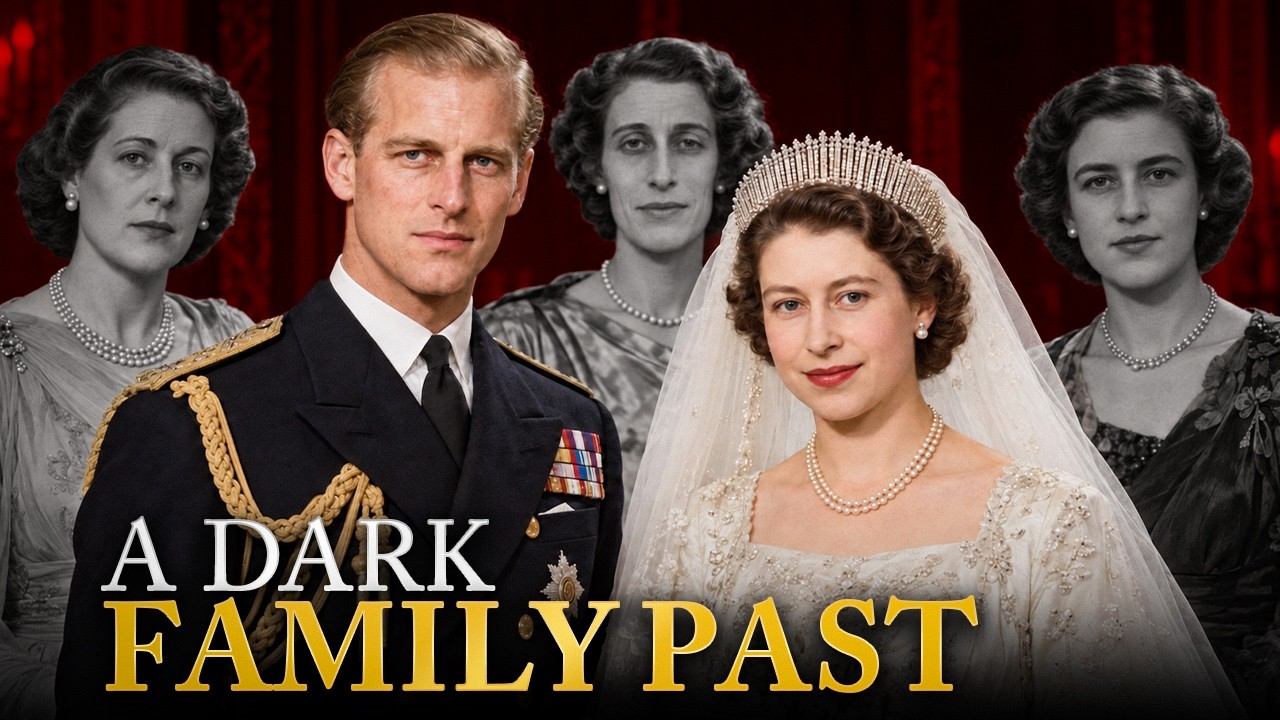
And Frederica carried a letter from Princess Alice, the mother of the groom, who had sat in Westminster Abbey and watched her only son marry the future queen, and then written to her daughters a description of the whole day. It ran to twenty-two pages. That letter is where the family’s own record of the day begins. The sisters had not been invited to the wedding.
Not one of them. All three were married to German princes, and one sister’s husband had been an officer in Hitler’s SS. Yet cousins from countries that had fought on Hitler’s side did receive invitations. So on the day their little brother married the future queen, Margarita, Theodora, and Sophie sat in a castle in Germany waiting for news.
A year and a half earlier, he had gone to one of their weddings with his arms full of food. And to this day, no document has surfaced that says who kept them out. The castle at Marienburg is a place of pale stone and pointed towers on a hill south of Hanover. In November 1947 it belonged to the Duke and Duchess of Brunswick, and the Duchess was not an ordinary German aristocrat.
Her name was Victoria Louise. She was the only daughter of Kaiser Wilhelm II, the man Britain had fought in the First World War. Her own wedding in Berlin in May 1913 had been the last time the Kaiser, King George V, and Tsar Nicholas II—three cousins—sat at the same table. Fifteen months later their countries were at war.
Thirty-four years after that, she was hosting the sisters of the man who was marrying King George’s granddaughter because they had not been asked to the wedding. Three of her guests were Philip’s sisters. Margarita, the eldest, was forty-two. Theodora was forty-one.
Sophie, the youngest, was thirty-three, and the castle at Marienburg was family to her now: the year before, she had married Victoria Louise’s son. With them were cousins from the same tangle of German and Greek royal houses. The sisters had come partly to get away from the press, which wanted to know how it felt to be left out. In London that morning, the bridegroom’s side of the Abbey had a thin look.
Philip’s father had died three years before in Monte Carlo. His mother, Princess Alice, sat on the north side of the Abbey beside her own mother, the old Marchioness of Milford Haven. His uncle, Lord Louis Mountbatten, was there, and Mountbatten’s family. One of the bridesmaids was Mountbatten’s younger daughter, Pamela, Philip’s first cousin.
Count the faces from Philip’s own blood in that church: a mother, a grandmother, an uncle, and a few cousins. Of the four girls he had grown up beside, one was ten years dead, and the other three were in Lower Saxony. The BBC carried the service across the world. In the castle, whatever reached the sisters that day came from far away.
To see why the sisters were in Hanover and not in London, it helps to know what the family on the other side of the aisle had done thirty years earlier. In July 1917, in the middle of the First World War, King George V gave up his family’s German name. The royal house of Saxe-Coburg and Gotha became the House of Windsor overnight. The same summer, the King’s German relatives living in Britain gave up their titles, too.
Philip’s grandfather, Prince Louis of Battenberg, became the Marquess of Milford Haven, and the family name Battenberg was translated into English. It became Mountbatten. Philip would be married under it. So by 1947 the House of Windsor had spent thirty years making itself as English as a royal family could be.
Two years after the Second World War, with bomb sites still open in London and rationing still on every kitchen table, the King’s heir was marrying a prince born in Greece with a Danish and German family tree. Her new sisters-in-law were German princesses by marriage. Their husbands had worn German uniforms. The decision to leave the sisters out was not announced.
It was simply visible in who was in the Abbey and who was not. The distance between Marienburg and the Abbey had started seventeen years earlier, with four weddings in nine months, when Philip was nine years old. Philip was born on the tenth of June 1921 on the island of Corfu, the fifth child and only son of Prince Andrew of Greece and Princess Alice of Battenberg. By the time he arrived, his sisters were almost a generation ahead of him.
Margarita was sixteen, Theodora was fifteen, Cecilia was nine, and Sophie, the closest to him, was six. A year later the family was driven out of Greece and settled in exile, mostly in a borrowed house at Saint-Cloud outside Paris, on money that came from relatives. The sisters were the noise and company of his early childhood. Then, at the end of the 1920s, the house came apart.
In 1930 Princess Alice was taken to a clinic in Switzerland at Kreuzlingen and kept there for treatment. Her husband moved to the south of France, and in the same months, one after another, all four daughters married. Sophie went first: on the fifteenth of December 1930, at the age of sixteen, she married Prince Christoph of Hesse at Kronberg near Frankfurt. On the second of February 1931 Cecilia married Georg Donatus, the hereditary Grand Duke of Hesse, in Darmstadt.
It was a double ceremony, Orthodox and Lutheran, with around fifty guests. Their mother could not attend—she was still in the clinic. In April it was Margarita’s turn, with Prince Gottfried of Hohenlohe-Langenburg at his family’s castle in Württemberg. And on the seventeenth of August 1931 Theodora married Berthold, the Margrave of Baden, at Baden-Baden.
Four weddings in nine months. All four husbands were German princes. None of the four sisters married a Greek, a Briton, or a Dane. For a boy of ten with no home, those marriages became the map of his school holidays.
He was sent to school in England and lived between relatives there, the Mountbattens and his grandmother. But the summers were often German. There were the castles of Hesse at Wolfsgarten and Kronberg, Langenburg above its valley, and the Baden family’s former monastery at Salem near Lake Constance, where Berthold’s father had founded a school with the educator Kurt Hahn. In 1933 Philip was sent to that school.
He was twelve, and the school belonged to his sister’s husband’s family. That same year the new government in Berlin arrested Hahn; he was released and fled to Britain. Within a year Philip followed him there, to the new school Hahn opened at Gordonstoun. The four men his sisters married were serious, titled, and in the 1930s ambitious.
Three of them would put on German uniforms. One of the four marriages would carry a sister straight into the circle around Adolf Hitler. Two years after Philip left Salem, one of those sisters was sitting at a wedding with Hitler in the room. The wedding was Hermann Göring’s.
In April 1935 the head of the German Air Force married the actress Emmy Sonnemann in Berlin, with Adolf Hitler as a witness. Among the guests of honor was Sophie, Princess Christoph of Hesse, twenty years old. The historian Jonathan Petropoulos later published a photograph of that wedding in his study of the Hesse family. Look at who sits across the table from Sophie in the pictures of that day: Adolf Hitler.
And the young woman facing him was a great-great-granddaughter of Queen Victoria. Sophie was there because of her husband. Prince Christoph of Hesse had joined the Nazi Party in 1931, quietly at first, and the SS in early 1932. He rose to the rank of Oberführer, a senior SS rank.
Göring had brought the couple into the circle of the regime’s leaders, and through Göring they met Hitler. Christoph went to work in the Forschungsamt, the research office under Göring that listened in on telephone lines across Germany. Accounts differ on whether he ran it or worked under its chief. Either way, he was inside the machinery of the state.
Sophie herself never joined the party. In 1938 she joined the National Socialist Women’s Organization. In 1937 she gave birth to her first son, and the boy was christened Karl Adolf. Petropoulos, who worked in the Hesse family archive, reads the second name as a tribute to Hitler.
Christoph’s elder brother went further still. Philip of Hesse joined the Brownshirts of the SA, became the governor of the Prussian province of Hesse-Nassau, and was close enough to Hitler to act as his go-between in Italy. He had married Princess Mafalda of Savoy, a daughter of the King of Italy. The other houses moved the same way at different speeds.
On the first of May 1937 Margarita’s husband, Gottfried of Hohenlohe-Langenburg, joined the Nazi Party. By the historians’ count, Margarita joined it, too. That same spring Cecilia and her husband, Georg Donatus of Hesse, became party members. Six months later Cecilia was dead.
In November 1937 the plane carrying her, her husband, their two small sons, and her mother-in-law to a family wedding in London hit a factory chimney in fog at Ostend. Philip, sixteen, went to the funeral in Darmstadt. A photograph from that day shows him walking among the mourners, with men in Nazi uniform in the procession around him. So by the end of 1937 two of Philip’s three surviving sisters were married to party members.
One of them was a senior officer of the SS, and the woman who sat at Göring’s wedding was the sister closest to him in age. But the fourth house does not fit the pattern. Theodora and Berthold of Baden at Salem tried to keep their distance from the regime. Philip’s biographer Philip Eade records that while the relatives around them were joining the party, the Badens held back.
They had seen what the new government did to Kurt Hahn, the man who had built their school. When the war came, Berthold served as an officer and was badly wounded in the leg in France in 1940. Then he went home to Salem and stayed there. That difference would matter not at all in 1947.
To the British public the sisters were one thing: Germans. In September 1939 Philip was eighteen, a cadet at the Royal Naval College at Dartmouth. His three brothers-in-law were in Germany. Within two years they would be on the opposite side of a world war.
In March 1941 Midshipman Philip, Prince of Greece, was serving on the battleship Valiant in the Mediterranean. At the Battle of Cape Matapan off southern Greece he was in charge of the searchlights that lit up the Italian cruisers for the British guns. He was mentioned in dispatches for it. He was nineteen.
On the other side of the same war, each of his living brothers-in-law was in German uniform. Christoph was a Luftwaffe officer flying with a fighter wing that would fight over Tunisia, Sicily, and Malta. Gottfried went to the Eastern Front with the Wehrmacht and came back badly wounded. Berthold had already been wounded in France.
The family did not stop being a family. In 1942 Princess Alice, who had spent the war in occupied Athens, met Margarita and Theodora in Berlin. Afterwards she wrote to Philip about the comforts of country life where one could still get butter, eggs, and milk. Inside Germany, loyalty to the regime was wearing thin in at least one house.
In June 1942 the SS leader Reinhard Heydrich was assassinated in Prague. Christoph wrote to his mother: “The death of a certain dangerous and cruel man is the best news I have had in a long time. ” Hugo Vickers, the biographer of Princess Alice, describes Christoph by then as disillusioned with the party he had joined eleven years earlier. He did not live to leave it.
On the seventh of October 1943 the small plane carrying Christoph hit a mountain in the Apennines, southwest of Forlì, in Italy. His body was found two days later. The circumstances have never been fully explained, and the regime made no announcement. Sophie placed a short death notice in the party newspaper.
She was twenty-nine, with four children and pregnant with a fifth. Her daughter Clarissa was born in February 1944, four months after her father’s death. The Hesse family’s turn toward the regime was ending in the worst way. In September 1943 Italy changed sides.
Hitler had Christoph’s brother Philip arrested, and Princess Mafalda was seized in Rome and sent to Germany. She died at Buchenwald concentration camp in August 1944, after an Allied bombing raid on the camp. Philip survived the camps only to be interned by the Americans as a senior Nazi when the war ended. In those same months, far to the south, Philip’s mother was doing the opposite.
When the Germans took over Athens in the autumn of 1943, Princess Alice hid Rachel Cohen, the widow of a Greek politician the family had known, and her daughter, in her own house. They stayed until the liberation. When the Gestapo came to question her, Alice, who had been deaf since childhood, made a show of not understanding a word until the officers gave up. Put those two homes side by side in the autumn of 1943.
Sophie, a widow at twenty-nine with a fifth child on the way and a husband who had died in Luftwaffe uniform. Her mother in Athens hiding a Jewish family from the same party’s police. After the failed plot to kill Hitler in July 1944, Gottfried was dismissed from the army, according to his obituary in the New York Times. In December 1944 Prince Andrew died in Monte Carlo, cut off from all of his children by the war.
There was so little left in his estate that his debts were only settled in 1947, the year of the wedding. By the summer of 1945 the war was over. Philip was in Tokyo Bay for the Japanese surrender as first lieutenant of a British destroyer. His sisters were in a defeated country divided into zones, with their houses requisitioned and their names on lists that the Allied authorities were drawing up.
Then, in the spring of 1946, the brother went back to Germany. He went for a wedding. On the twenty-third of April 1946 Sophie, widowed for two and a half years, married again. Her new husband was Prince George William of Hanover, the son of the Duke and Duchess of Brunswick.
The wedding was at Salem, Theodora’s home. Philip came. It was the first time he had seen Sophie since Cecilia’s funeral in 1937. In a Germany of ration cards and ruins, he arrived, in the phrase the family biographers repeat, with his arms laden with food and gifts.
Set the two weddings next to each other. In April 1946 the British naval officer crossed into occupied Germany to stand beside his sister at her wedding. Nineteen months later, she would not be at his. Sophie’s world that spring was precarious in ways that had nothing to do with politics.
The Hesse family’s castle at Kronberg, Friedrichshof, had been taken over by the American army as an officers’ club. Before the Americans arrived, the family had buried its jewels in a zinc-lined box under the cellar floor. In November 1945 officers running the club found them. By early 1946 a captain of the Women’s Army Corps, Kathleen Nash; a colonel named Jack Durant; and a major named David Watson had smuggled them out.
The family discovered the loss while Sophie was preparing for her second wedding. The three officers were court-martialed, but only about a tenth of the jewelry ever came back to the family, in 1951. While his sister’s family was being robbed by the victors, Philip was trying to become one of them on paper. The romance with Princess Elizabeth was no secret inside the family.
King George VI liked the young man. He had already asked his private secretary, Sir Alan Lascelles, back in March 1945, how Philip might become a British subject. In the summer of 1946 Philip asked for Elizabeth’s hand, and the King agreed on condition that nothing be announced until after her twenty-first birthday the following spring. The newspapers got ahead of it.
In September 1946 Lascelles put out a flat denial: Princess Elizabeth is not engaged. The denial only fed the rumor. What the court feared was not hard to read. At least one opinion poll recorded strong disapproval of Philip as a foreigner.
Across the Atlantic, the Chicago Tribune called the match fraught with dark political implications. A prince of Greece and Denmark, educated partly in Germany, with four sisters married to German princes, was exactly the kind of bridegroom a renamed royal house would have to explain. So Philip paid the first part of the price himself. Early in 1947 he became a naturalized British subject.
He gave up his Greek and Danish royal titles and his place in the line to the Greek throne. He needed a surname. The Home Secretary, James Chuter Ede, floated an English disguise for his father’s line, the old German house of Oldenburg. In the end Philip took his mother’s family name, the one his grandfather had translated from German in 1917.
He became Lieutenant Philip Mountbatten, Royal Navy. In October 1947, a month before the wedding, the Greek Orthodox prince was received into the Church of England. The bride, meanwhile, was saving clothing coupons like everyone else in the country. The government gave her two hundred extra for the dress.
The engagement was announced in July 1947. The wedding was set for November in Westminster Abbey, and someone, somewhere in the palace and the government, began drawing up the guest list. The wedding of the twentieth of November 1947 was planned as a lift for a worn-out country. The night before, the King made Philip a royal highness and Duke of Edinburgh.
On the morning, the processions went from Buckingham Palace to the Abbey through crowds packed along the route. The list of royal guests was long. The King of Norway was there, the King and Queen of Denmark, the young King Michael of Romania, queens and princesses from across the old royal families of Europe. Two groups were missing.
The first was the King’s own brother, the Duke of Windsor, who had abdicated eleven years earlier. He and his wife were not invited. His sister, the Princess Royal, stayed away too, officially because she was unwell. The former colonial governor Sir Ronald Storrs claimed it was a protest on her brother’s behalf.
The second missing group was Philip’s sisters and their husbands. The accounts agree on the reason: two years after the war, German relatives were impossible. Pamela Mountbatten, the bridesmaid, said it bluntly decades later: “So soon after the war, you couldn’t have the Hun. ”
And yet, look at who was on the list.
Princess Helen, the Queen Mother of Romania, a first cousin of the groom, was invited. Romania had fought on Hitler’s side until 1944. Princess Irene, the Duchess of Aosta, another cousin, was invited too. She had married into the Italian royal house, and Italy had been Hitler’s ally until 1943.
So the line was not drawn around the old enemy alliance. Cousins from two of Germany’s former allies were in the Abbey. The line was drawn around one word, and it was German. The biographers record that when the sisters understood who had been invited, they felt snubbed.
There is a famous version of who drew the line. In 2022 a British tabloid ran the story that Philip’s sisters had been banned from the wedding by order of the King: “Why the Queen’s father banned Prince Philip’s family. ” It is a satisfying story. It gives the exclusion a face and a stern father of the bride.
It does not come with a document. The books built on the family’s letters and archives—Vickers in 2000, Petropoulos in 2006, Eade in 2011—describe the decision in the passive voice. The sisters could not be invited. Philip found himself unable to invite them.
An older royal history from 1982 says the bride herself was barred from inviting them. Not one of those writers names the person who said no, and none of them quotes an order. The King, the prime minister’s office, the palace staff, Mountbatten, and Philip himself all had reasons to want the guest list clean. The record does not say which of them wrote the rule.
The documented version is harder, and the simpler reading is that no order was needed. The King, the government, and the groom’s own family all saw the same problem, and the sisters’ absence solved it quietly. The groom had changed his nationality, his church, his titles, and his name to get into that happy ending. His sisters were simply the last item on the list of things he could not bring with him.
What the sisters asked, according to Pamela, was simple: “Why weren’t we allowed to come to your wedding? ”
The answer came in the letter from Princess Alice, delivered to the castle at Marienburg in the last week of November 1947. Alice had sat in the Abbey with her mother, watched her only son marry the future queen, and then written to her daughters a description of the whole day. Twenty-two pages.
What the biographers quote from Alice that week comes from the note she wrote to Philip himself: how wonderfully everything had gone, and how comforted she was to see the truly happy expression on his face. The sisters’ own verdict, as the biographers give it, had two halves. They thought the exclusion wrong and hurtful, and they understood it. The royal history of 1982 puts the contrast sharply: unlike the Duke of Windsor at the time of his own marriage, Philip’s sisters understood.
They made no public complaint and gave no interviews about it. Sophie wrote a memoir of her life, and it was never published. That silence was not the end of the account. It was a deposit.
Three years later the first repayment came. In September 1950 the sisters’ grandmother, the old Marchioness of Milford Haven, died in London, and Margarita came to England for the funeral. A month later, in October 1950, Philip and Elizabeth’s daughter, Princess Anne, was christened at Buckingham Palace. She had five godparents.
One of them was Margarita, Philip’s eldest sister, the Princess of Hohenlohe-Langenburg, whose husband had joined the Nazi Party in 1937. Then, in February 1952, the King died, and Philip’s wife became queen. A coronation was coming in the same Abbey where the sisters had not been welcome. This time the sisters did not wait for a letter.
Philip Eade puts it plainly: after having been excluded from the wedding, Philip’s sisters were all the more determined to be there this time. Margarita wrote to Mountbatten that at least a year before the coronation they had fixed that in Philip’s mind. Two exclamation marks in the eldest sister’s hand. On the second of June 1953 Margarita, Theodora, and Sophie were in Westminster Abbey with their husbands and some of their children for the crowning of their brother’s wife.
Their mother sat near them in a long gray dress and a nun’s veil, the habit of the religious order she had founded in Greece. From their seats they watched their brother become the first man to kneel before the new queen and swear to be her liege man of life and limb. Five and a half years after they had followed the wedding from a castle in Germany, they had seats in the Abbey. But the most uncomfortable part of the family’s history was still locked away.
And the person who finally talked about it was Philip himself, more than half a century later, at the age of eighty-four. In the early 2000s Jonathan Petropoulos, the American historian, was given access to the archive of the House of Hesse for a book on the princes of Hesse in Nazi Germany. Part of his research was an interview with the Duke of Edinburgh, Christoph’s brother-in-law, by then in his eighties. Philip did not pretend the family had been innocent bystanders.
He tried to explain what the regime had looked like from inside those German houses in the 1930s. “There was a great improvement in things like trains running on time and in building,” he said. “There was a sense of hope after the depressing chaos of the Weimar Republic. People latched on to someone who appeared to appeal to their patriotism.
You can understand how attractive it was. ” He said he had never been conscious of anybody in the family actually expressing anti-Semitic views. Then he went further than most royal relatives have ever gone on the record. He acknowledged there had been inhibitions about the Jews and jealousy of their success.
The book came out in 2006, and the Mail on Sunday put Philip’s words on its front page. Sixty years after the wedding, the reason his sisters had been kept out of the Abbey was finally being discussed out loud. And the man doing the talking was the bridegroom. Eleven years before that book, the family had already been back to the war once in public.
In October 1994 Philip traveled to Jerusalem, to Yad Vashem, Israel’s memorial to the victims of the Holocaust. A year earlier Yad Vashem had named Princess Alice one of the Righteous Among the Nations for hiding the Cohens in Athens. Her children came to plant a tree in her honor. Standing with Philip was his sister, listed in the record by her married name, Princess George of Hanover.
It was Sophie—the guest of honor at Göring’s wedding in 1935, the mother of a boy named Karl Adolf—planting a tree for the mother who had hidden the Cohens from the Gestapo. Follow the sisters to the end of their lives. Theodora died in October 1969. Their mother, Princess Alice, died seven weeks later at Buckingham Palace.
She had moved there in 1967 after a military coup in Greece and spent her last two years under her son’s roof. Margarita died in 1981. Sophie, who in 1964 had become godmother to Philip’s youngest son, Prince Edward, died in Bavaria in November 2001, leaving seven children. The guest list, one more page.
Prince Philip died on the ninth of April 2021, two months short of his hundredth birthday. Because of the pandemic, his funeral at St. George’s Chapel, Windsor, was limited to thirty mourners. Thirty places for a family of dozens, for a man who had been the Queen’s husband for seventy-three years.
Three of those places went to Germans. Bernhard, the hereditary prince of Baden, the grandson of Theodora. Prince Philip of Hohenlohe-Langenburg, the grandson of Margarita. And Prince Donatus, the head of the House of Hesse, into which Cecilia and Sophie had both married.
Donatus is the grandson of Philip of Hesse and of Princess Mafalda, the King of Italy’s daughter, who died at Buchenwald. In 1947 there was no room in the Abbey for any of the sisters. In 2021, with only thirty seats to give, the family made room for theirs. It was never really a snub.
A snub is personal, and it is about feelings. This was a payment. To marry the heir to the throne, Philip had to hand over his country, his titles, his German past, and his family name. And the name he took in its place was itself a German name, translated in 1917.
The three women who had given him a home when he had none were part of the price. They understood what it was, and they never said a word against it in public. Then they spent the rest of their lives collecting it back: a godchild in 1950, three seats at a coronation, and at the very end, three places at his coffin. Princess Alice’s twenty-two pages told the sisters what the day looked like.
The guest lists tell what it cost. Some families keep a place for everyone they love, and some have to wait a lifetime to set it again.
