On a September morning in 1862, in the middle of the carnage at Antietam, a Union soldier was struck down by a shell fragment. The surgeons who reached him did what they had done for hundreds of other men that day: they cut away the uniform to treat the wound. Only then did they realize that the soldier lying before them was not a man at all. No one in the regiment had known.
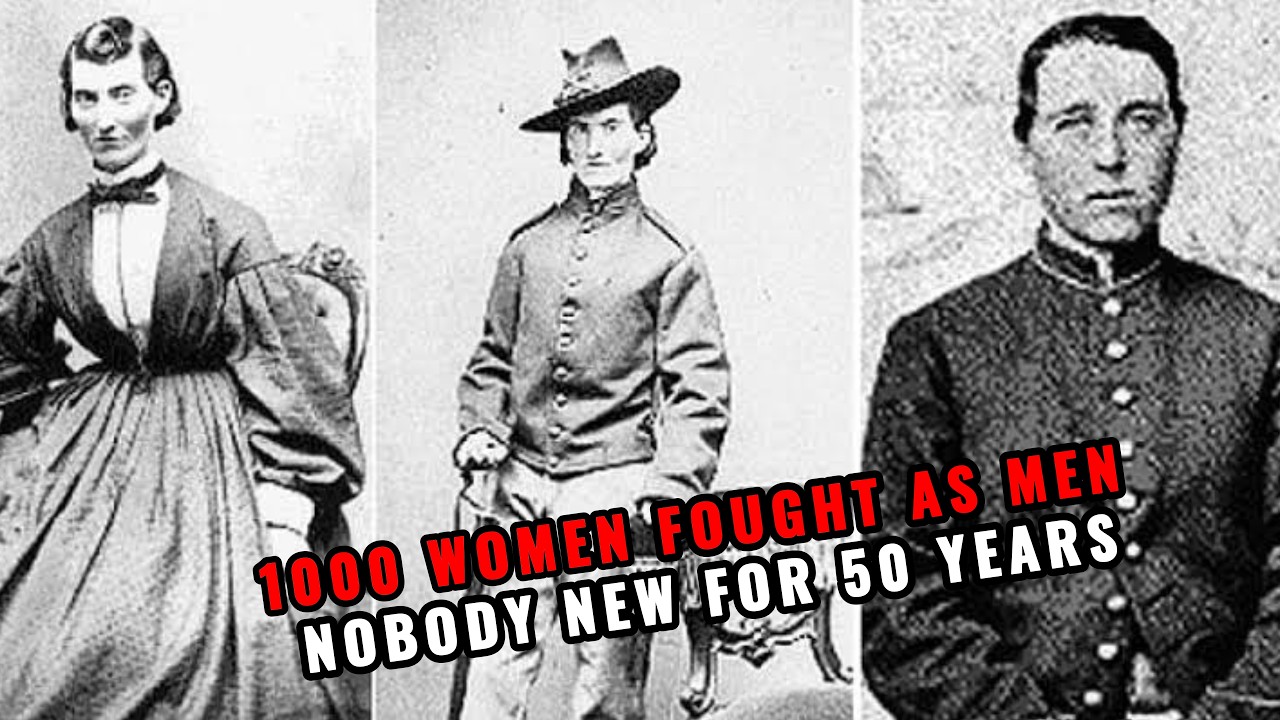
Not the men who had marched beside this soldier for months, not the officers who had given the orders. The soldier had drawn the same rations, slept under the same tents, carried the same rifle, and faced the same dangers as everyone else—and done it all without anyone noticing. Nor was it an isolated case. Historians who have spent their careers digging through pension records, hospital ledgers, and regimental rosters now estimate that between four hundred and a thousand women served in the American Civil War disguised as men.
They came from both the Union and the Confederacy, from North and South. Some were discovered within weeks. Others served for years. One woman in this story kept the secret for the rest of her life—more than five decades after the war ended.
The obvious question comes first. How could no one have noticed? When the war broke out in 1861, both the Union and Confederate armies needed to grow from almost nothing into forces of hundreds of thousands of men. The rapid recruiting stations were overwhelmed, understaffed, and working on a schedule that left little room for scrutiny.
A medical examination of a new recruit often amounted to a doctor checking that you had enough teeth to tear a paper powder cartridge, enough fingers to pull a trigger, and the rough general build of a healthy young man. Recruiters were paid a bounty for every man they signed, which gave them every incentive to look the other way and not ask difficult questions. Camp life did not make concealment much harder. The Union and Confederate uniforms were designed to be loose and formless.
Nothing like the modern tailored uniform that reveals the shape of the body underneath. Soldiers rarely stripped down completely in front of one another. Men bathed alone in streams and rivers whenever they could, slept in their clothes most of the time, and used the latrines away from their tentmates as a matter of basic modesty, not suspicion. A small soldier with a high voice, no beard, and a slight build did not automatically raise suspicion either.
There were plenty of teenage boys already, some of them thirteen or fourteen, serving in the ranks on both sides. A woman who bound her chest, cut her hair short, deepened her voice as much as she could, and chose a respectable male name had a real chance of blending in among thousands of other young men going through the same daily routine. What logistics alone cannot explain is why these women did it. The honest answer is that there were as many reasons as there were women.
Some had husbands, brothers, or fiancés who enlisted, and they did not want to be separated from them—or they wanted to protect the men they loved. Some were fleeing abusive homes and saw the army as a way out with a guaranteed paycheck. Some were driven by the same patriotic conviction that moved the men around them, a belief in the Union or the Confederacy, a cause they were legally barred from participating in in any other official capacity. And some, based on their later writings, simply wanted adventure, independence, and a sense of purpose that nineteenth-century society reserved almost exclusively for men.
Five of their stories have survived well enough, and are documented closely enough, to be told in detail. Sarah Emma Edmonds was already living as a man for two full years before the Civil War even began. Born in New Brunswick, Canada, she ran away from a difficult and abusive home as a teenager, according to most accounts, and reinvented herself under a new name and identity: Franklin Thompson, a traveling salesman of Bibles and religious literature making his way across the northern United States. When the war broke out in 1861, Franklin Thompson joined the Second Michigan Infantry, and Sarah Edmonds effectively disappeared into a role she had been practicing for years.
She served primarily as a field nurse, caring for the wounded in and near the great battlefields, including First Bull Run and Antietam, among the bloodiest battles of the entire war. According to her later memoirs, published after the war under the title Nurse and Spy in the Union Army, her service went far beyond nursing. She claimed to have crossed into Confederate territory several times as a spy, adopting additional disguises on top of her disguise as Franklin Thompson—at various points, by her own account, taking the role of a Black laborer, an Irish peddler woman, and other covers designed to move unnoticed through enemy lines and gather information. It is worth being honest here.
Some of these spy stories are known only through Edmonds’s own book, which was written and published for a paying audience. Historians have seriously debated over the years how much of it holds up as strict fact versus how much was embellished or dramatized for sales. But that kind of skepticism does not erase her existence. It is simply responsible history.
What is undisputed—because it is supported by military records and pension files, not just by her memoir—is that she served in the Union Army for about two years, was present at major and well-documented engagements, and did the work of a soldier and a nurse under real fire. Her time in the army ended when she contracted malaria. Rather than risk a medical examination that would surely have exposed her, she made the decision to flee, leaving the army entirely rather than allowing a doctor to discover the truth. That decision came at a cost.
Franklin Thompson was officially listed as a deserter from the Union Army, a stigma that stuck in the record for years and would have permanently disqualified her from any veteran benefits. Edmonds would not let that stand. Years after the war, she petitioned the United States Congress directly, revealing the truth of her identity and what she had done, and asked for her record to be corrected. Congress agreed.
The desertion charge was officially stricken, and she was granted an honorable discharge retroactively, along with a veteran’s pension, making her one of the only women of her era to receive one—and one of the few former Union or Confederate soldiers, male or female, whose names Congress personally intervened to clear. Jennie Hodgers is the one known as Albert Cashier. Most of the women in this story have a tale that ends one way or another when the war ends. Jennie Hodgers’s story is different, and that is what makes her case one of the most remarkable in this entire history.
Born in Ireland, Hodgers volunteered in the Ninety-Fifth Illinois Infantry of the Union Army under the name Albert Cashier. During her service, she fought in more than forty documented battles and skirmishes, including the brutal months-long Siege of Vicksburg, one of the pivotal campaigns of the entire war. The soldiers who served alongside her later described Albert Cashier in their memories and testimonies as a quiet, reliable, completely unremarkable soldier. No one suspected anything, not once, throughout years of shared service.
Here the story becomes truly extraordinary. When the war ended and the other soldiers went home to resume their old lives, Jennie Hodgers did not. Albert Cashier continued to live as a man for the next fifty years. She voted in elections in an era when women in the United States were legally forbidden to do so.
She drew a veteran’s pension under her male identity. She held steady jobs as a farmhand, a facility guard, and a general maintenance worker in small Illinois towns, and was known to her neighbors for half a century simply as “Albert,” the old Civil War veteran and hard worker, nothing more. The truth only came out by accident in 1911, when she was struck by a car and taken to a hospital, already elderly and suffering from dementia. The doctors treating her injuries discovered her sex during the examination.
What happened next says a great deal about the loyalty she had earned. Her fellow Civil War veterans who learned the truth chose to protect her secret rather than expose it, and many of them testified on her behalf, specifically to ensure that her pension and benefits as a veteran were not withdrawn because of her real identity. Her final years were harsher. As her dementia worsened, she was moved to a care facility where the staff, either unaware of or unwilling to respect her fifty-year history of identity, repeatedly forced her to wear women’s clothing, something contemporary records indicate caused her genuine and obvious distress.
Jennie Hodgers died in 1915. She was buried in her Union Army uniform with full military honors under the name she had chosen and defended for over half a century. Loreta Janeta Velazquez fought for the Confederacy, and by her own account, she did so with more boldness and independence than almost anyone else in this story. Born in Cuba and living in New Orleans when the war broke out, Velazquez claimed that she used her husband’s money without his knowledge to buy a military uniform herself, then recruited and financed her own battalion of Confederate soldiers.
She presented herself to that battalion and to the Confederate Army more broadly as Lieutenant Harry T. Buford. Under that identity, she said she fought at First Bull Run, at Ball’s Bluff, and at the brutal Battle of Shiloh, before later moving on to work as a Confederate spy and blockade runner. In perhaps her boldest claim, she said she briefly worked in disguise on the Union side as well, playing both ends of the conflict at once.
This is the point in the story where a warning becomes necessary, because Velazquez is by far the most controversial figure in this whole account. Her memoir, published in 1876 under the title The Woman in Battle, was publicly and forcefully challenged after publication by Confederate General Jubal Early, who described large portions of her account as fabricated. Historians today remain genuinely divided over how to interpret that dispute. Some believe Velazquez exaggerated or invented parts of her military service to make her memoir more dramatic and more commercially successful.
Others point out that Jubal Early had strong motives of his own to disparage a story like hers. Early spent much of his postwar life working to craft the “Lost Cause” narrative of Southern honor. A narrative with no place for a rebellious, self-funding woman operating outside the authority or permission of any man. What external sources confirm independently of her memoir is that a woman using the alias Harry T.
Buford was known to and documented by Confederate officials during the war, and that she was arrested at least once specifically for impersonating a soldier. Where the verified history ends and the self-mythology begins is a question historians still actively argue about. Velazquez’s story is included here not despite that ambiguity but partly because of it. It is a useful reminder that not every account from that era survives with clean, uncontested documentation—and that does not necessarily mean it is false.
Frances Clalin Clayton’s story, like many in this list, begins with marriage. She joined a Minnesota artillery and cavalry unit under the name Jack Williams alongside her husband, Elmer Clayton, determined not to be separated from him by the war. The two served side by side in several engagements, and then at the brutal Battle of Stones River in Tennessee. Frances reportedly watched Elmer killed in battle only a few feet away from her.
According to contemporary newspaper reports from the period, she kept fighting anyway, stepping over her husband’s body to hold her place in the formation rather than breaking down and revealing her grief or her identity to the rest of the unit. She was eventually discovered. The surviving accounts differ on exactly how and when that happened. But instead of returning to an anonymous civilian life afterward, Clayton actively sought recognition and compensation for her service.
At one point she traveled to Washington, D. C. , to formally document what she had done and claim the back pay owed to her. It should be noted that the historical record on Clayton is less rich and less precisely documented than it is for Edmonds or Cashier.
Most of what we know comes from newspaper coverage of the period rather than official military or pension records, and the newspapers of that era were not always careful to verify sensational war stories before printing them. That does not mean her story is untrue, but it does mean it should be treated with a little more caution than the two service records that survived with stronger documentation. The final story here is that of Melinda Belloc, and it begins the same way Clayton’s does, with marriage, but it ends in a very different place. From the mountains of western North Carolina, Melinda cut her hair short, volunteered under the name Sam Belloc, and joined the Twenty-Sixth North Carolina Infantry alongside her husband, Keith Belloc.
But unlike most of the other people in this account, the Bellocs were not truly committed to the cause they volunteered to fight for. Keith and Melinda were Union sympathizers living in Confederate territory, and by most accounts, they had a planned scheme from the start: volunteer together and escape to the Union lines together at the first real opportunity. When that opportunity did not come as quickly as they had hoped, Keith took matters into his own hands, deliberately exposing himself to poison ivy to fake a medical condition serious enough to earn a discharge. Melinda had no intention of staying behind in a Confederate camp without him.
So she revealed her true identity directly to their commanding officer and obtained her own discharge to leave alongside her husband. From there, the two spent the rest of the war as guerrilla fighters on the Union side, operating in the mountains of western North Carolina against Confederate forces and sympathizers in the region. Irregular, dangerous fighting that came with its own real losses. Melinda was wounded at least once during that period of guerrilla warfare.
Her story stands out from the others in this list because it did not end with secrecy or scandal or quiet disappearance back into ordinary civilian life. It ended with her identity publicly known, recognized, and accepted by those around her as a full and effective partner in the fight she and her husband had chosen together. Those the history books never uncovered. Five stories out of a number historians can only estimate.
Why does this part of history remain so obscure even now, more than a century and a half later? Part of the answer lies in the very nature of what these women were doing in the first place. To succeed at passing as a man in the army meant, by definition, not drawing attention. That was the whole point of the disguise.
Those who did it most completely left the faintest trace. Part of the answer lies in what happened after the war. Admitting to service in disguise could mean accusations of fraud, disqualification from a deserved pension, or severe social consequences in a culture with rigid expectations about what women were and were not allowed to do. Many of these women chose, understandably, to tell no one for the rest of their lives.
Beyond the five stories told in detail here, historians digging through pension applications, hospital records, and regimental rosters have identified dozens of other documented cases. Women like Rosetta Wakeman, who served in a New York regiment under the name Lyons Wakeman, whose letters home survived and were later published. Women whose true identities were only confirmed generations later, when descendants or historians matched burial records with physical remains. And beneath that layer of partially documented cases lie unknown numbers of women never discovered at all—women who served and fought and in some cases died without ever being exposed, under male names the historical record never registered as belonging to anyone but the ordinary soldier everyone believed them to be.
The women whose stories survived in enough detail to be told, like the five in this account, are in a real sense the unlucky ones. Whether they were exposed by a stray shell fragment, a bout of malaria, an unrelated medical examination, or, in Jennie Hodgers’s case, a traffic accident more than fifty years after the war ended. For every one of them, there is very likely another name we will never know. Five names out of what may be hundreds.
The historical record will never fully recover. Different armies, different reasons for enlisting, different endings—heroic, tragic, controversial, and in at least one case, quietly triumphant. But beneath all that variation lies the same fundamental truth. Hidden in plain sight inside a war most people think they understand completely.
For four years, women fought and died in the ranks of both armies, alongside the men. History remembers the ones it mostly forgot.






