The black Cadillac sat at the red light on Lenox Avenue at 132nd Street, engine idling smooth and low. June heat pressed down on Harlem like a fist. Ellsworth “Bumpy” Johnson sat in the rear seat, window cracked just enough for air.
William “Quick” Davis gripped the steering wheel, eyes forward, watching traffic and corners, because in Harlem you watched both or you ended up face down in an alley with your throat opened ear to ear.
A ceiling fan in a store across the intersection rattled and squeaked. Cigarette smoke drifted from a bar. Jazz trumpet notes cut through the heat and noise.
Everything normal, ordinary, which made Bumpy’s shoulders tense, because ordinary was when people stopped paying attention, and that was when knives came out or car doors opened and men with guns stepped through.
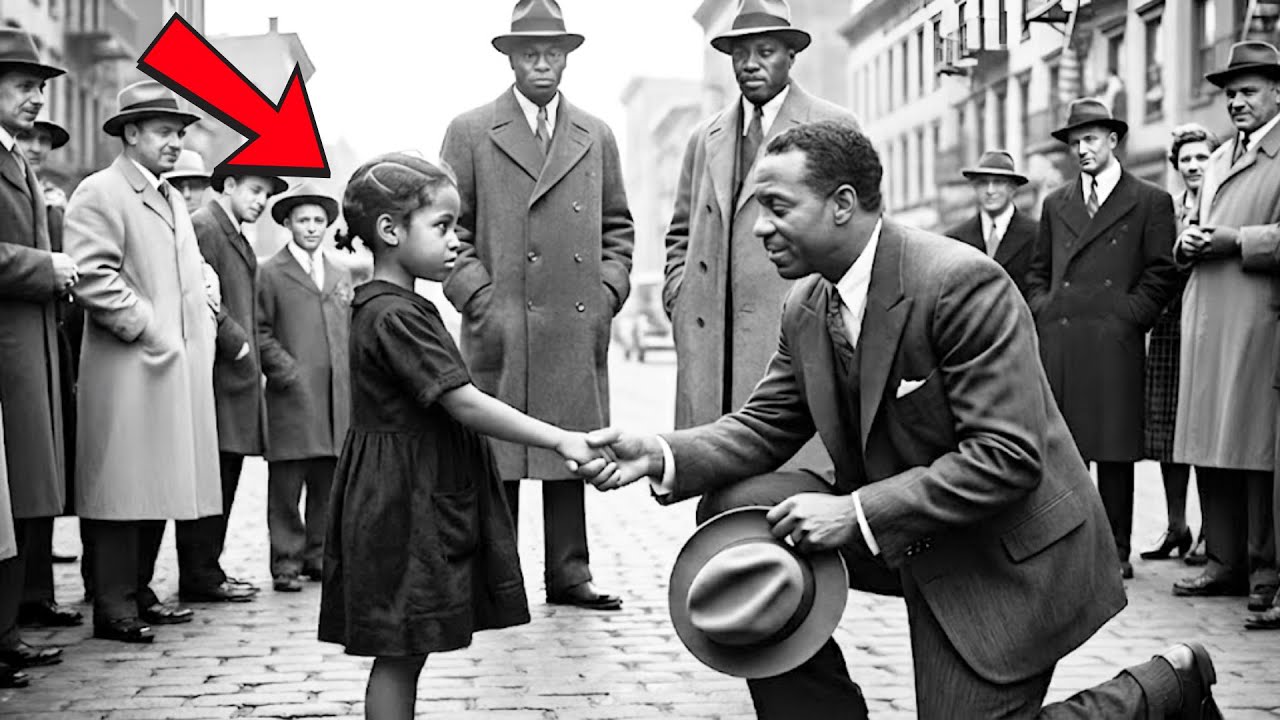
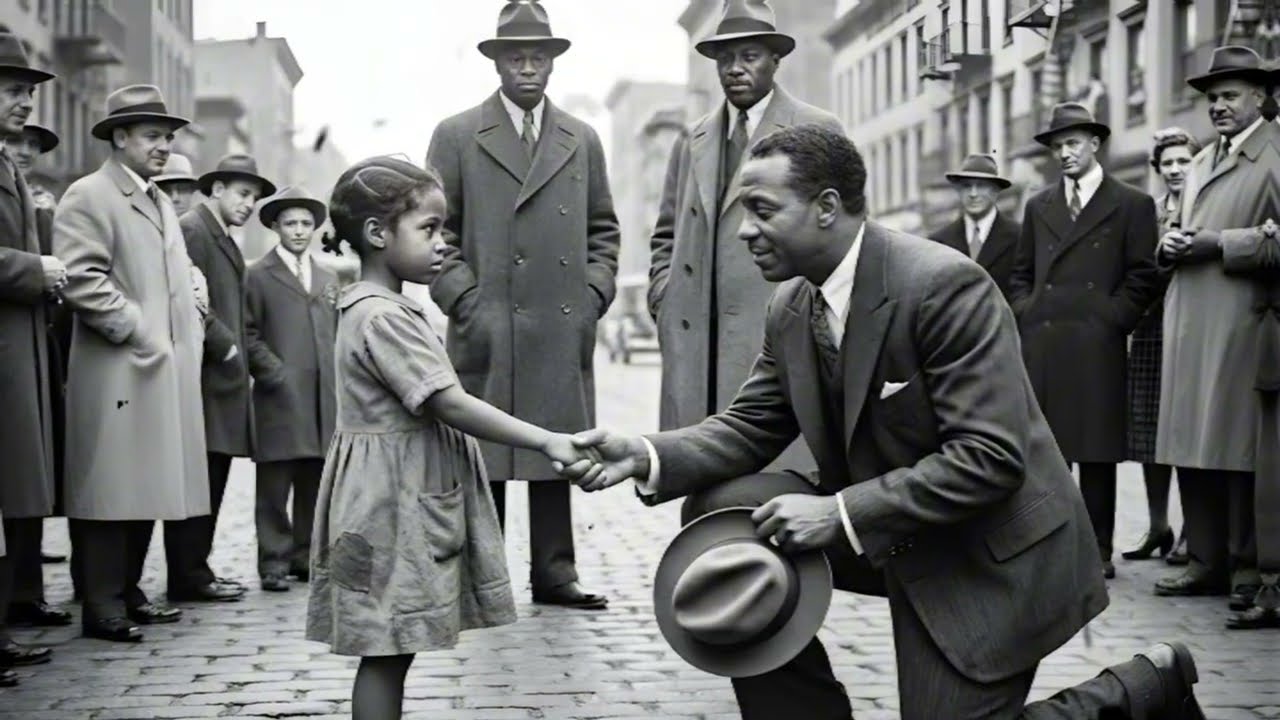
A small figure approached the passenger side. A little girl, five or six years old, wearing a dress too tight and too dirty, face hollow, like she had not eaten properly in weeks. She moved slowly, carefully, like someone who had learned that sudden movements brought fists or worse.
She knocked on the rear window, three soft taps, barely audible.
Davis turned his head. “Street kid begging. Want me to wave her off?”
Bumpy looked at the girl, looked at her eyes. They were too old for her face, the kind of eyes that had seen things children should never see. Eyes that understood hunger and fear before they should understand anything except play.
“Roll down the window.”
Davis hesitated, then complied. The window descended. The girl leaned closer, hands gripping the door edge.
“Are you Mr. Bumpy?”
Her voice was small and careful.
“I am. What is your name?”
“Kesha. Kesha Williams. My mama said you are the good man in this town.
She said if I ever needed help, I should find you.”
Good man. The words landed hard. Bumpy had been called dangerous, ruthless, reliable, but good—that word belonged to people who did not break fingers with hammers to collect debts, who did not make men vanish when they crossed lines, who did not profit from vices that destroyed families while calling it business.
“What do you need, Kesha?”
“We are hungry, me and mama. We are going to get put out because mama cannot pay rent. She cries at night.
I am scared.”
Bumpy reached into his jacket and pulled out his wallet. He removed five twenty-dollar bills and handed them to Kesha. One hundred dollars, more money than she had probably seen in her life.
“This is for food and rent. Take it to your mama. Someone will come tomorrow to make sure you have what you need.”
He pulled a business card from his wallet. Johnson Laundry Services, an address on 145th Street, a legitimate business that employed people and did not ask questions.
“Give this to your mama. Tell her to go there tomorrow morning. Someone will find her work.
And if anyone tries to put you out before then, call that number and say Bumpy sent you.”
He looked at Kesha directly.
“You are not going to be hungry anymore. You are not going to lose your home. That is a promise.”
Kesha whispered “thank you” three times, then ran back toward the sidewalk, money and card gripped tight.
Davis watched her disappear. “Boss, half the neighborhood will hear about this in an hour.”
“Let them hear.” Bumpy’s voice was cold as winter concrete. “Let them know Harlem takes care of its own.
Let them know children do not starve here, not while I am breathing.”
He glanced at faces watching from corners. Some he recognized, some he did not. They had all seen him help a child in public, seen him make a promise that would be kept or his reputation would shatter.
In Harlem, reputation was currency more valuable than money.
The light turned green. Davis pressed the accelerator. They drove two blocks in silence before Davis noticed something in the rearview mirror that made his chest tighten.
Bumpy was crying. Not sobbing, not making sound, just tears running down his face in steady streams, jaw locked tight, hands folded like he was trying to hold something together that was breaking inside him.
Davis had worked for Bumpy eight years. He had seen him negotiate with gangsters and cops. He had seen him order men beaten until bones broke and joints separated.
He had seen him sit through funerals and court hearings that would make other men fold. He had never seen Bumpy cry.
“Boss, you okay?”
Bumpy wiped his face. His voice was rough, strained.
“My daughter, Elise, is somewhere in this city right now, strung out on heroin. Three weeks ago, she had a baby, my granddaughter, Margaret. I have not seen either of them since the hospital.
I do not know where they are. I do not know if they are eating. I do not know if that baby is lying in some filthy apartment crying and nobody is coming.”
He looked out at Harlem passing by.
“That little girl knocked on my window and asked for help, and all I could think was that somewhere right now, my own granddaughter might be hungry and scared, and there is no one knocking on windows to save her. Because the people who should be protecting her are too busy chasing heroin to remember she exists.”
Davis said nothing. There were no words that fixed this. This was not a problem you could solve with threats or money.
This was family. This was blood. This was pain that power could not touch.
Bumpy straightened. The tears stopped. His face went cold and hard again, but something had shifted.
Something had broken open that would not close until it was finished.
“Drive to Small’s Paradise. I need to make calls. Tomorrow morning, I want everyone on the street looking for Elise and the baby.
I do not care what it costs. I do not care who we have to lean on. We find them today.”
Davis nodded and turned the Cadillac toward 135th Street. Behind them, Harlem kept moving, kept breathing, kept surviving. But for Bumpy Johnson, time had stopped running on clocks and calendars.
From that moment forward, time ran on something else, something more urgent, something that made every second feel like a knife pressed against skin, not cutting yet, but promising to if you moved wrong or moved too slow. Time ran on the sound of a child breathing.
To understand what happened next, you need to understand who Bumpy Johnson was in 1952. At forty-seven, he was not the loudest gangster in Harlem. He was the most dangerous.
He controlled the numbers rackets that generated millions in cash every year. He ran protection operations that kept businesses safe from crews who would burn them down or smash windows with baseball bats until owners paid. He kept balance between competing gangs who would have turned Harlem into a war zone if someone was not standing in the middle with enough power to break anyone who stepped out of line.
But Harlem had a new enemy that guns could not stop. Heroin had flooded the neighborhood like poison in water, turning fathers into corpses and mothers into skeletons and children into orphans while their parents were still breathing. Federal investigators were building cases with wiretaps and informants, looking for someone big enough to make headlines when they dragged him into court in chains.
And inside Bumpy’s own home, the thing he feared most was not bullets or badges. It was watching his daughter, Elise, slide deeper into addiction, watching her disappear one needle at a time while he stood powerless to stop it. The enemy was not outside anymore.
The enemy was in the substance flowing through his daughter’s veins, eating her from the inside while he counted money and broke fingers and pretended he controlled anything that mattered.
Bumpy operated through people he trusted absolutely. William “Quick” Davis was his driver, the man who knew which routes moved fast and which had exits when things went wrong. Marcus “Big Sam” Jackson was three hundred pounds of muscle who had learned in the boxing ring that watching corners kept you alive longer than throwing punches.
He could break ribs with his bare hands and had done it to men who thought size was the only thing that mattered in a fight. Robert Chen ran intelligence. He had connections in every heroin den, every gambling operation, every place where money and desperation met.
He knew who was selling, who was buying, who had vanished in the last ten minutes with needles in their arms or bullets in their skulls. Mayme Johnson was Bumpy’s wife, the woman who kept the house and family together when everything outside tried to tear it apart.
Two nights before Kesha knocked on the window, Mayme had sat across from Bumpy and said words that cut deeper than any knife. “If you wait any longer, you will lose them both. Elise and the baby.
You cannot save people by hoping. You have to go get them before there is nothing left to save.”
Doctor Samuel Williams was the community physician who treated gunshot wounds without calling police and delivered babies in apartments where ambulances would not go. He understood that heroin withdrawal could kill as easily as overdose, that saving someone required more than good intentions. It required systems and discipline and people who would not quit when the addict relapsed for the tenth or twentieth time.
Malcolm Little ran a rehabilitation program through the Nation of Islam with strict rules and stricter consequences. Malcolm understood addiction because he had lived through it, had climbed out of the hole and built a ladder for others. He knew how to talk to people at the bottom, knew what words worked when nothing else would.
These were the people Bumpy could call when the world collapsed.
Small’s Paradise sat on 135th Street where Duke Ellington played and bitter coffee mixed with cigarette smoke. At three in the afternoon the place was nearly empty. Bumpy sat in a back booth with a telephone and started making calls.
Davis stood near the door watching the street. Big Sam sat at the bar positioned to see both entrance and back exit. Chen was already gone, disappearing into Harlem’s network of informants and dealers and people who owed favors.
First call to Mayme. “Prepare the house for a baby, three weeks old, probably malnourished, possibly dying. Get Williams with medical supplies.”
Second call to Malcolm Little. “I need to talk tonight about getting someone clean, someone who has a child depending on her staying alive.”
Third call to Chen. “Find Elise. I do not care how many doors you knock on or how many arms you have to twist until bones crack.
Find her and find the baby. Do it quietly. Do it fast.
And understand that if we are too late, I will hold everyone responsible who slowed us down.”
He hung up and sat in silence. Davis walked over.
“Boss, moving on heroin operations means stepping on toes. People making money from that poison will not like you interfering. And if they figure out you are doing it because of family, they will use that against you.
They will grab Elise or the baby and put a gun to their heads to make you back down.”
Bumpy looked up. His eyes were cold and empty as gun barrels.
“Let them try. Let them come at me because I am saving my granddaughter. And when they do, they will learn what happens when you mistake mercy for weakness.
I have spent thirty years breaking fingers and opening throats to protect Harlem. Now I am protecting my family the same way. Anyone who gets in the way is choosing a side I will not forget.”
Davis nodded and stepped back. He recognized when negotiations were off the table, when the only options left were compliance or getting your kneecaps shattered with a tire iron.
But Bumpy understood something deeper. Moving against heroin was not just dangerous because of street violence. Violence was predictable.
The real danger was that heroin had tentacles in the police department, city government, federal agencies. People at every level were getting paid to look the other way, to file reports that went nowhere, to make sure investigations died before they found anything. Bumpy had avoided that web for years by staying in his lane, by not touching drugs even when the money was enormous.
Now he was walking straight into it because a little girl had knocked on his window and reminded him that somewhere in the same city, his own flesh and blood might be dying in a filthy apartment while he sat in clubs counting cash.
When you helped people, you made enemies of everyone profiting from their suffering. When you tried to save a neighborhood, you painted targets on yourself and everyone close to you. Doing the right thing in Harlem was more dangerous than doing the wrong thing, because the wrong thing had rules and the right thing disrupted systems people had spent years building and protecting with violence.
But Bumpy Johnson had made a promise to a six-year-old that she would not go hungry, and he had made an unspoken promise to himself that his granddaughter would not end up in a cardboard box in some heroin den because he was too slow or too scared to act.
The countdown had started. And whether it ended with his granddaughter safe or with Bumpy in the ground, he was going to see it through to the finish.
June 13th, 1952. Nine-fifteen in the morning. Small’s Paradise.
Bumpy sat in the back booth. He had not slept. His eyes were red and raw.
His hands trembled as he held the New York Times, the paper shaking just enough that the words blurred.
The headline hit him like a fist to the throat. “Mother and infant found dead in Harlem apartment. Suspected heroin overdose.
Woman aged 25 to 30. Infant aged 3 to 4 weeks. Apartment on 147th Street.
No food. Signs of severe malnutrition in both. Police investigating.
Cause of death pending autopsy but preliminary evidence suggested heroin overdose. Mother’s name withheld pending family notification.”
Bumpy stood so fast the table rocked. His coffee cup tipped over, dark liquid spreading across the newspaper, soaking through until the ink ran. His face went pale.
His breathing came short and ragged.
Davis looked up from the bar. “Boss.”
Bumpy could not speak. He stared at the ruined newspaper and thought about Margaret. Three weeks old.
Somewhere in Harlem with a mother who could not stay clean. The article did not give names, but the details matched. Twenty-five to thirty.
Infant three to four weeks. Harlem. Heroin.
“Get Chen on the phone now and get Williams. I need to know if that apartment is Elise. I need to know if that baby is Margaret.
Right now.”
Davis moved fast, dialing numbers, speaking in clipped urgent sentences. Big Sam stood and moved to block the entrance. Nobody coming in or out.
Nobody interrupting.
Bumpy deployed the process. Four steps. Clear.
Fast. Brutal when necessary.
Step one. Intelligence penetration. Davis activated every contact in the network.
Chen sent runners to every corner where information flowed. Big Sam became the wall that kept rumors from leaking outside before Bumpy controlled what people knew.
Step two. Zone mapping. Elise had been spotted in three places over the past month.
145th Street near the Apollo Theater. 143rd between Lenox and Seventh Avenue. 147th near the edges where Harlem turned into something darker and more dangerous.
Chen marked every heroin den, every shooting gallery, every apartment where addicts gathered to chase oblivion with needles and pipes.
Step three. Leverage. Every dealer who owed Bumpy money, every runner who had been caught and released because Bumpy made a phone call, every informant who lived because Bumpy had not ordered otherwise.
The questions were simple and direct. “Who is sheltering Elise Johnson? Who has seen a newborn baby?
Who just traded clothes or jewelry for heroin?”
Step four. Silent raid. No gunfire.
No shouting. Speed was the only weapon that mattered now. In rescue operations, bullets slowed everything down.
They brought police and attention and gave people time to hide evidence or hurt hostages or disappear into alleys. Silence and speed saved lives. Violence could wait until Margaret was safe.
Bumpy gave two orders that seemed to contradict but came from the same cold calculation. First order, delivered with eyes like frozen steel. “Anyone who holds back information, anyone who slows us down, I will consider them on the side of heroin.
And I will treat them the way I treat everyone who poisons my neighborhood. With broken bones and shallow graves.”
Second order, same cold voice, but different intent. “Do not hurt anyone who gives us information. I do not care how filthy they are or what they have done.
Today we are hunting time, not people. Anyone who wastes thirty seconds beating an informant is costing Margaret thirty seconds of life.”
The calls went out across Harlem. The network activated like a machine built from debts and fear and loyalty. And then came the waiting, the worst part of any operation, when all you could do was sit and listen to phones ring and hope the next call brought answers instead of more questions.
Nine-thirty in the morning. First report came back through the radio. Negative result.
No sign of Elise at any of the 145th Street locations they had checked.
Nine-forty-five. Second report arrived. Negative again.
143rd Street between Lenox and Seventh had been searched building by building. Nothing. Empty apartments and people who claimed they had never heard the name Elise Johnson.
Ten o’clock. Third report came through. Negative once more.
Nothing on 147th Street near Lenox Avenue. The apartments had been cleared. The shooting galleries had been raided quietly.
No sign of Elise or a baby.
Every fifteen minutes another call came in. Another location crossed off the list. Another place where Margaret was not.

Bumpy sat in the booth and listened to the reports and felt time crushing him like a vice tightening one turn at a time. He did something people rarely saw him do. He prayed.
Not out loud. Not with hands folded like in church. Just silent words directed at whatever force controlled the universe, asking for one thing.
Let her be alive. Let me get there in time.
But the more he prayed, the more terrified he became. Because praying meant he was out of options. Praying meant he had no control.
Praying meant the most dangerous man in Harlem was reduced to begging invisible powers for mercy he did not deserve.
Ten-thirty in the morning, negative report. Eleven o’clock, another negative. Eleven-thirty, still nothing.
Noon. The reports kept coming back empty. Each one felt like a nail being driven into a coffin.
Each negative meant Margaret was somewhere they had not looked yet. Somewhere time was running out, somewhere a three-week-old baby might be taking her last breath while Bumpy sat in a club and waited for phones to ring.
Twelve-forty-five in the afternoon. The call came from Chen. His voice was tight and breathless, like he had been running.
“Found Elise. She is alive, barely. On 147th Street between Seventh and Eighth Avenue, apartment above a butcher shop.
She is in bad shape, boss. Real bad. Withdrawal, dehydration, can barely talk.”
Bumpy’s hand clenched around the phone. “Where is the baby?”
Silence on the other end. Three seconds that felt like three hours.
“She says the baby is not with her. Says she left Margaret with other people. Says she does not remember where.
Boss, she is not making sense. We need to get her medical help or we are going to lose her, too.”
The phone almost shattered in Bumpy’s grip. Finding Elise alive should have been relief. Instead, it was just confirmation that the hunt was not over.
Margaret was still out there, still missing, still in danger. And the only person who knew where she was could barely form coherent sentences.
“Get Elise to Williams. Keep her alive and find out where she left that baby. I do not care if you have to slap her awake or pour coffee down her throat or whatever it takes.
Find out where Margaret is before we run out of time.”
He hung up and looked at Davis and Big Sam. “We move now. 147th Street, and we do not stop until we have Margaret in our hands and she is breathing.”
The three men walked out of Small’s Paradise into the midday Harlem heat. Somewhere in the neighborhood a three-week-old baby was lying in an apartment with people too high to notice she was starving, too far gone to hear her crying, too lost in heroin dreams to care if she lived or died.
In Harlem, things disappeared not because nobody saw them. They disappeared because everyone saw them and nobody wanted to be the one who spoke up, who got involved, who became responsible for what happened next. Silence was survival.
And survival meant looking away when you should have looked closer.
But Bumpy Johnson was done looking away. He was done with silence. He was coming for his granddaughter.
And anyone standing between him and Margaret was about to learn what happened when you got in the way of a man who had nothing left to lose except the one thing that still mattered.
Corner of 147th Street and Eighth Avenue. The Cadillac pulled up to a building held together by rust and desperation. Five stories of brick and broken windows, with fire escapes twisted like broken bones.
Bumpy stepped out before Davis fully stopped. Chen stood in the doorway, his face pale, like he had seen something that would never leave him.
Elise sat on the front steps. Twenty-six years old, but looked forty. Hair matted and filthy.
Arms covered with needle tracks, old scars, and fresh wounds running up her veins like roads leading nowhere. She mumbled to herself, words without meaning, syllables falling out without purpose.
Bumpy walked up the steps. Elise looked at him. Her eyes were empty, pupils dilated so wide there was almost no color left, just black holes where a person used to live.
For three full seconds she did not recognize her own father.
“Elise, where is Margaret?”
Elise blinked slowly. Her hand shook as she pointed up at the building. “Up there with the others.
Third floor.”
“Is she alive?”
Elise’s face twisted, like she was trying to remember something from years ago. “I think so. I do not know.
I had to go. I needed something. I was going to come back.”
Bumpy’s jaw locked. He did not yell or shake her or do what his body wanted. He just looked at his daughter, at what heroin had turned her into, and understood this was not a person anymore.
This was a shell. This was what happened when the drug ate everything inside.
He turned to Chen. “Get her to Williams. Now.
Do not let her out of your sight.”
Then he ran. Up the stairs two at a time, shoes pounding on wood that creaked and groaned. Davis and Big Sam followed, hands near weapons they hoped not to use.
Third floor. Door at the end. Not locked.
Bumpy pushed it open.
Five people lay on the floor in various stages of consciousness. Bodies sprawled across filthy mattresses and piles of unwashed clothes. Needles and spoons and rubber tubing littered every surface.
Empty bottles, burnt foil. The smell was overwhelming—human waste and rotting food and chemical stench. Windows covered with sheets nailed to frames, blocking sunlight.
Hot wind blew through gaps in walls. A bus passed outside, shaking loose plaster that fell like snow. The smell of cheap wine mixed with sweat and heroin and desperation thick enough to choke on.
In the corner near a broken window covered with cardboard, Bumpy saw the box. A cardboard box. Inside was a baby wrapped in a blanket so dirty its original color was impossible to tell.
The diaper had not been changed so long it had leaked through and stained the cardboard. The baby’s skin was dry and papery, stretched too tight over bones that showed through. Her eyes were open but unfocused, staring at nothing, too weak to cry, too exhausted to do anything except breathe in shallow gasps like wind through broken glass.
Margaret. Three weeks old. Lying in a cardboard box like trash waiting to be thrown away.
Bumpy crossed the room and picked up the box, cradling it against his chest. Margaret did not react. Did not cry.
Did not move. Just kept breathing those shallow, terrible breaths that said she was barely holding on.
One of the men on the floor stirred. Maybe thirty, skin covered in sores, teeth rotted black. “That is ours.
You cannot take that.”
Big Sam took one step forward. He did not speak. He just moved into the man’s sight and stood there, three hundred pounds of barely controlled violence.
The man’s mouth snapped shut. The room went silent.
Bumpy wanted to hurt them. Wanted to break bones until they understood what it cost to let a baby starve while they chased heroin. But he understood something more important.
Hurting them would take thirty seconds. And in that time, Margaret might stop breathing.
“Davis, get Williams. Tell him we are bringing Margaret now. Tell him to have everything ready.”
Bumpy carried the box down the stairs, moving carefully, each step measured. Outside, Dr. Williams was already waiting beside his car.
He took Margaret from the box with practiced hands, checked her pulse, listened to her breathing, looked at her skin. After thirty seconds, he looked up. His voice was cold as surgical steel.
“Another forty-eight hours and she would be dead. She is severely dehydrated, malnourished, body temperature too low. We need to get her to the house immediately, and even then I cannot promise anything.”
Bumpy stood holding the empty cardboard box and felt something inside him crack. He looked at the stains, at the filth, at three weeks of neglect.
“This is my fault. I was too slow. I waited too long, and while I waited, my granddaughter was dying because I was too busy protecting my empire to protect my family.”
Williams put Margaret in the car and started the engine. “You can hate yourself later. Right now, we keep her alive.
Everything else is noise.”
The car drove away. Bumpy stood on 147th Street and watched it disappear. Davis and Big Sam stood beside him, silent, because there were no words that fixed this.
Some days you learn the truth too late. The most dangerous enemy was not the rival on the street or the cop building a case. The most dangerous enemy was the sin you had tolerated, the evil you had ignored, the poison you had allowed to flourish because it was profitable or convenient, until the day it became yours, and by then, it was almost too late.
Bumpy had spent thirty years building power in Harlem. And in three weeks, heroin had almost taken the only thing that mattered more than all of it.
Three days of hell without gunfire. Elise went through withdrawal in a back room of Bumpy’s house, with Dr. Williams checking on her every four hours.
She shook so hard the bed frame rattled against the wall. She vomited until there was nothing left inside and then kept vomiting anyway. She screamed and cried and begged for heroin with words that cut deeper than any knife, promising anything, threatening everything, saying things no daughter should say to a father.
The nurses walked through the hallway with faces pale and exhausted. The clock on the wall ticked like a hammer striking metal each second, loud enough to make everyone’s nerves raw. The smell of disinfectant mixed with sweat and sickness, creating an atmosphere that felt like drowning in chemicals and despair.
On the evening of June 15th, Mayme came to Bumpy with her face tight and frightened. “She took Margaret to the window, the one that opens to the fire escape. She was holding her and saying things about angels and flying.
I got the baby away before anything happened, but Bumpy, if we keep them together, we might lose both of them.”
Bumpy understood then that saving Elise meant separating her from Margaret, that a mother in withdrawal was as dangerous as any enemy he had ever faced, that heroin turned love into something twisted and lethal.
That night, he met Malcolm Little at a small restaurant on Lenox Avenue. Malcolm was twenty-seven years old, thin and sharp like a blade, with eyes that had seen the bottom and climbed back out through discipline and faith. Bumpy sat across from him and spoke without preamble.
“I need help. I do not want to bury my daughter while she is still breathing.”
Malcolm did not waste time with sympathy or platitudes. He laid out a plan with the precision of a general deploying troops. First, separate Elise from the baby immediately.
A mother in withdrawal cannot be trusted with an infant, no matter how much she loves that child. Second, Elise enters a structured recovery program with rules she cannot break and consequences she cannot avoid. Third, Margaret stays with you and your wife with constant medical supervision.
Fourth, Elise does not see Margaret again until she is clean long enough to prove she can stay clean. Reunion happens when she earns it, not when she wants it.
He leaned forward, his voice hard and direct. “Your power does not work on heroin cravings. You can break fingers and burn buildings and make men disappear, but you cannot threaten addiction into submission.
Discipline beats cravings. Structure beats chaos. And sometimes love means keeping people apart until they are strong enough to be together without destroying each other.”
Bumpy’s jaw tightened. Malcolm was not afraid of him, but he was not trying to flatter him either. He was stating facts the way a doctor states a diagnosis, clinical and cold and absolutely accurate.
“You are right. Guns do not fix this. Money does not fix this.
I fix this by accepting that I cannot fix it alone.”
Morning of June 16th, 1952. Elise held Margaret one last time in the front room of the house. She was shaking less now, the worst of the withdrawal passing, her eyes clearer, but still haunted by what she had become.
She looked down at her daughter and whispered promises about being better, about coming back, about never letting this happen again.
Then Mayme took Margaret from her arms, and two men from Malcolm’s program escorted Elise to a car waiting outside. The recovery center was upstate, far from Harlem, far from the dealers and corners and temptations that would pull her back down the moment she was alone.
Bumpy stood on the front steps and watched the car drive away. The door to the recovery center would close behind Elise, and for the first time in his life, he would be completely powerless to protect her from what came next. He could buy food and pay rent and threaten anyone who crossed him, but he could not buy sobriety for his daughter.
He could not purchase back the years Margaret would grow up without her mother. He could not undo three weeks in a cardboard box, no matter how much money he spent or how many people he hurt.
On the street, Bumpy controlled crowds through fear and respect and the certainty that crossing him brought consequences swift and brutal. But in his family, he learned the hardest lesson power could teach. You could not control consequences once they started rolling.
You could only stand in their path and try to keep the people you loved from being crushed completely.
Some things money could not buy. Some problems violence could not solve. Some battles were fought not with guns and threats, but with discipline and patience and the willingness to accept that saving someone sometimes meant letting them go into places you could not follow.
Margaret was safe. Elise was in treatment. And Bumpy Johnson, the most dangerous man in Harlem, stood on his front steps and understood that for all his power, he could not control what happened next.
He could only wait and hope and pray that discipline would prove stronger than the heroin that had almost taken everything he loved.
The judge read the verdict with a voice cold as iron. Conspiracy to distribute narcotics. Fifteen years in federal prison.
Bumpy stood in handcuffs and listened to the sentence that would take him away from everything he had just fought to save. The judge leaned forward, eyes hard. “The irony is not lost on this court, Mr.
Johnson, that the same drugs you profited from nearly killed your own granddaughter. Perhaps prison will teach you what freedom could not.”
The visiting room at Alcatraz smelled like damp concrete and old fear, the kind of smell that stuck to clothes and skin and never washed out completely. Margaret was eleven months old, sitting in Mayme’s lap, reaching for Bumpy through the glass barrier. She said one word.
“Pop.”
Bumpy pressed his hand against the glass. Tears ran down his face and he did not hide them. He had saved Margaret from a cardboard box, pulled her back from the edge of death, and now he would miss her childhood because the law had finally caught what his power could not protect him from.
Metal doors clanged. Guard boots echoed on concrete. The visiting room was cold and institutional, designed to strip away dignity and remind everyone that mercy was not part of the architecture here.
Ten years. Bumpy served ten years in Alcatraz, and he survived it by living on letters. Every week Mayme sent photographs of Margaret.
First birthday, first steps, first day of school. Each milestone documented and delivered through prison mail that guards read before he did, that arrived wrinkled and marked, but still carrying the only thing that mattered. Bumpy pinned the photos to his cell wall like a map of a life he could not touch but refused to abandon.
Each crease in the paper was a reminder, each smudge a promise to himself. Do not go back to the old hell. Stay clean.
Stay focused. Because somewhere outside these walls, Margaret was growing up. And if he wanted to see her smile again, he had to survive this cage without letting it turn him into something she would be afraid of.
Elise went through treatment for two years. She relapsed twice. The second time almost killed her.
But Malcolm’s program did not give up, and eventually something inside her broke differently than it had broken before. She stopped chasing the drug and started chasing sobriety with the same desperation she had once chased heroin. She learned to be a mother again, slowly, carefully, under supervision.
That did not end until she proved she could handle the responsibility without destroying herself or her daughter.
Margaret grew up healthy and strong, raised by Mayme with discipline and love, attending school in clean clothes with food in her stomach and a home that did not smell like chemicals and despair. She was smart, quick with numbers and words, and she carried herself with the kind of quiet strength that came from surviving something terrible before you were old enough to remember it.
November 16th, 1963. Bumpy walked out of Alcatraz ten years older and twenty pounds lighter, his hair grayer, his face harder. But his eyes still clear, because he had stayed clean through every temptation prison offered.
He came home to Harlem. The apartment on Edgecombe Avenue looked the same, smaller maybe, or perhaps he had just grown used to cells that forced you to measure your life in square feet.
Mayme stood in the doorway. Elise stood beside her, clean and sober, her eyes clear for the first time in years. And Margaret, ten years old now, stood between them.
She did not hesitate. She ran across the room and threw her arms around Bumpy’s waist. And when she looked up at him, she said the word that meant more than any title or power or reputation he had ever earned.
“Dad.”
Not pop. Not grandfather. Dad.
The man who had saved her when no one else would, who had gone to prison for crimes connected to the same poison that almost killed her, who had spent ten years looking at her photographs and promising himself he would see her grow up even if he had to do it from behind bars and glass.
Bumpy Johnson lived five more years after his release. He died on July 7th, 1968, of a heart attack in a restaurant in Harlem, surrounded by people who respected him. Not because he could break bones or burn buildings, but because he had learned the hardest lesson power could teach.
That real strength came not from violence, but from taking responsibility for the consequences you created, even when those consequences cost you everything.
Elise stayed sober. She became the mother Margaret deserved, not perfect but present, not without scars but without the chains that had once held her prisoner.
Margaret grew up and chose a different path. She worked in community programs helping families torn apart by drugs, using her own story as proof that survival was possible. That even children left in cardboard boxes could grow up to build lives worth living.
Kesha Williams, the little girl who knocked on a Cadillac window in June 1952, received help from Bumpy’s organization for two years. Her family stabilized. She stayed in school.
She became a teacher in Harlem, and sometimes when students asked her about the neighborhood’s history, she told them about the day she was so hungry she knocked on a stranger’s car window and met a man who kept his promises even when it cost him his freedom.
Real power does not come from violence. It comes from the moment you accept responsibility for the consequences you created, when you stop running from your failures and start fixing them even if the price is your freedom or your life. And sometimes the new order begins not with gunfire or grand declarations, but with something small and quiet.
A knock on glass. A child asking for help. A man deciding that this time he will not look away.
Bumpy Johnson built an empire on fear and respect, but he saved his soul by saving a baby in a cardboard box. And when historians talk about his legacy, they can debate his crimes and his power. But the people who knew him best remember the day he chose family over empire, the day he understood that controlling Harlem meant nothing if he could not protect the ones he loved.
That was the lesson. That was the price. And that was the new order built not on violence, but on the understanding that some promises, once made, cannot be broken without breaking yourself.






