On the night of March 25, 2018, a GMC Yukon rolled to a stop on a gravel turnout above the Pacific Ocean along a remote stretch of California’s Highway 1. It idled for two seconds. The brake was released. The throttle went to full and stayed there.
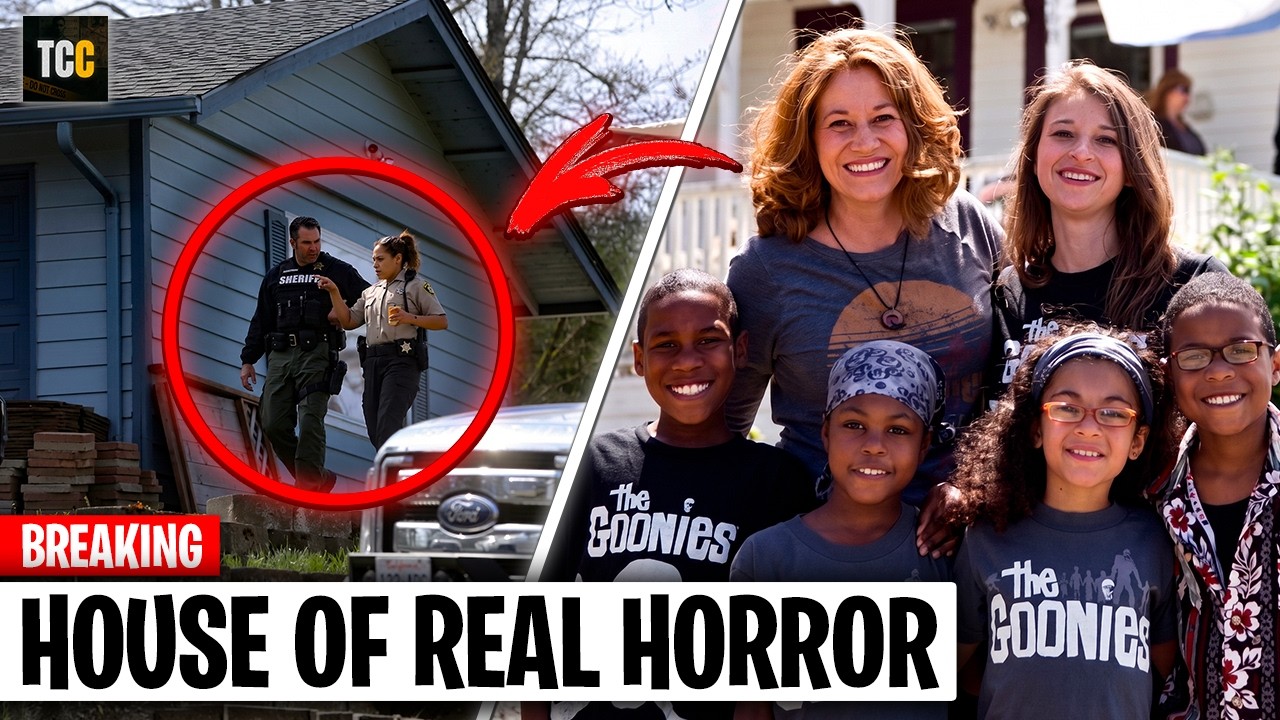
The vehicle accelerated across seventy feet of gravel and went off a hundred-foot cliff, nose first, and rolled onto the rocks below. The speedometer needle was later found pinned at ninety. There was no braking, no hesitation, no correction of the wheel. In the driver’s seat was Jennifer Hart.
Beside her sat her wife, Sarah. In the back were six of their adopted children. Jennifer Jean Hart was born in 1979 in Huron, South Dakota, a small railroad town where she was the oldest of three. People who knew her described someone with an enormous appetite for attention and a talent for filling whatever room she entered.
Sarah Margaret Engler was born ten weeks earlier and grew up in Big Stone City, near the Minnesota line. She was quiet, conscientious, the kind of student teachers remembered as easy to overlook. They met at Northern State University in Aberdeen, both studying elementary education, Sarah concentrating on special education. In rural South Dakota at the end of the nineties, their relationship stayed private.
Jennifer would later write publicly that when they stopped hiding it, they lost friends over it. That version of events, two women against a hostile world, became foundational. She would return to it for the next two decades whenever anyone questioned anything about her household. In 2004, the couple moved to Alexandria, Minnesota, and decided to be open about who they were.
Sarah worked her way up to management at a department store. Jennifer cycled through jobs and by 2006 stopped working outside the home entirely. That divided the household along a line that never moved. Sarah earned.
Jennifer ran everything else: the schedule, the rules, the discipline, and eventually the public story of the family. In 2009, they drove to Connecticut to legally marry. By then, they were not two people anymore. They were eight.
Before the adoptions, the couple had served as foster parents to a fifteen-year-old girl. It did not last. A week before their first three children were scheduled to arrive, they drove the teenager to a routine therapy appointment and dropped her off. They never came back for her.
The therapist had to tell her. The girl received no warning. It was not unlawful. It was simply a cold administrative act that would look very different a decade later when investigators finally pulled the family’s history apart and found the pattern had been there from the first page.
The children came from Texas, all six in two batches, twenty-seven months apart. Marcus, Hannah, and Abigail arrived in 2006, removed from a home and placed together, the outcome caseworkers fight for and rarely get. Jennifer was twenty-six. Sarah was twenty-six.
Neither had raised a child. Two years later, they adopted three more: Devonte, Jeremiah, and Sierra. Their biological mother lost custody over substance abuse, and the children had been placed with their paternal aunt, who wanted them and was related to them by blood. She called the children’s mother one day to babysit while she covered an extra shift at work.
A caseworker observed it, and the children were removed from the aunt’s home. The court barred her from obtaining permanent custody. The three children went into foster care and then out of state to a couple in Minnesota with no connection to them whatsoever. A fourth sibling, Dante, the oldest, carried behavioral problems and stayed behind in the Texas system.
He would spend his adolescence moving between placements while his younger brother’s face became a national symbol of tenderness. He never saw any of them again. By the summer of 2008, the Harts had six adopted children under the age of eleven. All six were black.
Both mothers were white. They lived in a small, overwhelmingly white town in west-central Minnesota. Adoption assistance subsidies followed the children out of state. Across the years, the payments totaled roughly $270,000 and accounted for close to half of everything the household lived on.
Every child in that house represented income. Jennifer, who did not work, built her entire identity around being their mother. Jennifer built the family’s public life on Facebook, and she was good at it. Six children in matching colors at music festivals.
Six children barefoot at the Oregon coast. Six children at a Bernie Sanders rally holding signs. Road trips, drum circles, long captions about race in America and building a family on purpose rather than by accident. She called them the heart tribe.
Thousands of people followed along. Then came November 2014, Portland, Oregon. Protests over the grand jury decision in Ferguson. Twelve-year-old Devonte stood in the street in a fedora with a cardboard sign that read Free Hugs, tears running down his face.
A police sergeant approached him. The boy asked for a hug, and a photographer caught the moment the officer put his arms around him. The image ran everywhere. It was reproduced as evidence that the distance between a black child and a white cop could be closed by ordinary human contact.
Devonte gave interviews. The family became a national fixture. What the audience did not see was the inside of the house. People who spent real time with the Harts described children who raised their hands before speaking at the dinner table.
Children who did not laugh at meals. Children not permitted to wish one another a happy birthday. A friend once watched Jennifer order pizza for the six and portion it out, one narrow slice each. When the box came back empty, the punishment was collective: no breakfast the following morning and an hour lying motionless on a bed.
Two separate observers reached for the same word: robots. Another said the children seemed frightened of Jennifer specifically and watched her face constantly, the way you watch weather. During photographs the children performed, smiled, arranged themselves. The shutter closed and within seconds the animation drained out of all six at once.
Food was the mechanism. It was withheld as discipline, granted as reward, measured constantly. It produced children who were noticeably small. Marcus, at nineteen, was under five feet tall.
Nobody outside the house did that arithmetic. The first report came in 2008. A teacher noticed bruises on Hannah’s left arm. The girl said Jennifer had hit her with a belt.
The mothers said she had fallen down the stairs. Nothing was substantiated. In 2010, six-year-old Abigail told her teacher she had been beaten after a penny went missing, her head held under cold water. When investigators interviewed all six children, they described routine spankings and being deprived of food.
Sarah stepped forward and pleaded guilty to a misdemeanor assault charge. Her sentence was a year of community service. Jennifer’s name stayed off the paperwork entirely. A year later, a school nurse reported that Hannah had said she had not eaten all day.
Sarah’s response was that the girl was playing the food card and that water would be sufficient. Shortly afterward, all six children were pulled out of public school permanently and declared homeschooled. Teachers, nurses, bus drivers, coaches: every mandated reporter who had ever laid eyes on those children was removed from their lives in a single legal administrative gesture. The family moved west, first to West Linn, Oregon, then in 2017 to a rural property outside Woodland, Washington.
They cut off relatives who had criticized how the children were being raised. Oregon authorities opened their own investigation in 2013. Caseworkers interviewed every family member separately. Friends described the raised hands, the rationed pizza, the frightened children.
Then they interviewed the children themselves. The children said nothing. Jennifer produced the argument she had been building for a decade: the complaints were not about her parenting at all. They were about two lesbians raising six black children in a country that could not tolerate it.
Oregon closed the case. The house outside Woodland sat next door to Bruce and Dana DeKalb. In August 2017, at roughly one-thirty in the morning, Hannah, then fifteen, came to their door. She had gone out her second-floor window, was wearing almost nothing, and was shaking.
She begged them not to send her back. She told them her mothers were racist and the children were abused. She said she wanted protection and told them she was twelve. The Harts found her before anything could be done.
Jennifer’s explanation followed the established formula: Hannah was lying, a drug baby acting out, and her biological mother was bipolar. Nothing had happened. Then Devonte started coming to the fence. He was fifteen, and he came for food, repeatedly, over months.
He asked the DeKalbs to leave things for him where nobody in his own house would see, and every time, not to tell Jennifer. By March 2018, the DeKalbs had heard enough. They contacted police and the Washington State Department of Social and Health Services. On Friday, March 23, 2018, a caseworker drove to the Hart property.
She knocked and rang the bell. Nobody answered. Following procedure, she wedged her card into the front door and left, intending to return. Someone took the card.
The family did not stay. That same day all eight loaded into the Yukon and drove away. At three the next morning, Sarah sent a text to a friend saying she was so sick she might have to go to a hospital. The caseworker returned on Monday.
The house was empty. A welfare check found nobody home. Investigators later reconstructed the drive out of cell tower pings, store receipts, and security cameras. It was not a family fleeing in panic.
It was a family on vacation. At a Walmart in Longview, they bought store-brand Benadryl. At half past midnight on Saturday, Sarah picked up her phone and started searching: how much Benadryl it would take to kill a person, whether drowning is painless, how long it takes. The searches continued intermittently for eighteen hours.
She also researched no-kill shelters for dogs. The dogs never made it to a shelter. They were left behind at the house in Woodland. By eight in the evening, they were in the Fort Bragg area on the Mendocino coast.
On Sunday morning, a Safeway security camera recorded Jennifer buying groceries, bananas visible among the items. It is the last confirmed image of any member of the family alive. Sometime after nine that evening, the Yukon pulled back onto Highway 1 and turned north, back onto the road they had just traveled, a fifteen-mile stretch of two-lane highway where the shoulder falls straight into the Pacific and there is no lighting after dark. Toxicology later established what was happening inside the vehicle on that final leg.
Sarah had a very high level of diphenhydramine in her blood, approaching toxic, a minimum of forty-two doses. Three of the children had taken large amounts as well. Jennifer took none. She had been drinking, with a blood alcohol of .
102, above California’s limit. People who knew her said she almost never drank. Four passengers were sedated to the point of unconsciousness. One was awake and impaired.
The driver had put just enough alcohol into herself to get through the next few minutes. The Yukon went over the edge just before midnight. It landed upside down on the rocks below and lay there through the night and most of the next day, in and out of the tide. Around three-thirty on Monday afternoon, a passing motorist looked down and called it in.
Jennifer was in the driver’s seat, wearing her seatbelt. Sarah was in the front passenger seat. Both women had died of multiple blunt force injuries. Three of the children were found outside the car on the rocks: Marcus, nineteen, Jeremiah, fourteen, and Abigail, fourteen.
That was five bodies. There should have been eight. Hannah, Sierra, and Devonte were not there. The search that followed was enormous.
Helicopters worked the cliffs. Boats worked the water. The FBI listed Hannah and Devonte as missing children. For a few days the theory circulated that one or more had never been in the truck.
Investigators worked that possibility hard because they had to. Nothing turned up. The sheriff of Mendocino County stopped calling it a crash. The black box had recorded a decision.
In the house outside Woodland, investigators found the property in disorder and the family’s finances far worse than anyone had understood. Sarah’s search history came off her device and later went in front of a jury. California Highway Patrol investigators asked the people who had known the Harts best whether they believed the couple was capable of killing their own family. Most of the witnesses said yes.
The bodies came back slowly over ten months. Sierra was recovered in April 2018. Hannah took far longer. What was found was a shoe with a foot still inside it; DNA matched it to her.
The identification was confirmed in January 2019, nearly a year after she went into the water. Devonte was never recovered, not a fragment. The Pacific kept him. Because everyone responsible was dead, there could be no trial.
In April 2019, Mendocino County convened a coroner’s inquest. Fourteen jurors heard the pathologist on the alcohol and the diphenhydramine, the reconstructionists on the eight seconds recorded by the black box, and the search history read aloud. They heard that the children in the back were almost certainly unconscious before the truck ever moved. The jury deliberated for about an hour and returned a unanimous verdict: Jennifer Hart, suicide.
Sarah Hart, suicide. All six children, aged twelve to nineteen, died at the hands of another. The following day, a death certificate was signed for Devonte, whose body has never been found. Everything had been documented over ten years: the bruises, the conviction, the interviews, the reports in three states, the neighbor’s call, the caseworker’s card in the door.
None of it was ever assembled into a rescue. Six children were removed from families that wanted them and handed to a household that photographed them beautifully and fed them almost nothing. The photograph of Devonte is still circulating. It still means what people wanted it to mean.
It just is not a picture of a boy being saved.






