The intake ledgers for that upstate New York ward were kept in meticulous copperplate script, the kind of handwriting taught in an earlier age, when a doctor’s records were expected to remain readable to anyone who might someday need them. The entries ran across almost fourteen years, from the winter of 1871 through the opening months of 1885, and they recorded the names of forty-three patients admitted under one physician’s care. What unsettled readers of those records was not the names. It was the adjacent column, headed discharge date, which for thirty-one of those forty-three patients had been left completely empty.
Not labeled deceased. Not transferred. Not escaped. Just empty.
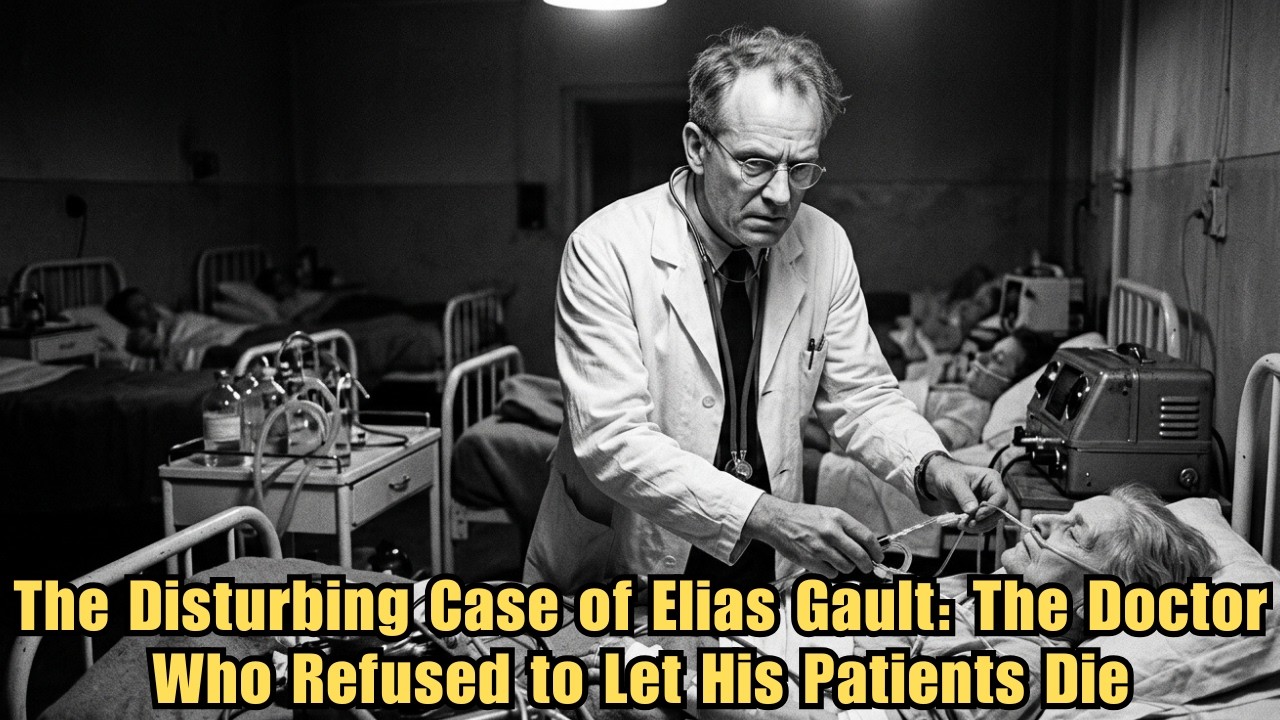
For decades those ledgers remained in the basement of a former county building, unread and uncataloged, bundled beneath the papers of a man whose medical license had been given up quietly, with no public hearing, in the spring of 1885. His name was Dr. Elias Gault. And if you had asked anyone in the village of Harwick Hollow during those years what sort of doctor he was, they would have answered at once that he was the finest physician in the county, a man of remarkable gifts, a man committed above all else to keeping his patients alive.
On that last point they were correct. The hamlet of Harwick Hollow lay at the floor of a narrow glacial valley roughly forty miles northeast of Albany, wedged between the Helderberg Escarpment on the west and a thick stand of old-growth hemlock forest on the east. It was not a wealthy place. It had never been wealthy.
The farms that rose along the valley’s lower slopes grew enough rye and potatoes to carry families through the long winters, but never enough surplus to draw the kind of commerce that might have turned it into a proper town. There was a mill, an inn, a general store, a Methodist church of pale clapboard in need of paint, and, by 1868, a one-room medical office attached to the back of the Gault house on Fallow Creek Road. The county seat was in Coxsackie, nearly two hours away by road when the weather allowed, which it rarely did between November and April. Before Elias Gault came in the autumn of 1866, the closest physician had been an elderly man named Dr.
Prentiss Halverson, who rode a circuit among four villages and was known as much for his taste for bourbon whiskey as for his medical skill. When Halverson died of a stroke while fording a creek in the spring of 1866, the valley was left with no medical care at all, and the town council, such as it was, being three farmers and the mill owner, had quietly begun to lose hope of finding anyone qualified to take his place. Elias Gault was thirty-two years old when he arrived. He came from Albany, where he had finished his formal training at Albany Medical College and then spent two years working the wards of Albany City Hospital.
His colleagues there would later describe him as methodical, precise, and unusually patient. A man who kept careful notes and revised them carefully. A man who never appeared to weary of a difficult case after other physicians had already begun to call the situation hopeless. In 1864, he had published a single paper in the American Journal of Medical Sciences on respiratory complications in patients recovering from typhoid fever.
The paper was unremarkable. What stood out was its tone: clinical, almost cold, as if the suffering of the patients it described were variables in an arithmetic problem rather than experiences being endured by living people. Nobody in Harwick Hollow read medical journals. What they saw was a tall, angular man with careful dark eyes and very clean hands.
Gault, who arrived on a Tuesday with a leather trunk full of instruments and reference texts, rented the house on Fallow Creek Road from the widow Tilda Mosgrove and opened his office within the week. He charged modest fees. He made house calls in all weather. He did not drink.
He attended the Methodist Church on Sundays without visible devotion, but also without visible reluctance. He was courteous to everyone and close to no one. Within a year, he was the most trusted man in the valley. There was reason for that trust.
In his first winter, a diphtheria outbreak swept through the farms along the eastern ridge and killed six children before Gault contained it. He did so by isolating the sick, enforcing quarantine with a firmness that angered several farmers who could not afford to be kept from their livestock, and administering treatments, some drawn from European literature that had not yet reached standard American practice, that seemed to slow the disease’s progression in at least three cases where death had appeared inevitable. The children who survived became a kind of testament. Their parents spoke of Gault with a reverence that the Methodist minister found slightly uncomfortable.
By the early 1870s, the valley’s population had grown modestly, not through prosperity, but through the arrival of two dozen German immigrant families who had come to work the limestone quarry that opened on the escarpment in 1869. These families brought their own ailments: industrial injuries from the quarry work, the chronic respiratory complaints that came from breathing stone dust, and, among the older men, the accumulated damage of decades of hard labor in worse conditions than anything Harwick Hollow offered. They also brought a cultural deference to educated professionals that fit comfortably alongside the valley’s existing respect for Gault’s abilities. It was for these quarry workers, and for the valley’s poorest farming families, that Gault proposed the ward.
He came to the town council in the winter of 1870 with a proposal written in the same precise hand that filled his patient ledgers. The valley, he argued, needed a facility for the care of patients whose conditions required sustained attention, not the kind of attention a family with a farm to run and other children to feed could provide, but the continuous professional attention that only a dedicated medical environment could offer. He had already found a building for the purpose: the old Renner farmhouse at the end of the hollow, which had stood empty since the Renner family left for Ohio in 1868, and whose owner, a man in Albany who had inherited it without interest, was willing to lease it for a modest annual sum. The council approved the proposal with some hesitation.
One member, a farmer named Cornelius Vander, raised the question of oversight. Who would inspect the facility? Who would ensure that its operations met the standards of the county medical board? Gault answered patiently that he would maintain full records and submit them to the county medical officer annually, as required by law.
This would not be a formal hospital, he clarified, but a private care home run under his license, which freed it from certain regulatory requirements while still upholding professional standards. Vander remained somewhat unconvinced, but the other council members were persuaded, and the motion carried three to one. Construction on the Renner farmhouse started in the spring of 1871. By November of that year, the ward—as it came to be known, though it had no official name—was prepared to accept its first patients.
The first patient taken in was a quarry worker named August Brenner, forty-seven years old, a native of Baden-Württemberg who had been in the valley for two years and whose lungs Gault concluded had been badly damaged by stone dust. Brenner’s breathing had deteriorated over the autumn to the point where he could no longer work, and his wife, Marta, had worn herself out trying to nurse him while also managing their four children and the small kitchen garden that supplemented their income. When Gault proposed that August might benefit from the care of the ward—consistent monitoring, proper ventilation, a diet tailored to his specific condition—Marta Brenner agreed with the relief of a woman who had been carrying a weight she could not set down. She visited the following Sunday.
The farmhouse had been turned into something clean and orderly, with four beds in the main room and two in a smaller chamber off the kitchen that Gault had enlarged with a lean-to addition. There were linen curtains on the windows, a wood stove that kept the air warm and dry, and a smell that Marta connected with a hospital she had glimpsed in Baden as a girl: carbolic, metallic, precise. Elias Gault met her at the door in his white coat and led her to August’s bed. August was sitting up, breathing more easily than he had in months.
He held Marta’s hand and told her the food was good. The doctor checked on him twice a day, and he was sleeping through the nights for the first time since summer. Marta Brenner went home reassured. She returned the following Sunday and the Sunday after that.
On the third Sunday in January of 1872, she arrived to discover that August had been moved to the smaller chamber off the kitchen. Gault explained that the main room was being used for a patient who needed more intensive care, and that August’s condition had stabilized enough that he could be moved without any risk to his treatment. He said this gently and clearly, with the unhurried manner that people in the valley had come to associate with absolute competence. Marta nodded and went to see her husband.
She noticed that the door to the small chamber had a new bolt on the outside. She said nothing about the bolt that day. She told herself it was for privacy, or for keeping out drafts, or for some other sensible medical reason she did not have the expertise to understand. But the bolt lingered in her mind the way an unexpected sound lingers in the ear long after it has passed.
When she returned the following week, a woman she did not recognize answered the front door and told her that the doctor was not in, and that Sunday visiting hours had been changed to two hours in the afternoon starting at two o’clock. Marta had arrived at half past one. So she waited in the cold for thirty minutes, then was admitted and taken to see August, who was sitting in the same position as the week before, in the same chair, with a blanket over his knees. He said he was feeling well.
His voice was flat in a way that Marta could not quite identify. When she asked him whether he wanted to come home now that his breathing had improved, he said the doctor thought it was too soon. When she asked him what the doctor had said exactly, he paused for a moment—a pause she would remember for the rest of her life—and said he couldn’t quite recall. Outside, walking back through the snow along the hollow road, Marta Brenner tried to understand what was bothering her.
Her husband was alive. His breathing was better. The facility was clean and orderly and under the care of a physician everyone respected. She had no evidence of anything wrong.
Only the bolt, and the pause, and the flatness in his voice, and the feeling, which she could not justify and could not dismiss, that her husband was being kept in that house the way a specimen is kept in a jar: preserved, and still, and entirely in someone else’s keeping. She did not know, as she walked home through the late January cold, that she had just had the last real conversation with August Brenner that she would ever have. He remained in the ward for six more years. The valley moved on as valleys do.
The quarry expanded. Three of the German families bought farmland and began to put down roots deep enough to feel permanent. A second general store opened. The Methodist Church got its fresh coat of paint.
Elias Gault’s ward received, over the following years, a slow and steady stream of patients. Some were sent by Gault himself after house calls, some arrived through referrals from neighboring communities that had begun to hear of the facility. One or two were brought in carriages by relatives from as far as Albany who had been told by someone who knew someone that Gault could manage conditions other physicians had given up on. The ward expanded.
By 1875, Gault had added a full second story to the Renner farmhouse and enclosed the lean-to into a proper wing. A woman named Theodora Kepler, who had trained as a nurse at a hospital in Utica and come to Harwick Hollow to care for an aging aunt, was hired as the ward’s only regular staff besides Gault himself. Kepler was efficient and quiet, and told anyone who asked that the work was satisfying and that Dr. Gault was an exceptional physician.
She said this without warmth, in the same careful, uninflected way that Gault himself spoke about nearly everything. Among the families whose relatives had been admitted to the ward, there was a layer of unease that grew slowly, the way ice grows on a still pond. You can’t see it happening, but one morning you step on what you thought was water and find it solid beneath your boot. Marta Brenner was not the only wife or daughter or son who had noticed something they could not name.
Carl Fritsch, whose father Otto had been taken into the ward in the spring of 1873 after a quarry mishap left him with a raging infection in his lower leg, discovered that the steady progress Gault reported, in full and frequent detail, never appeared to bring his father any closer to being released. Whenever Carl pressed about when the old man might return home, Gault would supply yet another complication, another stage of treatment that still had to be completed, another danger of relapse that no responsible doctor could overlook. The reasons were always believable. They came in the same measured, unhurried tone, and they always left Carl Fritsch trudging back down the hollow road with the vague sense that he had been a fool to ask at all.
Then there was the matter of the paperwork. When a patient died in the ward, as some did, the very old, the very sick, those whose illnesses had gone too far for even Gault’s methods to check, Gault submitted death certificates to the county as the law demanded, and these were properly entered in Coxsackie. Yet the certificates arrived in batches, at times months after the patient had actually passed, and the causes given were without exception the condition the patient had first presented with: lung disease, septic infection, heart failure. Not once had a county medical officer come out to the ward to examine its records or its circumstances.
In itself, this raised no alarm. Medical supervision by county authorities in rural New York during the 1870s was, for all practical purposes, almost unknown. But the result was that Gault’s intake logs and discharge records, the ones containing that empty column, existed nowhere except in his own files inside the farmhouse at the end of the hollow. In the summer of 1876, a traveling preacher by the name of Absalom Crane passed through Harwick Hollow on his yearly swing among the valley settlements.
Crane was unremarkable in most ways, but he had a keen eye, and he had visited the valley in each of the six years before. He took note of what had altered and what had stayed the same. He took note that the old Renner farmhouse stood considerably bigger than when he had last seen it. He took note of the additional chimneys, and of the curtains in what looked like second-story windows, which were forever pulled shut.
He took note that when he inquired at the inn that night about the establishment at the end of the hollow, the innkeeper, a plainspoken fellow named Peter Schiller, hesitated before replying in a manner Crane judged to be calculated. “It’s the doctor’s place,” Schiller said at last. “Gault’s ward.”
“And it does good work?”
Crane asked. Schiller met his gaze without flinching. “People go in,” he said. Crane said nothing and waited.
“And they don’t often come back out,” Schiller said, then swung away to scrub the bar and would say nothing further on the matter. Crane sat over his supper and turned Schiller’s words over in his mind. He kept turning them over for the remainder of his circuit, and when he got back to Albany that autumn, he brought it up almost casually at dinner with a colleague, a man named James Aldgate, a reporter for the Albany Evening Journal who gathered odd observations the way other men gathered postage stamps. Aldgate wrote nothing about it at once, but he held on to the name Elias Gault, Harwick Hollow, and he set about making inquiries quietly, and without any hurry.
It took James Aldgate the better part of two years to pull together enough material to convince himself he was dealing with something genuine rather than a jumble of unrelated complaints and hearsay. He was a cautious reporter, cautious enough to have learned through hard experience where the line fell between a story and a grudge, and what it cost to confuse the two. So he gathered slowly. Through the county clerk’s office in Coxsackie, he secured the death certificates Gault had filed between 1871 and 1878.
There were eleven in all. He set them beside the intake records he had managed to piece together in part from interviews with the families of admitted patients. The arithmetic was disturbing. From those interviews alone he could name at least twenty-eight people who had entered the ward during that stretch.
Eleven had death certificates. Of the other seventeen, he could uncover no record that any had ever been discharged. He made the trip to Harwick Hollow in the autumn of 1878 and put in four days at the inn, talking with anyone willing to speak with him, which turned out to be fewer than he had counted on. Peter Schiller, who had first set the thing in motion two years before through the circuit preacher’s account, talked with him at length, though never anywhere but the back room of the inn and never until he had made certain no one else was within earshot.
What Schiller told him was nothing dramatic. It was a string of small, everyday observations that together built a picture Aldgate found profoundly disturbing. In the warmer months Schiller had seen patients out in the ward’s yard, seated in chairs or shuffling slowly about near the garden Kepler tended on the south side of the building. Once he had spoken with a man he knew to be Emil Vorst, a farmer from the upper end of the valley who had been taken in two years before with a harsh winter illness that had almost finished him.
Vorst had gotten better. Anyone could tell that just by looking at him. He walked unaided, talked sensibly, and displayed no evident signs of serious sickness. Schiller had asked him when he would be going home, and Vorst had turned on him a look that Schiller could only call deliberately empty, and replied that the doctor had not yet decided it was safe.
Then Kepler had appeared around the corner of the building, and Vorst had glanced away, and the exchange was over. That look, deliberately empty, was the phrase that stuck with Aldgate. He had gotten some version of it from Marta Brenner, who still came to see her husband August each Sunday, four years after he was admitted, though August no longer seemed to know her from one visit to the next. He had gotten it from Carl Fritsch, who had been barred from seeing his father Otto for more than a year, Gault having explained that the older Fritsch was in a fragile stage of treatment that called for total rest and as little stimulation as possible.
He had gotten it from a woman named Louisa Tanner, whose mother had been admitted in 1874 and who three months afterward had received a death certificate giving the cause as cardiac failure, though the last time Louisa had seen her mother, the woman had been up and walking, clear-headed, and showing no sign of distress. Aldgate was a newspaperman, not a doctor, and he understood the boundaries of what he knew. But he had spent two years covering the Albany City Hospital and had picked up a thing or two about medical practice. What he was hearing pointed to a pattern that incompetence by itself could not account for.
Incompetence loses patients. It does not keep them. He asked for an interview with Gault. Gault said yes, which caught him off guard.
Their meeting took place in the front room of the ward on a chilly Thursday in November. The space was exactly as tidy and well-ordered as everyone had said: whitewashed walls, scoured floorboards, linen curtains filtering the dull, gray November daylight, and a slight carbolic acid smell that was not disagreeable. Gault sat opposite Aldgate, hands clasped on his knees, and responded to each question in the same careful, deliberate tone. The death certificates, he said, were accurate.
The cases Aldgate had raised were too delicate to address in detail, since patient confidentiality was a professional duty he regarded seriously. The facility’s records could be made available to the county medical officer on request. He had nothing to conceal and disliked the suggestion that he did. Aldgate then asked, as tactfully as he could, about those patients who seemed to have recovered but had never been discharged.
Gault regarded him briefly. Then he spoke: “Recovery is not the same as cure, Mr. Aldgate. A man who stops coughing may still be contagious.
A woman whose fever breaks may relapse without warning. Discharging a patient early, when I have not fully resolved their condition, is in my professional judgment a greater cruelty than keeping them somewhat longer than their family might wish. I have witnessed what happens when people go home too soon. I have seen them die in the very beds their children sleep in.
I have seen entire families consumed by illnesses that proper isolation would have stopped. What I do here is not comfortable, but it is correct.”
It was an entirely reasonable reply. It was the sort of reply that could not be contested, because it rested on sound medical reasoning and was expressed in terms of the patient’s welfare.
Aldgate departed the ward that afternoon without having found a single thing he could identify and call wrong. He was left only with the feeling, stubborn and cold and precise, that he had just been handled very expertly by a man who had done so many times before. He went back to Albany and started writing the only story he could actually write: not an accusation, but a question. The article ran in the Albany Evening Journal on the fourteenth of February 1879.
It was cautious, restrained, and profoundly disturbing to anyone who read it attentively. Aldgate leveled no crime at Gault. He laid out the ward’s operations, the families’ worries, the discrepancy between admissions and recorded discharges, and he put forward a series of questions nominally directed at the county medical board concerning the oversight of private care facilities in rural counties. He named no patients, cited no particular cases, and never once made an allegation that documented fact could not support.
In every legal and journalistic respect, it was a model of prudent reporting. It was also, within the valley of Harwick Hollow, taken as a declaration of war. Gault’s supporters—and they were numerous, for he had served as the valley’s physician for thirteen years and had in that time truly saved lives that would otherwise have been lost—were outraged. The town council convened a meeting at which Cornelius Vander, now older and somewhat gentler toward Gault, moved that the council send a letter to the journal expressing its confidence in the doctor’s character and the facility’s operations.
The motion carried unanimously. The minister delivered a sermon the next Sunday on the sin of slander. Three of the German families whose members were not patients at the ward circulated a document bearing forty-two signatures vouching for Gault’s professional conduct. Marta Brenner did not sign it.
Neither did Carl Fritsch. And four or five others, quieter and less eager to attract notice, likewise declined to sign, and in the weeks after the article appeared they became the focus of a kind of social pressure that fell short of outright ostracism yet produced much the same practical result. The valley had made up its mind about what it believed, and it believed in Elias Gault. Those who did not were an awkward presence in a community that had arranged itself around his competence for more than ten years.
Yet Aldgate’s article had also been read in Albany, where it came to the desk of the state medical board’s administrative secretary, a man by the name of Horace Delacroix, who was methodical in his own fashion and who took seriously his duty to act on credible complaints about licensed practitioners. Delacroix wrote to Gault asking for a formal submission of patient records covering the previous five years. The letter was courteously phrased and presented as routine administrative procedure. It reached the Gault house on Fallow Creek Road in the third week of February.
What occurred next is recorded only by indirect means. A farmhand named Silas Prout, who sometimes assisted with deliveries along the hollow road, afterward told Aldgate that on the night of February twenty-third he had noticed a substantial quantity of smoke rising from the chimney of the ward’s new stone outbuilding, the one added to the property in 1876 that seemed to serve as storage for the ward’s records and supplies. It was, Prout said, more smoke than a heating fire would give off. It was the sort of smoke that paper makes.
Three weeks afterward, Gault submitted to the state medical board a set of records covering only the years 1876 to 1879, which for that span showed nineteen patient admissions and nineteen corresponding discharges or death certificates. The records were neat, readable, and internally consistent. Delacroix examined them, found no obvious irregularities, and filed them. For the time being, the inquiry halted.
But something else had already started. Among the families who had read Aldgate’s article, and who saw themselves in the questions it raised without naming them, a slow hardening of resolve took hold. They had been cut off from one another, each family handling its own doubt, its own carefully sensible explanations, its own hesitation to appear ungrateful to the man who had, after all, kept their relative alive. Yet the article had shown them they were not alone, that others were asking the same questions, that the questions themselves were not unreasonable.
Marta Brenner wrote a letter to James Aldgate. So did Carl Fritsch. So in time did a woman named Hedwig Ross, whose brother Conrad had been admitted in 1874, and who had ceased receiving any word from the ward in 1877, when Gault informed her by post that Conrad’s condition had worsened past the point where visits could be allowed. Conrad Ross would have turned forty-one in 1879.
His death certificate, which Gault had not yet filed, did not exist. In the spring of 1879, Aldgate traveled back to Harwick Hollow with the letters in his coat pocket and a considerably clearer understanding of what he was facing. This time he did not ask for a meeting with Gault. He went straight to the ward and requested to see the patients.
Kepler met him at the door. She was courteous and would not be moved. The ward was not open to unannounced visits. The doctor was not there.
She would pass along his request. Aldgate specifically asked to see August Brenner. Kepler replied that Mr. Brenner’s care requirements did not allow for unannounced visits.
Aldgate then asked to see Conrad Ross. Kepler’s expression did not change, but something behind her eyes shifted in a way that Aldgate noticed and filed away. She said she was not aware of a patient by that name. Aldgate said that Conrad Ross had been admitted to this facility in July of 1874 and had not been reported discharged or deceased.
Kepler said she could not discuss individual patient cases. She said it with perfect composure. Then she closed the door. Standing on the steps of the former Renner farmhouse in the mild April light, listening to the sound of the bolt being drawn on the other side of that door, James Aldgate understood, with a clarity that moved through him like cold water, that he was not looking at a story about negligence.
The investigation that followed was not swift, and it was not clean. And it did not produce the kind of dramatic single revelation that makes for a satisfying story. What it produced was a slow accumulation of pressure, legal, medical, and journalistic, that eventually made Elias Gault’s situation untenable in a way that all his careful management could not address. It began with Marta Brenner.
In May of 1879, she retained a lawyer, a young man in Coxsackie named DeWitt C. Hollis, who had read Aldgate’s article and who agreed at a reduced fee to pursue a formal petition to the county court for access to her husband. The petition argued that Marta, as August Brenner’s wife, had a legal right to information about his condition and to make decisions regarding his care. It was a straightforward legal argument, and Hollis made it well.
The county judge, a cautious man named Orville Strang, who was aware of Gault’s standing in the community and disinclined to create controversy, nevertheless signed the order in June because he could find no legal basis for refusing it. Gault’s response, submitted through his own lawyer in Albany, was to present August Brenner’s condition as one of severe mental deterioration. The result, he claimed, of the original lung disease’s impact on August’s neurological function. He submitted a medical report in his own hand describing a man who was no longer capable of self-directed action or coherent communication, and who required continuous institutional care for his own safety and the safety of others.
He argued that Marta Brenner’s visits, far from benefiting August, were causing him distress that set back his treatment. Judge Strang appointed a neutral physician from Albany, a man named Dr. Francis Cleary, to evaluate August Brenner’s condition and report to the court. Cleary visited the ward on a Tuesday morning in August of 1879.
He was accompanied by a county constable, which Gault had not been informed would be the case, and which Kepler, meeting them at the door, had no legal basis to refuse. Gault himself was not present. He was at his office on Fallow Creek Road. Kepler led them through the ward with the careful composure of someone who had rehearsed this, or something like it, many times.
What Cleary found in the main room of the ward were three patients, all elderly, all in beds, all in states of apparent sedation. He examined them briefly and noted in his records the smell he associated with laudanum, the tincture of opium that was in the 1870s legal, widely available, and routinely misused. He noted that the patients’ muscle tone suggested long-term immobility, and that one of the three, a woman he could not identify, as no names were displayed, showed signs of pressure sores consistent with months or years of being confined to bed. He asked Kepler to show him the remaining patients.
Kepler said that the other rooms were in use and could not be disrupted. The constable said that the court order covered the entire facility. Kepler said she would need to consult with Dr. Gault.
The constable said that was not an option currently available to her, and stepped past her into the hallway. The second and third rooms held two patients each, in similar conditions to those in the main room. The small chamber off the kitchen, the one with the bolt on the outside, held one patient. Cleary estimated the man’s age at approximately fifty, which matched August Brenner’s age in 1879.
The man was awake, in a chair by the window, and he looked at Cleary when Cleary entered the room with the slow, slightly unfocused attention of someone who had been in a chemically dampened state for a long time. Cleary asked him his name. The man said, after a pause, that his name was August. Cleary asked him what month it was.
August looked out the window at the summer light, then back at Cleary, and said he didn’t know. Cleary asked him if he wanted to go home. August was quiet for a long time. Then he said, slowly and with evident difficulty, “I don’t think the doctor wants me to.
“
That sentence, six words, spoken by a man who appeared physically recovered from a respiratory illness that had been his original reason for admission eight years earlier, was the center of Francis Cleary’s report to the court. The report concluded that August Brenner showed no signs of active disease requiring institutional care, that his cognitive impairment appeared consistent with prolonged administration of sedative compounds rather than neurological disease, and that his retention in the facility was, in Cleary’s professional opinion, medically unwarranted. The report also noted carefully that the ward’s population appeared to consist primarily of patients who had, by all physical evidence, recovered from their presenting conditions, and who were being maintained in a state of pharmacological compliance that prevented them from exercising or expressing any desire to leave. Gault was called before the state medical board in October of 1879.
He came prepared with records, citations, and a detailed defense of his treatment protocols. He argued that Cleary’s observations were those of a general practitioner unfamiliar with the specific complexities of long-term chronic care. He argued that the medications he used were standard components of any responsible treatment regimen for patients with the profiles his ward served. He argued that Marta Brenner’s petition was the product of a misunderstanding about the nature of her husband’s condition, amplified by irresponsible journalism.
He was persuasive. He had always been persuasive. And the board in 1879 was not equipped to act decisively on what it had, which was a pattern of suspicious evidence rather than a single clear crime. But they kept watching.
And in the watching, more came out. Hedwig Ross finally demanded a formal accounting of her brother Conrad. Gault filed a death certificate in December of 1879 listing the cause as pneumonia and the date of death as September of the previous year. Hedwig, with Hollis’s help, then petitioned for access to the burial records.
The cemetery on the hollow road held nothing under Conrad Ross’s name. Gault’s explanation was that Conrad had been buried on the ward’s grounds, property he himself owned, at the family’s request. A request Hedwig went on record to deny had ever come from any relative, since no relative had been told of Conrad’s death until fifteen months after it supposedly took place. In the spring of 1880, an inspection of the ward’s property turned up signs of a small fenced-off patch on the north side of the building that looked as though it had served as a graveyard.
It held the remains of no fewer than four people. Three were ultimately named through the laborious process of comparing physical descriptions with intake records: Conrad Ross, a quarry worker called Philip Austin, and a woman from a neighboring valley whose family had been told she was discharged in 1875. The fourth was never named. Throughout it all, Gault insisted the burials had been carried out with the family’s knowledge and consent, that the deaths had stemmed from natural causes in keeping with the patients’ conditions, and that the late paperwork was an administrative lapse rather than a deliberate cover-up.
Again and again, in one legal setting after another, he was pressed to account for the empty discharge column. He called it a clerical arrangement he had since overhauled. He called it a byproduct of how he kept his records. He said it signified nothing at all.
The board could not establish that it signified anything conclusive. What they could do, and in the spring of 1885 did, was rule that his habit of giving patients sedative compounds with no documented medical reason, his neglect in keeping proper death records, and his repeated blocking of families’ legitimate efforts to reach their relatives amounted to grounds enough for him to surrender his license. The action was administrative, not criminal. No trial was held.
No jury was empaneled. There was a closed hearing, a formal agreement, and Elias Gault’s name on a document pledging that he would give up the practice of medicine in New York State at once and for good. He departed Harwick Hollow that spring. He headed somewhere west.
Years afterward there were reports placing him in Pennsylvania, then Ohio, then farther off still, always in counties where word of him had not arrived ahead. The ward on the Renner farmhouse property was cleared out, and the six patients still there, August Brenner among them, were sent back to their families or, in two instances where no family could take them, moved to the county almshouse. August Brenner came home to Martha in April of 1885. He had spent thirteen years in the ward.
He was sixty, and he moved with the wary hesitancy of a man relearning a skill. Of the years from roughly 1875 to 1885 he carried no distinct memories. They sat in him as a sort of gray void, broken now and then by fleeting impressions of a window, a chair, the smell of carbolic and laudanum, Kepler’s footsteps passing in the corridor. He lived four more years.
In the fall of 1889 he died in his own bed, Martha at his side. The death certificate, filed by the county physician, gave the cause as heart failure. It was correct. The question James Aldgate spent the final years of his career trying to answer was not whether Elias Gault had done something wrong.
The evidence of that was ample, even if it had never been ample enough for a criminal conviction. What kept him awake at night, what he came back to in his notes and in the long, meticulous essays he published after the ward was shut, was a simpler and more dreadful question. Why? Not why in the abstract, not what was broken in a man capable of this, but why in specific, mechanical terms, measured against Gault’s own professed beliefs.
Because Gault had, more than once, accounted for himself not by admitting fault but by defending a philosophy. Giving sedatives over long stretches, he contended, was a legitimate means of managing patients whose conditions made them hard to treat by ordinary methods. The drawn-out stays were the unavoidable price of taking recovery seriously, of refusing to release anyone until he was sure, entirely sure, that they would not relapse, would not pass on disease, would not come back to him in worse shape than when they arrived. He described it as a kind of care that families were too emotional, too impatient, too medically ignorant to value.
In the end, Aldgate came to think this was not wholly a lie. He believed that somewhere within the system Gault had built at Harwick Hollow lay a real medical conviction: that if he could only hold every variable in check, keep his patients in a state of flawlessly managed stability, shut out the unpredictable intrusions of the outside world along with the patient’s own choices and the disorder of ordinary life, he could produce outcomes ordinary medicine never could. He believed that what Gault called keeping his patients alive too long was, by Gault’s own reckoning, not a betrayal of care but its loftiest form. What made Gault dangerous was not that he was indifferent to his patients.
It was that he cared for them in a manner that left no room for their autonomy, their relationships, their own experience of being alive. They were cases to be managed, not people to be given back to their lives. And the institution he built, spotless, orderly, believable at every turn, and cloaked in the unassailable authority of medical expertise, was built precisely to stop anyone from questioning that framework until the harm was already done. Theodora Kepler left Harwick Hollow the same week as Gault.
No legal body ever summoned her, since the investigators concluded that she had merely followed a physician’s orders from start to finish and could not be blamed for what those orders had brought about. Whether she had ever known that what she was taking part in was wrong, whether she had buried that knowledge, reasoned it away, or simply concluded that the physician’s authority outweighed her own judgment, is a question nobody can settle for certain. She never gave any account of her years at the ward. She vanished into another life somewhere.
Perhaps under another name. She left behind no trace of herself that anyone has uncovered. The Renner farmhouse sat vacant for several years once the ward closed. In time it was bought by an Albany family who used it as a summer home and who, by all accounts, knew nothing of what had happened there.
By the early twentieth century it had been heavily remodeled. By mid-century, the original structure was all but lost beneath the additions. In the end, like so many buildings and valleys that time quietly leaves behind, it slid into neglect, then into the sort of ruin that blends into the landscape, and then into the earth. The intake ledgers, the ones with the empty discharge column, were kept in a county record storage facility that passed through several sets of hands over the decades that followed.
They had been misfiled, labeled as the general register of a hospital that no longer existed, and tucked beneath a category nobody would think to look under. There they remained, untouched, for close to a hundred years. Forty-three names and thirty-one empty spaces, awaiting someone who could recognize what they held. At last, during a survey of county medical records conducted by a local historical society, an archivist opened the ledger and observed in her notes that the penmanship in the discharge column was remarkably neat, that it bore no trace of correction or amendment, and that whoever had kept these records had meant from the very start to leave those spaces blank.
She was unsure what to make of it. She recorded it faithfully and went on to the next box. Certain questions, as it happens, are settled not by sudden discoveries but by the gradual, steady piling up of details that refuse to be explained away. The empty column.
The bolt fixed to the outside of the door. The deliberate smoke rising from the outbuilding chimney on a February night. The six words of a man who had been kept alive—carefully, methodically, professionally kept alive for eight years beyond any medical need—seated in a chair by a window with the summer light falling in, saying he didn’t think the doctor wanted him to go home.
