A single step deeper into the tomb and a crossbow bolt, loaded and ready for more than two thousand years, would tear through his chest. Open the wrong door and the floor would drop him into a river of liquid mercury, a shining, silver flood that had no cure and no forgiveness. Getting out of this place was nearly impossible; getting in, even for the archaeologists who had spent half a century working the site, was harder still. This was not a set from an adventure film.
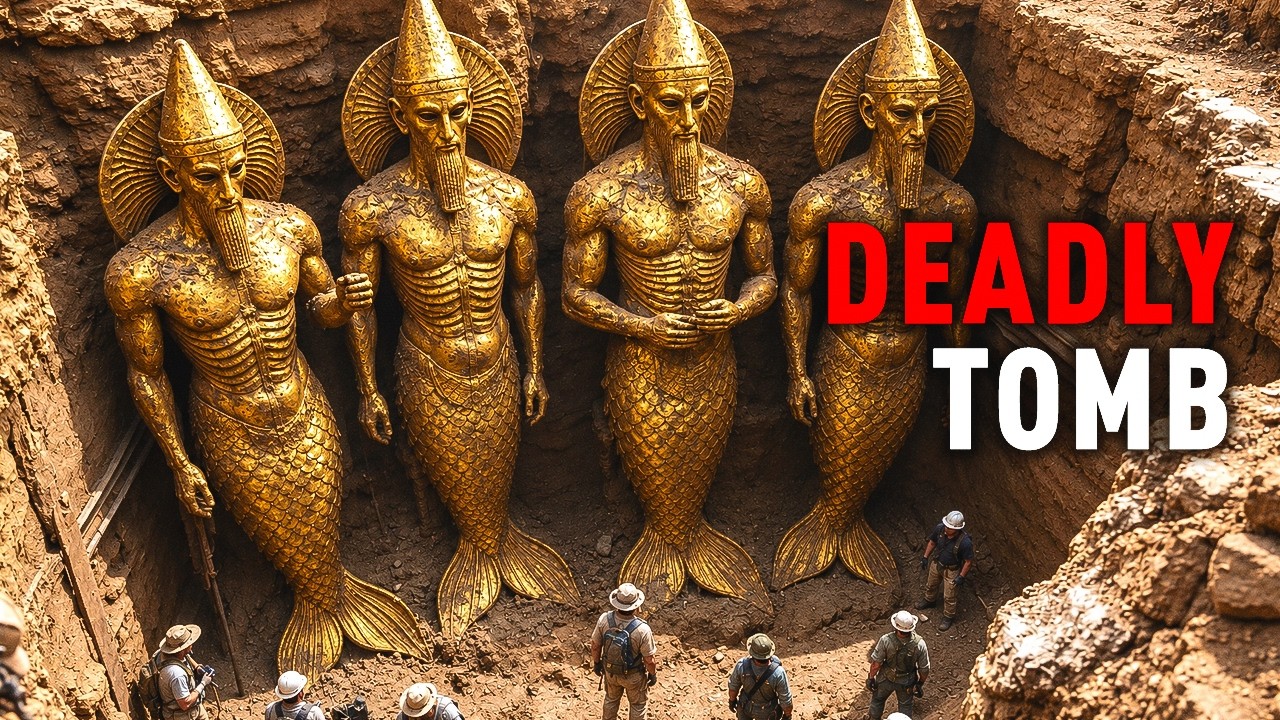
This was the burial complex of China’s first emperor, Qin Shi Huang, a tomb that sprawled beneath central China near the city of Xi’an, built more than two millennia ago, and one that, even in the twenty-first century, no living person has fully entered. The story begins with clay. Thousands of terracotta statues, life-sized soldiers, horses, and officials, have been pulled from the earth around the emperor’s tomb since 1974, when a group of peasants digging a well near Xi’an struck something far stranger than water. They unearthed a human-sized figure, exquisitely detailed, unique in every feature.
Fifty years later, the count has passed eight thousand, and scientists are still uncovering more. These statues were not an art project. They were an army, a symbolic garrison placed to guard the tomb of the man who had conquered and united the warring kingdoms of ancient China. He had been born in 259 BCE, the first son of the ruler of the kingdom of Qin, one of six rival states locked in conflict for more than two hundred years.
Through a combination of natural disasters that weakened his enemies, clever strategy, tactical brilliance, and sheer skill, he crushed them all. He was no longer a king among kings. He became the first emperor of China. Such a man could not be buried in a simple grave.
His servants built him a mausoleum the size of a small city, an underground kingdom filled with everything an emperor might need in the afterlife. The ancient Chinese, like the ancient Egyptians, believed that what was buried with the dead accompanied them into the next world. In earlier dynasties, that sometimes meant real people were sacrificed to serve their rulers. Qin Shi Huang chose a different path.
He buried clay, thousands upon thousands of statues, to stand in for his court and his army. It was a decision both humane and practical, but it was also a display of absolute ambition. The complex was designed to be impregnable, a fortress of stone and earth holding secrets, artifacts, and treasure no one was meant to see. The historian Sima Qian, writing roughly a century after the emperor’s death, recorded what lay inside.
The builders had installed crossbows with loaded arrows, rigged to fire on anyone who forced their way in. They had also poured staggering quantities of mercury, channeling it to simulate the flow of rivers and seas. After two thousand years, the crossbows were likely useless, rotted wood and corroded metal. But mercury does not expire.
It remains a dense, beautiful, lethal metal. A single drop can damage the nervous system, liver, and kidneys. A river of it is unsurvivable. Even without touching the liquid, a person inside the tomb would breathe its vapors, which seep through cracks and saturate the air.
Scientists measuring the site have confirmed that the mercury level in the soil around the tomb is far above normal. The threat is real, not legend. Why mercury at all? In ancient China, mercury was believed to be the elixir of youth, the source of immortality.
Qin Shi Huang reportedly took pills containing the metal, believing they would preserve his life. He died at forty-nine. Digging there would be reckless even without the mercury. Excavation has a history of destroying what it seeks to reveal.
When archaeologists opened Tutankhamun’s tomb, the entrance collapsed, crushing vases, scrolls, and decorations. The same tragedy hit the terracotta warriors in the 1970s: when the statues were exposed to sunlight and fresh air, the paint pigment that had survived for millennia flaked off and vanished. The outside world is a hostile environment for anything sealed away for thousands of years. Archaeologists eventually developed a careful technique to extract the statues without losing their coloring, a slow, painstaking process.
They learned from the damage. But the deeper tomb remains untouched, and that is precisely why it is so tantalizing. Ancient writings describe an underground palace at the center of the complex, its ceiling decorated with pearls to imitate the stars of the night sky. The walls and floor, the emperor’s own chamber, are beyond imagination.
Beyond the clay soldiers, scientists expect to find statues of officials, servants, and entertainers, a full court preserved for eternity. For archaeologists, it is paradise. But the excavation could take centuries. Some experts predict the full extraction of the tomb will outlast current generations entirely.
New technology may change that. Non-invasive methods allow scientists to see through the ground without entering. Muon imaging, using subatomic particles produced when cosmic rays strike the atmosphere, can penetrate solid stone like X-rays. Nanotechnology could one day send millions of tiny robots into the tomb to scan and map it, transmitting data to computers that build a holographic model.
It sounds like science fiction, and it might just work. But the charm of archaeology lies in the hands-on discovery, the careful brushing of ancient dust from a priceless artifact. Watching it on a screen is not the same. Still, when the alternative is watching a human being die in a river of poison, a robot falling into the trap is the better outcome.
Qin Shi Huang’s legacy reached far beyond his tomb. The same ambition that built his mausoleum built the Great Wall of China, though the wall’s story is wrapped in its own myths. It is not visible from space, nor from the moon, and the builders were not buried inside it. But the wall itself is real and staggering, stretching for more than thirteen thousand miles.
To put that in perspective, it is nearly five times the distance between New York and Los Angeles, a bit greater than the distance between the North and South Poles. Nothing built by human hands in modern times compares. It was not built in a day, or even a century. It was constructed, extended, repaired, and reimagined over the course of thousands of years.
The first Chinese emperor united the country in 220 BCE and conceived the idea of linking the walls of individual cities into one continuous defense against invasions from the north. A trusted general directed the work, enrolling soldiers, commoners, and convicts by the tens of thousands. The earliest sections were built of rammed earth and wood, rising to an average of about twenty-six feet. Later emperors took up the project, each adding their own improvements.
Some used bricks, others granite and marble. Watchtowers were not part of the original design; they were added by the Ming emperors, who used them to send messages via smoke and fire signals across vast distances. The wall is inconsistent in its materials, a patchwork of centuries and techniques, which only adds to its character. The secret to the wall’s longevity, in the sections where it still stands, is glutenous rice flour.
The sticky rice mortar used to bind the bricks is nearly as strong as cement, waterproof and airtight, sealing the stones so tightly that even weeds cannot find a foothold. The workers who built it left their marks literally. Many bricks bear inscriptions carved by the laborers, records of location, quantity, and the responsible officials. If a section of the wall failed, the supervisors knew exactly whom to hold accountable.
Recently, researchers combing through Ming dynasty documents came across records of something unexpected: secret doors. Using a flying robot to photograph ninety percent of the Ming-era wall in high resolution, they discovered the remains of more than two hundred hidden gates. Some were narrow, built for a single person to slip through. Others were wide enough for two horses to pass side by side.
On the inside, the entrances were hollow, allowing soldiers to walk through the wall itself. The exterior exits were camouflaged with bricks so perfectly matched that they were indistinguishable from the rest of the wall. The enemy had no idea where the gates were. Chinese soldiers could break through from within and launch a surprise attack.
Other doors served trade and commerce, allowing merchants to pass in both directions. Spies used the smallest ones to slip out and observe the enemy. The wall was never a single unbroken barrier; it was a living structure, open on demand, as much about intelligence and communication as defense. It was not, however, invincible.
The wall could be climbed over or marched around, and the ancient Chinese knew it. Its true value lay in the time it bought: time to signal the troops, to mobilize the army, to lure an enemy into a difficult strategic position. It was a force multiplier, not a magic shield. Its construction stopped at the end of the nineteenth century, when technological advances rendered it obsolete for military purposes.
Today, only eight percent of the wall remains in good condition. A third has vanished entirely, eroded by time and weather, dismantled by destructive farming, or scavenged for building materials. In the last century, countless bricks were hauled away to build farms and houses. Even now, tourists take stones as souvenirs, millions of them every year, chipping away at what remains.
Since 1987, the wall has been a UNESCO World Heritage site, one of fifty-six in China, a count that places the country second in the world. Italy holds the top spot with fifty-eight. The wall even hosts a marathon, established in 1999, one of the most challenging in the world. Runners sprint along the top of the wall, steps and all, in full, half, and five-mile distances.
The ancient world held other mysteries far older than China’s wall. Deep in the desert of Upper Egypt, at a place called Abydos, archaeologists have spent decades uncovering the secrets of a sacred city. To the ancient Egyptians, Abydos was the burial place of Osiris, the god who died, was dismembered, and rose again to rule the underworld. Pilgrims traveled from across Egypt to leave offerings and reenact his death and rebirth in festival rituals.
Pharaohs competed to be buried as close to Osiris as possible, and Abydos became a city of tombs, temples, and afterlife insurance. In early 2025, a joint team of American and Egyptian researchers began digging beneath a rocky rise ominously called Anubis Mountain, named for the jackal-headed god who guarded cemeteries. They uncovered a royal tomb hidden twenty-three feet below the surface. It had been looted long ago; the treasures were gone, carried off by robbers centuries before.
But the structure itself told a story of immense power. The chamber had mudbrick vaults rising more than sixteen feet, a soaring scale that still felt enormous after 3,600 years. There was no golden mask, no treasure, and frustrately, no name. The cartouche that should have spelled out the king’s identity was unreadable, erased or damaged beyond recognition.
In ancient Egypt, a cartouche was far more than a name tag. It was a large oval of hieroglyphs that contained the king’s royal name, a kind of VIP pass for the afterlife. To the Egyptians, a person’s name, their ren, was an essential part of their being. As long as a name survived, its owner survived.
To have one’s name forgotten was a fate worse than death. The tomb’s walls should have been covered in cartouches, bragging about who rested there. Instead, they were silent. Not everything was lost.
Painted in golden hues at the entrance were two deities: Isis, the magician who stitched Osiris back together and breathed life into him, and Nephthys, her sister, the eternal mourner and protector of the mummy. Their presence promised that whoever rested here would not face the afterlife alone. It was another proof of the mystery pharaoh’s importance. The tomb dates to Egypt’s Second Intermediate Period, a chaotic era when the country was divided among rival kingdoms, each with its own power base, something like an Egyptian version of Game of Thrones.
In the middle of that chaos lay Abydos, for a time home to its own line of kings, the so-called Abydos dynasty. These rulers left almost nothing behind: no great monuments, no sprawling cities, just fragments of names on broken blocks. For centuries, scholars doubted they existed at all. That changed in 2014, when archaeologists uncovered the tomb of Senebkay, one of those shadowy kings.
His bones revealed eighteen deep wounds, blows to the skull, back, and hands, wounds you get in battle. Senebkay likely died fighting, one of the few pharaohs known to have fallen in combat. His tomb was modest, built with reused artifacts from earlier kings, but it delivered proof. Until Senebkay, the Abydos dynasty was only a theory.
With him, it became real. The newly discovered tomb shares the same layout and style as Senebkay’s, with limestone chambers, mudbrick vaults, and protective deities, but it is much larger. That raises the possibility that this is the tomb of an even earlier, more powerful ruler of Abydos, a king who wanted to be remembered alongside the greats. History seems to have tried erasing him, and for now, it has succeeded.
Additional discoveries near the tomb may tell more. Not far away, in the village of Banawit, archaeologists uncovered a Roman-era pottery workshop, a factory close to a pharaoh’s burial ground. The site had huge clay kilns, storage rooms, and broken shards called ostraca, ancient sticky notes covered with receipts scratched in Greek and demotic Egyptian. These were records of everyday transactions, the kind of mundane detail you would never expect near a lost dynasty’s king.
Centuries later, in the medieval period, the same ground became a cemetery, with mudbrick graves holding skeletal remains. Abydos kept its aura of significance for hundreds of years after the age of the pharaohs. Different rituals, same sacred ground. Across the Atlantic, in central Panama, a team led by Julia Mayo has spent two decades uncovering something just as remarkable.
El Caño, a site that looks like an ordinary pasture, has proven to be one of the most important archaeological discoveries in the country. Beginning with a geophysical survey in 2005, the team dug a pit about sixteen feet deep by 2010 and found a chief covered in gold. More ornaments appeared, then more chambers, each one adding to a picture of a ceremonial landscape. In a tropical region where most life was built of wood, thatch, and fiber, materials that do not survive, gold becomes one of the only voices left.
The newest chamber, dated to around 800 to 1000 CE, contained pottery, gold ornaments, and a central high-status person marked out by where the gold was placed. Two bracelets, two earrings, and pectoral ornaments decorated with bats and crocodiles were not random wealth. They were a public statement about rank. Gold told everyone who mattered most.
The most striking detail came from an earlier discovery: a piece of chief’s regalia so small it could only have belonged to a child. That shifted the interpretation of El Caño entirely. It was no longer just a rich ceremonial site. It looked like a place where power passed from one generation to the next, a dynastic tradition.
Mayo said the site has produced nine similar chambers, places where elite individuals were laid to rest for about two hundred years. One rich chamber is interesting; nine, spanning generations, is a system. This was a ruling dynasty, buried in a field that looks like nothing from the surface. In southern Mexico, at a place called San Pablo, archaeologists stumbled on a tomb guarded by a giant stone owl whose open beak clamped down on a human face, as if swallowing a soul.
The discovery began with a report of looting. Officials investigated and found what they thought was an entrance. By it stood the carved owl, its beak open, inside it the painted face of a man, likely an important leader. For the Zapotec people, who sometimes called themselves the Cloud People, owls were linked with death and power.
The owl was either guarding the spirit of the buried person or holding it captive. The scientists went in anyway. The tomb was made up of two parts: a front chamber like an entrance hall, and a deeper burial room. A doorway between them was covered in carvings.
At the top sat a stone beam with symbols that worked like names based on a person’s birth date. On each side stood carvings of a man and a woman wearing detailed headdresses, positioned like guards. The walls were still painted in bright colors, white, green, red, and blue, and the paintings told a story of a funeral procession. People carried bags of copal, a tree resin the Zapotec burned as incense during ceremonies, much as candles are lit today.
The tomb was about 1,400 years old, dating to around the year 600, and it was miraculously intact. Most Zapotec tombs in the region had been looted before archaeologists reached them, their contents lost. This one had escaped. Experts from Mexico’s National Institute of Anthropology and History are now working to protect it, controlling the air and humidity inside to prevent damage, documenting the artwork, studying the carvings and symbols, and examining the few human bones found there.
Ancient tombs are not always hidden deep underground. In 2023, archaeologists working on the edge of Chapultepec Park in Mexico City found a group of graves about 3,500 years old, older than most of the pyramids in Mexico. There were ten tombs shaped like upside-down bells or bottles, wide at the bottom and narrow at the top. Half of them contained human remains: four women and one man, mostly young adults.
These people lived in a large village in the area during the early and middle pre-classic periods, long before the Aztecs. They likely had to abandon their home when a volcano erupted. The Xitle volcano, an ash cone about a thousand feet tall with steep sides, erupted sometime between 245 and 315 CE based on radiocarbon dating. The lava spread across the landscape, burying parts of it under solid stone, forming the Pedregal de San Ángel lava fields south of modern Mexico City.
One of the biggest victims of the eruption was Cuicuilco, once a major and advanced city in Mesoamerica. The lava buried it, freezing it in time. The survivors left, spreading their culture across central Mexico, a forced migration that may have influenced the development of later cities like Teotihuacan. Some scientists disagree on the timing, suggesting the destruction may have started as early as the first century BCE.
Either way, the eruption reshaped the land and the lives of the people who lived there. The bell tombs were small, three to six feet wide and up to five feet tall, about the size of a small closet. The style is found across different parts of Mexico, evidence that people shared ideas like trends. The site was not a one-time burial ground.
Archaeologists found later burials, meaning people kept returning to the spot for generations. Inside were offerings: tools made from deer antlers, a cup, and small female figurines, personal items or symbolic gifts left for the dead. All were moved to the National Museum of History for study. Construction work around Chapultepec Park has turned up other discoveries, including a sixteenth-century cemetery from less than a hundred years after the fall of the Aztec Empire.
Deep in the jungles near the border of Guatemala, Mexico, and Belize, a team led by an archaeologist named Estrada-Belli found a tomb hidden in a collapsing pyramid at a site the ancient Maya called Chactún. It was a place that meant little compared to great Maya cities like Tikal or Teotihuacan, or so scholars thought. The tomb belonged to a ruler, and what it contained rivaled the treasures of any Maya metropolis. The ceiling had collapsed long ago, but the offerings remained intact.
Archaeologists recovered more than sixteen spondylus shells, used by the ancient elite for power and ritual, a sign that whoever was buried here was wealthy and high-status. They also found carved femur bones etched with hieroglyphs and names. The Maya wrote their history in human remains. Most importantly, there was a mosaic jade mask, pieced together from luminous green tiles into an expression that felt almost human, almost alive.
It was the face of a forgotten Maya king, staring out after 1,700 years of silence. His name was etched into the femur bones: Kʼahkʼ Ujol Kʼinich. Historians think he may have reigned around 350 BCE. One bone showed a carved figure holding a deity’s severed head.
The deity’s head looked exactly like the jade mask. Other inscriptions mention the king’s father and grandfather, linking Chactún to the mighty capitals of Tikal and Teotihuacan. Tikal rose from the Guatemalan lowlands with towering step pyramids, home to tens of thousands of people, a hub of art, astronomy, and culture. Teotihuacan, further north, was a central Mexican metropolis, one of the largest cities in the world in its time, famous for its Avenue of the Dead and the Pyramid of the Sun.
Compared to these imperial capitals, Chactún was a whisper. But the king in the tomb was no ruler of a random village. He had political ties across Mesoamerica. The craziest part is how close the discovery came to being lost.
Looters had tunneled to within six and a half feet of the tomb before stopping, so close they could almost have touched it. Ironically, it was their tunnel that led Estrada-Belli’s team to the site. Archaeologists using lidar, a laser scanning technology fired from above, spotted the signs of intrusion. They realized that if someone had been digging there, they had probably been looking for something important.
Without the failing looters, the team might have walked past a discovery. They plan to keep searching, hoping to find more chambers buried inside the abandoned pyramid. The connection between Tikal and Teotihuacan appeared again in another recent discovery. Buried deep within the ruins of Tikal, archaeologists found a house containing a limestone altar covered in vibrant murals of red, yellow, and black.
The building was unquestionably Teotihuacan in style, and it was built about 1,700 years ago. The altar stood three and a half by six feet in the center of the home, very typical of Teotihuacan tradition, and bore a mural of the storm god, a central deity in the Teotihuacan pantheon. But it depicted no kings, no rulers, which was strange. The Maya worshiped their dynasties and political power, putting them everywhere.
This altar worshiped the deities alone, in the heart of Tikal. Archaeologists saw it as proof that Teotihuacanos did not just visit Tikal; they lived there, built homes, practiced their rituals, and left their deities behind. The Maya seemed to tolerate it. The house and altar were built around 300 to 400 CE, a period when Tikal was rising in power.
The two cities were not close allies. There was tension, maybe even surveillance. By 400 to 450 CE, the attention may have turned sinister. The altar could have been a symbol of domination.
Had the Maya of Tikal truly welcomed their northern guests, or had the Teotihuacanos arrived and bluntly built foreign altars in sacred spaces? If the Maya resented them, it would make sense to destroy the place or vandalize it. But the altar remained untouched. The Maya buried it with the surrounding buildings as they were, no destruction, no rebuilding.
Their feelings about Teotihuacan were complicated. In 1925, a British explorer named Percy Fawcett stepped into the Amazon rainforest with his son Jack and his son’s best friend Raleigh. They were chasing a legend: a hidden city Fawcett called Z. They were never seen again.
For almost a hundred years, Z remained a myth. Most scientists assumed the Amazon simply could not have hidden a real civilization. The soil was too poor, the floods too frequent, the diseases too dangerous. Nothing more than small, scattered communities could survive under that canopy.
That assumption collapsed, thanks to lidar. Researchers flew drones over the Amazon, firing millions of laser pulses at the ground, digitally stripping away leaves, branches, and trees to reveal the bare earth beneath. Underneath that jungle was a civilization. Some experts now believe they may be finding the lost civilization Fawcett spent his life searching for, by piloting a drone instead of hacking through vines.
The discovery centers on a region of northern Bolivia called Llanos de Mojos. Long before Europeans arrived, a culture archaeologists call the Casarabe thrived there from roughly 500 to 1400 CE. The lidar scans revealed not one settlement but a layered network: four different tiers of towns, from small outposts to massive regional hubs. The largest primary settlement covered close to two hundred square miles, about the size of Atlanta.
The full network of causeways, canals, reservoirs, and farmland sprawled across nearly 1,730 square miles, bigger than the state of Rhode Island. Inside that footprint stood conical pyramids climbing about sixty-five feet, massive U-shaped ceremonial platforms, and open plazas. The scale rivaled the famous Tiwanaku civilization of the Andes. But there was no dense downtown core, no tightly packed grid of streets like ancient Rome.
Instead, the Casarabe spread themselves across the landscape, stitched together by shared infrastructure, especially elaborate water management systems. Specialists described the layout as clearly planned and coordinated, designed not just as living space but as a way to connect an entire regional population. Similar urban logic appears at ancient Maya cities and at Angkor in Cambodia, suggesting this spread-out but connected model of city-building may be far more common than anyone assumed. How did a society thrive in a place written off as too hostile?
They re-engineered it. They invented Amazonian dark earth, a custom-made fertile soil produced by mixing charcoal, bone, and organic waste into the rainforest’s naturally weak ground. Over centuries, this transformed unusable land into farmland capable of feeding large settled populations. They reclaimed vast stretches of seasonally flooded grassland, building raised and drained fields that could be farmed reliably instead of swallowed by water every rainy season.
They dug extensive drainage canals and grew crops like maize at a scale nobody expected from people once dismissed as primitive rainforest dwellers. The Amazon was not a wilderness people merely endured. They actively reshaped it. Similar surveys in Ecuador’s Upano Valley have revealed thousands of ancient structures linked by organized road networks.
Researchers have found ceremonial earthworks and geometric enclosures across Colombia, Peru, and Brazil. Across the Amazon basin, the same story repeats: what looked like empty jungle from the ground turns out to be a heavily engineered, densely populated landscape from above. A team of researchers, convinced that unusual lidar imagery showed the remains of an undiscovered civilization, raised funds for an expedition. They spent two weeks trekking through dense jungle, surviving partly on piranha caught by hand in heat indexes pushing 115 degrees Fahrenheit.
Progress was painfully slow: take a step, cut through the brush, take another step. The jungle was so thick that a person a few steps ahead vanished completely from view. Even with GPS, the team got lost more than once. They returned with evidence they believe shows the structures are genuinely pre-Columbian, built before European contact.
Formal verification is pending, but they are already planning a return trip, hoping to give something back to the local community that helped guide them, including repairing a village well and its power supply. Plenty of mysteries remain. Researchers do not fully understand how societies like the Casarabe organized themselves politically, or what caused their decline centuries before Europeans arrived. Shifting climate, environmental strain, internal conflict, or disrupted trade routes are all possibilities, and several may have hit at once.
The discovery forces a complete rewrite of how we think about the Amazon. It was not a green void waiting to be tamed. It was home to organized, engineered, densely connected societies that were simply buried by time and vegetation. Thousands of years ago, the Sahara Desert was a green valley with rivers, lakes, and flowers, home to people whose DNA has changed scientists’ understanding of human civilization.
At a small rock shelter called Takarkori, among the endless dunes, scientists found two mummies who lived about 7,000 years ago. They analyzed fragments of DNA and discovered that the bodies belonged to female pastoralists. They lived during the time of the green Sahara, when the region was humid and fertile. But their DNA did not contain the genes typically found in populations that lived in that region.
Their genome did not resemble any other known genetic lineage. A similar genetic code was found in the remains of hunter-gatherers in the Taforalt cave in Morocco. The DNA of the people from the two caves was equally distant from the DNA of people who lived in the southern part of the Sahara. This tribe had lived quite separately, likely not accepting strangers and not moving from place to place.
They did not need to. The green Sahara had everything necessary for life. But then, how did they learn about animal husbandry? Farming and cattle breeding developed around the world during mass migrations.
The typical story involves thousands of outsiders arriving with agricultural knowledge, taking over land, driving some locals away, allowing others to stay, imposing their own rules. During these migrations, different people mixed, introducing diversity into the genetic code. In the case of the Takarkori tribe, there was no diversity. They were not attacked.
Large-scale migrations did not affect them. Yet they knew how to breed cattle. This surprised researchers, who were convinced that agriculture spread exclusively through large-scale migrations. The mummies showed that people simply exchanged knowledge and culture.
Perhaps a traveler came to the settlement, showed them how to breed animals, and left. No genetic mixing occurred. Or perhaps someone from Takarkori traveled elsewhere and returned with new knowledge. No one conquered anyone.
They shared experience, the way modern people do. The genetic material inside those mummies tells a story of how technological and cultural development changes over time. But there is also the reverse situation, when human civilization shapes our genome. Our DNA was changed by fire.
Humans are the only species on the planet that does not run from fire but uses it. No other animals live under a constant risk of burns. Evolution was not prepared for this and had to adjust our genes to match our behavior. The technology of controlling fire is one of the oldest in the world.
We used it to keep warm, cook food, produce metal and ceramic objects, build homes, and conquer territories. We put hot food into our mouths and drink hot tea. In all this time, we have been getting burned. No other species experiences anything close to the number of fire-related injuries humans do.
The danger has not disappeared. We interact with burning gas stoves, red-hot radiators, boiling water. As a result, we developed a unique genome. When we touch something hot and the body begins to heal, it seems natural, but this healing depends on specific genetic mechanisms.
Without them, even a small accident could cause serious problems. Intense natural selection took place as humanity adapted to fire. Some scientists suggest we are descendants of those who recovered from burns more quickly than others. Scientists studying primate DNA discovered a set of ninety-four genes that activate in response to burns.
In humans, some of these genes evolved much faster and became far more effective at healing and fighting bacteria. It is a superpower we never realized we had. But there is bad news. The same immune response that allows us to heal quickly from burns can cause serious problems.
For a small burn, the immune system triggers inflammation, immune cells neutralize the damage. It is an aggressive healing strategy, but it works. For a large-area burn, the same defense becomes dangerous, creating massive inflammation that can be life-threatening. Evolution developed protection against small incidents around a campfire, but not against massive fires.
After three hundred years of searching, archaeologists finally pinned down the location of the lost city of Sak Bʼalam, the city of the white jaguar, hidden in the jungles of Mexico. The story begins in the 1500s with the Lacandon Maya, survivors who refused to quit. When their main capital fell to the Spanish in 1586, most would have called it game over. Not the Lacandon.
They packed up, headed deeper into the rainforest, and built their last stronghold, Sak Bʼalam, a hidden fortress of stone temples and twisty jungle trails. For over a hundred years, they kept their traditions alive, far from European control. Then in 1695, a Spanish friar named Diego de Rivas stumbled into the city. It was the beginning of the end.
Soon the Spanish took over. By 1721, the Maya had abandoned Sak Bʼalam. The jungle swallowed it whole, roots tearing into walls, vines smothering plazas. The city did not just disappear; it was eaten alive.
For the next three hundred years, it became myth. Expeditions tried to track it down, but the rainforest is sneaky. Every path looks identical. Maps fall apart in the humidity.
GPS cannot cut through the thick green ceiling. It was like looking for a needle in a haystack, except the haystack was alive, covered in thorns, crawling with jaguars. How did scientists crack the mystery? A single letter from the seventeenth century.
Diego de Rivas’s letter described all the routes, rivers, and trails leading to Sak Bʼalam. It showed in detail the journey of the soldiers who walked for four days to the Lacantún River, then sailed for two days and arrived at the church of El Señor de Cristo, left their canoes, and continued on foot to Lake Panyab in Guatemala. Scientists fed this information into geographic information systems, taking into account vegetation layers and how much each person was carrying, and calculated where the city should be. It worked.
Archaeologists traveled through the jungle and found stone temples rising like broken teeth from the earth, along with tools, ceramics, and a Spanish church right in the middle of the ruins. The discovery rewrites history. For decades, people assumed the Lacandon scattered after their capital fell. Sak Bʼalam proves they regrouped, fought, and preserved their culture for over a century.
There is irony here. The Spanish friar who revealed the city helped doom it, yet his letter centuries later helped save its memory. Today, the ruins sit inside a biosphere reserve, protected by the same jungle that once hid them. Tourists cannot just walk in.
Another lost city, called Guiengola, was found buried under the jungles of Mexico, hiding for six hundred years. It covers about 360 hectares with more than 1,100 buildings, two and a half miles of defensive walls, its own network of roads, and a super-organized city plan. Using lidar, researchers flew over the site and in just two hours had a full 3D map. Guiengola was built between 1350 and 1521, in pre-Columbian times, and it was a major hub for the Zapotec people.
Families lived in homes with big central patios surrounded by rooms, adding more rooms as they grew. They used the mountains around them as natural walls and channeled mountain water for drainage. Many buildings are still standing. By the late 1400s, the Zapotec were powerhouses along the Pacific coast.
They fought off the Aztecs at Guiengola, surviving a brutal seven-month siege. But life in the mountains was not perfect. They did not have enough fresh water or farmland to feed everyone. Twelve miles away, the smaller city of Tehuantepec had what they needed.
The Zapotec moved there just before the Spanish arrived in 1521. The lidar scan revealed more than a thousand buildings, and archaeologists plan years of research, using advanced scanning tech to study the city without digging it up and risking damage. In Egypt, archaeologists stumbled on a lost city called Imit, tucked away in the eastern Nile Delta, buried under layers of mud, water, and time. Scientists first noticed it in satellite images, faint little clusters of mudbrick foundations.
They followed the patterns to the ground, started digging, and the city came back to life. They found multi-story tower houses, mini-skyscrapers of the ancient world, with multiple floors and thick foundations. Vertical living is rare in Egypt, especially outside the Nile Delta. It showed that people in Imit were not just spreading across the land but stacking upward, meaning the city was packed, carefully planned, and more urban than anyone thought.
Archaeologists also uncovered a grain processing center with paved work areas, animal pens, and organized spaces for food production. A ceremonial road once led to a temple for Wadjet, the city’s patron deity, but later buildings were plunked down over the road, showing her worship faded. The ruins coughed up amazing relics: a green faience funerary figurine, a stela showing Harpocrates perched on crocodiles and gripping snakes, and a bronze sistrum decorated with twin heads of Hathor. Imit was active from around the fourth century BCE onward, stretching from Egypt’s late period into the Roman era.
Its location along trade routes made it a magnet for merchants and pilgrims visiting Wadjet’s temple. In southeastern Europe, archaeologists found the remains of a lost city near the village of Bylazora in North Macedonia. They first thought it was an old defense outpost used to spot Romans coming from the west. But new digs changed that.
The ruins sit on an acropolis, a flat hilltop, with enough rooms and infrastructure to host a full city inside the fortress walls. It covers about 2. 8 hectares, and around 10,000 people may have lived there at its peak. Researchers found a textile workshop and plenty of artifacts, including a coin from the time of Alexander the Great with his image, axes, game pieces, an oil lamp, and a small ceramic with a heart motif.
One of the coolest finds is a reusable clay theater ticket, unique to North Macedonia. This means there was likely a theater here, possibly in one of the large buildings. Experts used to think the city dated from the time of King Philip V, but the coin and ancient tools and broken pottery suggest people may have lived there during the Bronze Age. The region, called Lynkestis or Lyncus, had intense weather, freezing, rainy winters, and super hot summers.
Life was about survival. The people were mostly nomadic herders, moving with their flocks of cattle, goats, and sheep. Macedonia was the outsider of the Greek world, part Greek but not accepted by powerful city-states like Athens and Sparta. On the edge, it had the chance to mix Greek traditions with local culture.
Eventually, under kings like Philip II and Alexander the Great, it took over and changed the ancient world. The new discoveries show how connected ancient Macedonia was, especially since the city sat along trade routes to Constantinople. Figures like Octavian and Agrippa may have passed through on their way to clash with Cleopatra and Mark Antony. The city could be the lost capital of the ancient kingdom of Lynkestis.
Alexander the Great, in just thirteen years, created one of the biggest empires in history, stretching from Greece to Egypt and India, before dying at thirty-two. The discoveries keep coming. A massive city hidden beneath the Amazon rainforest canopy, a network of houses, plazas, roads, and canals built 2,500 years ago and inhabited for nearly a thousand years. Researchers found 6,000 rectangular platforms, each about 66 by 33 feet and 6 to 9 feet high, arranged in clusters around central plazas with straight roads at perfect right angles.
One road was sixteen miles long. Building straight roads is far harder than going with the landscape. Some may have had spiritual or ceremonial significance. The civilization thrived thanks to rich soil from a nearby volcano, but the same volcano may have led to its downfall.
Researchers also found ditches blocking entrances to settlements, signs of threats. The next step is to study the adjoining 116 square miles to learn more about this complex society, which could be bigger than the well-known Maya cities of Mexico and Central America. Every new survey reveals more of what was hidden. The past is not gone.
It has only been waiting, buried under jungle, sand, and time.






