The two holes were already drilled into the young woman’s skull when the questions began. She lay in an operating room at George Washington University in Washington, D. C. , in November 1941, twenty-three years old, partially conscious, sedated only with a mild tranquilizer.
The doctors, Walter Freeman and James Watts, worked above her. Freeman asked the questions. Watts cut. “Recite the Lord’s Prayer.
Sing God Bless America. ” Her answers told them how deep to go. They kept cutting until her responses stopped making sense. Then they stopped.
They had cut too far. She was Rosemary Kennedy, the third child of one of America’s most ambitious families. The procedure was a prefrontal lobotomy, so experimental that the American Medical Association had warned against it that same year, calling the side effects too dramatic to justify the operation. The person who authorized it was her father, Joseph P.
Kennedy, Sr. Her mother, Rose, was not consulted. She was told after it was done. It is tempting to treat what happened next as the whole story.
But the absence at the center of it, Rose Kennedy’s twenty years without visiting her daughter, is not what it looks like on the surface. To understand it, you have to go back to a woman born in 1890 in Boston’s North End, who grew up inside one of the most politically sophisticated families in America, who understood exactly what power looked like, and who spent a century being kept away from it. Rose Elizabeth Fitzgerald entered the world on July 22nd, 1890, the eldest daughter of John Francis Fitzgerald, known across Boston as Honey Fitz. Her father’s rise was almost absurdly fast: the Boston Common Council by 1891, the Massachusetts State Senate by 1892, Congress by 1895 and three terms there representing the ninth district, and the mayor’s office by 1906, making him the first American-born Irish Catholic ever elected to that position.
It mattered deeply in a city where, as late as the 1920s, Irish Catholics remained firmly outside the Protestant establishment that controlled Harvard, the banks, and the major corporations. The Fitzgeralds occupied a particular tier of Boston’s social order. The phrase was “lace curtain Irish,” coined in the 1890s to describe the upwardly mobile Irish Catholic middle class, prosperous enough to hang lace curtains in their windows, still excluded from the institutions that granted old money Protestants their authority as a birthright. The Kennedys would eventually move the family to New York, explicitly to escape what one source describes as the great social divide separating Boston’s Protestant elite from Irish Catholic newcomers, regardless of intelligence or wealth.
That exclusion shaped everything about how the family understood ambition: always adjacent to power, always having to earn what others simply inherited. Rose grew up inside this world. She accompanied her father on his political rounds. She served as his translator for French and German dignitaries, speaking both languages.
When Honey Fitz brought her to meet President McKinley at the White House, McKinley addressed her younger sister, Agnes, instead of her. Rose registered the slight. She later recalled knowing right then that she would have to work hard to distinguish herself. Even as a girl, she was measuring herself against the room.
She graduated from Dorchester High School with honors at fifteen, in 1906. The ceremony made the front page of the Boston papers because her father awarded her the diploma personally, the kind of civic theater Honey Fitz performed instinctively. She had already been accepted to Wellesley College during her junior year. Her parents blocked the enrollment.
“Too young,” they said. They enrolled her instead at the Convent of the Sacred Heart on Commonwealth Avenue in Boston, then at a Sacred Heart school in the Netherlands, then at Sacred Heart Manhattanville in New York City, from which she graduated in 1910. She added courses at Boston University and the New England Conservatory of Music. In 1911, her father gave her a spectacular coming-out in Palm Beach.
That blocked Wellesley admission deserves a pause, not because the decision was unusual for 1906, but because of what it foreshadows. Rose had earned that place through her own academic achievement. A male authority figure redirected her into a religious education designed to produce Catholic wives rather than independent professionals. It would happen to her again, and again.
She was described in this period as the most admired young woman in Boston Irish society. She attended political events with her father, served as his informal hostess when he needed one, and understood at twenty how power operated in the rooms where it was practiced. The problem, structural rather than personal, was that none of the power in those rooms had been built with her in mind. Joe Kennedy entered her life the way ambition usually enters, with charm and her father’s explicit disapproval.
Honey Fitz disliked him and spent years trying to prevent the relationship, at one point enrolling Rose in a convent abroad to take her mind off Joe. It didn’t take. On October 7th, 1914, at age twenty-four, Rose Fitzgerald married Joseph Patrick Kennedy. Children arrived quickly and kept arriving.
Joseph Jr. in 1915, John in 1917, Rosemary in 1918, Kathleen in 1920, Eunice in 1921, Patricia in 1924, Robert in 1925, Jean in 1928, Edward in 1932. Nine children in seventeen years. To manage it, Rose built a card file index system, cards purchased from a stationer near their Brookline home and kept in her study.
Each card tracked a child’s medical history, vaccination records, Schick test results, weight, dental visits, confirmation dates, and academic progress. A second set of cards tracked clothing sizes. She described it, characteristically, as a most helpful system for checking back on health information. That system is not a footnote.
It is the clearest window into how Rose operated: with meticulous, professional precision inside the one domain she was fully permitted to own. Joe was overseeing diversified business interests that kept him away from home for months at a time. Rose managed large estates alone, coordinated domestic staff, oversaw the children’s religious education, and ran what was functionally a small institution. The household doctrine she established, documented in The Kennedys: Dynasty and Disaster, was that the children should hide their true feelings.
Showing sorrow or pain was weakness. Rose taught her children this. She had been teaching it to herself for years before they arrived. Joe Kennedy met Gloria Swanson in late 1927.
By early 1928 they were in an affair that lasted roughly three years. Swanson was among the most famous actresses in the world. Kennedy reorganized her financial affairs, gained power of attorney over her estate, produced her films, and charged the gifts he gave her against her own accounts. When the arrangement ended around 1930, Kennedy left after a dinner at which Swanson questioned a financial discrepancy.
He never contacted her again. She discovered how thoroughly she had been used. Within Hollywood the affair was an open secret. Gossip columnists circled it without fully landing on it.
In the social circles where the Kennedys moved, it was known. Doris Kearns Goodwin documented that one of Rose’s nieces reportedly overheard a confrontation between Honey Fitz and Joe Kennedy about Swanson, Rose’s father threatening to tell his daughter if the affair didn’t end. The strangest detail, documented in multiple biographical sources, is this. In September 1929, Kennedy arranged for Rose, himself, Swanson, and Swanson’s husband, the Marquis de la Falaise, to travel together to the European premieres of Swanson’s film, The Trespasser.
Rose purchased Christmas gifts for Swanson’s children. The two women spent extended time in each other’s company while the affair continued. Swanson’s written reflection on Rose during this period, published in her 1980 memoir, is the most quoted response to the spectacle. “Was she a fool?
” Swanson asked herself, “or a saint? Or just a better actress than I was? ” The honest answer is probably none of those things and all of them, depending on the moment. Rose had made a calculation.
Possibly when her father reportedly sent her back to the marriage during a period of genuine estrangement with the message that she had made her bed and needed to lie in it. Possibly at the altar, when she first understood the terms of the life available to her: this one or nothing. Catholic women of her background didn’t divorce. Her father had made that explicit.
The church had made it explicit long before him. What Rose had was a private architecture of endurance, and she built it carefully. Daily Mass every day, documented consistently across decades. The rosary.
Solo travel. Swimming. Walking. She took herself away from the household on extended trips, managing from a distance, returning to homes that ran smoothly because she had built systems that didn’t require her physical presence.
The Swanson affair became something she metabolized the way she metabolized everything she could neither change nor leave. Categorized. Contained. Filed away.
Joe later conducted a long affair with his secretary, Janet DesRosiers, which, by multiple accounts, he made no effort to conceal from his wife. Rose’s documented response never changed: public composure, private faith, an absence of recorded complaint. Historians have interpreted it variously as strength, sainthood, calculated survival, and as the behavior of a woman whose options were exactly as limited as they appeared. Pearls are formed by irritation.
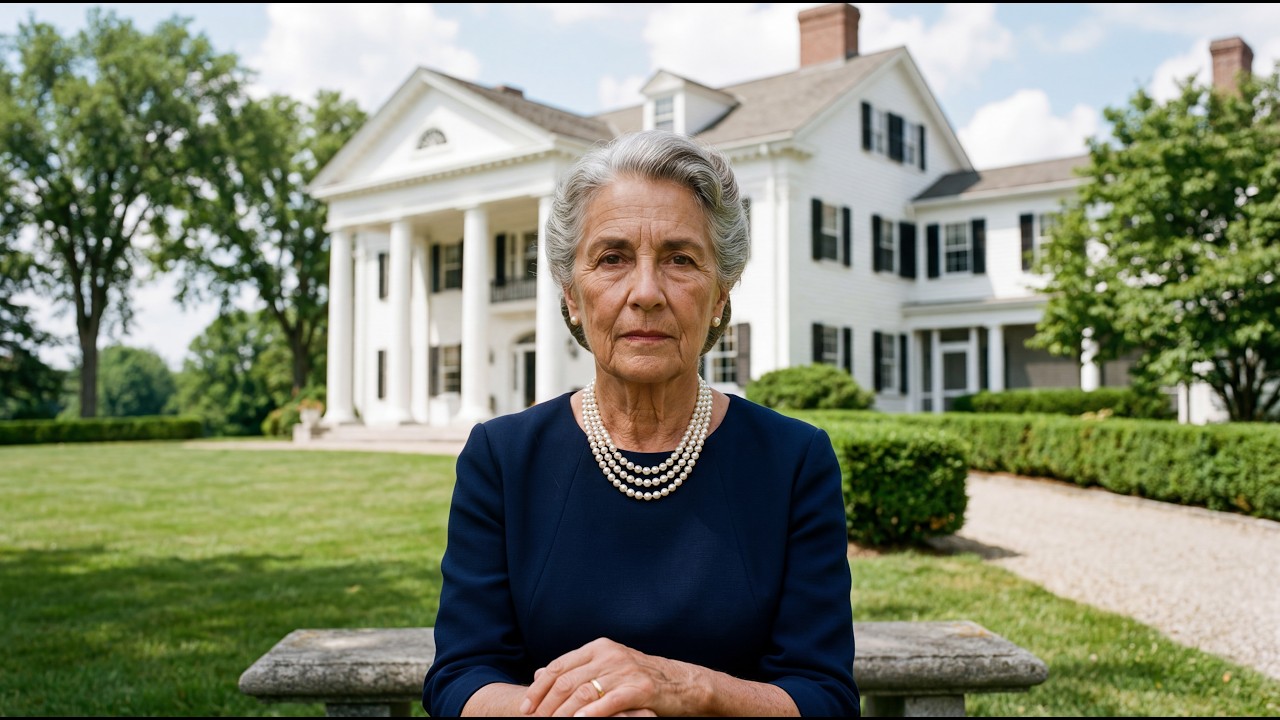
An organism can’t expel the grain of sand, so it encases it layer by layer over years in the same material as the shell itself. The result is beautiful, cold, and extremely hard. Rose Kennedy wore pearls in almost every public photograph. Then came Rosemary.
Back to November 1941, to the operating room and the two holes in the skull. Rosemary Kennedy was born September 13th, 1918, the third child and eldest daughter, in Brookline, Massachusetts. Her intellectual disability was present from birth, possibly the result of oxygen deprivation at delivery. A nurse reportedly held Rose’s legs closed for two hours waiting for the doctor to arrive.
Rose herself later said that if the doctor had arrived on time, Rosemary wouldn’t have had her disability. Despite the disability, Rosemary had a full life inside the Kennedy family. Rose played tennis with her for hours, something she didn’t do with her other daughters. Rosemary traveled, participated in family events, attended school with extra support.
In 1938 she was presented as a debutante before King George VI at Buckingham Palace. She reportedly tripped during her curtsy and recovered. She was a person with a life. By her early twenties the situation was changing.
She exhibited mood swings and behavioral episodes. Joe Kennedy, with his sons’ political futures already under active construction, Jack was twenty-four, Bobby sixteen, feared Rosemary’s behavior could produce a scandal. He consulted physicians. He was directed toward a procedure.
In November 1941 he authorized a prefrontal lobotomy. The AMA had specifically warned in the spring and summer of 1941 that lobotomies were too experimental and the side effects too dramatic to recommend. Kate Clifford Larson, who spent years researching Rosemary’s life in archives, argues that Joe Kennedy would have had access to those warnings and authorized the surgery anyway. Her reading of his motivation: this was not an act of medical compassion but of control.
He wanted to make Rosemary more compliant, more pliable, less emotional. To eliminate a threat to the family image and to the political futures he had invested everything in building. He didn’t consult Rose. He authorized the procedure and told her afterward.
The legal framework of 1941 enabled this: fathers and husbands held unilateral medical decision-making authority over women. Whether Joe would have overridden Rose regardless of the law is a question the record doesn’t directly answer. What it does answer is that he didn’t consider it necessary to ask. Doctors Freeman and Watts performed the procedure at George Washington University.
Rosemary was sedated with a mild tranquilizer and kept partially conscious. Watts cut. Freeman asked questions. “Recite the Lord’s Prayer.
Sing God Bless America. ” Her responses mapped the margin between intervention and obliteration. When Rosemary’s answers stopped making sense, they stopped cutting. They had cut too far.
Her mental capacity, already limited, was reduced to roughly that of a two-year-old child. She lost the ability to walk unaided. Her speech became unintelligible. She was incontinent.
The woman who had played tennis for hours, who had curtsied before a king, who had traveled Europe and danced at family parties, was gone. Joe Kennedy had authorized the destruction of his daughter’s functioning mind to protect a political project. Rosemary was moved first to Craig House, a private psychiatric facility near New York City. In 1949 she was transferred to Saint Coletta School of Exceptional Children in Jefferson, Wisconsin.
She would remain there for the rest of her life. The family’s public explanation in 1958 was that she was simply reclusive. They didn’t publicly acknowledge her intellectual disability until 1961. What had actually happened, the lobotomy, the unilateral decision, the decades of institutional isolation, wasn’t disclosed publicly until 1987, when Doris Kearns Goodwin published The Fitzgeralds and the Kennedys, forty-six years after the procedure.
Rose didn’t visit her daughter for twenty years. The full shape of what Rose knew and when is genuinely complicated. Sources confirm Joe didn’t consult her before authorizing the procedure. They confirm she was told afterward.
Her memoir, written in 1974, describes Rosemary’s condition in language that is forensically evasive: a neurological disturbance had overtaken her, and there was a recommendation that Rosemary should undergo a certain form of neurosurgery. No subject. No actor. No father making a unilateral decision about his daughter’s brain.
The most monstrous event in the Kennedy family’s private history is presented in Times to Remember as something that simply happened, recommended by unnamed experts, performed on a daughter with an unnamed condition. After Joe Kennedy suffered a massive stroke in December 1961, which left him unable to speak or direct family affairs, Rose and the other Kennedy siblings finally learned where Rosemary actually was and began visiting Saint Coletta’s. When Rose went, Rosemary reportedly recoiled from her, physically pulling away from the woman she’d last known in a world that no longer existed. Rose later told a neighbor, “Out of all the Kennedy woes, Rosemary’s fate was the worst tragedy.
”
A nun caring for Rosemary at Saint Coletta’s had written to Eunice Kennedy in 1958. Her letter contains the clearest window into how the Kennedy family understood what had been done. “The solution of Rosemary’s problem,” the nun wrote, “has been a major factor in the ability of all the Kennedys to go about their life’s work. ” A solution.
Joe Kennedy solved a problem. Rose Kennedy spent twenty years not knowing where her daughter was, carrying the weight of a decision that had never been submitted to her for consideration. Joseph P. Kennedy Jr.
died on August 12th, 1944. He was twenty-nine years old. The mission was Operation Aphrodite, a classified US Army Air Forces program deploying explosives-laden aircraft against German targets. Joe Jr.
had already completed his required twenty-five combat missions by the summer of 1944 and was eligible to come home. He volunteered anyway. His modified B-24 Liberator carried 21,000 pounds of Torpex explosives. The plan was for Joe and his co-pilot, Lieutenant Wilford Willy, to arm the aircraft over England, bail out, and have it guided by remote control to its target.
The explosives detonated prematurely, still over England. There was nobody to recover. Joe Kennedy Sr. had spent decades engineering his eldest son’s political future, a trajectory aimed eventually at the White House.
That architecture transferred immediately to the second son, Jack, who had previously seemed more drawn to journalism and intellectual life than to government. The family’s political ambitions weren’t disrupted by Joe Jr. ’s death. They were redirected.
Rose’s documented immediate response to losing her eldest son is thin in the historical record. What is documented is that by August 1944 she had been practicing the management of grief through movement and faith for many years. The mechanism was already built. Kathleen arrived four years later.
Kathleen “Kick” Kennedy, the fourth child, considered by most accounts the most like her father in temperament, had married William Hartington, the Marquess of Hartington and heir to the Duke of Devonshire, in a civil ceremony in May 1944. The Kennedy family opposed the marriage intensely. The Catholic Church wouldn’t sanctify a union to a Protestant. Rose’s opposition was documented and serious.
For a woman whose faith was the structural support of her entire interior life, the marriage was a genuine wound. Billy Hartington was killed in action in Belgium just four months after the wedding. Widowed at twenty-four, Kick entered a relationship with Peter Wentworth Fitzwilliam, a married Protestant Earl. Rose opposed this, too.
The estrangement between mother and daughter was real and documented. On May 13th, 1948, Kick and Fitzwilliam departed Cannes in a private plane despite warnings of bad weather. The aircraft came down near Saint Bauzille in the Ardèche region of southern France. Both were killed.
Kathleen Kennedy was twenty-eight years old. The grief of losing a child you’re in conflict with carries a specific weight. There’s no final conversation to retrieve, no version in which the relationship was fully repaired. Rose’s grief over Kathleen existed inside an estrangement that the record suggests wasn’t resolved before the plane went down.
November 22nd, 1963. Rose was at the Kennedy compound in Hyannis Port when the President of the United States, her second son, was shot in Dallas. Dear Mrs. Kennedy, a book assembled from condolence correspondence of the period, records what she did.
She walked back and forth across the lawn beside the sea, waiting for her youngest son, Ted, to arrive. Back and forth. The Atlantic in front of her, the compound behind her, telephone lines carrying only bad news. Joe Kennedy Sr.
had suffered his stroke two years earlier. He was in the compound. He couldn’t speak. Someone had to tell him his son was dead, and that person couldn’t be Rose.
She was outside, still walking, still trying to stay ahead of the grief on the lawn. In the days after the assassination, she played golf. Consistent with her documented pattern: if she sat still, the grief would consume her. Motion was management.
Motion had always been management. There is an archival interview in which Rose talks about the moment she first heard about Dallas. She says she thought maybe it was just an accident, something slight. The word said twice.
The mind keeps reaching for the smaller version and finding the larger one waiting. That repeated word is the only place in Rose Kennedy’s entire documented public history where the cost genuinely shows through. Robert Kennedy was shot at the Ambassador Hotel in Los Angeles on June 5th, 1968, after winning the California Democratic primary. He died the following day.
He was forty-two. Rose Kennedy was seventy-seven. She had now lost two sons to assassin’s bullets in five years. She and Ted issued a joint public statement on June 15th, 1968, thanking the nation for its condolences.
The statement was composed and dignified. There is a quote widely attributed to Rose Kennedy, consistent with every documented pattern of her behavior but without a confirmed primary source document, that she reportedly declared no one would ever feel sorry for her. Whether those exact words exist in a specific text, the posture they describe is accurate. She had built the armor too well and worn it too long for any other version of herself to be publicly available.
The lesson she had taught her children, hide your true feelings because if you show sorrow or pain it will be seen as weakness, had been her own operating principle from the beginning. She built the architecture and lived inside it first. In 1951, between the death of Kathleen and the assassinations still ahead, Pope Pius XII granted Rose Kennedy the title of papal countess. The honor recognized her exemplary motherhood and charitable works.
The church, in its own logic, was acknowledging what it had always celebrated in Rose: steadfastness, Catholic observance, the raising of children in the faith, public virtue maintained under duress. Her faith was real, not performed for an audience. Daily Mass, the rosary, the retreat into Catholic practice as a place where suffering had a framework and a purpose. These were the mechanism by which the interior life sustained the exterior one.
And yet the church was honoring Rose for enduring exactly what the institutions around her had insisted she endure. The title acknowledged none of the specifics. Not the affairs. Not the daughter hidden in Wisconsin.
Not the unilateral decisions made without her. It honored the composure. It celebrated the result rather than examining the cost. That isn’t coincidental.
It’s the precise structure of how Rose Kennedy was recognized throughout her life: praised for the performance, with no attention paid to what the performance was costing. In 1974, at eighty-four, Rose Kennedy published her autobiography. She titled it Times to Remember, wrote it with ghostwriter Robert Coughlin, and it is a document more interesting for what it excludes than for what it contains. Joe Kennedy’s affairs aren’t addressed.
Rosemary’s lobotomy is described in language that reads like legal text written to protect a defendant. A neurological disturbance had overtaken her, and there was a recommendation that Rosemary should undergo a certain form of neurosurgery. The passive construction is load-bearing. No one authorized anything in Rose Kennedy’s memoir.
Things happened. Recommendations emerged. Procedures were undergone. The clearest moment of genuine feeling in the text, confirmed as a direct quotation from the 1974 autobiography, is the observation that time doesn’t heal all wounds.
Stated characteristically as a general reflection rather than a personal confession. Even at eighty-four, with most of the tragedies already decades behind her, Rose Kennedy’s instinct was to frame the observation at one remove from herself. What the autobiography is, finally, is the last act of brand maintenance by a woman who had been maintaining the Kennedy brand since 1914. By 1974, Eunice was running the Special Olympics.
Ted was in the Senate. The family myth had survived everything that had tried to crack it. Times to Remember isn’t a memoir. It’s a monument that Rose Kennedy constructed for herself, and like all monuments, it’s most revealing in what it omits.
She had been editing her own story for sixty years before she sat down to write it. The specific, complicated, politically literate, grief-saturated woman who grew up inside Honey Fitz’s ward politics and spent a century navigating a household not fully her own, she isn’t quite in Times to Remember. The woman in that book is the woman the family needed her to be. She wrote herself out of her own story.
Not because she had to in 1974, but because she had internalized the requirement so completely that the other version of herself may no longer have felt available. The Kennedy compound at Hyannis Port is six acres of Cape Cod waterfront. Three white houses, a stretch of lawn, the Atlantic beyond. Rose had spent decades of summers there, raising children on those lawns, walking those paths to the water.
By the mid-1980s she was its most permanent and most diminished resident. She reportedly suffered a severe stroke that left her largely incapacitated, wheelchair-bound, her ability to communicate severely reduced. Ted Kennedy, the last surviving son, the man who had watched all three of his brothers die, oversaw her care in the compound where she had raised all of them. In April 1984, her grandson David Kennedy died of a drug overdose.
She outlived him. In May 1994, Jacqueline Kennedy Onassis died. Rose had watched Jackie become the most photographed woman in the world, had watched her bury a husband and maintain a composure that a generation of Americans treated as almost supernatural. The composure was architecture Rose recognized.
She had built the original. She outlived Jackie, too. In the house where she had assembled the card files and organized the confirmations and played tennis for hours with Rosemary and paced the lawn waiting for news from Dallas, Rose Kennedy spent her final years unable to speak. The woman who had been kept outside the family’s most consequential decisions was now, by the terms of her own body, outside all decisions.
The woman who had never been permitted to grieve loudly was now unable to make any deliberate sound at all. She died in 1995 at the age of 104. Ted Kennedy delivered the eulogy. President Clinton said she had played an extraordinary role in the life of an extraordinary family.
Played a role. She played it for a century. Rosemary Kennedy outlived her mother by ten years. She died at Saint Coletta’s in January 2005 at age eighty-six, having spent fifty-six years there.
By then the Kennedy family had built something genuine from the wreckage. Eunice’s Special Olympics serves millions of people across the world, and that institution was born directly from the grief and guilt of what happened to her sister. Something real and good emerged from the catastrophe. None of that undoes what happened in November 1941 in an operating room at George Washington University, when two doctors asked a young woman to sing God Bless America so they would know when to stop cutting.
The Kennedy curse is the American narrative for what happened to this family, a phrase that positions the Kennedys as victims of fate, struck repeatedly by forces operating from outside. In that framing, Rose is scenery. She is the photograph in pearls at the funeral. She is the composure in the archival footage.
She is the matriarch, the nine children, the 104 years. Barbara A. Perry’s 2013 biography, the first scholarly work to draw on a newly released cache of Rose’s personal diaries and letters, describes her as a paradoxical woman, complex and contradictory. That description points toward something the simpler version of Rose Kennedy, the stoic matriarch who endured everything with grace, can’t accommodate.
The fuller version is harder to hold. She was born into a political family and educated for a domestic one. She was literate in the grammar of power and confined to household management. She was married to a man who authorized the surgical destruction of their daughter’s mind without asking her opinion, who conducted affairs without concealment, who built the patriarchal empire that her labor and legitimacy made possible.
She absorbed all of those terms and continued. She was also, and this is where the story becomes genuinely complicated, partly complicit in her own erasure. She wrote the autobiography. She chose the passive voice.
She maintained the composure past the point at which it was structurally required, because by 1963 or 1968 she had been performing the role of Rose Kennedy for so long that stepping outside it may not have felt possible anymore. She had become the monument the family required. Monuments don’t argue back. The title of this story has a double meaning that was the point from the beginning.
Rose Kennedy buried four children, literally, which is the worst thing a mother can do, and outlived nearly everyone else she had ever known. But the Kennedys also buried Rose: kept her at the edge of the story she helped build, locked out of its darkest decisions, celebrated for the performance rather than acknowledged for the cost. She was buried in history for the same reason Rosemary was buried in Wisconsin, because the family’s need to function required it. She spent her last decade in a wheelchair in the compound at Hyannis Port, silent, unable to speak, the last survivor of the household she had built and managed for six decades.
Outside those windows was the Atlantic, the same ocean she had walked beside her whole life, when the marriage was intolerable, when the grief was too large to sit with, when she needed to keep moving to stay ahead of what was behind her. The question her life leaves is the same one it organized toward all along. Was the silence strength, or was it the price of admission? She never answered it.
What is available is the century itself: born in 1890 to a Boston politician who redirected her from Wellesley to a convent, dead in 1995 in a wheelchair at Hyannis Port, having outlived her husband, four children, a grandson, and her daughter-in-law. In between, the card files and the rosary and the ocean walks and the pearls at every funeral and the twenty years without visiting Rosemary and the archival footage where she reaches twice for a smaller word and the whole vast apparatus of a woman who was given a very narrow lane and drove it without recorded complaint for a hundred years. She built the dynasty. The dynasty buried her.
And she helped them do it, because she had learned from her father, from her husband, from the church, from the law, that this was what the women at the foundation of great things were required to do.






