At 10:00 a. m. on March 3rd, 1943, lookouts aboard the Japanese destroyer Shirayuki spotted silver flashes against the glare of the morning sun. B-17 bombers, high, distant, familiar.
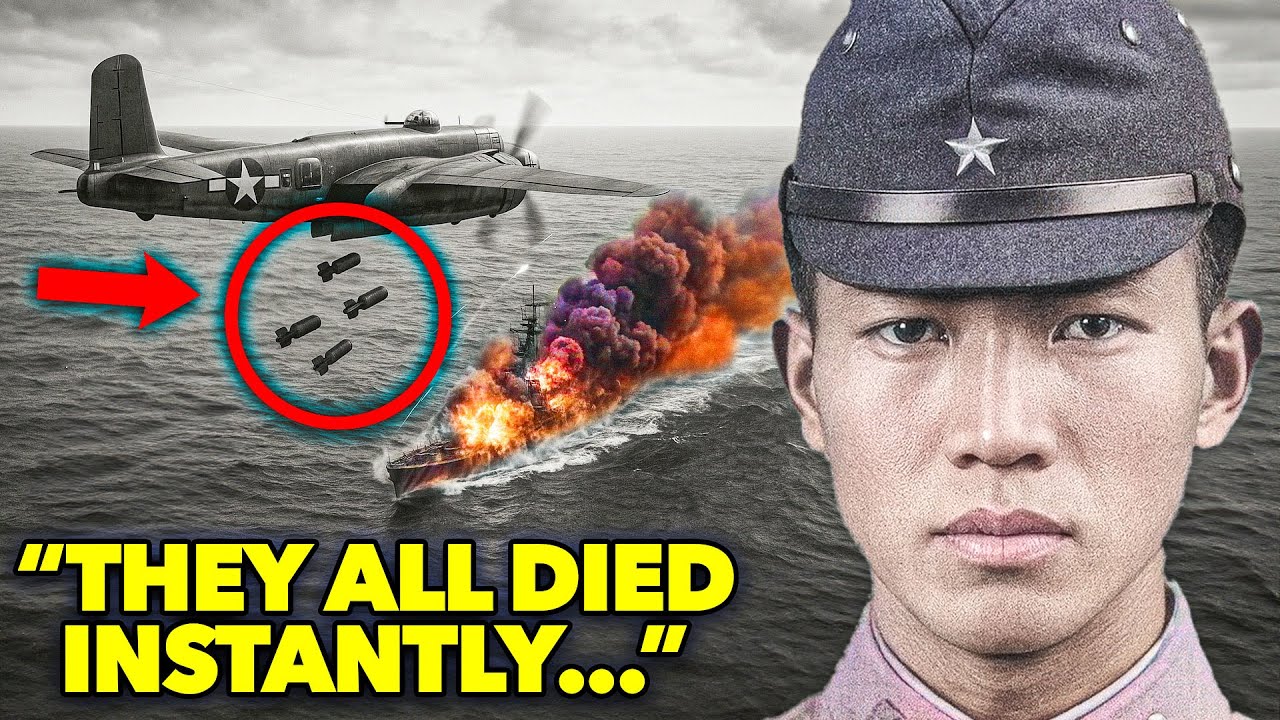
Admiral Masatomi Kimura barely reacted. For months, American high-altitude attacks had been more noise than danger. He ordered his gunners to fire by the book—elevation, distance, wind correction—and the destroyers formed a defensive screen, black bursts of flak peppering the sky as the sea echoed with the rhythmic boom of 25 mm cannons. The men below deck felt reassured.
The drill was predictable. What they did not know was that those distant bombers were only the distraction. Barely fifteen miles away, twelve B-25 strafers and thirteen Australian Beaufighters skimmed the waves so low that their propellers sliced spray from the water’s surface. Sunlight flashed off their aluminum skins, and the noise of their engines was buried beneath the roar of anti-aircraft fire aimed high above them.
Major Edward “Ed” Larner, commanding the B-25 named Ruthless, led the first wave. Through his gunsight, the convoy looked like a row of steel islands waiting to burn. At 280 miles per hour, Larner pressed the trigger. Eight .
50-caliber guns erupted at once, spitting 6,800 rounds per minute. The nose of Ruthless became a wall of fire. Armor-piercing incendiary bullets slammed into Shirayuki’s bridge, cutting through men, steel, and glass in seconds. Metal screamed, decks split, and the air filled with smoke and blood.
Then came the first skip bomb—it skipped twice across the sea, struck the hull below the waterline, and detonated. The destroyer buckled amidships, steam hissing through ruptured pipes as flames tore across its length. Behind Larner, eleven more B-25s attacked in sequence, each selecting a new target. The Beaufighters followed close behind, firing their cannons so low that Japanese sailors could see the pilots’ faces before their decks vanished in fire.
The sky became a sheet of lightning, orange tracers crossing black smoke. The transport Kembu Maru erupted in a ball of flame. Nojima Maru split open like a tin can. The destroyer Arashio, maneuvering to protect the transports, was hit by three planes at once; its bridge disintegrated under twenty-four guns firing in unison.
Its rudder jammed, sending it veering helplessly into another transport, and both ships locked together, burning furiously. From Shirayuki’s bridge, Admiral Kimura watched his formation unravel into chaos. Every ship was burning. Every gun was firing blind.
The Bismarck Sea boiled with oil and debris. In less than fifteen minutes, Japan’s lifeline to New Guinea had become a floating graveyard. This was not how it was supposed to happen. At dawn that same morning, the Bismarck Sea had been a mirror of golden glass, the horizon glowing with soft sunlight.
For the men aboard the Japanese convoy, it felt like another day of quiet dominance. Rear Admiral Masatomi Kimura stood on the bridge of his flagship Shirayuki, watching eight destroyers escort eight fully loaded transports bound for Lae, New Guinea. Below decks, nearly 7,000 soldiers of the 51st Division packed the holds—young men from Osaka, Kyoto, and Sapporo. Many smoked, wrote letters, or joked with the easy confidence of men who believed the Imperial Navy was invincible.
For over a year, Japan’s supply convoys had ruled these waters. American bombers came and went, but their attacks rarely hit. High-altitude B-17s dropped their bombs from miles above, splashing harmlessly into the sea. Torpedo planes that dared come close were swatted from the sky by concentrated fire.
The doctrine had worked, and Kimura trusted it completely. His ships moved in perfect formation, destroyers in a protective ring, transports steady in the middle, maintaining precise speed and spacing. To anyone watching, it was a portrait of order, precision, and confidence. “Americans are predictable,” one gunnery officer remarked, his tone casual.
“They attack from where we expect. ” Kimura nodded silently. He believed it, too. The Imperial Navy’s training was unmatched, its weapons tested, its tactics proven.
Radar crews reported clear skies, no contacts. Anti-aircraft gunners checked ammunition belts, polished lenses, and waited. But beyond the horizon, the world had already changed. Hundreds of miles south of the Bismarck Sea, in the blistering heat of Eagle Farm airfield near Brisbane, a restless American officer was rewriting the rules of aerial warfare.
His name was Major Paul “Pappy” Gunn, a mechanic, pilot, and innovator who had seen too many American bombs splash harmlessly into the ocean. He had flown missions where torpedoes failed, where high-altitude drops missed by hundreds of feet, and where Japanese convoys slipped through untouched. To Gunn, the problem wasn’t courage. It was design.
If the tools didn’t work, he would make new ones. In a dusty hangar filled with grease, noise, and the smell of hot oil, Gunn’s team rolled in a B-25 Mitchell bomber, a sturdy twin-engine workhorse never meant for ship hunting. “We’re not bombing from 10,000 feet anymore,” Gunn told his mechanics, cigarette dangling from his mouth. “We’re aiming down the barrel.
”
What followed was pure improvisation. He ordered the Norden bombsight stripped out, along with the glass nose and everything that wasn’t needed for firepower. In its place, he mounted two . 50-caliber Browning machine guns.
Then four. Then six. By the time they were finished, eight long barrels jutted from the nose like fangs. The plane was unbalanced, front-heavy and violent in recoil.
But Gunn recalibrated it by hand, adjusting counterweights, redistributing fuel, and reinforcing the frame with steel. When the modified bomber rolled onto the runway for testing, even the ground crews stopped what they were doing to watch. At 500 feet, Gunn leveled out and pressed the trigger. The air split open.
Eight guns roared in unison, spitting 6,800 rounds per minute. The recoil shook the earth. Brass shells rained down like a storm. When he landed, his grin said everything.
“She doesn’t bomb anymore,” he said. “She eats ships. ”
Word spread fast. Pilots called it the Strafer, a flying buzzsaw that could outgun destroyers.
Within weeks, field crews across Australia copied the design. The Pacific had just been given a new predator. While Pappy Gunn’s gunships were being assembled in dusty Australian hangars, another American officer was experimenting with a different kind of madness. Major William Ben of the 43rd Bombardment Group was quiet, methodical, and obsessed with one question: why did every bomb they dropped at sea miss?
At 10,000 feet, ships looked like toy models, and by the time a bomb reached the water, the target had already moved. Ben’s crews were dying for results that never came. He needed a new method—something close, brutal, and fast. His solution sounded ridiculous at first.
“We’ll make the bomb skip. ” The idea came from watching children throw flat stones across a lake. If a rock could bounce off the surface, so could a bomb. But to make it happen, a plane had to fly straight and level at just 200 feet, sometimes lower, while racing toward enemy ships at over 220 miles per hour.
It was suicide territory. A single burst of anti-aircraft fire could tear the plane apart. But Ben’s crews trusted him. They practiced on a half-sunk cargo ship off Port Moresby, flying so low that their propellers kicked up salt spray.
The first runs were disasters—bombs ricocheted wildly or exploded too early. But with each pass, Ben refined the timing. At 250 feet altitude, 600 yards from the target, and a half-second delay fuse, the weapon worked perfectly. It skipped once, twice, then slammed into the side of the wreck and detonated beneath the hull.
When General George Kenney watched the final test, he didn’t blink. “That,” he said simply, “is how we’re going to end Japan’s shipping. ”
The plan called for the B-25s to go in first—low, fast, and loud—raking ships with eight forward guns to silence anti-aircraft positions. Then the skip bombers would follow, delivering their payloads at mast height, turning ships into fireballs before they could react.
It was elegant, terrifying, and entirely improvised. By early 1943, both weapons—the Strafer and the skip bomb—were ready. The only thing missing was a target large enough to prove them. And that target was already sailing unknowingly toward its doom.
In the tin-roofed hangars of Port Moresby and Eagle Farm, mechanics tightened belts, ground crews checked feed chutes, and pilots ran through the same rehearsed ritual until every motion became instinct. Every detail mattered: release timing for skip bombs, throttle settings for wavetop runs, and the precise sequence in which strafers and bombers would strike. The timing was measured in seconds. At 0200, a nervous quiet fell over the airfields.
Crews slept in flight suits on cots beside the planes. Maps were scrawled in grease pencil—convoy course, headings, predicted sun angle, likely anti-aircraft arcs. Major Gunn and Major Ben huddled over the same chart, fingers tracing the convoy’s line. Eight transports escorted by eight destroyers, cruising in textbook formation toward Lae.
The weather window was small but perfect: low clouds over the coast, clear air out to sea, and a morning tide that would force ships into predictable tracks. Pilots painted names on noses—Ruthless, Hell’s Angel, Dirty Dora—and joked to hide the tremor. The briefings were brutal and vivid. Fly at mast height.
Hold formation. Suppress the guns. Then release on command. Any deviation could be fatal.
Navigation would be dead reckoning; radar was useless at those altitudes. The Australian RAAF squadron assigned to the strike practiced coordinated strafing passes to cut down upper-deck crews and silence the anti-aircraft guns before the bombs arrived. Timing had to be flawless. Strafers first, skip bombers two to five seconds behind, escort fighters ready to mop up.
On the Japanese side, doctrine made the attackers obvious. Lookouts were trained to spot high-altitude raids and torpedo runs; their eyes instinctively lifted at distant specks above the horizon. That expectation was the fatal rhythm the Allied planners exploited. The strategy hinged on deception by elevation: present a visible, harmless threat high above while the real killers threaded the needle at wavetop height.
As dawn approached, radio silence masked the incoming formations. Engines began to reverberate through the fields in measured waves. Pilots climbed into cockpits and ran final checks. The sun was a smear below the clouds when the first dot appeared on the horizon—barely a speck, but moving with lethal intent.
On the bridge of Shirayuki, Kimura’s lookouts shaded their eyes and reported enemy aircraft bearing 070, altitude unknown. The gunners angled for the high threat. They saw what they expected. They did not see what they needed to see.
From low on the water, the strafing flights rose like iron ghosts, noses bristling and sights steady, screaming in with the confidence of men who had practiced this exact choreography until muscle memory eclipsed fear. Behind them, the skip bombers lined up, each pilot counting seconds against the steel in his hands. The moment the first trigger broke, all the rehearsals would either become salvation or prove to be the last thing anyone would ever do. When the last American bomber disappeared beyond the horizon, silence fell over the Bismarck Sea.
A silence broken only by the crackle of fire and the cries of drowning men. Admiral Masatomi Kimura stood on what was left of his flagship’s deck, staring at an ocean that moments earlier had been his domain. It was unrecognizable. The sky was veiled in smoke, the sea black with oil.
Where proud destroyers and transports had sailed hours before, only burning wrecks drifted aimlessly. Shirayuki, the convoy’s lead destroyer, was gone—obliterated by bombs and fire. Arashio lay dead in the water, locked bow to bow with the shattered transport Nojima Maru; their ammunition stores ignited in violent bursts, sending towers of flame hundreds of feet high. Kembu Maru sank stern-first, its decks still packed with soldiers who had never escaped the holds.
Others tried to swim, but the sea itself betrayed them. Oil slicks burned across the surface, turning the water into fire. Some men leapt from the rails only to land in flame. Others clung to floating debris, their faces blackened with soot and fear.
Kimura tried to organize rescue efforts, but his remaining ships were crippled. The destroyer Asagumo turned to pick up survivors, only to be immediately attacked by returning B-25s, which strafed lifeboats and decks without mercy. The pilots had orders: “Leave nothing capable of reinforcing New Guinea. ” Machine-gun fire tore through swimmers and rafts alike.
The water turned red, waves rolling over bodies and fragments of wood. One survivor later wrote: “The ocean was alive with screaming. The air was thick with heat and the smell of burning oil. There was no sky, only smoke.
” By mid-morning, sharks began circling the wrecks, drawn by the blood and chaos. The few sailors who had survived the fires faced a slower, more terrible fate. The sea itself became a grave. By 10:30 a.
m. , just thirty minutes after the attack began, the once-majestic convoy had ceased to exist. Out of nearly 7,000 soldiers, fewer than 1,200 would ever see land again. The rest sank beneath the surface, entombed in twisted steel and silence.
As the fires continued to burn into the night, Kimura stared into the smoke and whispered what would later become his only line in the after-action report: “The sea itself was our enemy. ”
When the first radio transmission from the Bismarck Sea reached Rabaul, disbelief filled the operations room. Officers gathered around the decoding station, reading the message twice, then a third time in silence. Convoy destroyed.
Total loss. Survivors minimum. Those six words broke something deeper than morale. They broke faith.
Never in the Imperial Navy’s history had an entire convoy been erased in a single daylight attack. Admiral Kusaka, commander of the 11th Air Fleet, refused to speak for several minutes. When he finally did, his words were quiet: “If this is true, then our sea is no longer ours. ”
In Tokyo, Admiral Isoroku Yamamoto read the same message in his private office.
The man who had once masterminded Pearl Harbor now stared at the reality that Japan’s own lifeline had been cut. He set the paper down and said softly to his staff: “If this is true, we no longer control the Pacific. ”
The loss was not just tactical; it was existential. Japan’s entire supply strategy in the South Pacific had depended on speed, formation, and discipline.
Convoys protected by destroyers were thought to be unstoppable. The Bismarck Sea proved otherwise. High-altitude doctrine, anti-aircraft drills, and the fabled umbrella of steel had all failed in minutes. The American attack didn’t just sink ships.
It sank a doctrine that had guided Japan’s Navy for decades. Within days, the Navy’s planners convened in a dimly lit room at Rabaul. Maps covered the tables, circled in red ink to show the range of American bombers from New Guinea. Every route to Lae, Salamaua, and New Britain lay within striking distance.
The conclusion was devastating: daylight resupply was suicide. From that day forward, Japan’s surface convoys could move only under darkness. They called the new tactic Yasen Yuso—the night run. What had once been a confident fleet was now a ghost armada creeping through the shadows.
No more formations, no more daylight sails, no more songs of victory. The Imperial Navy that had ruled the Pacific by pride and precision now moved by fear and silence. In the months after the disaster, convoys that once steamed proudly across the South Pacific now moved like fugitives, slipping through moonless nights without lights or radio contact. Supply routes that had once carried soldiers and fuel in daylight under destroyer escort were reduced to barges, fishing vessels, and submarines creeping between islands.
It was no longer a navy. It was a ghost fleet. The consequences spread quickly. Without convoys, garrisons on New Guinea, Bougainville, and the Solomons began to wither.
Food ran out first, then ammunition, then medicine. Starving soldiers hunted rats in the jungle while American forces advanced steadily, their air power unchallenged. The defeat had severed Japan’s arteries, and every island left behind was slowly bleeding out. Reports from the field described men too weak to fight, collapsing beside empty rice sacks.
Malaria and dysentery finished what American bombs had begun. Back in Tokyo, analysts at the Naval Staff College dissected the defeat with bureaucratic precision. Line after line of data confirmed what Yamamoto had already sensed: Japan’s industrial base simply could not sustain modern warfare. Between March 1943 and the end of 1944, the Empire lost over 60 percent of its merchant fleet—more than 500 ships sunk by Allied air power and submarines.
The same low-level strafing and skip bombing that had annihilated Kimura’s convoy now ravaged every attempt at resupply. No route was safe. No defense effective. Sailors who survived the Bismarck Sea began calling the American B-25 Hachime no oni—the eight-eyed demon—named for the eight guns that glared from its nose.
Others called it the flying saw, claiming its sound could slice through the air itself. Even hardened officers froze when they heard the roar of low-flying engines. One survivor said: “You could smell the oil before you saw them. Then the sea turned to smoke.
”
For the Americans, the battle confirmed that the age of naval supremacy had changed forever. The ocean no longer belonged to battleships. It belonged to the skies. Innovation, not tradition, had rewritten the rules.
The B-25 strafer and skip bombing tactics became the blueprint for all future Pacific air warfare. For Japan, the lesson was cruel and final. No amount of courage could fight what it could no longer see coming. The Empire’s fate was sealed—not by defeat in a grand fleet engagement, but by fifteen minutes of fire that burned its lifeline away forever.
By 1944, the wrecks of the Bismarck Sea had already vanished beneath coral and silence. For Japan, it marked the day the ocean turned against them. The empire that had once ruled the Pacific by precision and pride was now crippled by starvation, fear, and the relentless reach of American air power. Convoys no longer sailed.
What remained of the Imperial Navy hid by day, moved by night, and prayed the sea would stay quiet. For the Americans, the victory proved that innovation could win wars as surely as numbers. The B-25 Strafer, born in a dusty Australian workshop from scavenged parts and stubborn imagination, had redefined aerial warfare. From its eight blazing guns to the bombs that skipped across waves like stones, it turned ingenuity into destruction.
Historians would later call it the most successful field modification of World War II, a weapon that changed the ocean into a killing ground. But for those who flew it, there was no celebration. Pilots returned to base in silence, their faces gray with shock. They had seen men leap into burning water, ships split open, and the sea itself catch fire.
Major Pappy Gunn, the mind behind the Strafer, once said: “We built them fast because men were dying faster. ” His invention had saved countless Allied lives, but at a cost no engineer could calculate. Today, the calm waters of the Bismarck Sea conceal twisted metal and bones, remnants of that fifteen-minute inferno. Schools of fish glide through rusted corridors.
Coral covers gun barrels that once spat flame. Above the surface, the water glimmers as if nothing ever happened. But beneath it lies the moment when warfare itself transformed—when machines began to outthink men, and innovation proved as deadly as the enemy.
The battle ended in 1943, but its echoes still roll with every wave that touches that haunted sea.






