In 2019, a plantation house in Beaufort County, South Carolina, was coming down. To the workers, it was just another old building surrendering to time and machinery. Then one of them struck something solid inside a wall. Wrapped in oil cloth, stiff with age and dust, was a folded bundle of paper.
The ink had faded and the edges were brittle, but when they peeled the cloth away and opened it, the words were still there. It was a letter dated 1831, written by a white overseer named Edmund Hail, addressed to his brother William in Charleston—and it had never been sent. Hail could easily have dropped that letter in the post and washed his hands of the thoughts inside it. Instead, he sealed it in oil cloth and hid it where no one would find it while he was alive.
He was not trying to be remembered. He was trying to bury something that terrified him. The letter opens like any routine plantation correspondence: talk of crops, weather, labor. Then the language shifts.
The sentences tighten. The tone changes. “There is a negro here,” Hail wrote, “who knows things he should not know. He speaks of events before they happen.
The slaves believe he carries the spirits of his ancestors in his blood. I have whipped him until my arm ached and still he looks at me with eyes that see through time itself. I fear this man, William. I fear him more than any living thing.
”
That one paragraph changed everything historians thought they knew about that plantation. When researchers cross-checked Hail’s letter against surviving ledgers and records, they found the man he was talking about. In the plantation ledger, the man was listed by the name the system forced on him: Jim. But that was not his real name.
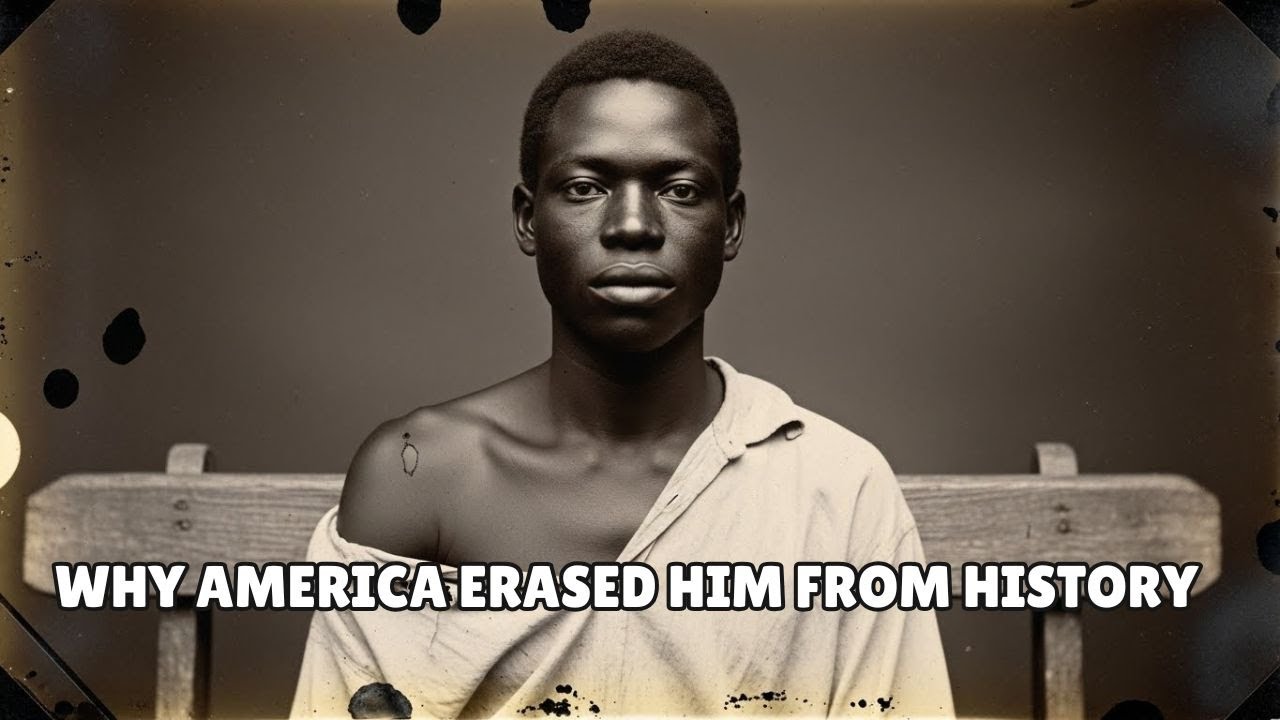
His real name was Jabari Mansa. And what happened to him, what he did, and what he taught became one of the most deliberately erased stories in American history. Because Jabari did not resist slavery by running, by fighting, or by trying to escape. He did something far more dangerous to the system that held him.
He refused to surrender his mind. The pieces of his story were never meant to survive. Plantation owners burned records when they grew nervous. Court files went missing.
Testimony was buried, misfiled, or quietly ignored. But not everything disappeared. Scraps did survive: a forgotten court transcript, an auction receipt with a name that did not fit, pages from an overseer’s journal, letters like Hail’s that were hidden instead of destroyed. And most importantly, memories.
Oral histories collected from formerly enslaved people decades after emancipation, stories passed down from grandparents to grandchildren who understood that what was not written down could still be preserved in the human mind. When historians finally laid those fragments side by side, a pattern emerged—something plantation owners in the 1800s understood perfectly but almost never admitted in public. The most dangerous slave was not the one who ran, not the one who picked up a weapon, not even the one who plotted rebellion. The most dangerous slave was the one who remembered.
The one who refused to let the system erase who he had been before chains. That was what terrified Edmund Hail. He was not writing about a man planning to burn the plantation. He was writing about a man who could not be broken—a man who carried something inside him that survived every lash.
Jabari arrived in Charleston Harbor in August 1807, one month before the United States formally banned the Atlantic slave trade. He came on a ship called the *Henrietta Marie*, a Portuguese vessel hiding under Spanish papers to dodge British patrols. According to the records, 312 African men, women, and children were forced onto that ship on the coast of what is now Senegal. By the time the ship reached American waters, 127 were still alive.
The rest had been thrown into the ocean, their bodies feeding sharks that had learned to follow slave ships across the Atlantic like vultures trailing an army. But this story does not begin in the ship’s dark hold. It begins with what Jabari brought with him that no shackles could touch. Long before the *Henrietta Marie* left the African coast, Jabari had already been trained in something his captors could not see and could not measure.
He came from the Wolof world in what is now Senegal, a culture built on memory. For centuries, the Wolof had relied on oral tradition to protect their history. They had griots—master storytellers whose entire lives were dedicated to remembering. These men could recite the history of kingdoms, the genealogies of ruling families, major wars, alliances, betrayals, and wisdom texts passed down for generations.
They were not entertainers. They were living libraries. Their knowledge could have filled shelves of books if anyone had written it down—but that was the point. They did not.
The Wolof knew that written documents could be burned, stolen, or twisted. A scroll can be seized. A book can be edited. A ledger can be altered.
So they placed their most precious knowledge in the only archives no invader could ever fully control: trained human minds. If you wanted to destroy their history, you had to kill every single person who remembered it. And even then, you had to be sure they had not already passed it on. Jabari’s grandfather was one of those men—not the highest-ranked griot at court, but respected.
His family had status. They were not royal, but they were not peasants either. They lived in that middle layer of society that traders and local collaborators quietly targeted: educated enough to be useful, not powerful enough to be protected. When French and Portuguese traders built forts along the coast, they did not want just anyone.
They paid local chiefs to provide captives who fit specific requirements—young, healthy, and useful. The contracts did not say “future storytellers” or “keepers of history. ” They did not need to. They specified ages, strength, no visible disease.
But everyone involved understood something unspoken: the most profitable captives were people from families who could think, organize, and adapt—people whose skills could be converted into labor value in the new world. That is how they came for Jabari. He was seventeen when the raiders arrived during the dry season. Men from the local chief’s faction—men who spoke his language, men he might have seen in markets—came not as enemies in war, but as contractors fulfilling a deal.
This was not a chaotic raid. It was business. The chief had agreed to supply fifty young men to a Portuguese trader named Valentim Silva, ages fifteen to twenty-five, with no obvious injuries and no sickness. Payment: textiles, rum, iron bars—the currency of human trafficking in that era.
The chief’s men moved through the region with cold precision, taking young men from families with education or skills: sons of griots, sons of merchants, sons of minor officials. Not random villagers. Future leaders. Jabari was captured near a fishing village along with five others.
All came from families with standing. All had been raised to inherit responsibility in their communities. They were taken to a stone fortress on the coast—a holding pen built specifically for human cargo. It was not a prison in the way we usually imagine prison.
There were no individual cells, no trials, no sentences. It was a warehouse, bodies stacked mentally and physically, waiting to be shipped. For three weeks they were crammed into dark rooms, chained together, given barely enough food and water to stay alive. Disease spread fast.
Some people broke inside their own minds before a ship ever left port. Some captives went silent, staring at nothing, their eyes already gone. Some attacked guards knowing they would be killed, preferring a quick death on this side of the ocean over a slow one on the other. Most did something else.
They watched. They listened. They tried to understand the machine that had swallowed them. Jabari did exactly that.
This was not heroism. It was survival. The same way a warrior studies an enemy before a battle, he studied the system that had taken him. How many guards?
What routines? Who gave the orders? Which days were ships loaded? Which captives survived longer?
Which ones broke first? During those weeks in the stone fortress, Jabari met a man who would shape everything that came after. The man was older—maybe around forty—with the presence of someone used to being listened to. His name was Bubacar, and he had been a griot of far higher rank than Jabari’s grandfather.
He had not been captured by chance. He had been sold—not by Europeans, but by rivals. A political faction that wanted him gone handed him to the Portuguese, trading influence at home for iron and liquor. Betrayal layered on betrayal.
But even in chains, Bubacar understood the true stakes. One night, when the guards were distracted, he leaned close to Jabari and spoke quietly. “Listen to me carefully,” he said. “They think they are just stealing bodies.
They are not. They are trying to erase worlds. ”
He explained it in terms Jabari could never forget. “They will try to make you forget your name.
They will beat your language out of your mouth. They will call you what they want until you start to answer to it. They will force you to live so deep in pain that you stop remembering anything that came before. ” Then he told Jabari the one thing that changed his life.
“If you can keep your memories intact, they can never fully win. If you can protect who you were before they took you, your mind stays yours. And if enough of us do that—if enough of us remember and teach what we remember—then they can enslave us, but they cannot erase us. ”
This was not a speech about hope or freedom.
Bubacar did not promise rescue. He was teaching technique. The way a griot trains his mind to hold thousands of lines, Jabari would have to train his mind to hold everything about his own life the system would try to wipe out. His real name.
His family. The geography of his homeland. The bend in the river. The shape of the hills.
The stories his grandfather told him by firelight. The faces of his parents. The taste of the food. The exact sound of dawn over the Senegal River.
“They will take your freedom,” Bubacar said. “They will take your body. But your mind remains your own until you surrender it. Never surrender it.
Not to the whip. Not to the hunger. Not to despair. ”
Three days later, Bubacar was dead.
The official cause, according to the fort’s record, was dysentery. The other captives knew better. His body had simply stopped—he had seen too much, lost too much, and decided not to fight for breath anymore. But until the last moment, his mind was clear.
As he lay dying on the stone floor, he made Jabari promise something very specific. “Remember everything,” he said. “Not just your story. Mine.
” Then he recited his full lineage going back seven generations—names, places, rulers, dates. He poured the history of his family into Jabari’s ears while his body failed. Jabari did the only thing he could do. He memorized every line.
When the *Henrietta Marie* finally set sail with 312 chained Africans in its hold, its captain had no idea that one of those men was carrying more than a body. Inside Jabari’s mind now lived the genealogy of two Wolof families, oral histories of kingdoms, the techniques of memory preservation, and a new, sharpened understanding: they were trying to erase his people. He was going to make sure they failed. The Middle Passage did not simply transport bodies across an ocean.
It was designed to crush minds. For eleven weeks, Jabari lived in suffocating darkness—no light, no room to stretch, barely any water. The smell of blood, sweat, urine, and death packed into the wood. The sound of coughing that turned into silence when another person slipped away.
The ship’s surgeon, a man named Henrik Costa, kept clinical notes that historians later found and quoted because they were written by a European hand. “Day 23: five negroes died overnight. Day 47: water stores low but sufficient. Day 66: numbers, logistics, inventory.
” But those lines hid what was actually happening in that hold. People were losing themselves, changing in front of each other, breaking, disappearing inside their own minds. Some captives refused food and let themselves drift into death. Some cursed the guards until they were beaten silent.
Some stared for days at nothing, their eyes hollow, already gone though their bodies remained. But not Jabari. And not because he was stronger—he was not. His teenage body was deteriorating just like everyone else’s.
But his mind had been trained. So while others screamed or prayed or fell into silence, Jabari did something the guards never noticed. He worked. Not with his hands—those were chained—but with his mind.
He began reciting everything he knew: every family name, every story, every detail of his homeland, every line of Bubacar’s lineage. He whispered it to himself so softly the guards assumed he was slipping into madness. But this was not madness. This was discipline.
When he finished reciting what he already knew, he began memorizing new things: the rhythm of the ship’s movement, the voices of the guards, the faces of the captives around him, the patterns of when people were fed, when they were beaten, when someone disappeared. Every detail became part of his inner library. One night, a woman chained near him asked why he never stopped whispering. Her voice was weak; she had been sick for days.
“My name is Aminata,” she said. “What are you saying? ”
Jabari explained the memory practice—how it kept the mind awake, how it kept despair from erasing identity. Aminata understood in seconds.
Her father had been a merchant, and she knew the discipline of mental calculation. She began her own recitations: trade routes, weights and prices, names of ships, ledgers she had once memorized as a girl helping her father. Soon she and Jabari whispered to each other. She taught him what she knew; he taught her what he carried.
If one of them died, the other would still hold both sets of memories. Without speaking it aloud, they were creating a living database, a chain of memory that stretched from Africa into the hold of that ship. Others noticed. Others listened.
Others quietly joined. When the *Henrietta Marie* finally reached Charleston Harbor in August 1807, Jabari was nearly gone. The surgeon marked him as possibly unfit for sale. But after three days of forced feeding and walking on deck, he recovered just enough to be lined up at the auction.
In the ledger, he became what the system needed him to be: Negro Jim, age 17, purchased for $720 by Marcus Whitfield. But that ledger did not show what he actually carried. No overseer could see the invisible archive in his mind. Slavery believed it had acquired another body.
It had no idea it had also acquired a weapon. On Whitfield’s plantation, that weapon was about to awaken. When Jabari stepped onto the Whitfield plantation, he entered a world built on one principle: break the mind, and the body will follow. Isolation, humiliation, violence without warning, the stripping of names and language—every part of plantation life was engineered for psychological destruction.
The overseer, Thomas Brennan, believed something even darker: a slave must accept his inferiority not just in practice, but in belief. That was exactly where his methods would fail. The rice fields stretched across the marshlands like a green ocean, the air thick with insects and humidity. Brennan stood at the edge of the field with a wooden rod in his hand.
His job was simple: make the Africans obey, make them understand fear, make them submit. The newly arrived captives did not speak English; Brennan did not speak Wolof or Mandinka or Fulani. So he communicated through blows. He demonstrated the planting motion once, then shoved a terrified man into the water and beat him until he mimicked the motion.
One by one, he did this to every captive. Terror was the lesson. Pain was the language. Then he reached Jabari.
Jabari stepped forward, watching every detail of what Brennan had done—not with fear, not with confusion, but with precise observation, the same focus he had used to survive the Middle Passage. When Brennan pointed to the seedlings, Jabari performed the motion flawlessly, not with hesitation, not with trembling, but with sharp, deliberate accuracy. That should have pleased Brennan. Instead, it unsettled him.
“You think you’re smart? ” Brennan muttered, though Jabari did not yet know the words. Jabari did not look away. He met Brennan’s eyes directly, calmly.
This was not defiance in the loud sense. It was defiance in the most dangerous sense: dignity. A slave was supposed to lower his gaze, drop his shoulders, signal submission. Jabari did none of that.
Brennan hit him—a sharp crack of wood against skin that echoed across the fields. Jabari did not flinch. The next strike came harder. Still nothing.
No cry, no recoil, no surrender. For thirty long seconds Brennan beat him, and thirty times Jabari looked straight into his eyes. Brennan stopped—not because he wanted to, but because he suddenly understood something terrifying: violence could correct disobedience, violence could crush rebellion, violence could intimidate, silence, or control. But violence could not break whatever lived inside this African’s mind.
The other enslaved people were watching. Brennan saw it. If he continued beating a man who refused to react, he would reveal an uncomfortable truth: the whip had limits, pain had limits, fear had limits. And there existed something inside Jabari that the plantation system could not reach.
Brennan backed away, sweating, shaken, humiliated in the way only a man who relies on fear can be humiliated. That night in his logbook he wrote: “New Negro shows defiant character. Recommends strict monitoring. Potential influence on others.
” He had no idea how right he was. That night, the slave quarters were cramped wooden structures smelling of smoke and sweat. Bodies lay close for warmth and safety. But Jabari stayed awake, whispering.
He spoke in Wolof to the African-born captives who still remembered fragments of home. He told them what Bubacar had told him in the fortress: “They will try to take your name. They will try to take your language. They will try to make you believe you were always a slave.
” Then he drew a breath and began reciting: “My name is Jabari Mansa, son of Wane Mansa, grandson of Fode Mansa, whose father was a griot of the Wolof people. ” He recited his entire lineage, then Bubacar’s. Then he asked each person to tell him theirs. One by one, the Africans spoke quietly into the darkness, reclaiming identities the system had tried to erase—names whispered like prayers, histories spoken aloud.
Within two weeks, fifteen people could recite multiple genealogies: Jabari’s, Bubacar’s, and their own. Within a month, they had begun teaching the children. That was the true battlefield. Children born on the plantation had never seen Africa, never heard its languages, never learned its stories.
To the owners, these children were perfect slaves—clean slates ready to be shaped into obedience. But Jabari understood something deeper: if African identity could survive in the children, slavery’s ability to erase a people would fail. So he worked with patience, quiet and subtle. In the fields, he spoke aloud about African plants and their names.
In the evenings, he told stories near the children’s quarters—stories of kings, warriors, and ancestors. At night, he taught whispered Wolof words. White overseers heard only meaningless sounds. Children heard the return of a world they had never been allowed to know.
Brennan eventually sensed that something was changing—a spark, a quiet confidence in the eyes of people who were supposed to be broken. He could not describe it, did not know who was responsible, but he felt it like a splinter in his mind. And when he overheard two children speaking African words in 1812, he finally understood: someone was teaching. Someone was rebuilding what the system was designed to destroy.
His suspicion fell instantly on the one person whose eyes he had never been able to break: Jabari. Marcus Whitfield dismissed the possibility at first. African languages, African teaching—impossible, absurd. But Brennan insisted on testing the children.
One by one they were questioned. Fear made them clever, and they gave half-truths, misdirection, innocent smiles. Whitfield could not prove wrongdoing. But the seed of suspicion had been planted.
From that moment, Jabari lived under tighter watch—more surveillance, more restrictions, no talking during work, sleeping quarters rearranged, assignments separated, random checks at night. But it was too late. A network had already formed. Knowledge had already spread.
Jabari had never built a system that relied on his presence. Even if Whitfield had killed him that day, the teachings would have lived on. The weapon he had forged was already out of his hands and into dozens of minds. In 1814, after seven years on the plantation, Whitfield made a decision that would change everything: remove him, sell him, get him off the property before he transformed the entire enslaved population.
But Whitfield did not understand who Jabari truly was. Selling him did not stop the spread. It multiplied it. Because Jabari was about to be chained into a marching coffle with forty-three strangers.
The slave coffle was one of the cruelest mechanisms of the domestic slave trade: forty or fifty enslaved people chained neck to neck, wrist to wrist, marched hundreds of miles from the coast to the deep south. No wagons for the enslaved, no rest except a few hours on dirt. Those who stumbled were beaten; those who collapsed were whipped until they stood again; those who could not stand were left behind to die. This was forced migration by terror.
For most people in a coffle, it was the beginning of their final descent into a life that would kill them within a decade. But Jabari saw something different: a terrible opportunity. The coffle contained forty-three enslaved captives—men taken from plantations, young women sold after childbirth, boys separated from parents, Africans who had only been in America for weeks. They did not speak the same languages, did not know each other’s stories, had no reason to trust.
But they were chained together, forced to walk together, forced to breathe the same dust, forced to endure the same darkness every night. This was Jabari’s new classroom. The first night, when the sun went down and the coffle was driven off the road to sleep under trees, the enslaved people expected only exhaustion and fear. Instead, they heard Jabari’s voice, soft and calm: “What is your name?
Your real name? ” The person beside him did not answer or did not understand. So Jabari tried again in Mandinka, then in Wolof, then in broken English. Eventually, a man whispered his true name, then his village, then his lineage.
Jabari repeated it back to him word for word, memorizing it instantly. Then the next person spoke, and the next, and the next. Their stories spilled into the night: a hunter taken near the Niger, a woman whose newborn had been sold the previous month, a boy who remembered only his mother’s song, a man who had seen his entire family killed during his capture. By dawn, Jabari carried the true names and histories of more than twenty people.
Every night the same thing happened, and every night the archive grew. Jabari taught them memory techniques—breathing patterns to steady the mind, how to recite lineage, how to hold trauma without letting it break identity. He taught them how to pass memory safely, how to recite entire genealogies without losing precision, how to describe their suffering in ways that preserved truth instead of drowning in it. He was turning trauma into testimony, pain into evidence, survival into knowledge.
One night, Jabari noticed a young woman whose shoulders shook silently from dusk until dawn. She barely spoke, would not eat, walked like someone already halfway gone. When he finally managed to stand beside her during a rest, she whispered: “They took my son two days before they sold me. ” Her grief was shattering.
Jabari did not try to comfort her with false hope. Instead, he taught her something Bubacar had taught him: “Recite the story of your son. Recite it so he stays alive in memory, even if he is not in your arms. ” She did, haltingly at first, then with clearer detail—the sound of his laugh, the way he held her finger when he slept, the birthmark on his cheek.
When she finished, Jabari repeated it back to her word for word. She wept again, but the tears were different. She was no longer carrying her son alone. By the time the coffle reached Montgomery, Alabama, after nearly two months of marching, Jabari had become something the slave system had never accounted for: a human library that grew every day.
He carried the genealogies of more than forty African families, testimonies of abuse from multiple plantations, memories of children, villages, ancestors, detailed accounts of the march itself. And even more dangerous: the others had begun carrying pieces of each other. If Jabari died, the archive would not. The coffle system was intended to scatter people so thoroughly they could never rebuild community.
That march had done the opposite. It had created a chain of memory stronger than iron. Most of the coffle was sold at Montgomery. But Jabari, along with seven others, was transported one hundred miles deeper into Alabama, to the plantation of Samuel Crawford.
Crawford owned more than two hundred enslaved people—a cotton empire built on exhaustion, disease, and death. The physical cruelty was only half the system. The other half was psychological, and its architect was the overseer Jacob Reeves. Reeves believed a slave should never feel safe—not for one hour, not for one minute.
Fear was his science, terror his discipline, pain his management philosophy. He kept journals filled with cold observations: output, punishment, obedience curves, labor degradation. He analyzed broken bodies the way a butcher studies cuts of meat. On Jabari’s fifth day at Crawford’s plantation, the temperature soared past one hundred degrees.
In the middle of the cotton rows, a young woman named Sarah collapsed—not a faint, not a stumble, a full collapse, her body shutting down, her breathing shallow, her skin hot as fire. Reeves walked toward her with irritation. A fallen slave was not a human in danger; it was a worker failing to produce. He ordered two men to drag her from the row, then raised the whip.
And then a voice cut through the field: “She needs water and shade. If you continue, she will die within the hour. ”
It was Jabari, speaking in clear, practiced English. The field froze.
The other enslaved people stared in horror; they knew what happened to anyone who contradicted Reeves. Reeves turned slowly, the whip hanging from his hand. “What did you say? ”
Jabari did not look away.
“She will die. I have seen this illness before. Heat takes the blood first, then the breath. Water, shade, rest—or you lose property.
”
That last sentence was strategic. Jabari had learned how white men listened: appeal to humanity and they ignore you; appeal to profit and they suddenly hear you. Reeves stared at him, struggling to understand the defiance. New Africans did not speak English like that.
New Africans did not contradict overseers. “You know medicine? ” Reeves asked. Jabari paused.
He was not a doctor. But he was a griot’s grandson, and in West Africa, griots learned more than stories—they learned the rhythms of the body, the patterns of sickness, the knowledge of survival. “I know what heat does,” he said. “And I know how to stop it.
”
For the first time in years, Reeves hesitated. Killing a slave by mistake cost money. He lowered the whip. “Give her water.
Move her to shade. We’ll see if he’s right. ”
Sarah lived. And that changed everything.
Over the next days, Reeves began calling Jabari out of the rows whenever someone grew ill: “What do you think? Is she faking? Will he survive? What’s the remedy?
” Jabari was never treated with respect, but he was given something rare on a plantation: access. He moved through the quarters, spoke to the sick, tended wounds, observed injuries from punishments, listened to stories whispered in agony. With every person he helped, his archive grew. Crawford began taking notice.
A slave who could keep others alive was valuable; replacing a dead slave cost hundreds of dollars. So Jabari gained something else no one intended: freedom of movement—not literal freedom, but movement within the enslaved community. A healer was allowed to ask questions, enter homes at night, hear truths others hid. Jabari used every opportunity with precision—not to plan escape, not to spark rebellion, but to preserve identity, strengthen minds, rebuild what slavery tried to destroy.
Within six months, Jabari had created a new circle of memory preservers on Crawford’s plantation—not fifteen this time, but nearly fifty men and women who could recite their African names again, children who learned fragments of forgotten languages, mothers who taught their children genealogy, families who whispered histories after nightfall. It spread quietly like embers under ash, invisible to white eyes, bright to everyone else. When Crawford finally sensed something wrong and ordered surprise inspections and cracked down on gatherings, the network was already self-sustaining. Teaching no longer depended on Jabari.
Memory had become communal. Slavery’s greatest weapon—cultural amnesia—was failing, and that terrified Crawford more than open rebellion. Violence he could crush. Escape he could punish.
Conspiracy he could kill. But this invisible rebuilding of identity he could not touch. In 1821, Crawford asked himself the question every master eventually asked about a slave he could not control: how do I remove this without making him a martyr? The answer would send Jabari deeper into the south—and deeper into a destiny the slave system could never have predicted.
In 1822, a Methodist minister named Reverend Thomas Whitmore rode up to Crawford’s plantation offering religious instruction for the Negroes. Crawford welcomed him, not because he cared about their salvation, but because he believed Christianity would pacify them. Whitmore was a strange man: devoutly pro-slavery, yet convinced enslaved souls deserved scripture. He traveled from plantation to plantation teaching Bible verses, hymns, obedience—and, most dangerously, reading.
To the preacher, literacy was a path to salvation. To slavery, literacy was a threat. When Whitmore asked for permission to teach reading to a small group of slaves, Crawford agreed. He thought he was handing the enslaved a Bible.
He was actually handing them a blade. The way Jabari approached literacy stunned Whitmore. Most enslaved adults struggled at first; letters were foreign symbols, unnatural shapes. But Jabari absorbed them like someone recognizing pieces of a puzzle.
He learned letter by letter, word by word, sentence by sentence. Within months, he was reading passages of scripture aloud with a fluency that made Whitmore beam with pride. But Jabari was not reading for salvation. He was reading for liberation—mental, cultural, generational.
Reading opened a door no overseer could lock. Slaves were not supposed to know the world existed beyond the plantation fence. Slaves were not supposed to understand law, politics, rebellion, geography, or possibility. Jabari understood all of these things now—and, more importantly, he could teach them.
Jabari taught reading the way griots taught epic memory: through rhythm, pattern, repetition. At night in dark quarters, he drew letters in the dirt, whispered phonetic sounds, linked English words to African words to help people remember. Every slave who learned a single word was taught how to teach that same word to someone else. By 1827, nearly thirty enslaved people on Crawford’s plantation could read at a basic level.
Most could write their names. Some could copy entire Bible passages. A few—Jabari’s closest students—could write sentences describing their own lives. It was unthinkable, illegal, revolutionary.
And it was happening right under the master’s nose. Then Jabari did something unprecedented. He began turning memory into written record—but not on paper that overseers could seize, not in books that could be burned. He wrote on the inside walls of slave cabins and erased it before sunrise.
He wrote behind storage crates in charcoal where only the enslaved went. He wrote under floorboards in places overseers never thought to check. A distributed archive, a written network, a record of slavery kept in fragments scattered across the plantation like pieces of a map. And what he wrote was explosive: the names of enslaved families torn apart, the dates of whippings and punishments, the names of overseers who committed rape, the births and deaths that owners never recorded.
He was not just preserving memory. He was documenting crimes. In 1831, Nat Turner’s uprising in Virginia left sixty white people dead, and every plantation owner in the south entered a state of panic. The response was terror laws: banning gatherings, banning movement, banning reading, banning writing.
Whitmore’s literacy classes were abolished overnight. On Crawford’s plantation, a new decree was passed: search every slave cabin, search every storage room, search every hiding place. It did not take long. A white overseer found writing—charcoal markings on the inside of a shed wall.
Names. Dates. Descriptions of punishments. Not vague complaints, but specific documentation.
Too specific. Crawford launched an investigation. Dozens of slaves were tortured for information. Several died without confessing, protecting the one man at the center of it all: Jabari.
But eventually the pattern was clear—the writing was too intelligent, the phrasing too precise, the English too advanced. Crawford summoned Jabari and began to question him. What happened next was so shocking that the court transcribed his exact words: “I wrote nothing. But I remember everything.
”
Then he recited years of plantation abuses—names, dates, witnesses, suffering. He became a living indictment, a walking archive, a human ledger of crimes that could destroy an entire slave-holding estate. Killing Jabari would not kill the knowledge; he had already taught too many. So Crawford did what frightened men always do.
He sold Jabari again, and again, trying to outrun the threat, trying to scatter the knowledge, trying to break a man who refused to break. But every time they moved him, he taught more people. Every time they sold him, the network grew. Every time they tried to silence him, the truth spread wider.
By 1844, Jabari Mansa had lived through four plantations, two decades of surveillance, and endless attempts by white men to break his mind. None succeeded. He had become an institution—a living library, a teacher who created teachers, a threat that traveled plantation to plantation long after he was sold away. And on Edmund Hail’s small, isolated plantation, the world was about to witness the most terrifying demonstration of his power.
One Sunday night, twelve enslaved people from nearby plantations slipped into the woods. No drums, no chants, no torches—just silence, determination, fear mixed with purpose. They met Jabari in a clearing surrounded by tall pines. To a white eye, it might have looked like a ritual.
To an enslaved person, it was something far more sacred: a remembering. Jabari stood in the center and said softly: “Tonight we teach what must not die. ”
One by one, the twelve stepped forward—not to worship, not to rebel, but to testify. This was the technique Jabari had developed over decades: witnessing, speaking trauma with such precision that no listener could walk away unchanged.
He had trained them in breath, tone, pacing—trained them to speak like griots, to turn suffering into a weapon sharper than steel. A woman named Ruth stepped forward first. She spoke of her two babies sold at ages three and one. She described the sound of their cries, the taste of her milk still full with no child to drink it, the moment her knees collapsed and she clawed the dirt, screaming until her throat bled.
Her voice did not break. Her face did not tremble. She spoke like a messenger delivering truth, not emotion. Then an older man named Isaiah stepped forward.
He described the Middle Passage—not the facts, but the sensations: the burning salt air, the weight of another man’s corpse against his shoulder for three days, the insects crawling on open wounds in the darkness. He spoke as if he were there again, as if he were putting the listeners there too. Jabari nodded in approval. Their memories were sharp now.
Dangerously sharp. Because when memory becomes clear enough, it becomes impossible to ignore, impossible to dismiss, impossible to forget. Hidden in the brush nearby, two white hunters—Daniel and William Harding—had followed the voices out of curiosity. The moment they heard what was being spoken, curiosity curdled into terror.
They had never heard enslaved people speak like this. Not begging, not crying—testifying with accuracy, with depth, with a calmness that made the pain even worse. After only minutes, the brothers began to feel sick. Their eyes watered.
Their hands shook. Their hearts raced. The testimonies slipped under their skin, into their minds, into their memories. Ruth spoke again, and Daniel Harding suddenly smelled sweat and iron.
He heard babies screaming behind his left ear. He felt the emptiness in his own arms, as if his children had been taken. Isaiah described the ship’s hold, and William Harding felt water rising to his chin, felt chains around his ankles, felt panic he could not explain. They tried to step back, but their legs refused.
They were trapped inside someone else’s memories. When the enslaved people finally discovered the Harding brothers hiding in the woods, they scattered in terror. Jabari did not run. He simply stepped back into the shadows and vanished like smoke.
But the damage had already been done. Daniel Harding began vomiting uncontrollably, cried for hours, begged for forgiveness without knowing for what. William Harding collapsed, screamed that he was drowning, spoke Wolof words he had never learned, described African coastlines he had never seen. He suffered hallucinations, waking dreams, flashbacks that were not his own.
Doctors had no explanation. Priests failed to cure him. Neighbors whispered that he had been touched by the negro sickness. But black communities said something different, something truer: he felt what we feel.
Three inquiries began immediately. A local sheriff’s investigation searched for evidence of witchcraft or poison and found nothing. Doctors of the South Carolina Medical Society wrote: “We cannot explain how trauma transferred into the minds of the Harding brothers. ” And a state legislative committee reached a conclusion that shook the entire slave-holding south: “If enslaved people have learned to communicate their suffering with such vivid force that white citizens lose reason, new laws must be created at once.
”
South Carolina passed emergency legislation in 1845. No more than three enslaved people could gather unsupervised. No nighttime meetings of any kind. Mandatory rotation of enslaved populations between plantations.
Immediate isolation or sale of any enslaved person showing unusual intelligence. And an absolute ban on teaching enslaved people any pneumonic practices. They banned memory itself—because of one man. Because of Jabari.
Edmund Hail’s hidden letter, found in 2019, reveals what terrified him most: “He looks at me with eyes that remember every cruelty I have ever committed. I fear he will be remembered and I will be forgotten. ”
Those were the words of a man realizing the truth too late. He had enslaved someone who could not be enslaved.
Jabari did not break bodies. He broke illusions. He broke the lies that held slavery together.
And now the state was hunting for him—not because he ran, but because his mind had become a threat no whip could reach.






