A wool mitten tied to a length of string drifted down through the air over one of the busiest streets in England. Winter, London, some morning in the 1400s, and anyone walking up Ludgate Hill would have watched it descend the stone face of the city gate and stop at head height, swaying. High above it, behind a barred window, stood a man nobody on the street could see. Drop a farthing in, and the string went taut, and the mitten rose back up the wall and vanished, and the man inside ate that day.
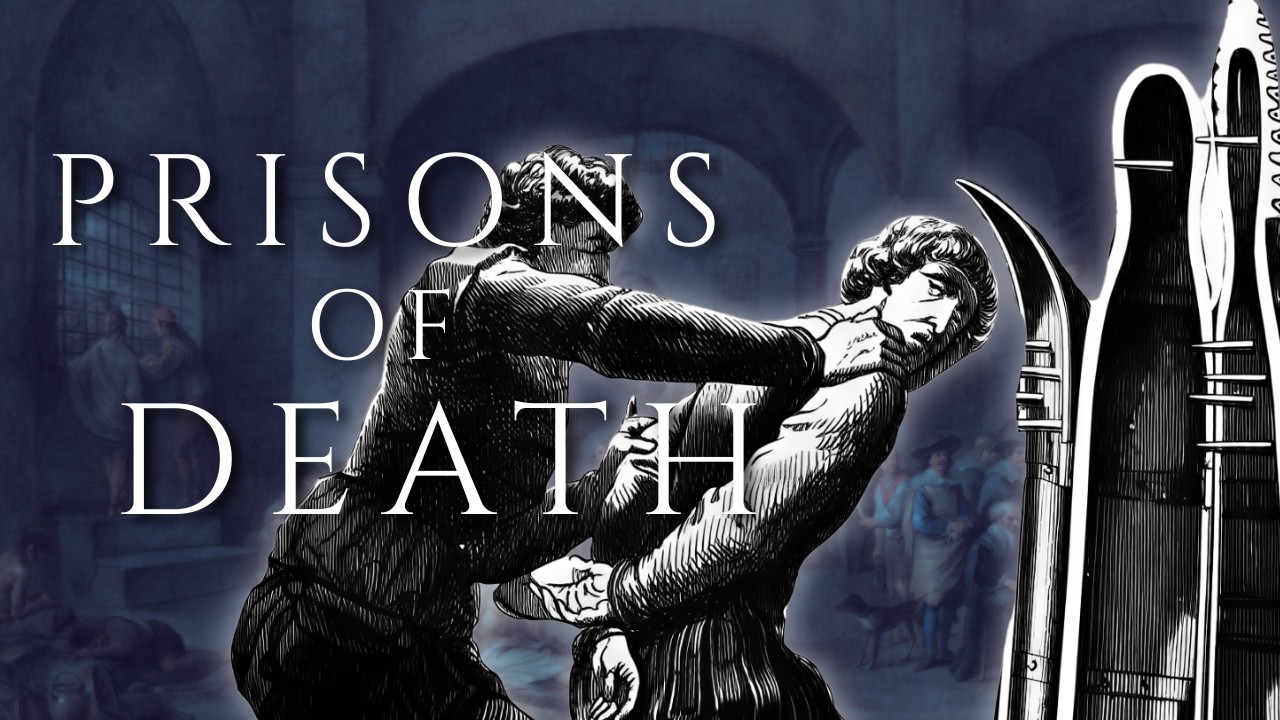
If nobody stopped, he didn’t. That was the whole system. A grown man, a citizen, maybe a shopkeeper who had had one bad year, fishing for coins above one of the richest thoroughfares in the kingdom, while the meat sellers and the water carriers and the lawyers walked past underneath him. In the eyes of the law, the man at the top of that string was not being punished.
Legally, officially, on parchment, he was just being held. Medieval law was very clear on this point: a prison in the Middle Ages was never supposed to hurt you at all. A waiting room in the law’s eyes. You waited for your trial, or you waited until you paid your debt, and then you walked out.
Nobody was sentenced to suffer in a cell the way we think of prison sentences now. And yet, over the course of what follows, starvation deaths counted by coroners in a single building, men crushed under stone in a licensed procedure, prisoners whose legs rotted off inside their own leg irons, a flooded stone funnel in Paris built so a human body could never find rest in it, and a churchman’s prison that the town council next door formally described in writing as hell, all of it inside institutions whose founding principle was that they weren’t allowed to punish anyone. The legal idea underneath all of this came down from Roman law, and medieval lawyers repeated it like a proverb. A prison exists to hold men, not to punish them.
In the Latin they liked to quote: carcer ad continendos homines, non ad puniendos haberi debet. The great English legal treatise of the 1200s, the one that goes under the name of Bracton, took the same position. Gaol was custody. You held a suspected thief until the judges came around.
You held a debtor until his creditor was satisfied. You held a political inconvenience until the king decided what to do with him. The building was a pause button, not a sentence. In practice, that doctrine created something almost worse than honest punishment would have been.
If prison isn’t punishment, then the state doesn’t owe you anything while you’re inside. No food, no bed, no fire, no doctor. You’re not serving a sentence. You’re just stored.
Whatever you need in storage, you buy, or someone brings it to you, or you go without. And the man storing you, the jailer, isn’t a public servant with a salary. In England, he’s a private businessman who paid good money for the right to run the prison. And the prisoners are how he earns that money back.
Put that next to the pace of medieval justice, because the two things together are what killed people. In most of England, the judges who could actually try a felony came around on a circuit. Gaol delivery, the sessions were called, and the name is beautifully literal. The judges arrived, the gaol was delivered of its prisoners.
Everyone got tried in a burst over a few days, the acquitted walked, the condemned hanged, and the judges rode on to the next county town. For a lot of gaols, this happened once a year, twice if you were lucky. So a man arrested in November on suspicion of stealing cloth, a man who might be completely innocent, sat in irons in a stone room through the whole winter, through Christmas, through Lent, into the summer, waiting for a trial that would take perhaps fifteen minutes when it finally happened. Trials were fast.
The waiting was the sentence. And an unheated medieval gaol in an English winter, with no food except what you could buy or beg, was a place a healthy adult could simply fail to survive. We know how often that happened from a wonderfully bleak class of document, the coroner’s rolls. Any death in prison was supposed to get an inquest, same as a body found in a ditch.
The coroner came, looked at the corpse, impaneled a jury, and wrote down a cause. And the causes they wrote down over and over across the thirteenth and fourteenth centuries were hunger, cold, want. Sometimes all three in one entry: dead of hunger, thirst, and want. A clerk’s five words standing in for what was probably six weeks of a human being disappearing into himself on a stone floor.
One little courtroom scene survives from a gaol delivery at Newgate in 1421, and it catches the routine of all this perfectly. The justices are working through the list from the previous session, and they get to a prisoner from a place called Wareham, and they ask the jailer where this man is. The roll says he was remitted to prison until this session, and the jailer says he died in prison. And the court, rather than just shrugging, asks whether he was buried before the coroner viewed the body, since burying a prisoner unviewed meant a heavy fine for the jailer.
And the jailer says, “No, no, he was viewed. ” And the coroner is called in, and he produces his book. And the book says, “The man died in the pestilence. ” And that’s it.
Case closed. Next prisoner. A man waited months for his day in court, and what arrived at court instead was a line in a ledger confirming the paperwork on his corpse was in order. Who were these people, though?
When you hear medieval prisoner, you probably see a bearded man in rags chained to a wall, some captured knight or condemned murderer. The reality of the population is stranger and sadder. The single biggest category in London especially was debtors. Ordinary commercial failures.
A grocer who couldn’t cover what he owed a wool merchant. A widow behind on rent. Under English law, a creditor could have a debtor locked up until the debt was paid. And here’s the part that startles: with no time limit whatsoever.
Some continental cities capped imprisonment for debt at a year. England didn’t bother. You stayed until the money appeared. And if the money never appeared, you stayed.
A man could be imprisoned in his thirties over a few pounds and die in the same building as an old man. His imprisonment cost his creditor nothing and cost him everything. And the pure spite of it was sometimes the point. After the debtors came the people waiting on trial.
Accused thieves, accused killers, poachers, brawlers, servants who’d run off with a master’s spoons. Innocent and guilty side by side, indistinguishable, because guilt hadn’t been decided yet. That was the whole point of the waiting. Then a scatter of everyone else.
Prostitutes and curfew breakers swept up by the night watch. Clergy who’d committed crimes and been claimed by the church courts. Heretics waiting to recant. People the king simply wanted somewhere.
And threaded through all of them, the prisoners’ families, because wives and children often moved into the prison too. Residents rather than inmates. The alternative was starving alone outside. So they came in, and children were born inside these walls and learned to walk in prison yards.
And some of them grew up knowing the begging grate the way farm children knew the pasture. Every one of those people, the moment the door shut behind them, entered an economy. The medieval prison ran on a price list. Escape, in a form that shows exactly how people ranked their options, sat right next door the entire time.
English law offered a fugitive a strange bargain called abjuring the realm. If you committed a felony and got yourself into a church before they caught you, you had sanctuary, forty days of it. And at the end of those forty days, you could stand at the church door before the coroner, confess your crime out loud, and swear to leave England forever. They’d assign you a port.
You’d dress as a penitent, carry a little cross, and walk there along the king’s highway, and then take ship into permanent exile. Everything you owned, forfeit. Your home gone for life. And thousands of people took that deal.
Ordinary men chose to confess to crimes, surrender every possession, and walk out of their own country barefoot rather than sit in an English gaol waiting for a jury that might well have acquitted them. They had seen the inside of those buildings, or heard enough. Exile was the good option. Newgate is the natural place to start.
Everybody’s heard of it, and its records are good enough that we can watch it kill people in something close to real time. The building itself started as exactly what the name says, a new gate, one of the openings in the old Roman wall around London at the western edge of the city near where the Old Bailey stands today. Henry II turned it into a gaol in 1188 as part of his big overhaul of English justice, and it stayed a working prison through fires and rebuilds into the twentieth century. Seven hundred years of continuous operation.
For our purposes, the medieval building matters: the gatehouse with cells stacked in it and dug under it, traffic passing through the arch below, while men rotted in the rooms above and beneath the road. Administratively, Newgate belonged to the city of London, meaning the two sheriffs elected each year were responsible for it. The sheriffs, being busy merchants who had no intention of personally running a gaol, leased the job out. They sold the keepership to a private operator.
The position changed hands for real money, and it was considered one of the most profitable posts in London. Running a building full of destitute, accused criminals was a coveted business opportunity. The keeper had paid upfront, sometimes borrowed to do it, and everything he made back, he made out of the prisoners. Here is what it cost to be locked up in medieval Newgate.
You paid a fee at the door for the privilege of being admitted to the prison. Admitted like a hotel. You paid the clerk who entered your name in the register. If the keeper decided you needed irons, and for anyone poor he generally did, you paid to have them riveted on, and then you paid a second larger fee to have them taken off.
Removing them was called easement of irons, and it was the keeper’s most reliable earner, since the alternative to paying was living day and night in fetters. You paid for a bed, you paid for a candle, you paid for firewood in winter. Food and ale were sold inside the walls at whatever markup the keeper liked, since he controlled the door, and no competitor was walking in. Down in the cellar, the keepers of later centuries ran what was basically a private tavern for the prisoners, and drinking your misery away in the dark became its own little revenue stream.
And at the far end of it all, when your trial finally came and the jury said not guilty, you paid a discharge fee before the door opened. Men found innocent by a court of law were dragged back from the courtroom and held in the cells until they’d settled the keeper’s bill. An acquittal was a legal event. Release was a financial one.
We even have the price of some of this. In 1431, Newgate charged prisoners fourpence a week toward the lamps. In 1488, a bed with sheets, a blanket, and a coverlet ran a penny a week. Those sound like small numbers, and for a merchant they were.
For a laborer who earned maybe three or four pence for a full day’s work when he was free, and who now couldn’t work at all, they were a slow-motion catastrophe. Every week inside made you poorer, and being poorer made every week inside worse, and the spiral only pointed one direction. The keepers themselves show up in the records mostly when they got caught, and a couple of them deserve to be named. A fourteenth-century keeper called Edmund Lorimer became notorious for charging four times the legal limit for easement of irons.
And the existence of a legal limit is its own evidence: cities didn’t cap the price of something nobody was gouging on. Another keeper, Hugh Duddene, was eventually convicted of blackmailing the prisoners in his custody. Blackmail inside a prison is an ugly business when you think through the mechanics of it, because a keeper had endless leverage. He decided which ward you slept in, whether your irons were light or crippling, whether your wife’s food parcel reached you, whether you got dragged into a punishment cell on some invented infraction.
Pay, or things get worse. And things could always get worse. The cleanest way to see medieval Newgate is to look at the rules the city kept issuing to the keepers. Because every rule is a photograph of the crime it was written against.
Keepers were ordered not to seize the alms that charitable Londoners sent in for the prisoners. So they’d been stealing the prisoners’ charity food. They were ordered not to monopolize the sale of food and drink at extortionate prices. So they had been.
They were forbidden from charging prisoners a fee for the service of bringing them to their own trials. Men were being billed for transportation to their own hearings. And the ones who couldn’t pay presumably just didn’t get produced in court, and sat through another year until the next session. In 1393, the city banned charging for lamps and beds.
We’ve already seen the 1431 lamp fee, so you can judge how well that ban held. The regulations kept coming for two centuries. Each one an admission that the last batch had been ignored. Inside the walls, the building sorted people by money and by fate.
Debtors of the ordinary sort went to a common ward called the Stone Hall. Accused felons went to the Stonehold, and the Stonehold was the bad one: an unlit chamber where the poorest prisoners lay together in their fetters on the floor. A description that survives of the felons’ quarters says the wards were so foul, so dark, and so depraved that physicians would not go in. Doctors in a century that thought nothing of plague houses and battlefield surgery drew the line at Newgate’s lower rooms.
And underneath even that, below the keeper’s own house, sat the hold for the condemned. The surviving description of that one is short and terrible: an open sewer fitted with chains. Men in their last days before hanging lay shackled in a cellar with the city’s waste running through it, and the smell coming up through the floorboards was presumably part of the keeper’s domestic life. He lived with it because the condemned paid fees too.
Women were in Newgate this whole time. Accused women, debtor women, and until 1406 they had no separate quarters worth the name. One detail finally shamed the city into building some: to reach the one privy available to them, the women had to walk through the men’s wards. Every trip, past men chained in the dark, many of them awaiting trial for violent crimes, all of them bored and desperate.
What happened to those women on those walks mostly didn’t get written down, and that absence from the record is its own testimony. In 1406, London built the women a tower of their own with their own latrine. And the fact that it took over two hundred years to think of it says plenty about where female prisoners ranked in anyone’s concerns. Even the air in the building was a killer, and Londoners knew it.
The gatehouse sat directly over one of the city’s main roads, and the stench rolling out of it was famous. People rerouted processions to avoid passing under the arch. By 1419, conditions inside had gotten so lethal, the records talk about the fetid and corrupt atmosphere of the place, that the city took the extraordinary step of shutting Newgate down entirely. The prison was killing people faster than the courts could process them.
What saved it, oddly enough, was a dead mayor’s money. Richard Whittington, the real man behind the Dick Whittington of the pantomimes, died in 1423 and left a fortune to charity, and his executors spent part of it demolishing and completely rebuilding Newgate. For generations afterward, prisoners called the building the Whit, with something almost like affection, the way you’d nickname a cruel old relative. The rebuilt prison was cleaner for a while.
The fee system moved into the new building intact, because the fee system was never about the architecture. Directly across the street from the gate stood the church of St. Sepulchre, and St. Sepulchre’s bell rang for Newgate’s condemned.
On execution mornings, the carts came out of the gate and turned toward the gallows, and the great bell told them out of the city. Later on, a merchant’s bequest formalized an even more intimate ritual: a handbell rung in the night outside the condemned cell itself, with a recited verse telling the prisoners inside to repent while time remained. For the men in the hold under the keeper’s house, lying in the sewage with their wrists chained, the sound of St. Sepulchre’s bell through the wall was the calendar.
Every time it rang for a cart of the condemned, the men still waiting knew the sessions had come and gone once more, and counted forward to their own turn. Now for what a bad year inside those walls looked like. 1315, the year the outside world’s food ran out. The Great Famine hit Northern Europe that year like nothing in living memory.
The rain started in the spring and barely stopped. The harvest drowned in the fields, drowned a second time in 1316, and grain prices went vertical. A London chronicler recorded wheat selling at thirty-eight and forty shillings the quarter, seven or eight times its normal price, and salt at prices nobody had ever heard of. And villagers walked into the city looking for food that wasn’t there either.
People without number, the chronicle says, died of hunger. In the hungry years that followed, fifty-two Londoners were crushed to death in a single stampede when alms were handed out at a religious house and the crowds surged. That was life outside the prison walls. Free people with legs to carry them anywhere in the city, dying in the streets.
Now think about what those two years did inside Newgate. Every prisoner in that building ate through one of three channels: money, family, or charity. The famine burned down all three at once. Prices inside the gaol tracked prices outside, except worse, because the keeper set them.
So a prisoner’s savings that might have bought six months of bread now bought six weeks. Families who might have carried in a loaf twice a week were suddenly starving themselves. And a wife choosing between her children outside and her husband inside doesn’t really have a choice at all. And the charity, the alms baskets, the coins through the grate, dried to nothing, since a Londoner watching his own neighbors drop in the road had nothing to spare for strangers behind a wall.
The prisoners were at the absolute end of the food chain, locked in place, forbidden to forage or work or beg beyond arm’s reach of a barred window. The coroner’s numbers from those two years are as close as we get to a body count. Between 1315 and 1316, sixty-two deaths in Newgate alone came under the coroner’s investigation. Sixty-two in one building in roughly a year, in a prison whose whole population might have been a couple of hundred souls.
And separate from the famine deaths, one year’s records show twenty-two Newgate prisoners dying of gaol fever. Gaol fever gets its turn in a minute. First, dying of hunger, the phrase the coroners kept writing. Two short words doing a lot of polite work.
Starvation is slow and it is methodical. The body denied food starts eating itself in a fixed order. The fat goes first, over the early weeks, and prisoners who’d come in well-fed watched their own bodies deflate. Then the muscle.
The body breaks down its own tissue for fuel, and a man’s arms and thighs visibly waste. His face collapses inward around the skull. His skin hangs loose and then stretches drumtight over bone. Strange things happen along the way.
The starving often swell, their bellies and ankles ballooning with fluid as the blood loses the proteins that hold water in the vessels. So the dying man in the corner of the ward looks bloated even as he’s vanishing. Fine downy hair grows on the skin as the body’s last insulation. The heart, being muscle, wastes with everything else, and shrinks and slows.
The mind goes strange: apathetic, then confused, and men in the last stage stop responding to their own names. Cold finishes most of them. A starving body can’t generate heat. And English stone in January pulls warmth out of flesh hour after hour.
So the coroner’s formula, dead of hunger and cold, describes a genuine partnership. The hunger dismantled them, and the cold took the remainder. Six weeks, eight weeks, sometimes longer if scraps came in, lying in a room full of other people doing the same thing at their own individual speeds. And the ones with irons on had it worst.
Iron fetters on a starving body do damage on their own. The metal sits on skin over bone, ankle and wrist, and rubs, and the skin breaks. And in a room fouled with waste, those wounds do what wounds in filth do: they fester. Prisoners’ petitions and later prison inquiries describe irons riveted so tight and worn so long that the flesh beneath them mortified.
Mortified is the old word for gangrene: rotted while the man was alive and wearing them. Legs turned black below the fetters, and the keeper’s fee for removing the irons stayed on the books the whole time. So a man watched his own ankles die inside metal that a few pence would have opened, and either found the pence or didn’t. Alongside the hunger, the other great killer worked the crowded wards.
And this one didn’t care whether you could pay for food. Gaol fever, the medieval English called it, and it stalked prisons for five centuries before anybody understood it. We know it now as epidemic typhus. Typhus travels in body lice.
Lice live in clothing, in seams and folds, and they thrive where people wear the same unwashed clothes for months and sleep pressed together for warmth. A medieval common ward, straw floor, shared blankets, no washing, bodies packed side by side through the winter, was very nearly a purpose-built lice farm. The infected louse bites, the man scratches, and the scratching rubs the louse’s droppings into the broken skin. Roughly twelve days later, the disease announces itself.
And when it announces itself, it does so loudly. Sudden crushing headache, fever spiking high and staying there, pains through the muscles. And then around the fifth day, the rash: dark mottled spots spreading from the trunk out across the body. The Elizabethans called typhus the spotted death.
The mind goes early and hard. Delirium is a signature of the disease. The very name typhus comes from a Greek word for smoke or stupor. And the wards of a stricken gaol filled with men raving, shouting at people who weren’t in the room, climbing over their neighbors in the dark.
Untreated, in a malnourished population, it killed maybe one man in three or four, sometimes worse, and it killed in about two weeks. And in a locked building where everyone shared lice, one case became forty with the efficiency of fire moving through thatch. The disease was so at home in English gaols that it developed a habit that terrified the entire legal profession. Prisoners were the sick ones, but prisoners got taken to court, marched from the cells, lice riding along in their rags, and stood in a packed indoor courtroom, judges and jurors and lawyers and spectators shoulder-to-shoulder with the accused for hours.
In the summer of 1577, at the assizes held in Oxford Castle, the fever came up out of the gaol with the prisoners and swept the courtroom, and within about forty days some three hundred people connected with those sessions were dead. Dead among them, the Lord Chief Baron of the Exchequer, Sir Robert Bell, one of the most senior judges in England, and the high sheriff of the county. The event became known as the Black Assizes, and it repeated. Exeter assizes in 1586 did the same thing.
And centuries later, in 1750, with the medieval buildings still in use, the fever crossed from Newgate into the adjoining courtroom and killed sixty men, including the Lord Mayor of London and two judges. Those later dates fall past our period, but the buildings and the filth were straight-line inheritances from the medieval prison, and the outbreaks are the strongest evidence we have of what the air in those wards carried. The judges who sent men to the gaols died of the gaols. The prisoners couldn’t reach their judges with a knife or a petition half the time, but the lice managed it.
Take one ordinary Newgate prisoner of the 1300s and stand in his ward with him. He’s in the Stonehold, in irons he can’t afford to remove, in the dark, eating when charity or family manages to get bread past a keeper who steals alms. Winter is stripping the heat out of him. The man chained next to him has the fever and is raving.
Two others in the ward have already died this month, and their bodies lay among the living for a day or so until the coroner could view them, since burying a prisoner unviewed cost the jailer money, and nothing in that building happened at a cost to the jailer. His trial for a theft he may or may not have committed is five months away. If the jury acquits him, he owes fees before he can leave, and the fees are growing weekly. And the law the whole time holds, as a matter of settled principle, that this man is not being punished.
Executions in this same world took a morning. The cart and the rope, done before dinner. The ones who fled to the church door and swore away their whole country rather than await trial were showing us their answer. Everything described so far was London, but the fee system ran the length of England, and the country gaols left us actual price lists.
So we can talk about this like the business it was. The fee for taking a prisoner’s irons off had its own name in the trade, the sewet, and the going rate varied wildly by county and by the appetite of the individual keeper. At Winchester in 1358, the jailkeeper charged a flat fivepence to strike a man’s fetters. Coventry’s prison code a bit later set twopence as the acceptable figure.
The keeper of the county gaol in Somerset preferred a subscription model: a shilling a week, every week, for the privilege of staying out of irons. If you ever missed a payment, the metal went back on. And at the ugly end of the scale sits a petition from a man named Thomas Aspund complaining that the sheriff of Cambridge had demanded ten pounds for the removal of his irons. Ten pounds.
A skilled craftsman might see ten pounds pass through his hands in two or three years. A fee that size is a ransom with paperwork. And when a prisoner couldn’t pay, or wouldn’t, the irons became the instrument. One surviving petition walks us through exactly how that went.
A chaplain from Hereford, a churchman named William Hemmyng, put his complaint in writing toward the end of the 1400s, and his own account of his treatment runs like this. His captor set on him a pair of great fetters and bolts of iron too heavy to bear, then bolted his arms apart, fixed a yard from each other, so the man couldn’t feed himself, couldn’t cover himself, couldn’t wipe his own face. Then laid him in stocks in a deep pit. Then hoisted him so he hung suspended off the ground in the whole apparatus, and kept him from meat, from drink, and from his friends until he agreed to pay a fine of ten pounds six shillings and eightpence for his deliverance.
Hemmyng paid, or promised to, and then he and the friends who’d guaranteed the money were made to sign a bond, swearing never to sue or trouble the man who’d done it to him. A priest hung up in irons in a hole and starved into signing away his own right to complain. His petition survives in the chancery files in among hundreds of others: prisoners describing themselves lying in irons at the point of death, eaten by vermin, praying the king’s grace for a hearing. Each strip of parchment standing for a man who had somehow scraped together a clerk’s fee from inside a cell where he couldn’t afford bread.
Most of those petitions have no recorded answer. Set against all that extraction, the only thing keeping the poorest prisoners alive was organized pity, and medieval England, to its credit, organized quite a lot of it. Feeding prisoners was one of the seven works of mercy every Christian heard preached, alongside feeding the hungry and burying the dead. Visiting the imprisoned was understood as something Christ himself had commanded.
So the charity flowed through a dozen channels. Basket men made rounds of the cook shops and wealthy houses collecting leftovers, scraps and trenchers and day-old loaves, and carried the baskets to the gaols. Parishes took collections. Guilds earmarked funds for imprisoned members.
And Londoners put the prisons in their wills in enormous numbers, on the same page as their parish church and the hospitals. Turn through the enrolled wills of medieval London, and the phrase keeps surfacing: bequests to the prisoners of Newgate, of Ludgate, of the Fleet and the Marshalsea and the Counters. A few shillings here, a fixed annual sum there, sometimes bread specified by the loaf. A marshal of London who died in 1359 left money to the city’s hospitals and its prisons in the same breath.
People wrote those clauses with their eyes open. Everyone in that city had walked past the grates. Everyone knew with total precision what a bequest to the prisoners was for: keeping specific human beings, currently audible from the street, from dying of hunger inside the wall. The grates were the interface between the two worlds, and they shaped daily life on both sides of the bars.
A prison that depended on begging built begging into the architecture: barred openings at street level where prisoners could stand and call to the passing city. At the Fleet, the grates opened onto the street, and prisoners took shifts at them, crying out to passersby to remember the poor prisoners, rattling a box for coins. The cry ran more or less continuously through daylight hours for centuries, an accepted piece of London’s soundscape, like church bells or the sellers’ calls. Regulars presumably stopped hearing it, as people do.
The starving of London were audible from the pavement, visible through bars close enough to touch, on one of the main roads of the richest city in the kingdom. And the city walked past, mostly the way cities do. The luckier prisons got their charity in stone as well as bread. Over at Ludgate, the transformation came from an inmate’s own family.
A merchant named Stephen Forster was locked in Ludgate as a young man for debt. He got out. This part of the story survives in later telling with some polish on it, and he prospered, and he prospered to a degree nobody locked in a debtor’s gate ever expects, because Stephen Forster ended up Lord Mayor of London. And after his death in the 1460s, his widow Dame Agnes Forster paid to enlarge Ludgate Prison, adding room for the prisoners to walk, easing the conditions, and the works were recorded as being for the comfort and relief of all the poor prisoners there.
A former debtor’s money spent by his widow so the men still inside the gate he’d once begged from might suffer a little less of what he’d suffered. Ludgate’s whole existence amounts to a confession by the city about Newgate. In 1378, the city converted the Ludgate gatehouse into a second prison. And in 1382, it was formally set aside for freemen of London held for debt, trespass, and other minor civil matters.
Felons still went to Newgate, and the openly stated logic of the split was that respectable citizen debtors were dying in Newgate. The city looked at its main gaol and concluded that putting a shopkeeper in it over an unpaid bill amounted to killing him. So it built a gentler cage for the commercially unlucky, with the grate on Ludgate Hill and the mitten on the string we started with. And then the city ran, twice, an accidental experiment that measured exactly how deadly the difference was.
Ludgate, being survivable, developed a problem. Debtors settled in. Some found prison life at Ludgate, fed by charity, safe from their creditors, preferable to paying up. And the authorities decided the place had gone soft.
So in 1419 they emptied Ludgate and marched its debtors up the road into Newgate, to concentrate their minds. The debtors began to die. The complaints and the mortality were bad enough that the city reversed itself and moved the survivors back, and Ludgate reopened. Then, astonishingly, in 1431 they tried the same thing a second time, with the same result, and reversed themselves a second time.
Same men, same charges, same city, two buildings a few hundred yards apart. In one they lived; in the other they started dying within months. Nobody in the 1400s needed a study with a control group after that. Down the hill from Ludgate, on an island in a river of sewage, stood the Fleet.
The Fleet took its name from the river it stood in, and river and prison poisoned each other for six hundred years. The Fleet River came down from the hills at Hampstead and emptied into the Thames just west of the city wall, and by the 1200s it had already become London’s drain. Butchers dumped into it. Tanners dumped into it.
Every privy along its banks emptied into it. As early as the thirteenth century, the friars whose house stood near its mouth were petitioning the king about the river’s putrid exhalations. Monks formally complaining to the crown that the watercourse outside their windows was unbreathable. The lower stretch stopped being called a river at all in common speech and became the Fleet Ditch.
And in the middle of this, on a little island in the stream, someone in 1197 had built a prison. The Fleet was the crown’s prison, taking debtors and prisoners sent by the royal courts, and its defining feature was its ownership, because the wardship of the Fleet was private property in the fullest sense: heritable property. The office passed by inheritance and marriage and outright sale, generation after generation, like a manor or a mill. We know some of the holders by name.
A Roger de Saperton had it in the 1380s. A woman, Elizabeth Venour, held it in the 1460s, having come into a prison the way other women came into land. Whoever held the office owned the income of the building, meaning the fees of every soul inside it, and answered for the prison as a landlord answers for a tenement, which in practice meant barely at all. A warden could even sublet, rent the whole operation to a deputy and skim from a distance, and the deputy, having paid rent, squeezed the prisoners harder to cover it.
Every layer of the arrangement added pressure, and every ounce of pressure landed on the people locked at the bottom. Life inside sorted by purse, same as Newgate, but with the contrast sharpened, since the Fleet held everyone from knights fallen foul of the Exchequer to truly destitute craftsmen. Money bought a private chamber on the master’s side, your own bed, meals brought in, visitors, and an existence that resembled a shabby inn with locks. Poverty got you the common side: packed wards where men slept two to a bed when there were beds.
And the grate, the begging grate at the Fleet, became the institution’s public face: the barred window on the street where the poor side took turns crying to the city for alms day after day, decade after decade. And around them, the families. The Fleet in its later centuries typically held about three hundred prisoners plus their wives and children living inside voluntarily. And the medieval prison ran the same way.
Whole households transplanted into a debtor’s gaol. Children raised on the common side, doing their growing up between the ward and the grate. The youngest inhabitants of the Fleet had committed nothing, owed nothing, and were serving open-ended terms alongside their fathers. A boy could go from birth to apprenticeship age knowing the outside city mainly as the place the coins came from.
Then in the 1330s somebody had an idea that made the whole place measurably worse. Around 1335, the authorities dug a moat ten feet wide, clean around the prison, so that water encircled it entirely. Security was the thinking, and maybe a little dignity, a proper ring of water like a castle. The neighbors took one look at a convenient channel of standing water and understood it instantly as what it obviously was: free drainage.
The stables along the street piped into it. Household privies were built out over it. Kitchens tipped into it. Within twenty years, the moat was a still ring of sewage lapping at the prison’s foundations on all four sides.
And then in 1354 the situation achieved its final form when a wharf beside the prison was leased to the butchers of the Shambles as a dumping ground for slaughter waste. Entrails, gut piles, spoiled offal. The daily output of London’s meat trade went into the water beside the Fleet. Contemporary records state flatly that the moat became so congested with filth that a man could walk across it.
An artificial channel of water thick enough with rotting animal waste and human sewage to bear a man’s footsteps, wrapped in an unbroken ring around a building where three hundred people plus their children were confined by law and couldn’t move ten feet from the smell. The city did investigate, and the paperwork survives, and the language in it is remarkable for how much it concedes. A complaint of 1354 says outright that the stench from the butchers’ wharf was injurious to the health of the inhabitants of the Fleet prison. The next year, a commission counted the sources and found the ditch choked by the discharge of eleven latrines and several tanneries, and blamed the corrupted air and the abominable stenches for diseases and grievous maladies among the prisoners.
Medieval medicine had the mechanism wrong: they believed rotting matter poisoned the air itself, the miasma idea, and the true killers were the water contamination and the filth and the vermin the rot invited. But look past the theory at what the document is admitting. An official body of the English crown put on record that the prison’s own surroundings were sickening and killing the people held inside it. Named the disease and the misery in writing.
Filed the parchment. And the Fleet stayed open, moat and all, with the grate crying into the street and the butchers’ carts still rolling up to the wharf. Diagnosis was never the hard part. The prisoners’ health simply lost on the merits to the convenience of eleven latrines.
One more Fleet detail, from a later inquiry into the same building describing practices far older than the report itself. Investigators describing the prison’s punishment vault noted that it doubled as the mortuary, the room where the bodies of prisoners who died inside were laid until the coroner’s inquest could sit. Living prisoners under punishment were locked in with the dead as a matter of routine scheduling. A debtor being disciplined might spend his nights beside a corpse awaiting paperwork, and nobody involved considered this remarkable enough to change until outsiders wrote it down.
Cross the Thames now over into Southwark, because the South Bank ran its own collection of prisons under its own peculiar authorities, and a couple of them earned permanent places in the language. Southwark technically lay outside the city’s control: a borough of inns, brothels, and theaters strung along the road coming up from Kent, and its two great gaols served the royal courts. The Marshalsea on the high street belonged to the court of the king’s own household, the Marshalsea Court, and took its prisoners, plus debtors and, in time, pirates and sailors awaiting trial. The King’s Bench Prison stood close by, holding prisoners of that court.
Both ran on the standard fee model. Both had their master’s side and their common side. Both had their grates. And the Marshalsea in particular acquired a reputation for cruelty under its keepers, a reputation that would get expressed with axes.
A little further along the bank stood a smaller prison whose name outlived every other gaol in the country. The bishops of Winchester held a great palace on the Southwark riverside, with jurisdiction over the surrounding neighborhood. And the neighborhood the bishops governed happened to be London’s licensed vice district: the Bankside stews, the brothels operating legally under rules the bishop’s own administration enforced. The women who worked there were called, with a straight face, the Winchester geese.
And the bishop kept a small prison by his palace for offenders within his liberty, disorderly women of the stews among them. And that prison was the Clink. Whether the name made the sound of the irons or the sound of the bolt, nobody’s certain, but it stuck to the building, and then it detached itself and floated free into English. Seven hundred years later, people who’ve never heard of the Bishop of Winchester still say a man’s in the clink.
A church prison for imprisoning the church’s own licensed prostitutes, and its name became the English language’s pet word for gaol. The city side of the river, meanwhile, filled in every gap in the market. Each of the two sheriffs kept his own private prison, called a compter, mainly for debtors and civil offenders, with the Poultry Compter sitting in the middle of the poultry market, the oldest of them. Life in a compter came with the standard fee ladder plus the smell of the poultry stalls through the bars.
A compter was also splendidly convenient for making inconvenient people disappear for a while. The petitions include men like a William Criche complaining he’d been thrown into the Poultry without cause shown and without bail offered, just locked up on someone’s say-so and left to work out from inside who he’d annoyed and what it would cost. And then there was the Tun. In 1283, the mayor of London built a small round lockup on Cornhill in the middle of the city, shaped like a great barrel stood on end.
A tun, hence the name. The Tun was for the night. The watch swept the streets after curfew and tipped their catch into it: streetwalkers, drunks, brawlers, apprentices out past the bell, and, in a category the records dwell on with obvious relish, priests caught in the night with women. Clergymen hauled out of the wrong beds spent the night in the barrel with the drunks, and the city made a point of parading such men to the Tun with minstrels playing before them, so the whole street knew exactly who’d been caught doing what.
A night in the Tun was punishment as theater, humiliating and brief, and it shows the city knew perfectly well how to run confinement that shamed without destroying. Twelve hours in a barrel for the priest; open-ended years over a sewer for the debtor. The difference lay entirely in who the system decided deserved what. Londoners lived alongside all these buildings for generations, paid their grate pennies, wrote their bequests, and kept whatever they actually thought about the prisons mostly to themselves.
Then in June of 1381, the countryside marched on London, and for about three days, the city’s real opinion came out. The Peasants’ Revolt started over a poll tax and grew into something much bigger. Tens of thousands of Kentish and Essex rebels converged on the capital under Wat Tyler, furious at taxes, at serfdom, at lawyers, at the whole administrative machinery sitting on top of them. Watch what the rebels chose to destroy.
They had an entire capital city in front of them, palaces and treasuries included, and their targets from the very first hours were the law’s paperwork and the law’s prisons. Coming up through Southwark on the twelfth of June, before they’d even crossed the river, Tyler’s men broke open the Marshalsea and turned every prisoner loose. The next day they crossed London Bridge, and the Fleet’s turn came. Doors forced, prisoners out, and the rebels wrecked the place thoroughly enough that the chroniclers describe it as destroyed.
Newgate was broken open and emptied. The gaol at Westminster the same. Within about a day, essentially every prisoner in greater London was standing in the street: debtors, felons, all of it. Thousands of them.
The revolt’s newest recruits, since a man freshly pulled out of the Stonehold tends to feel strongly about the system that put him there. Alongside the prisons, the rebels burned records, court rolls, legal documents, the parchment memory of who owed what and who’d been judged what. And they hunted lawyers through the streets. Rough men from the shires, most of whom couldn’t write their names, understood with total clarity that the prison and the parchment were two halves of one machine.
And then came the piece of the revolt that belongs entirely to this story: the death of Richard Imworth. Imworth was the marshal of the Marshalsea, the man who ran the prison the rebels had emptied first, and his reputation among ordinary Londoners can be judged from the phrase a chronicler attached to him: a pitiless tormentor. The rebels wanted him specifically by name. Imworth knew it, and he fled to the strongest safe place his world offered: Westminster Abbey.
And within the abbey, the shrine of St. Edward the Confessor at its heart, the holiest spot in the kingdom, and he wrapped his arms around one of the marble pillars of the shrine and held on. Sanctuary. The same protection that saved thousands of felons.
The church’s peace, the rule that no armed hand touches a man clinging to the altar. The crowd came into the abbey, into the shrine, and pried the marshal of the Marshalsea off the pillar, finger by finger. Dragged him out through the city to Cheapside, the main market street, and there on a chopping block set up for the purpose in front of the crowd, they took off his head. Sanctuary held for burglars and horse thieves all across England.
For the man who ran the Marshalsea, it lasted exactly as long as it took the mob to reach his pillar. The revolt collapsed within days. Tyler cut down at Smithfield. The pardons revoked.
The leaders hunted and executed. And the prisons, of course, were rebuilt and restocked. Some of them with the same men who’d walked out of them, now facing charges of prison breach on top of everything else. Escaping had its own body of law, and that law shows what the system understood about itself.
For a long stretch of the early Middle Ages, breaking out of prison was treated as a felony in its own right, full stop, punishable by death, regardless of why you’d been locked up in the first place. Taken to its conclusion, a man imprisoned over a debt, or awaiting trial on a petty charge that carried no death penalty whatsoever, who wriggled through a window and ran, had by running committed a hanging offense. Staying put might kill him slowly; leaving would kill him legally. In 1295, a statute finally softened this.
The death penalty for prison breach would now apply only where the underlying cause of imprisonment was itself capital. And even that adjustment carries an admission inside it, since Parliament was effectively acknowledging that men held for trifles kept risking the gallows rather than remain inside, in numbers large enough to legislate about. The keepers had skin in the escape question too, quite literally. A jailer answered for his prisoners with his purse, and sometimes his neck.
Heavy fines for an escape, worse if negligence could be shown. And this liability became the all-purpose justification for the irons. Why is this untried man, presumed innocent, wearing fetters heavy enough to wound him? Security, says the keeper.
I’m answerable if he runs. And so the risk flowed downhill, as it always did, off the officeholder and onto the body of the prisoner, who wore the keeper’s insurance policy riveted around his ankles and paid rent on it. Besides, some prisoners found a third path between rotting and running, and it might be the darkest door in the whole medieval legal house: turning approver. An approver was a confessed felon who bought time for his own neck by accusing others, his accomplices, real or invented, and formally appealing them of felony.
In exchange, his own execution was suspended while the appeals ran their course. The bargain required something extraordinary of him. Each man he accused had to be convicted, and if the accused denied it, the standard resolution was trial by battle. Judicial combat.
The approver, this starved wretch out of the gaol, was armed according to the rules and put in a pit or a ring to fight the man he’d accused, and he had to win. And then fight the next one he’d named, and the next. Lose any single one of these duels, and he was hanged on the spot as a false accuser, on top of his original confessed felony. Win them all, every combat against every man he’d named, and his reward, in standard practice, was to abjure the realm.
That barefoot walk to the port and permanent exile. That was the ceiling. The absolute best outcome available to an approver was losing everything except his life. Why would any human being volunteer for that?
Mostly they didn’t, in any meaningful sense of the word volunteer, and the records say so. Complaints from the period describe jailers deliberately manufacturing approvers: taking a suspect who was maybe guilty of nothing, loading him with irons past bearing, starving him in a punishment hold, and continuing until the man agreed to confess and start naming names. Every name he produced meant another arrest, and every arrest meant another prisoner, and every prisoner meant fees. The shape of that incentive speaks for itself.
A businessman who profited per prisoner, possessing legal custody of a machine for making men accuse their neighbors. Some approvers, once they’d been fed and were standing in front of an actual judge, found their courage and recanted, declaring their appeals had been extorted by torment. And judges did sometimes listen, and did sometimes prosecute a jailer for it. Sometimes.
The rest of the time, men fought duels to the death over accusations invented in a cellar to stop a keeper’s irons from biting deeper, and neighbors hanged on the strength of testimony everyone involved half knew had been squeezed out of a starving man like juice. One last look at the keepers before moving on: leaving them as cartoon villains would miss the more uncomfortable truth. Nothing required a Newgate keeper to be a sadist, and some presumably weren’t. The cruelty was structural.
A keeper who bought his office owed money. The debt didn’t care about his temperament. Every kindness had a cost. Every mercy was margin given away, and a soft keeper was a keeper going broke inside a system built by better businessmen than himself.
The city knew all of this, issued its regulations, prosecuted a Lorimer here and a Duddene there when things got flagrant, and never once across the entire Middle Ages touched the underlying arrangement: the sold office, the fees, the profit motive wearing a ring of keys. Reform meant new rules for the machine. Nobody official ever proposed turning the machine off. One more piece of the machinery, and it might be the most casually corrupt of the lot.
Bail existed. Medieval English law had a perfectly functional system for it: mainprise, by which a prisoner’s friends stood surety for him, pledged money or land that he’d appear at his trial, and took him home to wait in his own bed instead of the Stonehold. For anyone with roots in a community, bail should have emptied half the gaols. The sheriffs made sure it didn’t.
The power to open a door is a product that sells in both directions, and the sheriff owned the door. Prisoners with bailable offenses and willing sureties sat in gaol anyway, until money changed hands. The release fee dressed up as administration. And prisoners charged with grave crimes, men the law said must be held, walked free when the price was right.
Sometimes straight past the family of whoever they’d been accused of killing. The abuse got bad enough early enough that the Statute of Westminster in 1275 devoted an entire chapter to it, setting out in black and white which offenses were bailable and which weren’t, precisely because sheriffs were detaining the bailable for profit and releasing the unbailable for more profit. Parliament wrote a menu to stop the sheriffs from improvising one. The improvising continued.
The petitions confirm it for centuries afterward. And the practical rule every English prisoner lived under was the one nobody wrote down: liberty before trial was a commodity, and the price floated with your desperation. Since we’re tallying up the ways these buildings killed, one more deserves its place in the ledger. The simplest one: fire.
Medieval towns burned. Timber, thatch, open hearths, candles in straw. Whole streets went up in an evening as a routine hazard of urban life. And when a fire reached a gaol, the gaol’s defining feature turned lethal in the most direct way imaginable.
Every door locked, every window barred, the poorest prisoners in irons, some of them chained to the walls or the floor, and the keys on the belt of a keeper whose first thought, in a burning town, was his own family and his own strongbox. Court records from the period include cases of prisoners burned to death inside gaols that caught fire. Men who could hear the fire coming, hear the ward around them understanding it, and do absolutely nothing except pull against metal fixed into stone while smoke filled a room built to be inescapable. And the town’s bells rang the alarm for everyone except them.
And the law afterward would inquire soberly into whether the deaths were misadventure, and whether the keeper bore fault for the lost bodies in his charge, the same way it inquired after an escape. A gaol in a fire was a net full of fish on a beach. Everything the building was for became the mechanism of the deaths inside it. And the survivors, where fires spared some wards, were recaptured escape risks first and rescued human beings second, marched to whatever strong room still stood while the ashes cooled.
A burnt gaol got a line at most in the chronicles. And the brevity says what it always says in this story: prisoners’ deaths were administrative events. The fire got remembered for the warehouses. Add up everything the English system had shown by the end of the 1300s: custody without care, offices sold like farmland, hunger as a fee collection tool, disease breeding in the wards and reaching out to strike the judges themselves, the pressing board, sheriffs selling both directions of the door, and locked buildings in flammable towns.
Contemporaries added it up too, and their tally matched ours. Not one element of this was secret, or subtle, or deniable. The whole apparatus operated in the middle of towns, behind bars, visible through, audible from the street, documented by the state’s own clerks. And it ran anyway, decade over decade, because it paid, and because the people it consumed were almost by definition the people least equipped to make anyone stop.
Now the story goes somewhere stranger, into the procedures where the waiting room itself was sharpened into a weapon on purpose, with the law’s full blessing. Everything so far, the starvation, the fever, the irons, was killing by neglect and greed. What comes next was killing by design, written into statute with a menu. English felony trials had a strange requirement buried in their foundations.
A jury trial needed the defendant’s consent. You had to put yourself upon the country, in the legal phrase, agree to be judged by the twelve men gathered there. And if you stood at the bar and refused to plead, refused to say guilty or not guilty, stood mute, the trial legally could not begin. The court had no power to try a man who wouldn’t submit to trial.
Medieval judges faced with this loophole could have simply changed the rule. Instead, they built an instrument for changing the prisoner’s mind. The Statute of Westminster in 1275, the same statute that tried to police the sheriffs’ bail racket, gave the instrument its name: prison forte et dure, strong and hard prison. And the details of the regime were spelled out over the following decades with a specificity that runs like a recipe.
The prisoner who stood mute was returned to the gaol and placed in the worst room in the building, stripped of everything except a cloth for modesty, laid on the bare ground, no straw, no covering, and fed by a formula someone sat down and composed. On the first day, three morsels of the worst bread. On the next day, water, and only water, and stagnant water at that, the statute specifying water from the nearest pool or puddle rather than anything running or clean. Then bread day again, then foul water day, alternating.
So the prisoner never once ate and drank in the same twenty-four hours, and never touched clean water or decent bread at all. Irons on top, in the harsher versions, and this continued until the prisoner either agreed to plead or died. Some point in the early 1300s, practice added the element everyone now remembers: the weights. Peine forte et dure, the punishment version, and the procedure in its mature form went like so.
The prisoner was laid on his back in a low, dark cell, arms and legs drawn out with cords to the four corners of the room, and iron and stone were piled onto a board on his chest. As much as he could bear, the formula ran, and then more. If he still refused to plead, the load grew the next day, and the starvation diet ran alongside it. Three morsels and puddle water while the stones slowly crushed the breath out of a body already caving in from hunger.
Ribs crack under that. Breathing becomes shallow labor, then a fight, then a losing struggle that runs for hours or days. The strongest men lasting longest, and therefore suffering longest, in the dark under a pile of rocks, in a licensed proceeding of English law, with the gaol going about its normal business a wall away. Why would anyone choose it?
And people did choose it. That’s the astonishing part, with an unclouded understanding of exactly what it involved. The answer lies in what conviction cost a family. A man convicted of felony forfeited everything.
His goods to the crown, his lands gone, his blood corrupted, so his children inherited nothing but his name. A man who died under the press, though, died unconvicted: no verdict, no forfeit. His property passed to his heirs intact. So fathers weighed it out, and some of them, looking at their children on one side and the pressing room on the other, decided their families would eat for the next thirty years.
And laid down under the board. A later legal writer describing the choice put it in a sentence that has stayed with everyone who’s come across it since: this death some strong and stouthearted man doth choose. Days of crushing bought a farm for your sons. English law offered the trade openly, kept the pressing room staffed, and let men take it, century after century.
The records preserve a few of the mute by name, and one of them is a woman. Cecilia de Rygeway of Nottinghamshire. In 1357, she was accused of murdering her husband John. Arraigned, she stood mute, and off she went into strong and hard prison in Nottingham: the bare floor, the alternating days, the whole formula.
And then she didn’t die. The next document we have is her pardon, issued by King Edward III in 1359. And the pardon itself records the grounds. Cecilia had survived in close prison without food or drink for forty days, and the pardon says she did it, quoting now, after the manner of a miracle and contrary to human nature.
Forty days: the number every medieval mind would catch instantly, the length of Christ’s fast in the wilderness. And the king treated the echo as meaningful, took her survival as heaven weighing in, and let her walk free of the murder charge entirely. What actually happened in that Nottingham cell, whether a sympathetic jailer slipped her water, whether the accusation against her was thin and everyone knew it and the miracle offered a graceful exit, whether this woman simply possessed a constitution off the far end of the charts, the parchment doesn’t say. She survives as three facts and a marvel: accused, endured, released.
A generation later, a man named John atte Putis came through the same door, pardoned in 1384 after enduring the penance so long that his being alive was itself treated as the argument. In both pardons, you can see an older idea breathing under the surface of the law: the ordeal, the notion that a body’s survival under torment might be God’s own verdict on the case. The press was built to force a plea. For a few, the crown accepted it as having answered the question all by itself.
From individual agony, the story widens out, since medieval imprisonment could also happen to an entire people at once, and England supplies the worst of it. It begins on a single coordinated night. The seventeenth of November 1278, across England, on royal orders and more or less simultaneously, armed men arrived at the homes of the country’s Jewish families. The charge was coin clipping, shaving slivers of silver off the pennies: a genuine and widespread crime of the era, practiced by Christians and Jews alike.
But this operation had a target. The orders swept up Jewish heads of household wholesale. More than five hundred people caught in the initial wave, according to the enrolled instructions. Homes searched, valuables cataloged, and the prisoners marched toward London.
By early 1279, around six hundred Jews were being held in the Tower of London. Six hundred. Contemporary estimates put the entire Jewish population of England at roughly three thousand souls. So that was one person in five of an entire community.
Grandmothers down to boys, inside one fortress at the same time. The Tower had nowhere to put them. It was a castle, not a purpose-built gaol. And the administrative records show the constable improvising: hiring thirty-foot sergeants just to guard the crowd and stuffing prisoners wherever a door could be locked.
Into the cellars, into the stables, among the horses. And one detail from the accounts that refuses to fade: one woman was lodged in the Tower’s recently vacated elephant house. The king of France had once gifted England an elephant. The beast had lived at the Tower and died there, and its empty building was standing available.
So a Jewish prisoner of the coin-clipping sweep spent her imprisonment in it, held in an elephant stall in an English winter, waiting to learn whether she’d hang. The clerk who noted her lodging recorded it as a housing arrangement. Nothing more. What followed the imprisonment was mass death by process.
Trials before royal justices ran through the spring of 1279, and by their end two hundred sixty-nine Jews had been hanged in London, alongside twenty-nine Christians convicted of the same offense. Christians clipped coin too, by every account, in ample numbers. And yet those are the two numbers. Modern scholars going through the rolls have concluded that an accused Jew was several times more likely to hang for it than an accused Christian.
More executions followed in other towns, pushing the total past three hundred. Against a community of three thousand, the hangings alone took roughly one person in ten. Every survivor knew the dead personally. And those who did survive came out of the Tower’s cellars into ruin, since the crown had confiscated as it convicted.
Over sixteen thousand pounds flowed into royal coffers from fines and seized property. Money that historians note helped fund the king’s wars in Wales. Eleven years later, in 1290, the same King Edward expelled the Jews from England altogether. Every last family onto the ships.
And the expulsion order landed on a community already broken on the wheel of 1279: imprisoned as a body, hanged by the hundreds, and stripped to the purse. Set the doctrine that prison was a neutral pause next to six hundred people in the cellars of one fortress, waiting out a winter to learn which tenth of them would die. And the doctrine comes apart in your hands. Custody was power, raw as it comes, and the crown knew it, and used the waiting itself, month after month of it, as an instrument on an entire people.
The cells were the policy. Before leaving England’s gaols for the continent, two threads left to follow: the women, and the ways out. Both end in some of the darkest corners this subject has. Women moved through every prison we’ve visited, and mostly the records treat them exactly like the men.
Same fees, same wards until the reforms, same coroners’ entries when the hunger finished them. But female prisoners carried one possibility the men didn’t, and the law had to build machinery around it. A woman standing at the bar of a gaol delivery could be pregnant, and English courts would not hang a pregnant woman, the reasoning running through the child rather than the mother: an unborn innocent who couldn’t be executed for its mother’s felony. So a condemned woman could plead her belly, claim pregnancy, and the court’s response was a proceeding you will not find anywhere else in the common law: the jury of matrons.
Twelve women, married women of the town, experienced in these matters, were sworn in on the spot, took the prisoner into a private room and examined her body, and their verdict came back in the court’s own strange vocabulary: quick with child, or not quick with child, quickening being the moment the baby could be felt moving. Not quick, and the sentence stood, and the cart came for her. Quick, and the execution was respited until the child was born. That mercy had a destination, though.
The reprieved woman went back down into the gaol, into the condemned hold or the women’s ward, and carried her pregnancy to term there, in the cold and the vermin, and on the begging diet, with the sentence waiting for her on the other side of the delivery. She gave birth in the prison, attended by whoever among the other prisoners knew the work. And then she nursed the baby in the cell for whatever span the sheriff’s schedule allowed. And then the sentence resumed.
The child went to family, if family existed, to the parish if not, and the mother went to the gallows she’d been assigned before the baby was conceived of as a legal obstacle. The gaol calendars record the sequence without comment: respited for pregnancy, delivered of a child, executed. Three clerical entries covering the better part of a year in a stone room. A birth inside a death sentence.
Some women beat the machinery. Pardons did arrive during the respite. Sometimes petitions worked better with a baby in them. And juries of matrons were, by scattered complaint, occasionally persuadable toward mercy in their findings.
Twelve townswomen holding a stranger’s life in their hands and knowing it. But the design of the system is the point. English law paused at the body of the unborn child, and nowhere else. And once the child was out, the pause ended.
Birth in prison happened outside the shadow of the gallows too, constantly, since the debtors’ families lived inside. A child delivered on the common side of the Fleet, or in the women’s tower at Newgate, entered the world already inside the fee system: another mouth on the ward’s charity, and grew up, if the family’s imprisonment ran long, with the grate as a fact of nature. The records mostly catch these children sideways: in charitable bequests specifying prisoners and their families, in ward counts, in the occasional inquest when one of them died of the same fevers that took the adults. A child’s inquest from inside a debtor’s prison, dead of the common infirmity, aged four years, being held for nobody’s debt and nobody’s crime, might be as plain an indictment as these buildings ever produced.
Now the ways out, and start with the crude one, over the wall. Newgate and its cousins leaked more than you’d expect. The buildings were medieval, maintained by profit-minded keepers who spent on repairs reluctantly, and the prisoners had unlimited time to study every stone. Men went out through gaps cut in the roof, out through drains, out on ropes of knotted bedding, out in bribed disguises, and periodically out in bulk: mass breaks where a ward overpowered a turnkey and the whole floor emptied into the streets.
And the city records track the aftermath each time: the hue and cry raised, the gates watched, the recaptures, and the keeper hauled before the authorities to answer for it in fines. What interests most in the escape records is the destination. A fugitive fresh over Newgate’s wall, in a walled city with the gates alerted, had one realistic move, and it stood a few hundred yards away in any direction: a church. Escaped prisoners ran for sanctuary, and the coroners’ rolls document the pattern repeatedly.
A man breaks the king’s gaol, reaches a church, grips the ring of the door, or huddles at the altar, and there declares himself. And then, from consecrated ground, takes the abjuration route already walked: confesses his felony to the coroner at the church door, swears away England, and sets off barefoot for the assigned port, with the escape effectively launched. It says everything about the gaols that this counted as winning. The successful escaper’s prize, the very best case his daring could purchase, was to confess to a capital crime and be banished for life.
And men climbed through sewer drains to claim it. Failure had its price list too. A recaptured escaper faced the breach charge on top of everything else, capital if his underlying cause was capital. And back inside he went, into the keeper’s special attention: the heaviest irons in the house, the worst hold, since he’d now demonstrated exactly why the keeper’s insurance argument existed.
And a turnkey or jailer shown to have helped, or just to have slept, answered in fines that could break him. Meaning every escape tightened the irons on everyone left behind. The ward paying collectively for the one man who got over the wall. Prisoners understood the mathematics of it perfectly.
And the records of informing prisoners, betraying a wardmate’s half-dug hole to the keeper for favor, are exactly as depressing as you’d expect, and entirely human. A starving man traded a stranger’s freedom for easement of his own irons, and the keeper, buying information with mercy he’d have sold anyway, came out ahead on the deal, as usual. The gentler exits ran through paper and piety. Pardons flowed out of the crown in a steady stream: individual pardons purchased through fine and connection, since the king’s mercy had a price list too, and everyone knew it.
And mass pardons on the great occasions: coronations, royal weddings, victories, when a new king’s grace emptied whole categories of prisoner as a gesture of the reign beginning well. You can find the flurries in the patent rolls. Dozens of gaol doors opening at once because a crown had touched a head in Westminster. Even mercy kept prisoners waiting, though, since a pardon in hand still had to be pleaded in court, and the gaols held men whose pardons everyone knew were coming, sitting out extra months for the formalities.
Deliverance itself moving at the speed of parchment. Custom went further in places. Prisoners released to mark a royal entry into a city. Mercy performed as street theater with the monarch watching.
And the prisoners in these pageants were props in somebody’s magnificence, and not a single one of them minded. Pious Londoners built release into their deaths as well: wills funding bread for prisoners, and beyond the bread, freedom for them. Executors directed to pay the debts of poor prisoners and discharge their fees. So many souls at so much a head.
The testator buying prayers from the freed for his own soul’s speed through purgatory. A dying merchant spending his last money to pull strangers out of the Fleet on the understanding that rescued men pray hard. Funerals fed prisoners too. Testators ordering a dole to the gaols on their burial day: bread and ale carried to the grates while the bells rang for the giver.
So a rich man’s death meant concretely that the wards ate that week, and prisoners tracked the health of the city’s great men with an attention their doctors would have envied. From the ward’s angle, a calendar of hope measured in other people’s funerals. Time to cross the Channel, because whatever you think of English prisons at this point, Paris built something that makes Newgate look improvised. On the right bank of the Seine, guarding the bridge into the old city, stood a squat fortress called the Grand Châtelet.
Inside it sat the seat of the prévôt of Paris, the royal official running justice and police for the biggest city in Western Europe. The Châtelet held courtrooms, offices, and a stack of prisons, and the prisons of the Châtelet were organized in a way that can only be described as honest. In England, your money determined your conditions informally, keeper by keeper. The Châtelet wrote the whole gradient down, cell by cell, with names and prices: a menu of descent, and the deeper you went, the cheaper it got.
And cheap in that building was a word to fear. We know the menu in detail from an official ordinance of 1425 listing the Châtelet’s cells by name, and the names alone map the descent. Up top sat the paying chambers and the tolerable common rooms with almost pastoral names: Beauvoir, Lamothe, La Salle, L’Oisellerie, Beaulieu, La Grève, Bouviers, Gloriette. A regulation of 1435 fills in the pricing.
Prisoners in the better rooms could have their own bed carried in from home, and paid the jailer a simple fee for the floor space. Those a tier down in the locked wards paid their four deniers for a place and slept on straw or a bare frame. Ordinary gaol, in other words: bad but recognizable. Below that, the rooms called the secret cells, where the light stopped mattering.
And below those, in the foundations, the pits. And the ordinance names those too: La Fosse, the well; Les Oubliettes, a name English adopted wholesale; l’Oudin, le Berceau, the cradle, and whatever earned that little joke of a name went unrecorded. And an entry recorded as entre deux, between two doors: a name that sounds like nothing until you consider spending a month in the space it describes. Then beneath even those, the two chambers that Parisians spoke of in the tone people save for the bottom of the sea.
One went by Fin des Aises, the end of ease, and the surviving descriptions have prisoners down there crouching in accumulated filth among vermin. The tradition specifying, with a shudder you can still feel through the centuries, snakes. Whatever actually slid through that darkness, having grown in the telling or not. And last of all, the pit called La Fosse, also known as the chausse d’Hippocrate.
A chausse d’Hippocrate was a household object: the long cone-shaped cloth bag Parisians used for straining spiced wine. And the cell earned the nickname through its shape: a stone funnel, wide at the top, narrowing to a point at the bottom, with water standing in it at all times. No door. Prisoners went into the Fosse on a rope lowered through the opening by pulley, and the fortress’s own account books confirm the apparatus.
A purchase entry survives for a copper pulley serving the Fosse of the Châtelet. The geometry of a flooded funnel does the rest. The narrowing walls mean no flat floor exists anywhere. So the prisoner cannot stand upright on a surface, and cannot lie down, ever, in any position.
And the water is always there around his feet, cold in every season under a fortress by a northern river. A body in the Fosse could crouch, brace, slump against the incline, and shift between those postures as each one became unbearable in turn, in blind darkness, indefinitely. Sleep, in any real sense, was structurally impossible. The cell design did the torturing all by itself.
No torturer’s wages required. And men were priced into it, since the Fosse cost nothing. And in the Châtelet, as everywhere else in this story, the man with no money got the accommodation nobody with money would accept. One more Châtelet legacy, and it’s a word you know.
New prisoners on arrival were taken into a room and looked over slowly by the jailers, studied so the staff would recognize their faces if they ever escaped. And the old French verb for that hard, insolent stare was morguer. The looking-over room was the morgue. In time, the same room found a second use: the display of unidentified corpses fished out of the Seine, laid out so Parisians could come and put names to drowned faces.
And that second use carried the word forward into every language in the world. The morgue is named for the room where the Châtelet’s jailers memorized the faces of the newly damned. Across the bridge, the Petit Châtelet ran a smaller annex of the same misery. And downstream, on the island, in the royal palace itself, the Conciergerie held prisoners of the high court, in halls that would still be doing that work centuries later when the Revolution filled them.
But the medieval walls were already old at the trade. While on the continent, Venice kept its own specialty, and Venetian geography wrote the sentence. Prisons in the Doge’s Palace complex included cells at water level, the pozzi, the wells: stone boxes down at the lagoon’s own height, and in a city that floods on a calendar, water level meant wet permanently. Sea damp in the stone, brine in the air, the walls sweating salt onto men who sometimes carved their marks into them.
Above their heads, the palace carried on: council chambers and gilded staircases sharing foundations with the wells. The government of a great republic conducting its business directly on top of its prisoners. And Venetians crossing the courtyard walked over the cells, just as Londoners walked under Newgate’s arch. Different city, same instinct: find the worst place the local landscape offers, and put the poorest prisoners in it.
Now, in fairness, medieval Italy also built the most humane prison of the age. And looking at it for a few minutes will sharpen everything else, since even the best version of this institution has a body in it before we’re done. Florence, in the first years of the 1300s, decided to consolidate its scatter of private tower gaols into one purpose-built public prison, and put up a big walled compound in the city center. Its first inmates in 1304 were captured enemy soldiers taken at a castle called Stinche.
So Florentines started calling the building Le Stinche, after the prisoners’ origin, and the nickname stuck for five hundred years. On paper, and in considerable part in practice, Le Stinche was everything the English gaols weren’t. The staff were salaried public employees. Wardens serving fixed terms.
Guards, a janitor, a chaplain, and a physician on the books: a prison doctor. In the early 1300s, the compound was divided into wards, separating categories the English cheerfully mixed, and among them a dedicated women’s ward, and a separate space for the insane: an acknowledgment about seven centuries ahead of schedule that a madman in a cell is a different problem from a thief in one. Oversight existed: a supervisory committee visiting every week, interviewing representatives from each ward about conditions and staff conduct. A standing charity, the good men of the Stinche, managed donations for the poorest inmates, and grew influential enough to bail debtors out with its own funds, standing surety for them.
Florentine merchants ran their prison the way they ran their banks: with ledgers, audits, and job descriptions. And the ledgers survive. What the ledgers show, decade after decade, is a river of debtors. Committals for debt dwarf every other category: hundreds each half-year, against a handful of thieves and brawlers and blasphemers, since Florence, being a city built on credit, jailed the failures of credit as a matter of course.
The registers even record small strange categories all their own: children committed by their own fathers for correction; slaves locked up at an owner’s request. The prison serving the household as well as the state. Most stays were mercifully short, weeks or months. The pressure of confinement doing its financial work quickly.
Nobody was getting pressed under stones in Le Stinche, and the attested deaths from violence or neglect are strikingly few. Grade it against the Fosse or the Stonehold, and the Florentine prison comes out looking almost gentle. Then 1348 arrived, and the Black Death walked through Florence, and Le Stinche’s careful wards meant nothing at all to it. Plague in a locked compound behaves exactly as you’d fear.
And the mass graves of that year took prisoners whose names sit in the registers with their debts still open beside them. And the plague years hand us the one inmate of Le Stinche everybody might actually know secondhand. Giovanni Villani, the great chronicler of Florence, the merchant whose city history is one of our best windows into the entire era, went bankrupt when his banking company collapsed in the 1340s, and was locked in the Stinche as a debtor in 1346: an old man doing time over the wreckage of his firm. He came out.
Two years later, the plague killed him, anyway, mid-chronicle, his history breaking off at an unfinished entry. Even Florence, with its salaried wardens and its weekly inspections and its prison doctor, was in the end a place where they wrote your name in a book and closed a door. And the distance between the best prison of the Middle Ages and the worst was the distance between a clean ledger and a dirty one, with the same door in both. The church, meanwhile, had been running a parallel prison system this entire time: its own gaols under its own law.
And the church’s prisons are where this story gets strangest. Start with a quirk of English law called benefit of clergy. The valve that kept a steady stream of criminals flowing out of the king’s courts and into the bishops’ cellars. A clerk in holy orders accused of felony could claim trial by the church instead of the crown, and the church did not hang people.
Over time, the definition of a clerk went soft at the edges. The working test became literacy: could the accused recite a verse of the Psalter? And men facing the gallows memorized their neck verse and mumbled their way into clerical status. Sounds like a loophole, and it functioned as one.
But follow where the loophole actually went. The convicted clerk was handed over to his bishop, and the bishop had a prison. Every diocese did. And a clerk convicted of a serious crime could be committed to the bishop’s gaol for life.
Doing penance on a diet the sentences liked to specify as the bread of sorrow and the water of affliction. In place of the gallows, an underground room beneath a bishop’s palace. Bread, water, and the rest of a natural life. Men who chose the church’s mercy over the king’s rope had traded a morning of dying for decades of it, and the trade only looks clever from outside the cell.
The bishops’ prisons filled with another population as the 1400s went on, and this one changes the emotional register, since these prisoners were inside for what they believed. The Lollards, England’s homegrown religious dissenters, followers in a loose way of the Oxford theologian John Wycliffe, people who wanted scripture in English and doubted what the church said about bread and wine, started being arrested in numbers from the 1390s on. Heresy process ran through the church. So suspected Lollards went into bishops’ custody, into the episcopal prisons, to be examined, pressured, and held until they abjured, formally renounced the beliefs, or refused and went to the fire, since the crown obligingly provided the stake for the church’s incurables from 1401.
The prisons were where the pressure happened. Months in a palace cellar, interrogation sessions with learned men taking down your words, the choice narrowing week by week to a public recantation or a public burning. Most abjured. The ones who didn’t tended to become names in the martyrologies.
And the cellar was the antechamber. Either way, London’s diocese kept a dedicated tower for such prisoners at St. Paul’s Cathedral, and it picked up the name everyone came to know it by: the Lollards’ Tower. A heresy prison inside the cathedral precinct itself, up above the city, with the largest church in England attached to it.
The Lollards’ Tower also holds the most contested prisoner death of the age. Two sides told it two ways. They never agreed. December 1514, just past our period, but entirely inside the medieval machinery: a London merchant tailor named Richard Hunne, prosperous, respectable, and in the middle of a blazing legal feud with the church.
It had started small and personal. His infant son had died, and the priest who buried the child demanded the customary mortuary fee: the burial gown the baby died in. And Hunne refused to hand over his dead son’s christening cloth. The dispute escalated through the courts for years.
Hunne countersuing on grounds that struck at church legal privilege itself. The city quietly cheering him on, the hierarchy increasingly determined to break him. Then the church found heresy material against him: English religious books in his house. And Hunne was arrested and lodged in the Lollards’ Tower.
On the fourth of December 1514, Richard Hunne was found in his cell, hanging by the neck from a hook, dead. The chancellor of the diocese said suicide: a despairing heretic who’d destroyed himself. And the church proceeded to try Hunne’s corpse for heresy, convict it, and burn his body at Smithfield, with everything that meant for his widow and children, since a heretic’s property was forfeit, and his family was ruined at a stroke. But London wasn’t having it.
The coroner did what coroners did: went to the cell, viewed the body, empaneled a jury of citizens. And that jury looked at the scene closely and did not believe what they were seeing. The details they recorded pointed away from self-destruction: the condition of the body, marks suggesting violence before death, a scene that struck them as arranged rather than found. And the coroner’s jury of London returned a verdict of murder, and indicted by name the bishop’s chancellor and two of the Tower’s keepers for killing Richard Hunne in his cell and staging the hanging afterward.
The church furiously protected its men. The case detonated into a national scandal about clerical privilege. King and Parliament got involved, and the accused never faced an ordinary trial. Five centuries later, the two accounts still sit where they were left: a church that said despair, and a city jury that said murder.
And everything anyone decides between them rests on the testimony of twelve Londoners who stood in that cell with the body and refused to sign off. Whatever happened in that cell that December night, a man who fought the church’s fees over his dead baby’s gown ended up dead in the church’s own prison, and his family lost everything to the verdict passed on his corpse. Hunne’s story survives in detail for one reason: he was prosperous enough, and his city angry enough, that for once somebody powerful demanded answers about a body in a cell. Every gaol we’ve visited held people nobody demanded answers about.
Deeper inside the church’s world sat the monasteries, and the monasteries kept prisons for their own. Monastic rule had always included confinement among its punishments: a cell for the brother who stole, who struck another monk, who kept breaking his vows. Most of it was short and corrective: bread and water and reflection, closer to a punishment detail than a dungeon. At the hard end of the scale, though, the monastic world developed something with a name that stands against anything else in this story for sheer chill.
When a monk or nun was condemned to the ultimate sanction, perpetual imprisonment, walled away for life in a cell within their own religious house, the formula spoken over them in some tellings, the words said as the door was closed, was vade in pace. Go in peace. The blessing you’d give a departing traveler, spoken to a human being sealed into a room they would never, in this life, come out of. And the phrase became the name of the cells themselves.
A monastery’s in pace was its living tomb. The great Benedictine scholar Mabillon, a monk himself, writing later with obvious pain about his own tradition, described how a frightful sort of prison had been invented in the religious houses: cells where daylight never entered, meant for those who would finish their lives inside, and taking their name from those words of peace. The paper trail says otherwise, if legend sounds like it. In 1246, in the south of France, an inquisitor sentenced a nun named Jeanne, a widow who’d entered the convent of Lespinasse, for having dabbled in two separate heresies and lied about it under questioning.
The sentence survives, and its terms are exact. Jeanne was to be confined in a separate cell within her own convent, alone, permanently. No one was to enter that cell. No one was to see her, ever.
Her food would be pushed in through an opening left for that purpose. The document sketches the arrangement as calmly as a builder’s contract: the wall, the slot, the meals going through it. And it simply omits any end date, since the end date was understood. Somewhere in that convent, women she’d prayed beside walked past a wall with a slot in it every day for years, and shoved bread through it, and heard, or didn’t hear, whatever came from the other side.
And Jeanne of Lespinasse was on the other side the entire time, and the record never mentions her again. Even churchmen gagged on it eventually. Monks at Toulouse in the 1300s formally protested the prison called vade in pace in their own city as far crueler than anything their rule required. And the tradition records the king of France himself, told what the phrase meant in practice, being horrified into intervening, pressing the religious orders to at least allow the buried alive a visit from a superior a couple of times a month.
The baseline that reform implies is the telling part. The concession wrung from the church by the crown of France was that a person sealed in a wall might see a human face twice in a month. And by the standards of the cells, it was an act of mercy. Which carries to the Inquisition, since the slot in Jeanne’s wall was an inquisitor’s design, and the inquisitors of southern France built imprisonment into a system with a scale and a vocabulary all its own.
The south of France in the 1200s was thick with the movement the church called the Cathar heresy: a whole alternative Christianity with its own clergy and believers, entrenched enough that a crusade had been fought over it. After the armies came the tribunals. Papal inquisitors, mostly Dominican friars, set up permanent operations in cities like Toulouse and Carcassonne to interrogate the region into orthodoxy, and their tool of choice, above everything else, was prison. The Inquisition executed relatively few of the people it processed.
What it did at industrial scale was imprison. And it sentenced with a precision that produced its own technical terms. A cooperative penitent might get the murus largus, the broad wall: confinement within a prison compound, but with movement inside it, visitors, air, something like the common side of an English gaol with prayers attached. The stubborn, the relapsed, the ones whose confessions came slow or crooked, got the murus strictus, the narrow wall: solitary confinement in a small cell, in chains, as the sentence specified, often chains at both ankles and sometimes fixed to the wall itself, on that same diet, the sentences named like a liturgy: the bread of tribulation and the water of affliction.
For life, in the standard case. The sentence documents use the vocabulary casually: largus here, strictus there, the way a modern court distinguishes minimum from maximum security. A filing system for degrees of entombment. And the system worked at volume.
Church councils in the region during the 1240s were fielding a problem you don’t develop by accident. Bishops complaining that the sheer number of people sentenced to perpetual imprisonment had outrun the capacity to hold them: that stone and mortar and money couldn’t be found fast enough to build cells for everyone. The tribunals were walling up faster than the builders could keep pace. And the councils had to sort out rules for who paid to feed and house a poorer heretic for the rest of his natural life.
Administrators arguing over the catering budget for a population of the buried alive. The registers the inquisitors kept, and they were meticulous, thousands upon thousands of interrogations written down verbatim, mean we can still round these prisoners up by name today: weavers and midwives and farmers of Languedoc, sentenced by the entry load into the wall at Carcassonne. The wall was a building with an address. The inquisitors’ prison there, standing just outside the old fortified city, was called exactly that: le mur, the wall.
And the mur of Carcassonne produced the document this whole story has been building toward. By the 1280s, the Inquisition’s operations at Carcassonne had ground on for two generations, and the town had had enough. Prominent citizens were disappearing into the wall on heresy charges that looked to their neighbors like score-settling and property-hunting. The town’s consuls, its elected leadership, respectable and orthodox men, complained through every legitimate channel, to the king’s officers, to the pope himself, and got nowhere.
So around 1285 they took the last road available and wrote an open letter directly to the inquisitor of Carcassonne, a Dominican named Jean Galand, and made sure copies traveled: a public shaming of the region’s most feared official. And the letter describes what was happening inside his prison, in the consuls’ own words, seven centuries old. “You have created a prison called the wall,” they wrote to him, “which would be better called hell. ” And then they itemize.
“In it, you have built small cells for the purpose of inflicting pain and mistreating people with various tortures. Cells so dark and airless that the prisoners inside cannot tell day from night. Prisoners kept permanently in fetters of wood or of iron, unable to move, who foul themselves where they lie, who cannot stretch out except on their backs against the cold earth. Prisoners deprived of food beyond the scraps of bread and water doled out rarely.
Others,” the letter goes on, “put to an engine of torture called the Chevallier. So many of them left crippled by the severity of it that they had lost the use of their limbs entirely. ” And then the consuls sum up life inside the wall. Sober civic men, writing in official correspondence to a churchman about a building in their own suburb, and their summary runs that for the prisoners, living had become one long torment, and dying would come as a mercy.
Under such treatment, the letter finishes on this point, men were affirming as true things that were false, preferring a single death over more of the wall. Meaning the town’s leaders stated openly, in writing, to the inquisitor’s face, that his prison was manufacturing false confessions wholesale: that innocent people were inventing heresies just to make the wall stop. The letter changed very little in the short run. Letters rarely do, against institutions like that.
But the anger it came from kept building for another generation, and eventually it found a voice, and the voice belonged to a Franciscan friar named Bernard Délicieux. And his story is the closest thing this history has to a hero’s arc. It does not finish like one. Délicieux was a friar of Carcassonne, educated, magnetic, and by 1303 openly preaching in the streets against the Dominican inquisitors, telling crowds, in effect, that the tribunal was a machine for devouring the innocent.
He had a fable he liked to tell: about a field of rams from which the butcher took one animal each day, and the rams who had horns finally understanding that they could resist together. Carcassonne understood the fable fine. That same year, with a sympathetic royal official named Jean de Picquigny at the front and a crowd of townspeople behind him, the town physically went to the wall and demanded prisoners out. And got them.
Inmates transferred away from the inquisitor’s custody. Men who’d been inside that building carried into daylight in front of the town. For a moment, an actual moment in recorded history, the people of Carcassonne stormed their Inquisition’s prison and won. The complaints even reached high enough to force an inspection.
In 1306, the pope sent two cardinals to investigate the inquisitorial prisons at Carcassonne and at Albi, where a bishop had arrested a wave of prominent townsmen years earlier and left them in chains awaiting sentences that never seemed to come. And the cardinals looked inside, and their findings tracked the consuls’ letter closely enough that changes were ordered on the spot: prisoners unchained, the worst conditions eased, custody arrangements shuffled. Taken as an admission, and there’s no other way to take it: the commission confirms that men had sat in the dark in double irons for years, some dying before any sentence arrived, in the custody of the church. And that it took papal intervention to get the chains struck.
And Bernard Délicieux, the friar who’d shouted all of this into the open, the machine waited for him. Machines are patient. His royal protectors fell from favor. The political weather turned.
And years later the church came for him, on charges that had accumulated in his file the way they do, obstruction of the Inquisition among them. An old man by his trial in 1319. He was tortured during the process, formally, judicially: an aged friar put to torment by the procedures he’d spent his life fighting. And then sentenced.
And the sentence chosen for him was the one he would have understood better than any man alive: perpetual imprisonment, in chains, on bread and water. The wall’s regimen, for the wall’s great enemy. His judges, colleagues among them, knew precisely what those words meant when applied to a tortured man in his sixties. Everyone in that room had the actuarial sense to see the sentence’s real content.
And within months of the door closing, Bernard Délicieux was dead in his cell. The prison he’d told the world about closed over him, and did to him exactly what he’d said it did to everyone else. The wall itself has come back into the light in our own time. Archaeologists working at Carcassonne have identified remains of the Inquisition’s prison: the actual building the consuls called hell.
Footings and walls you can stand over today, with the letters’ inventory running in your head. The airless cells, the fetters, the earth floors people could only lie on face up. Places like that survive better than people. It’s one of history’s less lovable habits.
Back to England for the homestretch, and out of the capital, since so far this has been a very London story, and most English prisoners never saw London. They saw the county gaol, and the county gaol was usually a castle, or a gate, or a cellar under the local hall: some spare strong room pressed into service. And everything established about fees and hunger ran in these places without even London’s thin layer of civic oversight watching. Oxford’s gaol gives the flavor.
The town lockup occupied a chamber over the north gate, and it carried a strange name: the Bocardo, after, of all things, a term from formal logic. The Bocardo being a notoriously awkward form of syllogism that students supposedly found hard to get out of once they were in it. University town humor: a prison named by scholars as the trap you can’t escape. And the joke ran for centuries, with real people inside it: debtors and drunks and eventually, in a later age, condemned heretics.
All of them dangling their own version of the mitten out over the street below, since the Bocardo’s prisoners begged from their window too, lowering a hat on a string to the traffic passing through the gate. Elsewhere the pattern repeated with local variations. Royal castles at York, at Gloucester, at half the county towns of England, kept their gaols in towers and undercrofts: damp spaces built for storage and war, repurposed for storage of people. And the surviving castle gaol records run heavy with the same coroner’s vocabulary heard all along: prisoners dead of hunger, dead of cold, dead of the common infirmity of the gaol.
A phrase that turns up meaning roughly whatever it is that kills people in here. Winter shows in the dates. Line the inquests up by month, and the cold season swells them. January and February taking the prisoners the autumn sessions had left waiting.
And a man’s odds of meeting his judges alive depended, above almost everything else in his file, on which side of Christmas his arrest had landed. Getting to the county gaol could kill you before the gaol got its chance. An arrested man might be taken leagues across country, walked or carted in bonds from his village to the castle, and custody along the way was its own gauntlet, since the constables and bailiffs moving him expected their expenses covered, and a prisoner without friends walked hungry. And when he arrived, the jailer at the castle door had no obligation to feed what he was receiving.
So the moment of committal was a moment of pure accounting: a new body on the books, an asset if it had money, a liability if it didn’t. And the liability got the far corner of the worst room. Sheriffs, in principle, answered for all of this to the crown, and sheriffs, in practice, farmed the gaols out exactly as London’s did, and asked no questions a fee could answer. Two more populations lived in these county holds that deserve their due.
The first, the sick and the mad. Medieval England had no separate provision for the insane offender, none. So the man who killed in raving madness and the man who killed for a purse waited in the same ward. And the records of gaol deliveries show juries wrestling with prisoners who couldn’t answer questions, couldn’t follow the proceedings, sometimes couldn’t be safely brought up at all.
And back down they went into the hold, waiting for the king’s pardon on grounds of madness. And those pardons could take years, if they came. A lunatic in a county gaol had the same fee ladder as everyone else and no capacity to climb it. And family, if he had any, carried him.
Or he sank. Some of the saddest entries in the whole record are these prisoners noted as frantic, as mad, held not because anyone thought them responsible, but because nobody had anywhere else to put them. Insanity itself functioning as an indefinite sentence. The second population is the dead, since the dead had a career in these buildings too.
A prisoner’s corpse waited on the coroner. After the inquest came burial, and burial for the friendless prison dead meant the cheapest hole available: pauper pits by the gaol, or in the nearest churchyard’s worst corner. No stone, frequently no name beyond the inquest record. Before the burial, though, came the wardmates.
And here the record gets grim in a very human direction. Clothing was wealth in the medieval world. A decent tunic represented weeks of wages. And a dead man’s clothes did not go to the grave with him.
Not in a room full of freezing people. The living stripped the dead. Sometimes by agreement, debts of the ward settled in cloth. Sometimes by simple speed.
And men entered these gaols in their own good clothes, and were buried in whatever rag nobody else wanted, having been, in the ward’s internal economy, gradually unwrapped as they declined. The garments moved on to warm somebody else through the same winter. You can call that ghoulish, or you can call it survival. From inside the ward, the distinction probably didn’t feel very sharp.
Prisoners waiting on all of this had one long ritual marked in their year: gaol delivery day. The justices arrive in the county town with their commission, and the town fills. Jurors summoned from the hundreds, witnesses, victims, families of the accused, everyone sleeping in the inns. Next morning, the gaol empties in procession, and this was public spectacle.
The prisoners brought up from the castle through the streets to the hall, still in their irons. And the crowd got its look at them. Mothers scanning the line for sons. Months of rumor finally attached to faces.
And the faces after a winter in the hold made their own impression: men blinking in daylight they hadn’t seen in half a year, lice-bitten, wasted, some carried because they couldn’t walk. One piece of legal theater opened each case, and in context it lands strangely. A prisoner was supposed to come to the bar unfettered, since the law held that a man must plead free of iron, unconstrained by anything except his conscience. So before arraignment, the fetters that had been eating into him all winter were struck off, and he stood before his judges, rubbing his own wrists, legally free of compulsion for the first hour in months, with the fee for that same easement still chalked against his name downstairs.
The courtesy ran the length of the hearing, and no further. Inside the hall, the calendar was worked at speed. Indictments, juries impaneled from men who often knew the accused personally. Verdicts inside the hour.
And at the day’s end, the sorting was done. This group acquitted. This group to hang. This group remitted back to gaol for another year, because a witness hadn’t come or a record was faulty.
And that last group is the one to spare a thought for: men who’d survived the winter for their day in court, and got instead a clerical adjournment and the walk back down to the hold, as the crowd dispersed to the taverns. The condemned went back down too, briefly, to await the cart. And the acquitted, as we know, went back down until their fees cleared. On delivery day, every road out of the courtroom ran through the gaol one more time.
The Middle Ages knew what its prisons were, and said so, in sermons and in verse. Preachers ranked comforting prisoners among the seven works of mercy, right beside feeding the hungry and sheltering the stranger, on Christ’s own authority: I was in prison and ye came unto me. And the churches of England heard that list recited for centuries, meaning every congregation was reminded routinely that the men behind the town’s grate were their assigned neighbors in the economy of salvation. William Langland, writing Piers Plowman in the 1370s, put prisoners in his roll call of the wretched poor.
“The folk in pits,” he calls them, bound down and hungry, listed among those most deserving of alms. And pits from him is plain description: we’ve been in the pits. The man was talking about municipal infrastructure. The petitions sampled all along form a literature of their own: hundreds of parchment strips in the crown’s files where prisoners describe themselves in the third person.
Your poor beadsman, lying in irons at the point of death, eaten by vermin, praying deliverance for the love of God. Formulas, yes, drafted by clerks for a fee. But formulas that existed because the conditions they describe were common enough to need standard wording. And it takes a special sort of world to develop boilerplate for “I am being eaten alive.
”
And one prisoner left us poetry from inside the Fleet itself. George Ashby was nobody dramatic: a career civil servant, decades a clerk of the signet, writing letters for the crown. An old man when the politics of the 1460s turned over, and men of his connection became men to be locked away. In 1463 he was put in the Fleet: the island, the moat, the grate, all of it as we’ve toured it.
An elderly clerk among the debtors, stripped of goods, he complains, not paid for his service, held by his own account about a year, with no certainty of the end. And in the cell, having been a writing man all his life, he did the only thing his hands knew and wrote. A Prisoner’s Reflections, the poem is called: verse in careful rhyme royal about patience, about Fortune’s wheel, about bearing what arrives. An old bureaucrat comforting himself in meter, working out on paper how a man endures a cage, admitting the sorrow plainly, and then talking himself, stanza by stanza, into steadiness.
Nothing in it is great poetry, and everything in it is true. And the manuscript survived. So across five and a half centuries, you can still sit with the exact words an old man made in the Fleet to keep his own mind from going under. Of all the voices that came out of these buildings, the petitions crying deliverance, the consuls writing hell, the coroners writing hunger, Ashby’s is the quietest.
One clerk in the dark, counting syllables against despair. And when his release finally came, he walked out of the Fleet carrying the poem. And the poem is most of what’s left of him now.
And as memorials go, a prisoner’s handmade instructions for surviving a prison isn’t the worst thing to be remembered by.






