She crouched in the cellar as the shells screamed overhead, a hill like the one above her town now the gateway for an advancing army. The war had come to Westbeke, and with it the French soldiers who had held this ground were pulling back, leaving behind their wounded and their dying. The Germans would be here soon. They were already entering the village.
Martha, a trained nurse, hesitated at the bottom of the steps before climbing up. In the corner of the room lay a French soldier, dying, pleading for water. Martha knew that giving him water would only stretch out his suffering. Then she heard voices outside.
German voices. A German soldier burst through the door. It was 1914 when the German Army marched into Westbeke, a town they would occupy for the next four years. Martha would remain there with her occupiers, and in that time she would become one of the most unlikely spies of the First World War.
Thousands of Belgians went from quiet countryside lives to living a stone’s throw from the front lines, and it was within this context that many turned to subterfuge, spying for their country against their oppressors. Martha, trained as a nurse, offered her services to the German Army, treating wounded soldiers coming back from the front. It was there that she became a useful asset to the Germans, and it was there that she later learned to gather information against them. By 1915, the shelling in Westbeke had grown too dangerous, and Martha moved further back behind the line to the town of Roulers, about six miles from the front.
One night she was talking with her mother when the doors slowly began to creep open. The pair looked at each other, then back at the door, their eyes wide with panic. A middle-aged woman appeared. It was their family friend, Louise Delton, who had been missing since the German invasion of Westbeke.
Now she had materialized in front of them. Louise explained that she had crossed the frontier into the Netherlands and had been working for the British as an intelligence agent. After brief pleasantries, she said she had been working in Roulers. Then it was time for her to leave, for fear of being caught by the German military police.
Martha recorded in her own words what happened next. “At the door she paused, as if a thought struck her, and looked hard at me. ‘Martha,’ she said slowly, ‘you are young and strong. Would you like to serve your country?
’”
Martha knew exactly what she meant: a spy. For a moment she was filled with horror. She knew that spies existed in Belgium, yet she regarded them as things inhuman, far removed from her own sphere. The reluctance was understandable.
Spies were regarded as almost a criminal race in this period: deceitful, moving in the shadows, causing unrest. In every major power of the First World War there was a huge fear of espionage, in parts brought on by the governments themselves to strengthen resolve against the enemy. In Germany it got so bad that the Kaiser actually stated that the population had reached a great, nearly frantic agitation. There were so many reports of enemy agents that the hysteria was seen as more of a hindrance than a help to the war effort.
Martha’s response to Louise was simple: “I will wait for my instructions. ”
Martha was in a unique position. The Germans trusted her, and she was in close proximity to soldiers coming back from the front. She could learn key information: troop movements, the locations of ammunition dumps, and more importantly, any big pushes that were planned.
Not everyone was recruited in the middle of the night by a family friend, though. There were other ways into the world of espionage. The Nachrichten-Abteilung was the German Naval Intelligence department, and like its army counterpart it struggled with recruitment. The intelligence units of Germany needed people who could speak the languages of their enemies on the Western Front, meaning either English or French.
Naval intelligence used steamship companies, notably the Hamburg-America Line, known as HAPAG. Shipping employees were useful for their maritime knowledge, their understanding of places and cultures, and their ability to speak English. HAPAG led them to a man named Carl Hans Lody, who had served in the Imperial German Navy under Arthur Tapken, the first director of Naval Intelligence for Germany. Lody was familiar with English, having lived and worked in America.
Fritz Prieger, the director of Naval Intelligence, approached Lody on the 8th of May 1914 to become an intelligence agent. Honored to be chosen, Lody was sent to France until the outbreak of war, at which point he was recalled and sent to Edinburgh. From there he was to monitor warships along the Scottish coast, finding out about losses and damage in the most unobtrusive way possible. Unfortunately for Lody, he received no formal training in espionage, learned no code, and his communications were intercepted by the British almost immediately.
This led to his arrest and eventual execution. One of the primary locations for espionage recruitment in the First World War was the Netherlands. As a neutral country, its citizens could travel between belligerent nations with more freedom, and it sat well positioned between Great Britain, Germany, and occupied Belgium. It became the go-to location for recruitment for both sides.
Hilmar Dierks was a spy handler for Germany’s Nachrichten-Abteilung, based in the Dutch port city of Rotterdam, where he frequently recruited Dutch citizens for work in Great Britain. Dierks recruited men like sailors, those who could move freely about the UK and gain naval intelligence. But much like Lody, men such as Haicke Jansen and Willem Roos, recruited by Dierks, were both arrested and executed in the Tower of London. They made no significant contribution to intelligence for Germany.
Dierks himself was arrested by the Dutch police in 1915 for recruiting Dutch citizens. The espionage organizations that had slowly been building traction at the beginning of the 20th century were slow to get started. Their recruitment was often haphazard, based purely on happenstance. The Germans in particular had a very small pool of people to draw from.
Because the need for agents was thrust upon them so suddenly in 1914, many were new to the art of espionage and had no experience, which resulted in mistakes. These mistakes led to the arrest and execution of many agents like Lody, who were easily caught thanks to the counter-intelligence networks that had been set up. That is not to say no training existed. Training was conducted in Antwerp at what was known as the Kriegsnachrichtenschule, run by Elsbeth Schragmüller from 1915.
Known as the “Fräulein Doktor,” she held the rank of Oberleutnant, or first lieutenant, by the end of the war and had been awarded the Iron Cross. Little is known about the school, but one could assume they learned ciphers, how to decode messages, discretion, and methods of surveillance. Martha had been recruited by the British, given the code name Laura, and told how to convey her messages. She would write down her reports and conceal them within her hair, then deliver them to another agent nicknamed Number 63 in Roulers.
She would not meet Number 63 face to face. She would go down an alley, knock on a window, the window would open just a crack, a hand would come out, and Martha would hand over her information. Martha began to notice shipments of ammunition and supplies coming into Roulers via the train station. She tried to work out the patterns of the trains but could not quite figure it out.
Deciding to seize her opportunity, one day she found herself with a couple of hours before she had to be back at the hospital. She could hardly stay at the train station without causing suspicion, but just then one of the German officers who worked there came up to her. To her surprise, the gentleman invited Martha for tea in his office. She gladly accepted, realizing it could be a chance to find out crucial information.
They sat down, and Martha cast her eyes around the room, hoping to find something that might suggest when the next train was due. The soldier was watching her. She had to be careful, so she carried on with pleasantries. Eventually the soldier suggested a day out in Ghent.
Martha seized her opportunity and asked when he was free. He went to his diary, and Martha looked over his shoulder. The next train was coming in at 3:00 a. m.
on Wednesday, carrying heavy and light caliber shells and small arms ammunition. They agreed on their date for Friday, and Martha left feeling a buzz of excitement. She hoped she could get the Royal Flying Corps to bomb the train station while the train was there. If all went to plan, she would not have to meet the slimy German officer again, and hopefully he would be no more.
She hurried back and passed her information to Number 63 that evening. After a few nail-biting, nerve-wracking days, Martha could breathe a sigh of relief. The British had come to Roulers in their planes, and after a short skirmish in the skies they managed to bomb the ordnance train. But the two British pilots who carried out the raid were shot down and died not long after, a frightful reminder of how dangerous flying was in the First World War.
Martha’s first mission had been a success. Her information had reached the British, and more critically, the British were willing to act upon it. But spies did not only operate close to the front. Some of the most effective operated far behind it, in positions of power.
One of Germany’s most successful spies of the entire war was Jules Crawford Silber. A German by birth, Silber managed to infiltrate British intelligence. But how, given that Germans were banned from entering the country after the outbreak of war? Silber only entered in September 1914, after hostilities had begun.
To understand, we have to step back. Silber was born in Germany and moved to South Africa as a teenager, where he learned English, Afrikaans, and Zulu. Thanks to his languages, he was recruited by the British to serve as a translator during the Second Boer War. He also worked in mail censorship for them.
After South Africa and a brief stint in India, Silber found himself in the USA when war was declared between Britain and Germany in 1914. Determined to help the Germans, he sailed for London. But because of the ban on Germans entering the country, Silber first traveled to Canada. Canada was still British, but being on the other side of the Atlantic, they were much more lenient about who they let in.
Silber concealed his German identity and showed only his British documents from his service. After a brief period in Montreal, he set sail for the UK, landing in Manchester, where he was extensively questioned for not having a passport. Eventually he was granted entry. Silber next traveled to London, where he was interviewed by a British army colonel for a position in the mail censorship office.
They found common ground over their time in India, and Silber was offered the position of mail censor on October 12, 1914. It was a highly sensitive role, involving opening the post of frontline soldiers and removing sensitive information. Silber was in a privileged position to see very sensitive information. Whenever he saw something useful, he used pre-stamped and pre-cleared envelopes, used microfilm, and sent the information back to Germany.
His time in the mail censorship office was highly productive, and after a string of promotions he became Chief Censor, which gave him unrestricted access to the most sensitive information. One of his most notorious successes came when he passed on information regarding Britain’s use of Q-ships: merchant vessels fitted with military-grade guns that were hidden. The idea was to lure U-boats to the surface, then open fire. Q-ships sank between twelve and fifteen U-boats and damaged at least sixty, responsible for over ten percent of U-boat sinkings.
Around half of those successes occurred between June and September 1915. It is very likely that Silber’s information regarding Q-ships reached Germany after this period, stunting their effectiveness almost entirely. In 1917 alone, Q-ships sank only three submarines, a crushing blow considering normal naval vessels sank around twenty-eight. Silber was never uncovered as a mole and finally returned to Germany in 1925.
But what about operating directly within the lines themselves? Captain Hargreaves of the Fifth Battalion Lancashire Fusiliers recorded a curious account. “Then a most peculiar thing happened. A Scottish soldier emerged from some ruined dugout in no man’s land when the stretcher bearers were looking around for wounded, and someone brought him up to me.
He was in the usual state, a bit worse for wear, and his uniform thick with dried mud. There were no Scottish troops that day anywhere near us, so I questioned him. He said that he’d been there for many days since a previous attack, that he’d been left in no man’s land and then lost direction and didn’t know which way to go. He had been living on the iron rations found on dead men and the water from their water bottles.
It seemed perfectly reasonable, so I simply told him to go off down the line. And then it struck me that filthy though he was, the man was perfectly clean shaven. It wasn’t the face of a man who’d been unable to wash or shave for the last ten days. It was the face of a man who had shaved that morning.
In retrospect, and much too late, I realized it could only mean one thing: a German who spoke English, wearing a uniform taken from a dead body who had been lying out in a forward listening post which had been overrun in the first attack. ”
We will never know if Captain Hargreaves was correct, but it highlights the distinct possibility. With so many bodies strewn across no man’s land, an enemy could recover a uniform and put it on. A man crossing no man’s land could easily learn troop morale, pick up rumors about upcoming attacks, understand the enemy’s perception, see the state of their supplies, and learn the locations of gun emplacements and artillery.
To get back, he would clamber across and use a predetermined method of reentry, usually a password whispered across, then reenter his own trench. That was if he survived his interrogation and was not caught by the military police. The most well-known spy network of the First World War was known as La Dame Blanche, the White Lady. Founded in 1916 by Walthère Dewé, a Belgian who had previously worked as an engineer in Brussels, the network expanded rapidly, and they were very selective in who they picked.
Officially, La Dame Blanche operated with British General Headquarters until July 1917, when it moved to be associated with the Tinsley organization, based in the Netherlands, working with the British Secret Service. The Netherlands was a hub for espionage due to its neutral status, allowing Britain to pay for operations and get orders across about the kinds of information they wanted. The British were primarily concerned with the railways: how many troops were coming to the front, the amount of ammunition, the weapons, and the frequency of trains. This could give the British an accurate picture of the enemy they would be facing across the line.
By the end of the war, the British would know the daily positions of the Germans thanks to the work of La Dame Blanche. By the end of the war the network had 1,084 official members. It was primarily established in Belgium, but by 1918 there were agents across France and even Luxembourg to observe the Germans. Around 800 members were men, with over 300 agents being women.
Churchmen made up about eight percent of the organization’s numbers, probably because priests were less likely to be suspected of spying. Throughout the organization’s operational years, there were only ten instances of La Dame Blanche coming into contact with Germany’s military judicial system. Of those interactions, only 45 agents were arrested, and almost unbelievably, only two were executed. The success can probably be put down to the fact that individual agents knew little outside their own operational activities.
Much like Martha, agents were localized and broken down into subdivisions, so if one person was caught, they could not bring down the entire network. By 1918, not a single German convoy could reach the front without La Dame Blanche reporting its existence. The biggest success came in March 1918, when agents noticed a rallying of troops and ammunition heading to the front. This warning gave the British several days’ notice of what was to become the German Spring Offensive, a huge attack that threatened to end the war.
The Germans came mightily close to doing so. One might suggest that without the forewarning of La Dame Blanche, Germany might have prevailed. But the Germans were repelled, and eventually the Allies launched their Hundred Days Offensive, which pushed the Germans all the way back and ended the war. Meanwhile, Martha had been working hard.
She successfully organized the bombing of a holding pen for new troops, managed to stand down a German spy in the British lines, smuggled British prisoners of war to the frontier, and tried to warn the British about the first gas attacks. In the chaos, she had even been awarded the Iron Cross for her services as a nurse to German soldiers. By this point Martha had moved with her family into a café in Roulers. Many guests passed through, including German officers.
One of these officers came to board at the café and became of particular interest to Martha: a man by the name of Otto von Prompts. He was more likable than most, and Martha was happy to be in his company. Then one day, Martha’s friend Stefan came to her with a shock: “The charming officer that’s been sent to live in your café is a decoy. ”
Martha felt her lies unraveling.
A counter-intelligence officer was here in her café. She continued to keep up the charade of being friendly to the young officer. Where once she saw a handsome man, now she could only see his sly look. He was cunning.
One evening Otto approached Martha, his eyes casting a furtive gaze around the room. “Frau, step aside a minute, will you please? ” Martha was trembling. Otto must have found something incriminating.
He asked her to come up to his room to speak more privately. “I want to speak to you on a very serious matter,” he said. Martha followed him up to his room and took a seat. After a brief moment he said, “Perhaps you may be surprised to learn that I’m a member of the German secret service.
The question I have to ask you, Martha, is this: already you have gained the Iron Cross. Are you willing to work for the Fatherland to gain even greater distinction? ”
Martha could hardly believe what she was hearing. Only a minute ago she believed she was about to be accused of being a spy, and here now was a German spy asking her to work for the Germans.
She could hardly refuse the offer; that would be far too dangerous. She politely accepted. Otto explained that she would need to spy on her own people, find out who had been collaborating with the enemy. It was a predicament.
Martha would have to give the Germans enough information to believe she was doing her job, but nothing that could be of actual use. For a week she tried putting off giving Otto any information, but at last she was forced to provide him with a report. Martha had scribbled down some numbers in a random sequence on a bit of paper, claiming she had received it from an anonymous Belgian who had found it tied around the ankle of a carrier pigeon. Otto was impressed.
But this could not go on forever. Eventually Martha told her friend Alphonse. Two days later, the dead body of Otto von Prompts turned up along the Menin Road. Martha had successfully evaded counter-intelligence for now.
Counter-intelligence for most of the major powers was fairly new at the outbreak of war, but the war catalyzed its expansion. In Germany they had established Abteilung III B in 1899, but by 1914 the service was rapidly expanding, taking on new roles: interrogation of prisoners, postal censorship, intelligence gathering, and propaganda. The organization was headed by Walter Nicolai, famous for employing Mata Hari, perhaps the most famous spy to operate for the Germans in the First World War. The main operational area of Abteilung III B was Belgium, an area rife with disaffected locals and thus potentially enemy spies.
The organization was highly adept at arresting and interrogating people they believed to be spies. The most common sentence for those convicted was forced labor in prisons such as Seberg or Rheinbach. The German counter-intelligence system resulted in the executions of 277 people, the majority convicted of espionage. Of that number, ten were women.
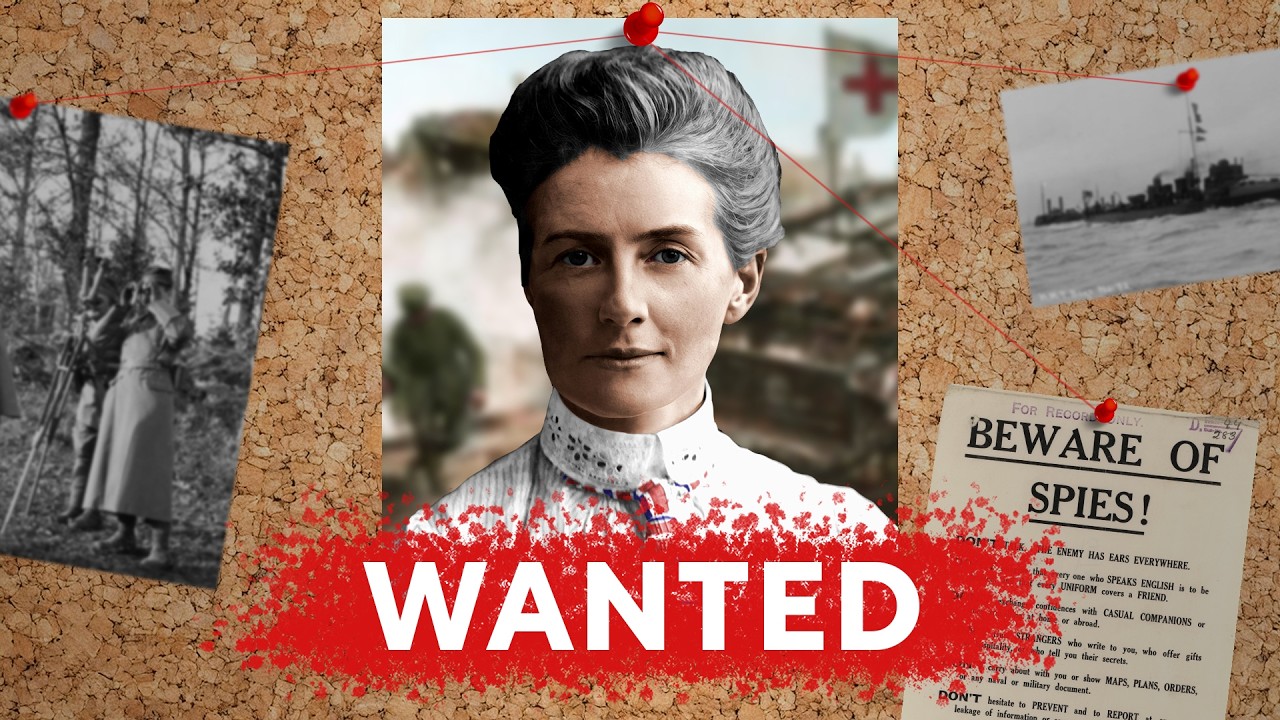
There was huge public backlash when the Germans executed the British nurse Edith Cavell, who helped prisoners escape to the Netherlands. This likely resulted in the Germans being far more cautious with who they executed, especially women, only passing the most damning cases where the evidence was unrefuted. Martha was informed by Alphonse one day that she could be involved in a plot to blow up an ammunition dump in the middle of Roulers. Alphonse told her about an old sewer system underneath the town that could be used to get past the guards.
It sounded exciting. Martha was in. She and Alphonse planted the explosives under the dump and retreated back along the tunnel to the hospital where they had entered. The dynamite went off, and a huge explosion erupted throughout the town.
It was a great success. Martha made her way home without being caught. It was the next morning when Martha made the discovery that her gold wristwatch was missing. She could not recall the last time she had seen it but thought it must have come off at the hospital.
By the end of November, Martha found a notice near the town commandant’s office listing lost property stolen by a soldier who had been apprehended. Luckily for Martha, her watch had been found, listed there with her initials, M. C. , on the inside.
The next morning at ten o’clock she went to the town commandant to collect it. He handed her watch back, and after a brief bit of shopping she returned home. Later that day, an officer of the brigade staff and two soldiers with a frightener stood outside the café with fixed bayonets. They were ordered to make a search of the property.
A short while later, behind her washstand, one of the soldiers found an encoded message. Martha was arrested, accused of espionage. The lost property bulletin had been a ruse. The watch had actually been found by children playing near the rubble of the ammunition dump.
The commandant believed Martha might have been implicated when they discovered the sewer entry point was near the hospital. Combined with the initials M. C. on the watch, it only confirmed suspicions.
When Martha had turned up to collect her watch that day, the encoded message behind the washstand was the nail in the coffin. All spies risk getting caught. In fact, most of the spies we know about today, we only know about due to their military trials. Perhaps the most successful spies we will never know about, thanks to their anonymity.
Martha was caught due to her own mistakes, and most spies were caught in a similar fashion. Others confessed under interrogation. One such case was Louise de Bettignies, also known as Alice Dubois. She operated incredibly throughout the war, setting up her own network of spies that became known as the Alice Network.
She worked most closely with another woman, Marie-Léonie Vanhoutte, whose alias was Charlotte Lameron. The pair were incredibly successful, most notably with the organization of the bombing of the Kaiser’s Imperial train on its way to the front. That information led to two British bombers coming over and trying to bomb the train, though unfortunately they missed their target. The Alice Network also managed to transmit crucial information regarding a large German attack planned for Verdun in early 1916.
However, the French dismissed this information, believing such an attack would not come. As we know, the Germans launched a large-scale invasion on Verdun in early February 1916, which Erich von Falkenhayn later claimed was meant to bleed France white. The Germans saw the success of the Alice Network so clearly that German High Command wondered what was going on on this so-called forty kilometers of a cursed front, out of a total of over 700 miles of front. Abteilung III B worked overtime to bring the Alice Network to its knees, and they succeeded when they captured Marie Vanhoutte on the 24th of September 1915 in Brussels.
Marie was forced to identify Louise from photos. When she did, Louise was arrested on the 20th of October 1915, caught crossing the Franco-German border with forged papers, returning from England. The Germans could not prove that Louise had been the head of the Alice Network, but all the same, by March 1916 she was sentenced to death for espionage. This was later commuted to life imprisonment.
Louise would not survive the war and died in prison on September 27, 1918. Marie Vanhoutte survived the war and was freed from prison in 1918. It was a tragic story, in which fellow spies could be forced into giving up their closest friends on pain of interrogation. But it is thought the work of the Alice Network likely saved upwards of 1,000 British lives by helping them cross the frontier into the Netherlands.
On the 16th of March 1920, a tribute was posthumously awarded to Louise de Bettignies. She was awarded the Legion of Honour, a palm, the British Military Medal, and an O. B. E.
Martha reached the doors of the prison, where a field guard greeted her. She walked into the dark, dank room. The cell door crashed closed behind her, and the hum of military boots faded away down the corridor. For three days, Martha was greeted only by a mug of tea and a piece of black bread placed inside her cell.
Finally, on the fourth day, a detective appeared. He greeted Martha with a friendly, “You’re going to die in a day or two,” then proceeded to try and wrench out a confession. Despite the detective’s determination, Martha held firm. The detective would crash into Martha’s cell upwards of twenty times a night, denying her sleep and hoping to force a confession.
Martha did not say a word. The minutes turned into days, the days turned into weeks, and Martha was finally transferred to the military prison in Ghent. Her new cell was eerily clean, certainly nicer than the one in Roulers. Four days into her time in Ghent, a lieutenant appeared with certain papers.
He issued Martha with her court-martial date. It was to be in a week’s time. That was when her death sentence would surely be passed. The days passed until a week had finally gone.
The cell door swung open, and an unter-officer was standing there with two privates. They marched Martha up the stairs and into a hall. There were nine men there: eight officers and one president, all staring down, ready to pass their judgment. The charges were read aloud.
Martha refused to comment on her charges. However, she was allowed a defense, in which the army military doctor who worked in Roulers with her came to defend her character. After the defense, the president pronounced that the sentence would be passed in four days’ time. Martha was taken back to her cell.
Four days later, the president had this to say: “It is a terrible thing to condemn a fellow creature, especially when that creature is a woman. But you have been a cause of the deaths of many of my countrymen during your many months of your nefarious activities. The sentence is therefore that, at an hour and a place to be appointed later, you will be taken out and shot to death. ”
Martha had been condemned.
She faced the firing squad for her efforts to save her Belgium, her compatriots, her allies. But this was not to be the end of Martha’s story. There was one more twist. Shortly after her death sentence, a German priest came to see Martha and said that her sentence might be commuted.
The next day she was marched back up to the courtroom to hear what was happening. It was there that she was told the commander-in-chief of the army under occupation had commuted her death sentence to life imprisonment, for her contribution to Germans in the field, and of course the fact that she had been awarded the Iron Cross. Martha had escaped death. She remained in prison until 1918, when the war was over and she was released.
Her life as a spy was over. After the war, Martha was awarded the French and Belgian orders of the Legion of Honour. She wrote of her experiences in a book called I Was a Spy, from which most of her story comes. There was no doubt certain embellishment, but it nevertheless gave one of the most detailed accounts of what it was actually like to be a spy during the First World War.
And it is there, in her own account, that Martha’s story concludes.






