It was just past midnight when Leo stepped out of a yellow cab in front of the Golden Griddle, a dilapidated all-night diner perched on the jagged borderline where Harlem bled into the industrial gloom of the Bronx. The neon sign buzzed with a harsh, erratic electrical sound, the G and the R burned out, casting a sickly half-lit glow onto the cracked sidewalk. Inside, the air smelled of stale boiled coffee, burnt griddle grease, and the ghosts of ten thousand unfiltered cigarettes. Leo adjusted the collar of his sharkskin suit, a nice suit that hung a little too loosely on his thin, boyish frame, making him look like a kid playing dress-up in his father’s closet.
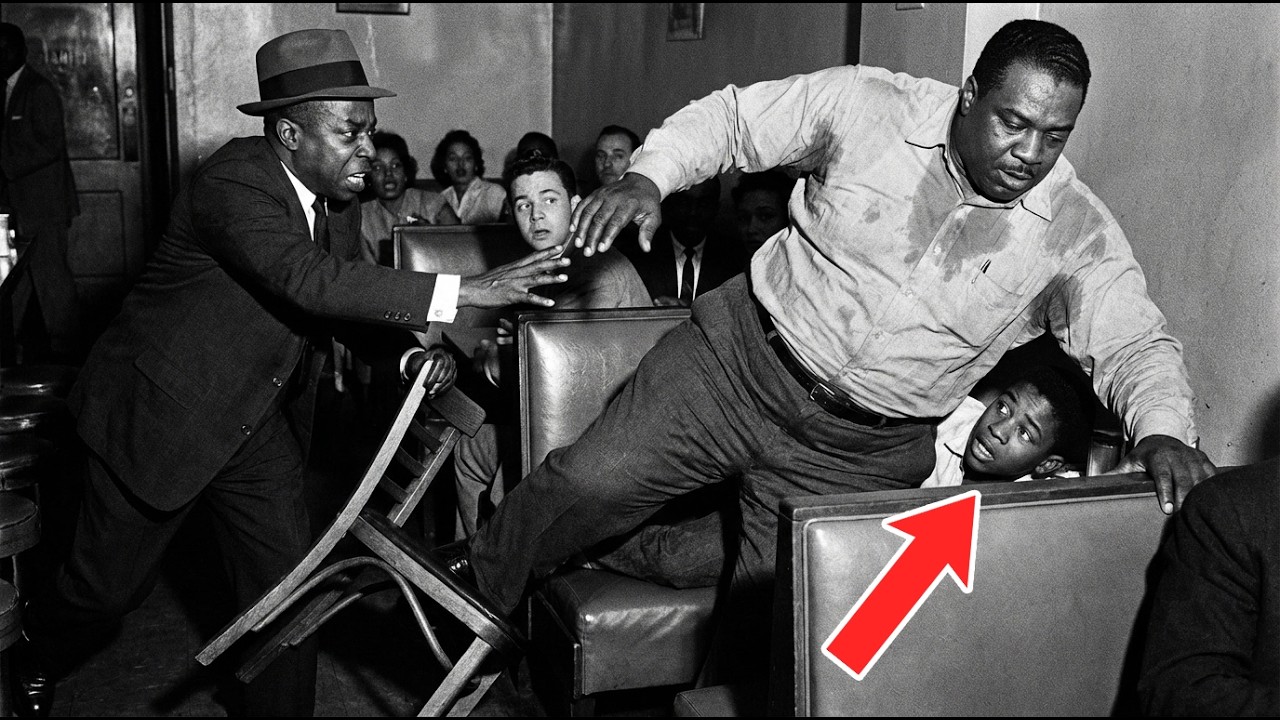
He was nineteen years old, and he had been sent to collect a five-thousand-dollar debt from a six-hundred-pound loan shark named Big Paulie Gatto. His uncle had given him one instruction: walk in, ask for the envelope, take it, and walk out. August 1962 had settled over New York City like a suffocating blanket that refused to lift. The asphalt on Lenox Avenue was soft enough to hold the imprint of a wingtip shoe, and the boxy air conditioning units rattling in the brownstone windows fought a losing battle against the heavy, wet air.
The sky was the color of a bruised plum, promising a thunderstorm that never delivered. In this heat, tempers frayed and patience evaporated, but Ellsworth Bumpy Johnson brought his own weather. While the rest of the city sweated, he sat in his corner booth at the Flash Inn, perfectly pressed in a lightweight charcoal suit, running his empire with the precise exactitude of a master watchmaker. The numbers racket, the subterranean clubs, the neighborhood protection—it was all one massive, intricate machine, and to keep it running, you had to delegate.
Usually, Bumpy sent seasoned operators, men like Junie Byrd, who could silence a room just by clearing his throat, or Illinois Gordon, who viewed violence not as a passion but as simple, necessary arithmetic. But family was a different kind of obligation. Leo was Bumpy’s nephew, the son of a sister who prayed every Sunday that her boy wouldn’t end up a headline in the Amsterdam News. Leo was sharp in school, quick with numbers, but he had a desperate, glowing hunger to be part of the life.
He looked out the window of their modest apartment and saw the Cadillacs, the pinky rings, the respect that parted a crowded sidewalk like the Red Sea. Bumpy had tried to steer him away. He bought him books on philosophy, paid his tuition for business classes, told him the streets were a hungry ghost always looking for a new soul to swallow. But Leo was relentless, a moth mesmerized by a flame he didn’t understand.
“You think this life is a movie, Leo,” Bumpy had told him earlier that week, sitting in the parlor while Mayme, his fiercely intelligent wife, poured coffee. “I just want a chance to prove I’m solid, Uncle Ellsworth. I ain’t some square. I know the score.
I can handle myself. I just need you to put me in the game. ”
“The game isn’t played with dice, Leo. It’s played with lives.
Your uncle doesn’t want you carrying that weight,” Mayme had said, setting the silver coffee pot down with a sharp clink. But Bumpy knew human nature. If he kept telling the boy no, Leo would sneak behind his back and prove himself to some lesser hustler, maybe get mixed up with junk pushers or wild street gangs who didn’t operate with Bumpy’s strict code. So he gave him a test—a simple, low-risk errand designed to strip the romantic varnish off the criminal life.
It was supposed to be a milk run, the safest play on the board. Polly Gatto, called Big Paulie, was a mountain of pure greed who operated on the lowest fringes of the Italian family’s territories. The higher-ups tolerated him because he kicked up on time, but they kept him at arm’s length because he was crude and lazy and lacked class. He had recently dipped his beak into a Harlem numbers bank belonging to Bumpy’s operation, and the penalty was a fine: exactly five thousand dollars.
It was a petty debt for a man of Bumpy’s wealth—he spent five thousand on a quiet weekend—but in the underworld, money is secondary. Principle is primary. Respect must be audited daily. Let a man steal a dime today, and he’ll come back with a blowtorch for the safe tomorrow.
The instructions had been clear, delivered in Bumpy’s softest, most dangerous tone. “You walk in. You ask for the envelope. You take the envelope.
You turn around and you walk out. You do not linger. You do not engage in banter. You do not try to match wits with him.
You are a messenger pigeon, Leo. ”
“Solid, Uncle Ellsworth. I got it,” Leo had beamed, puffing out his narrow chest. The Golden Griddle smelled exactly like failure.
The checkered linoleum floor was sticky under Leo’s brand-new leather shoes, bought specifically with this life in mind. He pushed the heavy glass door open, the bell clattering dully. Big Paulie Gatto was impossible to miss, crammed into a corner booth in the back of the restaurant, the vinyl bench groaning beneath his immense spreading weight. His neck was a series of thick, sweaty rolls that consumed his shirt collar.
His breathing was a wet, heavy wheeze audible across the room. Spread before him was a feast: three plates of greasy steak and runny eggs, a stack of buttermilk pancakes dripping with butter and syrup, a side of heavily salted home fries, and an entire cherry pie waiting its turn. The few scattered patrons—two weary longshoremen, a lady of the night nursing tea, a cab driver reading a racing form—kept their eyes glued to their tables. They recognized the cut of a mobster’s suit even on a kid, and they knew when to play blind, deaf, and dumb.
Leo stopped at the edge of the table. “Mr. Gatto,” he said. His voice cracked on the first syllable.
He cleared his throat and tried again, aiming for a deeper register. “Mr. Gatto, I’m here on behalf of Mr. Johnson.
I’m here for the envelope. ”
Paulie paused. A fork loaded with steak and dripping egg yolk hovered halfway to his mouth. His small, dark eyes rolled up to fix on the boy—the eyes of a wild boar, shrewd, cruel, devoid of empathy.
He swallowed, washed it down with a gargantuan gulp of scalding black coffee. “Mr. Johnson. You mean Bumpy?
The so-called Uptown King? ” He laughed, a wet, rattling sound like a diesel engine trying to turn over in winter. “He must be running mighty low on real men if he’s sending a skinny little string bean like you. ”
Leo felt his face flush hot.
He remembered the cardinal rule—do not engage—but the disrespect stung like acid. “The money was due yesterday, Paulie. Five thousand. My uncle sent me to get it, and I’m not walking out that door without it.
”
Paulie wiped his mouth with the back of a sausage-fingered hand. He hated taking orders from anyone, but he especially hated taking them from a black man in Harlem. “You know, your uncle thinks he’s a very smart cat sitting up there reading his European philosophy books. But out here, philosophy doesn’t mean a damn thing.
Words are just wind. Out here, physics is what matters. Size, weight, mass, gravity. The big fish eats the little fish.
And you, kid, are a very, very little fish. ”
He shifted his immense bulk and heaved himself upright, towering over Leo. The smell—days-old sweat, cheap bay rum, heavily digested meat—hit the boy like a physical blow. “Tell you what, kid.
I got your uncle’s envelope right here in the inside pocket of my jacket. ” He patted his coat. “But my sciatica is killing me tonight. The humidity locks my spine right up.
You slide into the booth, reach over, grab it off the seat where I left it, and we call it square. ”
Every survival instinct in Leo screamed at him to turn around and walk out. But his pride, that blinding need to prove he wasn’t just a fragile boy running errands, anchored his shoes to the floor. He wanted to walk into Bumpy’s office, drop the fat envelope on the mahogany desk, and say, “Handled it, boss.
”
“Just hand it to me,” Leo said, fists clenching. “Quit your yapping and get in the booth, kid. Or are you too scared of a little dark corner? ” Paulie took a heavy step forward, forcing Leo back with his stomach.
Reluctantly, Leo squeezed past the giant and slid into the booth. There was no coat. There was no envelope. He didn’t get to finish his thought.
He never got to finish his thought. Paulie didn’t reach for his pocket or pull a weapon. A sickening smile spread across his greasy face. He looked around the diner.
The waitress had retreated to the kitchen, watching in paralyzed terror through the porthole window. The patrons stared rigidly at their plates. The coast was perfectly clear. “You know, kid,” Paulie whispered, leaning his colossal frame forward, “I really hate being interrupted during a hot meal.
It ruins my digestion. ”
Without a single sound of warning, he threw his six-hundred-pound body violently forward, wedging his massive torso into the booth beside Leo. The boy gasped as the impossible weight slammed into him, pinning him instantly against the wall. It was like being caught between a brick wall and a reversing cement truck.
“Hey, man, get off! You’re crushing me! ” Leo’s tough-guy facade shattered into pure adolescent panic. Paulie pushed harder, wedging his shoulders and stomach deep into the corner, trapping the boy completely.
Leo’s arms were pinned to his sides. His legs were trapped beneath the table’s heavy metal edge. “Physics, kid,” Paulie wheezed, his breath hot and foul against Leo’s cheek. He reached out, grabbed a piece of cold buttered toast, and took a loud bite.
“It’s all about physics. Matter displaces matter. ”
Leo struggled frantically, thrashing his head like a snared rabbit. The air was being systematically forced out of his lungs.
He tried to draw a breath, but he couldn’t expand his ribs. “Tell your uncle,” Paulie said softly, chewing the toast right next to Leo’s ear, crumbs falling onto the sharkskin suit, “that I ain’t paying. Tell him that Big Paulie doesn’t pay tribute to Harlem jive turkeys. Tell him his little messenger boy tripped and had a clumsy accident in the Bronx.
”
“I can’t breathe,” Leo wheezed. His face was turning a terrifying shade of crimson, shifting toward purple. He pushed with everything he had, but it was like trying to push a parked freight train with bare hands. “Take a deep breath, kid,” Paulie laughed.
“Oh, wait. You can’t. That’s a shame. Guess you should have stayed in school.
”
Leo’s frantic struggles grew steadily weaker. The thrashing turned into uncontrollable twitching. Black spots danced in his vision. In his final moments, his thoughts didn’t go to the glamorous life he had wanted.
He thought of his mother sitting by the radio in her floral dress. He thought of his Uncle Ellsworth at the chessboard. He realized with shattering clarity that Bumpy had been right. He was a boy playing a man’s game.
With one last, pathetic, rattling shudder, the air completely left his lungs, and his body went limp. Paulie sat there. He waited a full, slow-ticking minute to be absolutely sure. He took another bite of toast, chewing methodically.
Then he pushed himself backward, extracting his immense bulk from the booth. He looked down at Leo, slumped awkwardly in the corner like a discarded ragdoll, eyes open and vacant, face a horrifying shade of blue. He picked up a paper napkin, wiped his mouth, and tossed it casually onto the boy’s lap. He dropped a crumpled five-dollar bill on the table to cover his meal, and lumbered out the door without a backward glance.
Two hours later, the heat in Harlem had not broken, but the temperature inside the heavily guarded VIP room of the Flash Inn felt like the dead of an Arctic winter. Bumpy Johnson sat at a velvet-lined table, a vintage chess set laid out before him. Across sat Illinois Gordon, sipping bourbon. Mayme Johnson sat on a tufted leather sofa nearby, sipping iced tea with mint.
The faint, weeping notes of a tenor saxophone drifted up from the club below. Then the heavy oak door opened. It was Nat Pettigrew, one of Bumpy’s most trusted soldiers. His face was the color of wet ash.
He walked to the table, leaned down, and whispered directly into Bumpy’s ear. Mayme watched her husband. She watched his hand, hovering over a black knight, slowly lower to the table. She watched the muscles in his jaw tighten until they looked like coiled steel cables.
Bumpy didn’t flip the chessboard. He didn’t shout. He simply reached out with his index finger and gently tipped his own black king over onto the board. “Are you absolutely certain of this, Nat?
” Bumpy asked. His voice was a bare whisper, but it carried a deadly chill that made the hairs on Illinois’s arms stand up. “I’m certain, boss. The precinct cops are calling it a freak accident.
But I got to the waitress before the uniforms did. She saw the whole thing. ”
“Saw what? ” Illinois asked, his hand dropping to the revolver in his waistband.
“He sat on him,” Bumpy said slowly, tasting the words like ash. “That fat piece of Bronx trash used his weight. He crushed the boy to death in a diner booth. ”
Mayme gasped, her iced tea slipping from her fingers and shattering on the floor.
Bumpy stood up smoothly, walked to the sofa, and gently kissed the top of her head. There was no comfort to be found in this room tonight. Only the cold mathematics of retribution. “Just give me the address, Bumpy,” Illinois said, checking the cylinder of his .
38. “Give me the word. I’ll paint his living room walls with him. ”
“No,” Bumpy said, his voice cutting through the room like a straight razor.
“A man who lives like a gluttonous, unthinking pig does not get the mercy of a quick, clean bullet. A bullet is for a soldier. Big Paulie Gatto is not a soldier. He is a parasite.
We are going to make him understand exactly what it feels like when your own body becomes a prison. ”
He began issuing orders. Six of their strongest, quietest men. A heavy-duty canvas tarp, the kind used to cover cargo on the docks.
A veterinarian who owed a favor, for a syringe of whatever they used to put a racehorse to sleep. And master keys to the old abandoned high school track on the east side, the one by the river, surrounded by a ten-foot chain-link fence topped with razor wire. “The track? ” Nat blinked.
“Boss, that guy is six hundred pounds. He hasn’t walked a city block in ten years. ”
“We,” Bumpy whispered, a cold, predatory smile touching the corners of his mouth, “are going to host a midnight track meet. And Nat—go to the junkyard in Queens.
Get the Greek’s three Dobermans. Make sure they haven’t been fed since yesterday morning. ”
At exactly three in the morning, an unmarked panel van backed into the alley behind Paulie Gatto’s Bronx apartment building. Paulie lived on the ground floor because his ruined knees couldn’t handle a single flight of stairs.
The lock on the back door yielded to Bumpy’s crew in a few practiced twists of a tension wrench. Illinois Gordon led the infiltration. Six men dressed in black moved through the apartment like living shadows. From the back bedroom came a sound like a rusty chainsaw cutting through wet timber: Paulie snoring.
Even Illinois, a hardened man who had seen the blood-soaked aftermaths of dozens of mob hits, was momentarily taken aback by the sheer monstrous scale of the man in the bed. Paulie was sprawled on his back across a reinforced king-sized mattress in nothing but massive sweat-stained white boxers, his stomach rising and falling like a restless mountain. Illinois stepped to the edge of the bed, raised the veterinary-grade syringe, drove the thick steel needle deep into the meaty part of Paulie’s thigh, and pushed the plunger all the way down. Paulie grunted, his eyes fluttering open for a fraction of a second, and then the horse tranquilizer hit his bloodstream like a runaway freight train.
He was out cold. It took all six men, straining until the veins bulged in their necks, to roll the six-hundred-pound deadweight onto the canvas tarp. They wrapped him tight, secured the bundle with heavy cargo straps, and dragged him out the back door. The friction of the canvas hissed against the linoleum and concrete.
It took every ounce of their strength to heave him over the bumper and into the van. The truck’s suspension dipped drastically under the sudden weight. “Drive,” Illinois said, slamming the rear doors. “The boss is waiting for us at the finish line.
”
The van bounced over the broken curb of the East Side riverfront and came to a shuddering halt. The air outside was heavy with the smell of stagnant river water and rusted iron. They were standing at the rusted gates of the old high school track, a sprawling desolate oval entirely surrounded by the towering fence and razor wire. Only one way in, exactly one way out.
Nat unlocked the gate, hinges screaming into the humid night. “Take him to the far end of the infield,” commanded a calm voice from the darkness. Bumpy Johnson stepped out of the shadows, immaculate in his charcoal suit, fedora pulled low. In his left hand he held a silver-plated Zippo.
In his right, three thick braided leather leashes. At the end of those leashes stood three Doberman pinschers, heavily muscled, ears cropped, ribs prominent and visible. They had been deliberately starved for the past forty-eight hours. They vibrated with murderous hunger, saliva dripping from their jaws.
They didn’t bark. Their golden eyes locked onto the canvas bundle with the focus of apex predators. It took ten grueling minutes to drag the loan shark to the center of the infield. Illinois slashed through the nylon straps and ripped the canvas back.
Paulie lay there, a mountain of pale flesh in stained boxers, breathing a horrific rattling wheeze. Bumpy walked to the bottom row of the rusted bleachers, twenty yards away, and took a seat. He wrapped the leashes around his wrist, lit a Cuban cigar, and watched the ember glow. “Wake him up.
”
Nat hurled a bucket of filthy river water into Paulie’s face. The shock broke through the tranquilizer. Paulie gasped, spasmed, his eyes snapping open with absolute panic. He coughed, spitting stagnant water.
The first thing he registered was the smell—damp earth, rust, fear. He pushed himself into a semi-upright position and looked around. The dark oval of the track stretched around him. The razor-wire fence loomed.
And then he saw the glow of the cigar in the bleachers, and heard the low, guttural growl of starving animals. “Bumpy,” he breathed. “Good evening, Paulie,” Bumpy said, his voice smooth, conversational, which made it infinitely more horrifying. “I apologize for the abrupt change of scenery.
We needed a venue with a bit more open space than your bedroom or a diner booth. ”
The mention of the diner booth hit Paulie like a physical blow. “What happened at the grill—it was an accident. The kid panicked.
He had a heart attack. I didn’t lay a finger on him. ”
“You are absolutely right, Paulie. You didn’t lay a finger on him.
You didn’t strike him. You simply utilized the immutable laws of nature. You used your mass. What was the exact word you used?
Ah, yes. Physics. ”
The waitress had repeated his exact words to the king of Harlem. There was no lie big enough to save him now.
Paulie began to sob, tears mixing with sweat. “I got the money. I’ll give you twenty grand. Just let me go to a phone.
”
“Money is a very trivial thing, Paulie. Money can buy a lot of things. But there is one thing in this entire world that money cannot buy. And that is breath.
”
In desperation, Paulie tried his last card: the Italian bosses wouldn’t stand for it, he was a made man, they’d burn Harlem to the ground. Bumpy actually smiled, a terrifying, skeletal grin. “You are not a made man. You are a bloated, useless tick on the fringes of a dying empire.
If you disappear tonight, they won’t even light a candle. ”
Bumpy stood up. The dogs went rigid. He pointed across the field.
“Do you see that gate, Paulie? ” The heavy iron gate stood wide open, one hundred yards away. Beyond it lay the street. “That is your salvation.
If you can make it through that gate, you will find a taxi waiting on the corner. I give you my solemn word that if you cross that threshold, my men will not pursue you. ”
“You’re crazy,” Paulie wheezed. “I can’t run that.
Look at me. I’m six hundred pounds. Bad knees. Sciatica.
”
“It is only impossible if you choose to stay exactly where you are. ” Bumpy looked down at the Dobermans. “These animals haven’t eaten in two days. If you stay sitting on this grass, they will not kill you quickly.
They will start with your legs and keep eating until they reach something vital. It will take a very, very long time. ”
Paulie felt his bladder release. “No, please.
Have mercy. I’m a sick man. ”
“My nephew begged you for mercy. He told you he couldn’t breathe, and you sat there chewing your toast and laughed at him.
You talked to him about the laws of physics. Tonight you are going to get a practical lesson in the laws of biology. ”
“Ten seconds to stand up,” Bumpy commanded. “Ten.
” Paulie screamed, thrashing wildly. “Nine. ” Survival instinct is a terrifying force. Faced with the certainty of being eaten alive, the human brain sends a massive surge to muscles not used in years.
With a guttural scream, Paulie rolled onto his hands and knees. “Eight. ” He pushed against the earth, his arms trembling. “Seven.
” With a monumental heave, he stood upright, swaying violently. “Six. ” He locked his eyes on the gate. “Five.
” He took his first step, a desperate lumbering lurch. “Four. ” He brought his left foot forward, arms pumping. “Three.
” He picked up a pathetic shuffling jog, his massive stomach bouncing. “Two. ” “One. ”
Bumpy didn’t drop the leashes.
He let Paulie reach ten yards, then twenty, letting a spark of hope build. When Paulie hit the thirty-yard mark, Bumpy looked down at the trembling animals and whispered, “Go. ”
He uncoiled the leather and dropped the leashes. There was no barking.
Only the tearing sound of claws digging into dead grass as the three Dobermans exploded forward. Paulie heard the sound behind him. He tried to sprint. The cartilage in his right knee shattered under the concussive force.
He stumbled but caught himself, knowing that if he hit the ground, he would never get up. His heart, a muscle encased in fat that for ten years had only needed to pump blood to a body sitting in a chair, was now commanded to fuel a sprint. It was beating at two hundred times a minute. Fifty yards.
Halfway. Paulie felt a crushing tightness building in his chest, as if an invisible iron vise was closing around his ribs. It felt exactly like a six-hundred-pound man sitting on his chest. “No,” he wheezed.
The pressure exploded into searing pain radiating down his left arm and into his jaw. The massive heart attack hit him like a physical wall. His legs stopped receiving signals. He took one final, uncoordinated step, caught his foot on a crack, and collapsed.
Six hundred pounds slammed onto the hard asphalt with a sickening, wet thud. He slid a few feet, tearing the skin from his chest and stomach, and came to a halt exactly fifty yards from the open gate. He didn’t twitch. He was dead before his face hit the concrete.
A split second later, the Dobermans arrived. They leaped onto the unmoving pile of flesh, jaws snapping—but they didn’t bite. A sharp whistle cut through the night. The dogs stopped instantly, standing rigidly on the corpse, saliva dripping, perfectly trained.
They only ate when the king commanded it. Bumpy walked slowly down the bleachers and out onto the track, moonlight casting a long shadow behind him. He looked down at the massive, lifeless mountain. The loan shark’s eyes were locked forever in an expression of pure biological terror, his face a mottled purple—almost exactly the same color young Leo’s face had been in the diner booth hours before.
The scales of the street had been violently balanced. Illinois and Nat stepped up behind him, wordless. Bumpy reached down and calmly took the leashes from the dogs’ collars. He raised the cigar to his lips, took a long drag, and exhaled a thick blue cloud over the dead form.
He looked at Illinois, his face entirely blank. “You see, Illinois,” Bumpy remarked casually, “I always told the boy that cardio was a killer. ”
He turned his back on the body, the dogs walking perfectly in step beside him, and walked slowly toward the open iron gate, leaving the garbage of the Bronx exactly where it belonged—dead on the track, in the absolute silent darkness of Harlem.






