In November 1876, workmen lifting the floor of a chapel inside the Tower of London uncovered bones attributed to Anne Boleyn, and there was something wrong with them. The skeleton was not lying in repose. The bones had been shoved into a space far too small for a body, stacked in complete disorder, and underneath them lay the broken coffin of someone else entirely, a woman who had been buried in the same spot more than a century later. Most people know Anne Boleyn as the seductive schemer who stole a king and lost her head.
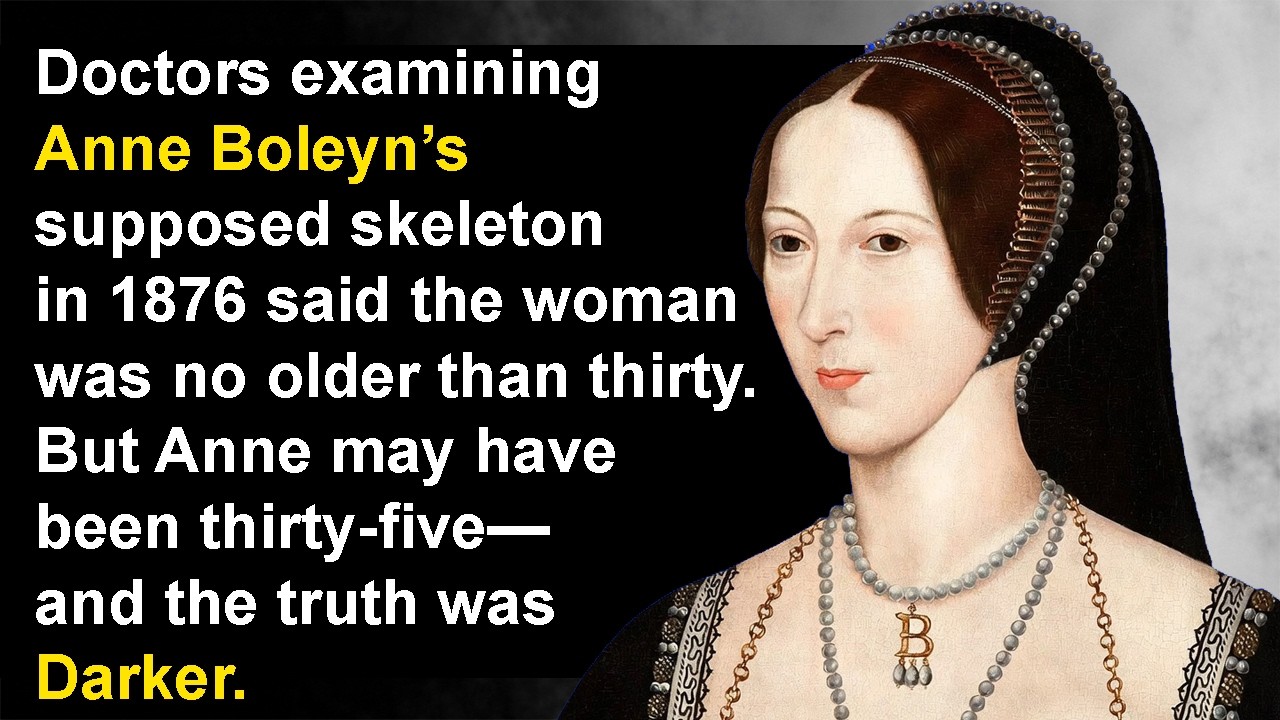
The real story is darker, and it did not end on the execution scaffold. It ended beneath those floorboards, with a mystery that has never been solved. The strangeness begins at the beginning, because history does not actually know when Anne Boleyn was born. Most modern historians place her birth around 1501, either at Blickling Hall in Norfolk or Hever Castle in Kent.
A minority argue for 1507. No record of her baptism survives. Six years may not sound like much, but that missing number would come back centuries later to haunt her grave. Her father was Sir Thomas Boleyn, an ambitious diplomat with a gift for languages and an even greater gift for climbing.
Her mother was Elizabeth Howard, daughter of the Duke of Norfolk, one of the most powerful and ruthless families in England. Anne was born into a system built for advancement, and she was placed inside it early. In 1513 she was sent to the glittering court of Margaret of Austria in the Low Countries, serving as a young attendant among the most polished figures in Europe. She was, depending on the birth year, either about twelve years old or about six.
From there she moved to the French court, spending roughly seven years in the service of Queen Claude, absorbing French fashion, French manners, and French polish. When she returned to England in early 1522, she was not like the other women of the English court. She was something the court had never seen before. And the most dangerous man in the kingdom was about to notice her.
At first, Anne’s story looked ordinary. She became a lady-in-waiting to Queen Catherine of Aragon and caught the eye of Henry Percy, heir to the Earl of Northumberland. The two young people hoped to marry. Cardinal Wolsey, the king’s chief minister, broke the match on orders from above, and Percy was led away.
The poet Thomas Wyatt wrote verses praising her. There is no contemporary evidence that anything physical ever happened between them. It seemed Anne would simply be married off wherever the system decided. By 1526, the system had a new decision-maker: King Henry VIII himself.
And he did not want to marry her off. He wanted her. What happened next is the part of the story that made Anne famous, and it deserves to be stated plainly. Anne refused the King of England, not once, but for nearly seven years.
Henry showered her with letters and gifts. Anne refused to become his mistress, a position her sister Mary had occupied and been discarded from. Whether that refusal came from virtue, strategy, or self-preservation may never be known. What is documented is the result.
Henry set about annulling his marriage to Catherine of Aragon, in a legal earthquake known as the King’s Great Matter, so that he could marry Anne. When the Pope refused, Henry did not back down. He broke England away from the Catholic Church entirely. A thousand years of religious order were torn apart for her sake.
And Anne’s star kept rising. On 1 September 1532, Henry did something unprecedented. He made her Marquess of Pembroke in her own right, with lands worth a thousand pounds a year. No English woman outside the royal family had ever held such a title alone.
That autumn she stood beside Henry at Calais when he met the King of France, presented before the courts of Europe as a queen in everything but name. Around that time, or in late January 1533, the sources differ slightly, they married secretly. On 25 January 1533 a quiet ceremony confirmed the marriage. On 23 May, Archbishop Thomas Cranmer declared Henry’s marriage to Catherine invalid.
On 1 June 1533, Anne Boleyn was crowned Queen of England at Westminster Abbey in a lavish state-funded ceremony. She had won everything, which meant she now had everything to lose, and only one way to keep it. Anne’s entire position hung on a single biological requirement: producing a son. On 7 September 1533 at Greenwich, she gave birth to a daughter, named Elizabeth.
Henry was disappointed, but a healthy child was a promising start. Then came 1534 and a pregnancy that ended in miscarriage or stillbirth. Whispers began in the court. Henry’s affection, always fickle, began to turn.
With every month that passed without a male heir, Anne’s crown loosened. Then came 29 January 1536, one of the cruelest days in Tudor history. That morning, Catherine of Aragon, the woman Anne had displaced, was buried. On the same day, Anne miscarried a male fetus of about fifteen weeks.
The son, the one thing that would have made her untouchable, was lost on the day of her rival’s funeral. Decades later, Catholic propaganda claimed the fetus was deformed, a shapeless mass. No contemporary source supports that claim. The truth needed no embellishment.
Anne had failed the single task Tudor England cared about, and Henry’s eye had already found its next target: a quiet lady-in-waiting named Jane Seymour. What happened next was not a scandal that spiraled out of control. Viewed coldly, it looks like something far more frightening: a demolition carried out with terrifying speed. The man holding the tools was Thomas Cromwell, the king’s chief minister.
Cromwell was a brilliant administrator who understood that failing the king’s wishes in Henry VIII’s court was a catastrophe. If Anne had to be removed, Cromwell would prepare the means. And to be fair to him, the means appears to have been his choice. He chose the instrument.
On 1 May 1536, a young court musician named Mark Smeaton was taken away in secret. Not to the Tower of London, but to Cromwell’s own house at Stepney, according to the accounts. There, according to the Spanish ambassador and later reports, he was interrogated, and some accounts say tortured. One account describes a knotted rope bound tightly around his head.
No official document confirms the torture. But as a commoner, Smeaton had no legal protection from it, and everyone at court knew that. What is certain is that Smeaton emerged with the one thing Cromwell needed: a confession of adultery with the queen. He was the only one of the accused who confessed.
The others denied everything to their faces. On 2 May, Anne was arrested at Greenwich and taken by barge to the Tower of London. She was charged with adultery with several men, conspiracy to murder the king, and, most grotesquely, incest with her own brother George Boleyn. Five men were arrested with her: Smeaton, Henry Norris, Francis Weston, William Brereton, and George.
The indictments cited specific dates and places. Modern scholars have noted that many of them were chronologically impossible. On some of the dates listed, Anne was elsewhere or recovering from childbirth. In other words, there is overwhelming evidence that the indictments were not a record of crimes but paperwork for a decision already made.
Here the story shifts from political tragedy to something genuinely disturbing, because inside the Tower, everything Anne said was being recorded. The Lieutenant of the Tower, Sir William Kingston, sent Cromwell detailed reports of everything the queen did and said. Through his letters, the last eighteen days of Anne’s life survive in excruciating detail. When she arrived at the Tower, she fell to her knees weeping, insisting on her innocence.
Then she suddenly burst into a fit of hysterical laughter, as if two contradictory states had collided inside her. Her moods swung between calm, terror, black humor, and grief. She suffered terribly over her mother. She asked Kingston again and again whether she would receive justice.
Then came the moment that has echoed for nearly five centuries. When she was told that her executioner would not be the usual axeman of the Tower but a skilled swordsman brought from Calais, Anne laughed, put her hands around her neck, and said, “I have a little neck. ” A joke from a woman preparing herself to be beheaded. That small, devastating phrase would return in this story 340 years later, in a way no one could have predicted.
Here is the detail that reveals the truth of the whole affair: the swordsman from Calais did not appear suddenly. The order summoning him was issued on 14 May or earlier, and Anne’s trial did not begin until 15 May. The verdict was unknown, the jury had not even met, and the king had already hired the executioner. Henry’s famous gesture of mercy, the clean French sword instead of the English axe, was no mercy at all.
It was a schedule manipulation, an execution procedure arranged in advance. The trials themselves were theater. On 12 May, Smeaton, Norris, Weston, and Brereton were tried at Westminster and convicted. On 15 May, Anne and George were tried inside the Tower before a panel of twenty-six noblemen, presided over by their own uncle, the Duke of Norfolk.
At least George defended himself fiercely. Handed a paper containing the explicit incest accusations and told to answer only yes or no, he is said to have read the lurid text aloud in full to the court, forcing everyone present to hear how absurd the charges were. Even his enemies admitted the brilliance of his defense. It changed nothing.
The siblings were both convicted of high treason. On 17 May, Cranmer, the same archbishop who had crowned her, declared Anne’s marriage to Henry invalid, for reasons never explicitly recorded. Consider for a moment the logic Tudor England did not want examined. If Anne was not legally Henry’s wife, she could not, by definition, have committed adultery with him.
The annulment erased the very crime she had been convicted of. No one in power cared. On the same day her marriage was legally wiped away and her daughter Elizabeth was declared illegitimate, the five men were executed on Tower Hill. Two days later, it was her turn.
On the morning of 19 May 1536, at about eight o’clock, Anne Boleyn walked to the scaffold on Tower Green. Her scaffold speech, recorded by the chronicler Wriothesley and others, was short and careful. She submitted to the law, accused no one, and prayed for the king. There were no defiant last words, no dramatic curses.
Those were invented later. She spent her final days as a devout Catholic, receiving her last sacrament according to traditional rites. At the edge of the blade, she held to her old faith. She handed her small prayer book, her Book of Hours, to one of her weeping ladies.
Inside, in her own hand, she had written: “Remember me when you pray, for hope leads you on day by day. ”
She removed her cloak and her English hood, and tucked her hair into a simple linen cap so her neck was bare. According to a Spanish account written years later, take it for what it is, unconfirmed, she kept glancing nervously over her shoulder, and the swordsman finally called to a boy to fetch his sword, a trick to distract her. In that moment, with a single stroke, the Queen of England died.
She had worn the crown for two years, eleven months, and eighteen days. Then came the detail that reveals her death more than the sword ever could. No coffin had been prepared for her. The woman crowned three years earlier with all the splendor the English state could muster lay on the scaffold while her ladies searched for anything to put her in.
What they found was an old elm chest from the Tower’s armory, built to store arrows. Her body and head were placed inside an arrow chest and buried the same day, without ceremony and without a marker, beneath the floor of the Chapel of St Peter ad Vincula, a few steps from where she died. The next morning, 20 May, Henry was formally betrothed to Jane Seymour. The scaffold had not even been taken down yet.
Then Henry ordered Anne’s name erased. Her falcon badges and the intertwined initials H and A were carved out of the woodwork of every royal palace. The workmen, tired, missed some. High in the dark ceiling of the Great Hall at Hampton Court Palace, her symbols survive to this day, eighty feet above where the king once stood, in the one place no one bothered to look.
Henry eventually got his son, but the boy died at fifteen. Anne’s daughter, declared illegitimate two days before her mother’s execution, grew up to become Elizabeth I, who reigned for forty-four years and gave her name to an entire age. Henry tore down a church and killed a queen for a male heir. It was Anne’s daughter who immortalized the Tudor name.
That should have been the end of the story. It was not. In November 1876, the floor of that little chapel began to sink. What the Victorians found beneath it is the reason Anne Boleyn’s grave remains a mystery to this day.
The Chapel of St Peter ad Vincula was under restoration, and the sagging chancel floor had to be lifted. Officials, working from a plan assembled from Tower of London records and old historical sources, knew roughly where every Tudor victim was buried. At the spot marked for Anne Boleyn, about sixty centimeters down, they found female bones. But there was nothing of a proper burial about them.
The official report recorded that the bones were not arranged in their original order but were, in the report’s own words, crowded into a smaller space. Among them were fragments of elm wood, matching the collapsed remains of an arrow chest. Directly beneath the pile lay the coffin of a woman named Hannah Beresford, buried in the same spot in 1750. At some point, more than two centuries after Anne’s death, grave diggers had broken into her final resting place, gathered up whatever bones they found, and shoved them aside in a heap.
A Queen of England had been disturbed, jumbled, and stacked like debris. No one ever recorded it. Dr. Frederick Moat examined the remains, and his findings, preserved in the official report of 1877, were remarkable.
The bones belonged to a woman of slight, delicate build, between 152 and 160 centimeters tall, in the prime of life. Moat estimated her age at twenty-five to thirty. Her hands were smooth, with tapering fingers, and her vertebrae were unusually small, especially the atlas, the topmost bone of the neck. The examiners themselves connected this to the line recorded in the Tower in 1536.
Three hundred and forty years after Anne laughed and wrapped her hands around her neck, a Victorian doctor lifted the smallest neck bone he had ever handled from a pile beneath the chapel floor. Her own joke was carved into her skeleton. But Moat’s report revealed something else, and this is the part the textbooks got wrong. The hands showed no sixth finger, no deformity of any kind.
The infamous sixth finger, and the deformities claimed to have marked Anne as a witch, appear in no contemporary source at all. They were invented by Nicholas Sander, an exiled Catholic who wrote propaganda in the 1580s to defame Elizabeth I by depicting her mother as a monster, decades after Anne’s death. The skeleton in Anne’s grave contradicts his account completely. Modern research keeps adding more evidence.
Analysis of a painting at Hever Castle in the 2020s revealed an underdrawing that deliberately emphasizes five fingers on each hand. Curators interpreted it as a painted rebuttal to the slanders circulating during Elizabeth’s own reign. In 2021, ultraviolet light revealed erased signatures of women connected to the Boleyn circle hidden inside Anne’s surviving Book of Hours, evidence, researchers believe, of a secret network that passed her prayer book down through generations in defiance of the campaign to erase her name. That same year, a black wooden falcon bought at auction for £75 was identified as one of Queen Anne’s royal badges from Hampton Court Palace.
It appears to have been wrenched off and hidden by an unknown sympathizer in 1536, surviving the purge for nearly five centuries. And yet here is the final uncomfortable truth about that grave. The identification of those bones rests on only two things: the precise location on a Victorian plan, and a matching physical description. There is no sixth finger to disprove, but there is also no analysis of wounds, no definitive marker, no DNA testing then or ever.
The bones were reburied on 13 April 1877, sealed in a lead-lined oak coffin under concrete ten centimeters below a memorial plaque, and they have not been touched since. There is a problem Moat could not see. His age estimate was twenty-five to thirty. If Anne was born around 1501, as most modern historians believe, she died at around thirty-five, an age entirely outside his estimate.
The skeleton only fits the less common birth year of 1507. Some historians have gone further, suggesting the jumbled bones may belong to another Tudor victim, and that Anne may actually be buried under a neighboring slab. That remains a minority view. Every 19 May, flowers are placed on the plaque bearing Anne Boleyn’s name.
The question remains: is the woman four feet beneath that plaque actually Anne, or did the state that killed her, boxed her, and buried her without a marker inflict one final indignity by losing her? Henry VIII took her crown, her marriage, her name, and her life. The pile of bones beneath the chapel floor suggests history may have taken the last thing she had left: the certainty of where she lies.






