On the morning of December 2nd, 1886, Edith Kermit Carow stood in St. George’s Hanover Square in London and married Theodore Roosevelt. She was twenty-five. He was twenty-eight, and had spent the previous month losing the race for mayor of New York, finishing third behind Abram Hewitt and Henry George, which was a genuinely embarrassing place to finish.
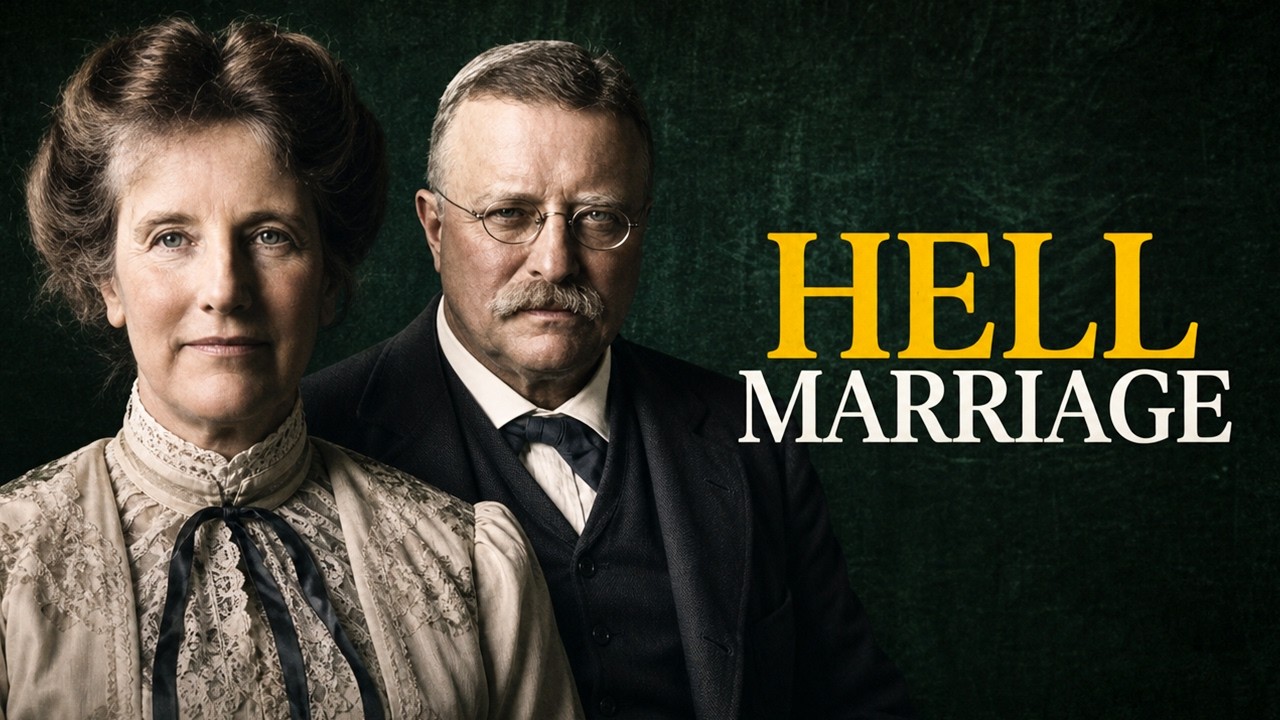
Then he had boarded a ship and sailed three thousand miles to be married in a country where he knew almost no one. Look at who was in the room. Edith’s sister Emily stood with her. A young British diplomat named Cecil Spring Rice, whom Roosevelt had met on the crossing, signed the register as a witness and stood up as best man.
Not one Roosevelt attended. Not his sisters, not his political friends, not the daughter he already had. This was not a couple eloping against family disapproval. The family knew.
The distance was the point. Roosevelt was marrying in another country because he was ashamed, and he had put the shame in writing. Two years earlier, on February 14th, 1884, his wife, Alice Hathaway Lee, had died at twenty-two, two days after giving birth. His mother had died in the same house on the same day.
Roosevelt drew a large X in his diary and wrote that the light had gone out of his life. Then he did something stranger than grief. He stopped saying her name. He would not allow it spoken in front of him.
When he published his autobiography almost thirty years later, in 1913, his first wife does not appear in it. Their daughter grew up being called Baby Lee, and later Sister, and by her own account never once heard her father speak her mother’s name. That is the man Edith agreed to marry. And he told his older sister Bamie exactly how he felt about it.
He wrote that he had always disbelieved in and disapproved of second marriages, that they argued weakness in a man’s character, and that she could not reproach him half as bitterly as he reproached himself. He wrote that before the wedding, not in a moment of panic afterward, as the terms of the thing. Edith did not marry a widower who had made his peace. She married a man who considered the act of marrying her proof of his own moral failure, and who would spend three decades refusing to name the woman she had replaced.
Nobody says that part out loud. She took the deal anyway. To understand why, you have to know what her alternatives actually looked like. Edith Kermit Carow was born in Norwich, Connecticut, in August 1861, into a family that had money and was busy losing it.
Her father, Charles Carow, came from a shipping fortune and was, by every account including his own family’s, a heavy drinker and a bad businessman. Her mother was a hypochondriac who managed the household by taking to her bed. The Carows kept moving in with relatives. There is a particular humiliation in that arrangement: the good name, the good address, someone else’s house.
Edith learned it before she was ten. She was four years old when the family stood on a Roosevelt balcony in New York and watched Abraham Lincoln’s funeral procession pass by. That detail survives because the Roosevelts kept everything. Almost nothing survives from her side of it, which is itself the first clue about who she became.
She was raised practically inside the Roosevelt house. Corinne Roosevelt was her closest friend. She did lessons there, and she and Corinne ran a little literary society for three years. Edith was the one who kept the minutes every week in writing.
The secretary. The recorder. The girl who wrote down what happened. At Miss Comstock’s school she picked up fluent French, a taste for Shakespeare and Thackeray, and a strict religious seriousness that never left her.
She also learned the household rule that her parents’ condition was not discussed. As an adult, she almost never spoke of her father or her mother. Not bitterly. Not at all.
She and Theodore were close as teenagers. There were feelings on both sides. The family believed it, and so did later biographers working from the letters. Then, in August 1878, while he was at Harvard, something happened between them and the friendship broke.
Nobody knows what. That is not a dodge; the record is genuinely blank. The explanations that got handed down include a proposal she refused, Theodore’s father objecting to Charles Carow’s drinking, a rumor about illness in the Roosevelt family, and the simplest one, that two people with hard tempers had a fight. Historians remain divided, and the reason they remain divided is that the two people involved never told anyone.
One of them made sure the paper didn’t survive. What she did next tells you more than the quarrel does. When Theodore got engaged to Alice Lee — beautiful, Boston, rich, universally adored — Edith gave a dinner in the couple’s honor. She went to the wedding.
She stayed close to his sisters. According to Sylvia Jukes Morris, she was cool toward Alice in private and impeccable in public, a distinction she would spend the rest of her life perfecting. Her father died of drink in 1883. Her grandfather had died the year before.
The money was effectively gone. Then February 1884 happened, and Theodore fled to the Dakota Territory, and Edith did not see him for a year. That was not an accident of geography. By several accounts, he avoided her on purpose because being drawn back toward her felt like a betrayal of the woman who had just died.
Then, in September 1885, he came into his sister Bamie’s house in New York. Edith was there. The meeting was accidental. What followed was not.
By November 17th, 1885, nine weeks later, they were engaged. And the engagement was a secret. Not a private matter. A secret actively kept from friends and from most of the family, because a widower remarrying inside two years was the kind of thing that got talked about in New York, and Theodore was a man who had already announced a political career.
Then they separated for eight months. She sailed for Europe with her mother and sister, because the Carow women could no longer afford New York. That is the plain financial fact. The house of Astor and Vanderbilt was not a place you could stay on a diminished income, and Italy was cheap.
He went back to the Bad Lands to sort out a ranching investment that was quietly destroying about half of his inheritance. They wrote to each other across that ocean for eight months. One of those letters exists. She destroyed the rest.
This is the first appearance of a habit that eventually becomes the whole story. The woman who once kept the minutes every week decided which pages of her own life the future was allowed to read. Now consider what she was actually agreeing to at twenty-five in Italy with no money. He was famous enough to be a newspaper item.
He was in mourning for a woman he refused to name. He had a two-year-old daughter being raised by his sister. He had a house half built in Oyster Bay called Lee Home, a name he had made out of his dead wife’s maiden name, and he intended to live in it. She said yes to all of it.
She was not naive, and it was not pure romance. She was twenty-five in a decade when that was late, with a dead alcoholic father, a dependent mother, and no dowry to speak of. She and Emily had one asset: an interest in a building on Stone Street in Manhattan. In 1886 the two sisters sued the elevated railway companies over damage to it, a case they fought until they won in 1890.
That is who she was. Not a girl waiting to be rescued. A woman who took a railroad to court. She also, by the surviving evidence, loved him.
Both things were true, and the second did not cancel the first. So on that December morning in London, she stood in a church where nobody was watching, with her sister and a stranger as witnesses, and married a man who was at that same moment privately convinced that what he was doing was a weakness in his character. The honeymoon ran through the winter: France, then Italy to see her mother, then back to England. On the way, she started editing his magazine articles.
She was working before they got home. They landed in New York in March 1887 and stayed with Bamie for two months. Then they moved out to Oyster Bay, into the house on the hill above the bay that he had designed for another woman. He renamed it Sagamore Hill.
She changed the furniture. Not redecorated. Replaced. She had her own family’s furniture brought to Oyster Bay and moved out the pieces that had belonged to the first marriage.
It is the single most legible thing she ever did, and she did it within weeks of arriving. There is no letter in which she explains it. There didn’t need to be. The house was hers to run, and almost nothing else about it was.
Roughly twelve servants, a working farm, and a husband who wrote all morning and expected to be walking or rowing by afternoon, frequently with guests he had invited without warning her. She kept the accounts. She hired her own childhood nurse, Mary Ledwith, to look after the children when they came. And within the first year, she made the decision that shaped the rest of her domestic life.
Alice was two and a half and had been living with Bamie since the week she was born. Bamie had raised her, disciplined her, loved her, and thought of her as hers. Edith decided the child would come to Sagamore Hill and that she would call Edith mother. You can read that as generosity.
Plenty of contemporaries did. Edith also arranged for Alice to spend a few weeks each spring and fall with the Lee grandparents in Boston, which was more than the girl’s own father managed emotionally. But the effect was that a small child was removed from the only mother she had known and installed in a household where the woman she was told to call mother had married her father inside a silence about her actual mother’s existence. That arrangement produced one of the longest and coldest feuds in American political family history.
Alice Roosevelt Longworth lived to be ninety-six and was still landing punches on her stepmother in interviews in the 1970s. Meanwhile, the money situation was worse than the address suggested. The Dakota ranching venture had gone badly enough to consume something close to half of Theodore’s inheritance. Cattle, weather, and a man who was better at describing the frontier than investing in it.
Edith took the finances and never gave them back. She kept exact records. She handed her husband a set allowance for the day — twenty dollars — and by the account preserved in the family, he generally could not tell her at night where it had gone. That is a funny anecdote.
It is also the structure of the marriage. The president of the United States later could not run a household budget, and everyone in the family knew it. And the arrangement was permanent. Ted was born in September 1887.
Afterward she went through a period that her biographer, working from the family papers, describes plainly as postpartum depression. She miscarried the following year. The headaches started around this time and never really stopped: days in a darkened room for the rest of her life. Her husband, during a good deal of this, was elsewhere.
West, mostly, hunting and writing, or campaigning. In 1889 Benjamin Harrison put him on the Civil Service Commission, and he moved to Washington. She was pregnant with Kermit and stayed at Sagamore Hill. The letters from that stretch show her sinking.
She joined him in December, after the baby. The picture of these years that got handed down is a cheerful one: the noisy family, the children, the bear hunts, the man who called his own house a menagerie. And a lot of it is true. She liked Washington.
She made a real friendship with Henry Adams, who did not hand out friendship generously. She learned tennis, rode, and became a better horsewoman than her husband. She read four books to his one, and he knew it. He admitted once that he thought she looked down on his literary judgment.
He was probably right. They were, at their best, extremely good company for each other. Hold on to that, because it is the reason none of what follows resolved the way an outsider would expect. Ethel arrived in 1891.
Archie in 1894. Two houses to maintain, and never enough money. And in that same year, 1894, came the moment that stands as the cruelest in this marriage, and it does not involve another woman at all. Theodore was offered the chance to run for mayor of New York.
Edith asked him not to. Her reasons were practical, and she said them out loud. She preferred Washington, and the mayor’s salary was smaller. He listened to her.
He didn’t run. Then he fell into a depression about it and made sure she understood that he blamed the decision on her. Her response was to promise she would never again offer an opinion about his political career. Read that again.
She used her influence one time, on a matter that affected where she lived and what she could feed her children, and the cost was high enough that she surrendered the right to speak. She broke the promise eventually. She couldn’t help it; she was too good at politics. But the lesson landed.
From then on, she worked around him rather than at him. Everything she later did with newspapers, with secretaries, with the Secret Service, with clippings on his desk descends directly from 1894, when she learned that direct opposition was expensive and indirect management was free. Her mother died in 1895, the same year Theodore became New York City Police Commissioner and dragged the family back to New York, where he worked nights walking beats with reporters and was almost never home. Then came Quentin, the last child, born November 1897, and after him four months of illness: an abdominal abscess and the surgery to deal with it, at a time when abdominal surgery could easily kill you.
She was thirty-six. She had five children under eleven plus a teenage stepdaughter. She spent that winter recovering in a Washington house while her husband, Assistant Secretary of the Navy, worked himself into a war. In April 1898 he resigned his office and enlisted.
Say it flatly. His wife had nearly died in the winter and was still convalescing. His son Ted was ill. And he left to go fight in Cuba, an act he had been openly desiring for years.
He was not drafted. He organized the regiment himself. And she defended it. When people criticized the decision, Edith argued his case for him.
On June 1st she went down to Tampa to see the Rough Riders off. When the regiment came back in August and was put under quarantine at Montauk because of the fevers they had carried home, she broke the quarantine to reach him, then spent four days working in the camp as a Red Cross volunteer. This is where the simple version of the story falls apart. She was not a woman being dragged.
She backed him. Publicly, energetically, at cost to herself. Whether that was love, or discipline, or an accurate reading of the fact that her only security ran through his career — probably all three, and the surviving record does not let anyone separate them cleanly. He came home a national hero.
Two months later he was elected governor of New York. Edith did not campaign. She stayed home, feared anarchist assassins, and handled his mail, which by then arrived in sacks. At the inaugural reception in Albany she carried a bouquet in each hand so that no one could shake them.
She used that trick for the rest of his career. It reads as charming. It is also a woman building a physical barrier between herself and ten thousand strangers. And it worked.
Albany was the happiest stretch of her married life to that point. Money at last. A house she could renovate. A husband within reach.
She joined a women’s club, went out botanizing, took a trip to Cuba with her sister, and walked up San Juan Hill to see the place that had made him famous. It lasted two years. She did not want the vice presidency. It paid less than the governorship and meant moving again.
They actually drafted a statement declining it. He went to the convention anyway and came home on the ticket. She got thin during the campaign from the stress of it. She started a diary that year, having decided her view of a public life was worth recording.
That is a small thing that becomes a large thing later. In September 1901 she was in the Adirondacks with the children when the telephone call came that McKinley had been shot in Buffalo. Her first instinct, correctly, was that the man who did it was an anarchist. McKinley died on the fourteenth.
Six months into a job neither of them wanted, her husband was president, and Edith Kermit Roosevelt — forty years old, six children, a widowed mother’s daughter with no money of her own — walked into the White House and did the two most revealing things of her life. She rearranged the furniture in the family quarters. Then she slept for two days. For about eight years, the marriage looks like the thing America decided to remember.
The money terror ended. She took the oval library next to his office as her sitting room, which meant she could see him working and send him to bed. She hired Belle Hagner as her social secretary. No first lady had ever hired one, and she invented, essentially by accident, the office that every presidential wife has had since.
She held meetings with the cabinet wives every Tuesday while the cabinet itself met. She ran the guest lists and kept off them anyone she believed had committed adultery. He did not read newspapers. She read four a day and decided which clippings reached his desk.
It was a genuine partnership, and by every surviving sign there was real affection inside it. He wrote about her in his fifties that she still looked so pretty he had to get up and make love to her, which he thought absurd in a gouty old man. And in the middle of all that, in 1902 and again in 1903, she was pregnant. Both times she miscarried.
Neither loss appears in the public record of that administration at all. That is the pattern in its adult form. The public got the tennis court and the Christmas parties. What the public never got was anything Edith did not personally approve for release.
She was ferocious about it. When reporters wrote about her wearing the same dress twice, she persuaded them to describe it differently each time. She had photographs taken of herself and the children and handed them to the press, which sounds generous and was in fact a blockade. If you already have a picture, you don’t go hunting for one.
When a New York society woman published a sneering piece about a first lady who spent three hundred dollars a year on clothes, Edith cut it out and pasted it in her scrapbook. She kept her own bad press filed. In 1905 she went down to Albemarle County, Virginia, and bought a cabin from a family friend with her own initiative and her own money. Pine Knot.
No staff. No plumbing worth the name. No reporters. It was the only place either of them owned that was not a Roosevelt house, a state house, or a public one.
That same period she did something that ought to be better known. Her husband ordered his Secret Service protection reduced. She instructed them to ignore him. She had two agents posted at Pine Knot every night and did not tell him they were there.
She overruled the President of the United States on his own security, quietly, and it held. The same year, Cecil Spring Rice, the best man from the London church, now a British diplomat in Russia, began writing to her during the Russo-Japanese peace negotiations, because it would have been improper for him to write directly to the President. His letters carried information Theodore needed. The back channel to the White House during the negotiation that won her husband a Nobel Prize ran through his wife’s correspondence.
Gifford Pinchot said afterward that she had far more to do with government business than people supposed. He would not say what. There were things she could not manage. He would not stay put.
They left the White House in March 1909, and he sailed for Africa for a year, taking Kermit. Sagamore Hill emptied out. Ethel was the only child left at home, and after a few months Edith could not stand the quiet, so she took three of the children to Europe. She came back in November and left again in March to meet her husband in Egypt.
They were all under one roof together for the first time in nearly two years in June 1910. Then he started the speaking tours. Then he started listening to people who wanted him to run again. In September 1911 she was thrown from a horse.
She was unconscious for two days. She spent months in rehabilitation, temporarily lost her sense of taste, and never smelled anything again for the remaining thirty-seven years of her life. Months later her husband went after the Republican nomination. She told him, and this is on the record, that he would never be president again.
She was completely correct, and it made no difference at all. She wrote speeches for him. She went to the Progressive convention. She did not campaign.
And in October, in Milwaukee, a man named John Schrank shot him in the chest. The bullet stayed in him for the rest of his life. Everything she had been afraid of since 1898 had now happened. He lost.
Then he went to South America. The River of Doubt expedition in 1913 and 1914 nearly killed him: a leg injury, infection, fever, weight loss. He never recovered. She traveled with them as far as the settled part of the journey and came home.
He came back in May 1914 permanently diminished. According to the biography built on the family papers, that was the trip after which her patience with his absences finally gave out. Her own health broke down the same year. She missed Kermit’s wedding.
In April 1915 she went through what the family recorded only as a necessary operation. Then the war. This is the part that is hard to narrate without flinching, so it will be kept short. He pushed all four sons toward the front.
He said in his sixties that he woke in the night wondering how he would tell their mother if anything happened. On July 17th, 1918, they learned that Quentin, the youngest, twenty years old, had been shot down over France. Theodore was hospitalized in November and died at Sagamore Hill on January 6th, 1919. She was fifty-seven.
By custom she stayed inside the house during the funeral. She told her sister-in-law Corinne, and apparently nobody else, that she considered herself to have died with him. She then lived another twenty-nine years, and those years are when she took the story. Start with what she destroyed.
She burned the letters between them at her own insistence — the correspondence of a thirty-two-year marriage gone by her own hand. She asked people who received her letters to burn those too. She had been doing it since 1886, when she kept one letter out of a year’s worth. Historians who write about her say the same thing in different words: they cannot get at her interior life because she made sure of it.
Then look at what she kept and built. She cooperated with every biographer of her husband who came to her and approved of almost none of them. She particularly hated Henry Pringle’s 1931 biography, which won a Pulitzer and portrayed Theodore as a kind of overgrown boy. She started an annual gathering of his friends at his grave, where they told stories about him year after year, and the stories hardened into the version everyone now repeats.
She wrote a book. Not about him. In 1925, with Kermit, she published a history of her own family, her grandmother’s people, the Tylers of Connecticut, going back to 1660. It sold badly.
She did it anyway. Then she bought Mortlake Manor in Brooklyn, Connecticut, the house built for her great-grandfather, and went there every Fourth of July. The woman whose childhood was spent in other people’s houses ended up owning the one her family started in. And in 1932 she got on an airplane, which she disliked, and flew to Washington to campaign for Herbert Hoover.
Partly because she opposed the New Deal and insisted it had nothing to do with her husband’s progressivism. Partly for a reason that is almost comic and entirely serious. More than three hundred letters had arrived at Sagamore Hill congratulating her on her son’s nomination. Franklin Roosevelt was not her son.
She went to Washington in person to make the country understand which Roosevelts were hers. She walked through the White House for the first time since 1909 and did not recognize the rooms. She called the visit hateful. Her last decades took the rest.
Kermit, the son she loved most, drank himself into a decline and shot himself in Alaska in 1943. Nobody told her it was suicide. Ted died of a heart attack in France the next year. She broke her hip, spent five months in hospital, and was bedridden the final year.
She died at Sagamore Hill on September 30th, 1948, at eighty-seven. And here is where the story turns all the way over. Alice Longworth, in her nineties and still talking to interviewers, produced the line that everyone quotes now: that Edith once told her that if her mother had lived, Theodore would have been bored to death by her. One hostile witness, sixty years after the fact, with a lifelong grievance and a book to sell.
Take it as what it is. But notice what it means if Edith did say it. It would mean she knew exactly what the silence around Alice Lee had cost her — and had done the arithmetic and had come out ahead. She had written her own funeral down to the details years in advance.
Simplest coffin possible. If the church has no pall, use one of her shawls. Nothing on the coffin but pink and blue flowers from her children. Hymn 85, and not at a slow tempo.
No embalming. And do not take off my wedding ring. That ring went on in a London church in 1886, in front of a sister and a man met on a boat, put there by a groom who had already written to his sister that remarrying proved a weakness in his character and that no one could reproach him as bitterly as he reproached himself. Roosevelt got his silence about the first marriage.
He got it for thirty-two years, and out of his autobiography, and out of his daughter’s childhood. Edith got the second silence, and it was bigger. She chose which letters survived, which biographers were tolerated, which anecdotes got repeated at the graveside every year, and which photographs the country was allowed to have. The great American love story is not a lie.
It is an edit. And the editor was the woman who spent her married life not being allowed to say the other woman’s name. The epitaph she picked for herself reads, “Everything she did was for the happiness of others.
”
She chose that, too.






