The heat of the Montana morning was already oppressive when the column crested the ridge above the Little Bighorn River on June 27, 1876. The soldiers had been marching for days, exhausted, hungry, haunted by the gunfire they had heard rolling across the valley two days earlier. Now they understood what that distant thunder had meant. The bodies lay twisted in the grass, scattered down the slopes and into the ravines.
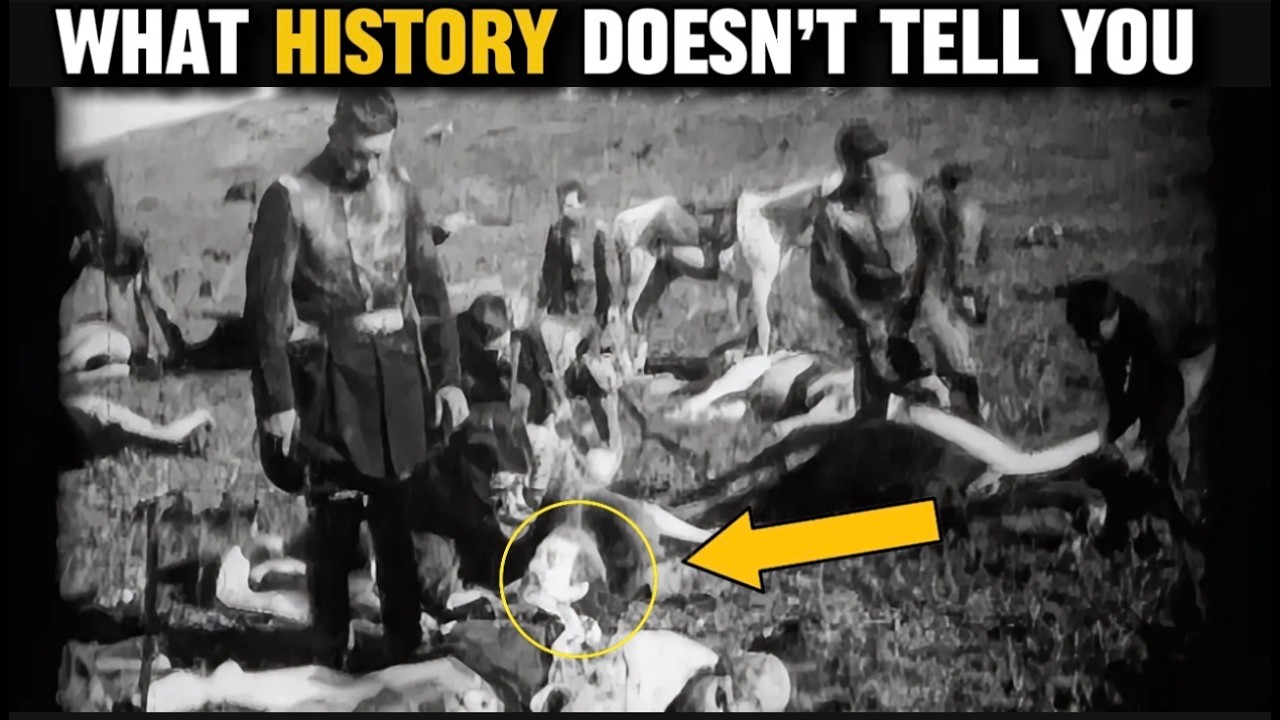
Stripped naked. Hacked. Left to the sun. Horses shot out from under their riders bloated in the heat, and the air carried a stench of blood and gunpowder and death that no wind could clear.
Major Marcus Reno and Captain Frederick Benteen, the two men who had survived their own desperate fight a few miles to the south, stared in stunned silence at what remained of George Armstrong Custer’s command. Two hundred and ten battle-hardened troopers of the 7th Cavalry. Gone. Every last one.
But it was not the number of dead that struck them hardest. It was the way they had died. There was no glorious last stand on a hilltop with flags flying and sabers drawn. No heroic circle of defiance.
Just panic, chaos, bodies tumbled into gullies like discarded toys. Reno and Benteen knew in that moment that they were looking at something the nation could never accept. So they buried the truth along with the bodies. For more than a century, that truth stayed hidden, until a freak wildfire in 1983 burned away the grass and modern science dug up the single detail that changes everything.
This is the story they tried to erase. Three days earlier, on June 25, 1876, the 7th Cavalry was pushing hard through the rolling hills of eastern Montana. Custer was chasing glory. Gold had been found in the Black Hills the year before, land that had been promised to the Lakota, Cheyenne, and Arapaho by treaty.
The government wanted the tribes rounded up and confined to reservations, and Custer, the boy general of the Civil War, saw his ticket to bigger things in the mission. He split his regiment into three battalions. Reno would attack the southern end of the massive Indian village. Benteen would guard the pack train.
Custer would take two hundred men and swing north for the knockout blow. His own scouts begged him not to. Bloody Knife, the half-Sioux guide who knew these plains better than any man alive, rode beside Custer and pointed to the horizon. “You will find more Indians than you ever saw together,” he warned.
Another scout, Half Yellow Face, was blunter still. “If you go in there, you will not come out alive. ” Custer laughed it off. The 7th Cavalry could whip any force of Indians.
He had his orders, his ambition, and his reputation. He was not about to turn back. By midday, the village came into view, a sea of more than a thousand lodges stretching for miles along the river. Nearly two thousand warriors, Lakota under Sitting Bull and Crazy Horse, Northern Cheyenne, Arapaho, had gathered in a way no one had ever seen before.
They were not running. They were waiting. Reno hit the southern edge first. His men charged, guns blazing, but the village was huge and the resistance ferocious.
Within minutes, Reno was forced to retreat to a bluff and dig in. Benteen, hearing the gunfire, joined him there. Together, they held off wave after wave of attackers for hours. But Custer, they realized, was nowhere to be seen.
He had taken his two hundred troopers and ridden straight into the heart of it. What happened next unfolded faster than anyone expected. The warriors did not wait to be attacked. They swarmed from ravines and ridges, from behind every hillock, pouring fire into Custer’s column from every direction.
Repeating rifles, Henrys and Winchesters, cracked in a deadly rhythm that the soldiers’ single-shot Springfield carbines could not match. Horses screamed and went down. Men were cut off from each other in the smoke and dust. Red Horse, a Miniconjou Lakota warrior who fought that day, later described what he saw.
“These soldiers became foolish,” he said. “Many threw away their guns and raised their hands, saying, ‘Sioux, pity us, take us prisoners. ‘ The Sioux did not take a single soldier prisoner, but killed all of them. ” Another warrior remembered it like hunting buffalo.
“We swirled around them like water circling a stone. ”
In less than an hour, some accounts say forty-five minutes, Custer’s entire command was gone. The soldiers did not die in one heroic knot on Last Stand Hill. Forensic evidence would later prove that they broke into small groups, fighting desperately as they tried to reach the river for water or break out of the encirclement.
Some ended up in deep ravines, backs against the earth, firing wildly until their ammunition ran out. Others were overrun in the open. The warriors moved among the fallen, collecting guns, cartridges, even uniforms. By nightfall, the only sound was the victory songs drifting across the valley.
Two days later, when the relief column finally arrived, the scene was worse than anything the survivors could have imagined. Lieutenant Edward Godfrey later wrote that the bodies had been stripped and mutilated in ways so horrible that the details were withheld from the public for twenty-five years. Skulls crushed by war clubs. Arrows still protruding from chests and limbs.
One trooper was found with more than twenty arrows in him. Arms and legs hacked off, faces unrecognizable. The men were not just killed. They were desecrated.
Custer himself lay near the top of the ridge, two bullet wounds on his body, one to the left temple, one near the heart. He was naked except for his socks. His body had been spared the worst of the mutilation. Some Cheyenne women who knew him from earlier encounters made sure of that.
But even he was not untouched. The legend of him standing tall with a pistol in each hand, surrounded by his dead men in a perfect circle, was pure fiction. He was found sitting against a horse, head slumped, no dramatic pose, no last defiant gesture. Just another corpse among the 268.
The burial parties worked in stunned silence. They dug shallow graves, marked them with what they could, and tried to make sense of it. But back east, the newspapers were already spinning the story. Custer’s Last Stand, a heroic sacrifice, a noble defeat.
The public needed heroes, not embarrassment. The army had just suffered its worst loss against native forces in its history, and it happened right when the country was celebrating its centennial. That is when the real cover-up began. Not some shadowy government conspiracy with hidden files, but something more personal and more powerful.
Elizabeth Bacon Custer, Libby, refused to let her husband be remembered as a reckless fool who had led his men to slaughter. For the next fifty years, she waged a one-woman campaign of books, lectures, and interviews. She painted George as the perfect soldier, the devoted husband, the victim of jealous superiors and overwhelming odds. She turned a military disaster into an American legend.
Paintings showed him standing tall, saber raised, surrounded by loyal men fighting to the last. Songs and poems followed. The myth took hold so completely that even the battlefield markers were placed according to the legend, not the facts. The single detail that would eventually shatter that myth stayed buried under thick prairie grass for more than a century.
Then, on August 19, 1983, a careless cigarette tossed from a passing car started a wildfire. Flames roared across the battlefield, burning away decades of overgrowth. For the first time since 1876, the ground lay naked. Archaeologist Douglas Scott and his team saw an opportunity no one had ever had.
They walked the ridges and ravines with metal detectors, GPS units, and forensic tools that would have seemed like magic to the men who fought there. What they found did not just rewrite the battle. It exposed the lie. Thousands of cartridge cases and bullets told the real story.
The soldiers’ Springfield cases were scattered in small, desperate clusters down the slopes and into the ravines, not in one neat defensive line on the hill. The Indians’ . 44 caliber repeating rifle cases formed wide arcs surrounding those positions, pouring fire from every direction. One warrior position alone had cases showing at least sixty-one different lever-action guns.
The troopers had been outgunned and outmaneuvered from the start. The bone fragments and equipment told an even darker tale. Men had died where they fell trying to escape, not where the myth said they stood their ground. There was no evidence of mass suicide.
No final defiant stand. Just a rapid, terrifying collapse into panic. The last stand was not a stand at all. It was a rout.
Scott and his colleagues mapped every artifact with scientific precision. They could literally follow individual guns across the battlefield by the unique marks left on the cartridge cases. One soldier’s carbine had been captured early and turned against his comrades. The data painted a picture of pure disorder.
Officers lost control. Units were cut off. Horses stampeded. In the end, it was not bravery that defined the fight.
It was fear. And that single detail, the precise location of those cartridge cases in the ravines, changed everything. It proved the accepted narrative was wrong. The heroic paintings, the schoolbooks, the movies, all built on a foundation of wishful thinking and deliberate myth-making.
The army had known the truth within days. The burial reports described the scattered dead and the mutilations in grim detail. But admitting Custer’s blunders, dividing his force, ignoring his scouts, charging a village he did not understand, would have been too humiliating. So they let Libby Custer turn failure into folklore.
The gruesome secret they tried to hide was not just the mutilations, though those were horrific enough. It was the fear, the panic, the realization in those final minutes that there was no escape, no glory, only the sound of thousands of warriors closing in. One trooper was found with a pocket comb and a five-cent piece still in his pocket, simple things that made him human. Another had his skull smashed so flat it looked like a pancake.
These were not faceless soldiers in a painting. They were young men, average age twenty-two, who died terrified because one man’s vanity outweighed every warning. Today, when you stand on Last Stand Hill, the marble markers still dot the ridge. But if you look down into the ravines, you understand that the real battle happened there, in the low ground, where the grass once hid the evidence.
The warriors did not need to storm a heroic position. They simply surrounded pockets of desperate men and ended it. The discovery after Custer’s Last Stand did not just shock the nation in 1876. It shocked the archaeologists a hundred years later.
And the truth they uncovered is still uncomfortable. It forces us to look past the romance of the Old West and see the raw, brutal reality of conquest and resistance. No glory. No last defiant stand.
Just 210 men who rode into history and never rode out. And for over a century, powerful voices tried to hide that fact behind paintings and poems and patriotic myths. But fire and science finally stripped it bare. What they discovered after Custer’s Last Stand was not just bodies.
It was the truth. Legends die hard, but the evidence never lies. This is the story America tried to forget.






