On October 7th, 1780, a British officer named Patrick Ferguson stood on a rocky ridge in South Carolina and watched 900 frontier riflemen surround his position. Ferguson was considered one of the finest marksmen in the entire British Army. He had invented his own breech-loading rifle. He had personally trained over a thousand loyalist militia to fight with bayonets and discipline.
He had spent months terrorizing the Carolina back country, and he had never lost a battle. That was October 1780. Sixty-five minutes later, Ferguson was dead. His army was destroyed, and the American Revolution had just been saved by a group of men who had no uniforms, no formal training, and no orders from anyone in the Continental Army.
If you had asked anyone in the Carolina back country about the state of the American Revolution in the summer of 1780, they would have told you it was over. They had good reason to think so. The British had completely shifted their strategy. After years of grinding, indecisive warfare in the northern colonies, the Crown decided to take the war south.
The thinking was simple. British commanders believed the southern colonies were full of loyalists, people who still supported King George and who would rise up and fight alongside the redcoats if given the chance. All the British had to do was march south, crush whatever Continental resistance they found, and then let the loyalists handle the rest. It sounded clean.
It sounded efficient. And for a while, it actually worked. In May of 1780, British General Sir Henry Clinton sailed south with over 14,000 troops and a fleet of warships. His target was Charleston, South Carolina, the wealthiest city in the southern colonies and the key to controlling the entire region.
Clinton surrounded the city by land and sea, cutting off every possible escape route. The American defenders, roughly 5,000 Continental soldiers under General Benjamin Lincoln, held out for weeks behind their fortifications, but the noose tightened every day. British artillery pounded the city. Supply ships could not get through.
Smallpox broke out among the defenders. On May 12th, Lincoln surrendered the entire garrison. It was the single largest American surrender of the entire Revolutionary War, and it would remain the worst American military disaster until the fall of Bataan in 1942. In a single stroke, the British had captured an entire American army without having to destroy it in the field.
With Charleston gone, the British owned the coast, and they were not finished. General Lord Charles Cornwallis, left in command of the Southern theater after Clinton returned to New York, pushed his forces inland with aggressive confidence. His goal was to pacify the Carolinas county by county using a network of outposts and loyalist militias to suppress any remaining rebel resistance. Cornwallis established a chain of fortified posts stretching from the coast to the interior, each one designed to project British authority deeper into the back country.
Loyalist families were encouraged to organize and arm themselves. Rebel sympathizers were given a choice between swearing an oath of allegiance and losing everything they owned. Then came Camden. On August 16th, 1780, Cornwallis met the hastily assembled Southern Continental Army under General Horatio Gates outside Camden, South Carolina.
Gates had been the hero of Saratoga, the man who captured an entire British army in the north, but Camden was a disaster. The American militia broke and ran almost immediately. The Continentals who stood and fought were overwhelmed. Nearly a thousand Americans were killed or captured.
Gates himself fled the battlefield on horseback and did not stop riding for nearly 60 miles. His military career was finished. After Camden, organized American resistance in the South effectively collapsed. There was no Continental Army left to speak of below Virginia.
Cornwallis controlled the major cities, the roads, and most of the populated lowlands. The revolution in the South looked dead. And this is where Patrick Ferguson enters the story. Ferguson was a 36-year-old Scottish officer, ambitious, skilled, and ruthless in exactly the way Cornwallis needed.
He held the rank of major in the British Army and had been given command of the loyalist militia forces operating on Cornwallis’s western flank. His job was to recruit Tories, arm them, train them, and use them to suppress rebel activity in the Carolina back country while Cornwallis drove north toward Virginia. Ferguson was exceptionally good at this job. He moved fast through the foothills, striking Patriot homesteads and supply depots before local militia could organize a response.
He fought hard when challenged, and he gave rebel sympathizers a simple choice: swear loyalty to the crown or watch your farm burn. For months, this approach worked. Fence-sitters fell in line. Patriot sympathizers hid or fled west.
Ferguson’s reputation grew, and with it grew a sense among the back country settlers that resistance was futile. By late September of 1780, Ferguson had pushed deep into western North Carolina with a force of roughly 1,100 loyalist militiamen. He was the only British regular among them. Every other soldier in his command was an American colonist who had chosen to fight for the king.
Ferguson was proud of what he had built. He had trained these men well. They could form lines, execute bayonet charges, and operate with a level of discipline that most militia forces on either side of the war could not match. He had turned farmers and shopkeepers into something resembling professional soldiers, and he believed they were ready for anything the Carolina back country could throw at them.
But Ferguson was about to make the mistake that would cost him everything. He sent a message across the mountains. West of the Blue Ridge, in the settlements along the Watauga, Nolichucky, and Holston rivers in what is now Eastern Tennessee, there lived a collection of frontier families who had carved their existence out of the wilderness. These were the Overmountain Men.
They were not soldiers. They were farmers, hunters, and Indian fighters. They had settled land that was technically still claimed by the Cherokee, and they had spent years defending their homesteads with long rifles, hatchets, and whatever else was available. They answered to no colonial government.
Many of them had ignored the entire revolution up to this point. Ferguson knew about these settlements, and he considered them a potential threat to his western flank. So, in late September, he sent a paroled prisoner across the mountains carrying a message for the Overmountain settlers. The message was blunt.
If the settlers did not cease their opposition to the crown, Ferguson would cross the mountains himself, hang their leaders, and lay waste to their settlements with fire and sword. This decision seemed small at the time. It was not. Ferguson intended the threat to intimidate.
Instead, it did the opposite. The Overmountain Men took it as a declaration of war, and they decided to deal with Ferguson before Ferguson could deal with them. Word of Ferguson’s threat spread through the mountain settlements like a brushfire. Colonel Isaac Shelby, a 29-year-old militia leader who had already fought the British at Musgrove Mill, rode immediately to the home of Colonel John Sevier.
Shelby had a simple proposition. Rather than wait for Ferguson to come to them, they should gather every fighting man they could find and go after Ferguson first. Sevier agreed on the spot. Within days, riders went out across the mountains carrying the call to muster.
On September 25th, 1780, the Overmountain Men gathered at Sycamore Shoals on the Watauga River at the site of present-day Elizabethton, Tennessee. They came from settlements scattered across hundreds of miles of wilderness. Some rode horses, some walked, some brought their own rifles and powder, others had almost nothing. Roughly a thousand men assembled at Sycamore Shoals over the course of two days.
They were led by a collection of colonels, none of whom technically outranked the others, and none of whom had been authorized by any government or military command to do what they were about to do. Colonel William Campbell brought 400 Virginians. Colonel Isaac Shelby brought 240 men from Sullivan County. Colonel John Sevier brought another 240 from Washington County.
Colonel Charles McDowell brought about 160 refugees from Burke and Rutherford counties who had already been driven from their homes by Ferguson’s loyalists. There was no chain of command. There was no supply line. There was no artillery, no cavalry in the formal sense, and no plan beyond one simple objective: Find Patrick Ferguson and destroy him.
Before the men marched out, a Presbyterian minister named Reverend Samuel Doak addressed the gathered militia. He delivered a sermon that ended with a phrase from the Old Testament, “The sword of the Lord and of Gideon. ” The men took it as their battle cry. Then they crossed the mountains.
The march itself was brutal. The Overmountain men rode and walked through the Blue Ridge passes in late September rain and early autumn cold. The trails were narrow, muddy, and steep. Some of the paths were little more than animal traces through virgin forest.
They had no tents. They carried what food they could, mostly parched corn and dried meat. Some of the men had no shoes. They covered ground at a pace that would have impressed professional soldiers, pushing through gaps in the mountains that most armies would have considered impassable.
The column stretched out for miles along the narrow mountain paths. Horses stumbled on loose rocks. Men slipped in the mud and picked themselves up without stopping. At night, they slept on the ground in their hunting shirts, soaked to the skin, with no fires for warmth because the wood was too wet to burn.
Two men deserted during the crossing, and one of them reportedly tried to warn Ferguson that the Overmountain men were coming. Whether that warning ever reached Ferguson is still debated by historians, but what is clear is that Ferguson knew something was headed his way. He just did not know how many or how fast they were moving. These men were not marching because someone ordered them to.
There was no draft, no enlistment bonus, no pension waiting at the end. Every single one of them had chosen to be there. They were fighting because Patrick Ferguson had personally threatened their families, their homes, and their way of life. That kind of motivation does not show up in any military manual, but it is the most dangerous force on any battlefield.
There was something else, too. These men knew each other. They were neighbors, relatives, church members, hunting partners. They had grown up together in isolated mountain communities where trust was not a word you threw around casually.
When Isaac Shelby told his men to follow him across the mountains, they did not follow because of his rank. They followed because they had known him for years, and they believed he would not lead them into something stupid. That kind of unit cohesion takes professional armies months or years to build. The Overmountain Men had it from the day they mustered.
As the Overmountain Men pushed east, they picked up reinforcements. Colonel Benjamin Cleveland joined with 350 men from Wilkes and Surry counties in North Carolina. These were big, rough, backcountry men. Cleveland himself weighed over 300 pounds, rode a horse that looked like it deserved a medal for endurance, and had a reputation for hanging Tories from the nearest tree.
He was not a man who believed in half measures. By October 6th, the combined Patriot force had swelled to roughly 1,400 men, but they had a problem. Ferguson was moving, and they were not entirely sure where he was. That evening, the Patriot colonels held a council of war at a place called Cowpens, a well-known cattle grazing area in South Carolina.
They had a problem that needed solving fast. Their force was large but slow, and Ferguson was mobile enough to slip away toward Cornwallis’s main army if given the chance. They could not afford to let that happen. If Ferguson linked up with Cornwallis, the opportunity would be gone forever.
The colonels made a decision that would define the battle. They selected 900 of their best horsemen, the fastest riders on the strongest mounts, and sent the rest of the force to follow behind as quickly as it could. The 900 would ride through the night, close the distance, and find Ferguson before he could escape or receive reinforcements. It was a gamble.
If Ferguson had moved, if the intelligence was wrong, if the horses gave out, 900 exhausted men would be stranded deep in hostile territory with no support. The night ride was miserable. It rained steadily. The trails turned to mud.
Men fell asleep on their horses and were jolted awake when their mounts stumbled. Some riders fell off entirely and had to catch up on foot, but they kept moving. Nobody turned back. By dawn, the rain had stopped, but a thick fog clung to the valleys and ridgelines.
On the morning of October 7th, they received intelligence from local scouts and a captured loyalist that Ferguson had made camp on a ridge called King’s Mountain, a narrow, flat-topped rise about 16 miles south of the present-day North Carolina border. King’s Mountain was not much of a mountain. It rose about 60 feet above the surrounding terrain and stretched roughly 600 yards in length. The top was relatively flat, shaped something like a footprint, narrow at the northeastern end, and wider at the southwest.
Hardwood trees and thick underbrush covered its slopes. Ferguson had chosen this position because he believed it was defensible. He reportedly told his officers that he was on King’s Mountain, that he could not be driven from it, and that God Almighty himself could not drive him from it. Ferguson would look back on that boast and wish he had made a different call.
The position he chose was, in reality, a death trap. The Patriot colonels arrived near King’s Mountain around 3:00 in the afternoon on October 7th. They dismounted, tied their horses, and formed into columns. There was no elaborate battle plan.
The colonels simply agreed to surround the mountain from all sides and attack uphill simultaneously. Each colonel would lead his own men up a different section of the slope. When they reached the top, they would converge on Ferguson’s position. At roughly 3:15 in the afternoon, the attack began.
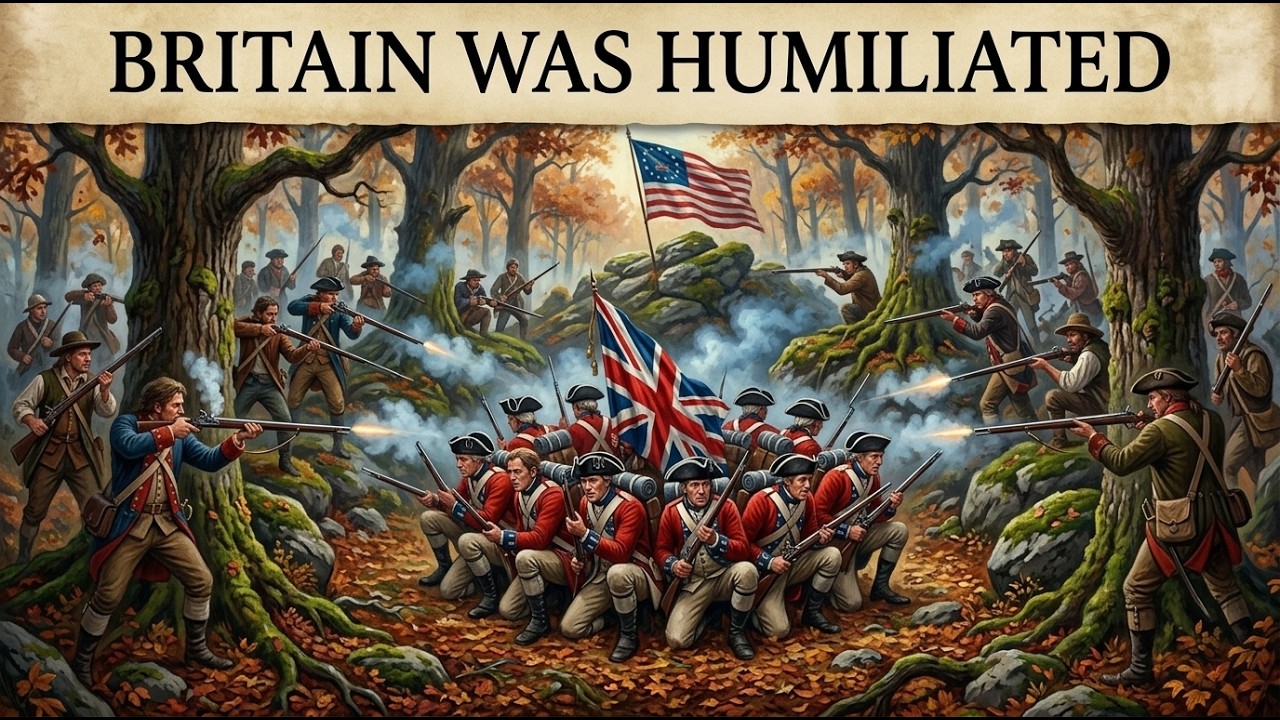
The Overmountain men moved through the trees like hunters stalking game because that is exactly what they were. These were men who had spent their lives hunting deer, elk, and bear in the Appalachian wilderness. They understood cover. They understood how to move quietly through dense forest, and they were carrying long rifles, the weapon that had made the American frontier marksman the most feared individual combatant in the Western Hemisphere.
The long rifle was accurate at ranges that a standard Brown Bess musket could not dream of matching. A skilled rifleman could hit a target at 200 yards or more. Ferguson’s loyalists were armed primarily with smoothbore muskets effective to maybe 80 yards. The mathematics of the engagement were devastating before the first shot was ever fired.
The Patriots came up the slopes from multiple directions at once. Shelby’s men hit the southern face. Sevier’s men attacked from the north. Campbell’s Virginians charged up the northeastern end.
Cleveland’s men stormed the southwestern approach. The sound of rifle fire erupted from every direction simultaneously. Ferguson’s loyalists responded the way they had been trained. They formed lines and launched bayonet charges down the slopes.
And at first, these charges worked. The Overmountain men had no bayonets. When a wall of screaming loyalists came crashing downhill with fixed steel, the frontiersmen fell back into the trees, but they did not break. They did not run.
They simply melted into the forest, reloaded, and came back up. A conventional army would have routed. A militia force without bayonets facing a disciplined bayonet charge should have disintegrated. That was how 18th century warfare worked.
But these men were not conventional anything. They were not fighting a war. They were fighting a grudge. Every time Ferguson’s men charged downhill, they gained ground temporarily, but exposed themselves to rifle fire from the other sides of the mountain.
The Patriots on the opposite slopes would pour fire into the loyalists as they advanced. Then the loyalists would wheel around and charge that direction, and the men they had just pushed back would creep up the hill again behind them. It was like trying to push water uphill. Every charge solved one problem and created three more.
The fighting was close, savage, and relentless. The mountain was shrouded in gun smoke. Men shouted, screamed, and cursed. The Patriot battle cry echoed from every direction.
The loyalists began to waver. They were trapped on the summit with nowhere to go, taking fire from every angle, watching their officers fall one by one. Ferguson rode back and forth across the hilltop on horseback, blowing a silver whistle to rally his men, and personally leading counterattacks wherever the line seemed weakest. He was conspicuously brave, wearing a checkered hunting shirt over his uniform that made him impossible to miss.
Several of the Patriot riflemen later said they had deliberately targeted the officer on horseback. Ferguson had his sword shot from his hand. He kept fighting. His right arm had been permanently crippled by a wound at the Battle of Brandywine three years earlier, so he wielded his blade with his left.
A rifle ball cut his sash. He kept rallying his men. Another ball struck his hat. He replaced it and kept riding.
The ferocity of the fight on the summit was staggering. At certain points, the opposing forces were so close together that men were fighting hand-to-hand with rifle butts, knives, and bare fists. The air was thick with sulfur smoke from hundreds of black powder weapons firing continuously. Wounded men on both sides dragged themselves behind rocks and fallen trees.
The noise was deafening, a constant rolling thunder of musket and rifle fire punctuated by screaming, shouting, and the clash of metal. Within roughly 45 minutes of the first shots, the situation on King’s Mountain had become completely hopeless for the loyalists. Ferguson’s men were being pushed into a tighter and tighter perimeter on the summit. White flags began to appear.
Loyalist soldiers started trying to surrender. Ferguson would not allow it. Every time a white flag went up, Ferguson rode over and personally cut it down with his sword. He refused to surrender to what he reportedly called a band of bandits, and so the killing continued.
Then, sometime around 4:00 in the afternoon, Ferguson made his last decision. He gathered a few of his officers and attempted to break through the Patriot lines on horseback, apparently hoping to cut his way to freedom and ride for Cornwallis. He charged downhill toward the southeastern slope, sword raised, whistle blowing. He never made it.
Multiple rifle balls struck him almost simultaneously. His foot caught in his stirrup as he fell, and his horse dragged his body across the rocky ground before coming to a stop. Patrick Ferguson, the finest marksman in the British Army, the man who had threatened to lay waste to the mountains, was dead. With Ferguson gone, the remaining loyalist officers raised the white flag for the final time.
The Battle of King’s Mountain was over. From the first shot to the last, the entire engagement had lasted roughly 65 minutes. The numbers tell the story with brutal clarity. Ferguson’s force of approximately 1,100 men suffered 290 killed, 163 wounded, and 668 taken prisoner.
The total Loyalist casualties amounted to the entire army. Every single man was killed, wounded, or captured. Not one organized unit escaped. The Patriot losses were 28 killed and 62 wounded.
Nine hundred untrained frontiersmen had surrounded a fortified hilltop position defended by over a thousand disciplined troops, attacked uphill from every direction, and annihilated the entire enemy force in just over an hour while losing fewer than a hundred men themselves. If you wrote this as fiction, nobody would believe it. The aftermath of King’s Mountain was ugly. The Patriot militiamen, many of whom had seen their homes burned and their neighbors murdered by Loyalist raiders, were not in a forgiving mood.
Some of the surrendering Loyalists were shot or bayoneted after throwing down their weapons. Colonel Campbell eventually restored order, but the anger ran deep. In the days following the battle, the Patriots held a hasty field court-martial for several captured Loyalists accused of crimes against Patriot civilians. Thirty-six men were tried and found guilty.
Nine were hanged from a large tulip tree before the remaining executions were called off, partly because some of the Patriot officers objected to the proceedings and partly because word arrived that a British force might be approaching. The Patriot army then began a long, difficult march north with their hundreds of prisoners. Many of the Overmountain men simply went home after the battle, melting back into the mountains as quickly as they had appeared. They had done what they came to do.
Ferguson was dead. His army was gone. Their families were safe. But what happened next reveals why King’s Mountain mattered far beyond that single bloody ridge in South Carolina.
When Lord Cornwallis received word of Ferguson’s destruction, he was stunned. He had been preparing to march north into North Carolina, continuing his campaign to roll up the southern colonies one by one. Ferguson’s force had been protecting his western flank. Now that flank was gone, along with 1,100 trained soldiers he could not replace.
Cornwallis was reportedly so shaken by the news that he felt physically ill. One of his officers later described the mood at headquarters as one of disbelief. Cornwallis immediately halted his advance and retreated south to Winnsboro, South Carolina. He would stay there for nearly three months, regrouping and trying to rebuild his shattered loyalist network.
The momentum of the British southern campaign, which had seemed unstoppable after Charleston and Camden, ground to a halt overnight. For the first time in months, the British were going backward. The psychological effects radiated outward in both directions. Loyalist recruitment across the Carolinas collapsed almost immediately.
Men who had been considering joining the British cause looked at what happened at King’s Mountain and decided to stay home. Men who had already sworn allegiance to the crown quietly switched sides or disappeared. The loyalist militia network that the entire British southern strategy depended on began to crumble from within. King’s Mountain had proven that fighting for the king could get you killed just as quickly as fighting against him.
And the loyalists who survived the battle carried that message back to every settlement in the Carolinas. At the same time, Patriot morale surged. After months of nothing but catastrophic defeats, King’s Mountain was proof that the British could be beaten, not just stalled or harassed, but completely destroyed. Militia recruitment for the Patriot cause spiked across the Southern colonies.
Men who had given up on the revolution picked up their rifles again. The tactical ripple effects were enormous. With his western flank exposed and loyalist support evaporating, Cornwallis was forced to completely rethink his campaign. The delay gave the Continental Congress time to appoint a new commander for the Southern theater, General Nathanael Greene, who was arguably the most talented strategic mind in the entire Continental Army.
Greene arrived in the South in December of 1780 and immediately began a campaign of maneuver and guerrilla harassment that would slowly bleed Cornwallis dry over the next year. Greene understood something that previous Southern commanders had not. He did not need to win pitched battles. He just needed to keep the British chasing him, stretching their supply lines thinner and thinner, while partisan leaders like Francis Marion and Andrew Pickens tore apart the loyalist support structure behind enemy lines.
Without King’s Mountain, Greene might never have gotten the chance. Cornwallis would have continued his advance unchecked through the fall of 1780, potentially overrunning North Carolina and Virginia before any organized resistance could form. The three months that Ferguson’s defeat cost Cornwallis were three months that the American cause desperately needed to survive. The battle also intersects with one of the strangest what-ifs of the entire revolution.
Back in 1777, at the Battle of Brandywine in Pennsylvania, Patrick Ferguson reportedly had George Washington in his rifle sights. Ferguson later wrote that he saw an American officer in a distinctive uniform ride into range, accompanied by a French hussar officer. Ferguson raised his rifle, had a clear shot, and decided not to fire because he considered it unsportsmanlike to shoot an unsuspecting man from ambush. That officer was almost certainly George Washington.
If Ferguson had pulled the trigger, the entire American Revolution might have ended three years before King’s Mountain ever happened. The same personal code of honor that spared Washington’s life in 1777 ultimately contributed to the death of Ferguson himself, who refused to surrender to men he considered beneath his station as a gentleman officer. Thomas Jefferson later called the Battle of King’s Mountain the turn of the tide of success in the South. Theodore Roosevelt wrote about it as one of the most significant engagements of the entire war, noting that the Overmountain Men represented a type of American fighter that had no equivalent in European military tradition.
They were not soldiers. They were citizens who had armed themselves, organized themselves, and marched hundreds of miles through the wilderness to destroy a threat to their homes. The battle changed the course of the Southern Campaign and, by extension, the course of the war. After King’s Mountain, the sequence of events becomes almost inevitable in hindsight.
Cornwallis’s stalled campaign led to the Battles of Cowpens and Guilford Courthouse, which bled his army to the point of exhaustion. His desperate march north into Virginia ended at Yorktown, where Washington and the French trapped him in October of 1781, exactly one year after King’s Mountain. There is a granite obelisk at the King’s Mountain battlefield today. The ridge is quiet now, covered in the same hardwood forest that sheltered the riflemen over 240 years ago.
The trees are taller. The underbrush has been cleared for walking paths. Small stone markers note the positions where the different Patriot columns began their attack. A cairn of rocks marks the spot where Ferguson fell.
The military park sits just off a two-lane highway, easy to miss if you are not looking for it. Most of the visitors who do find it are surprised by how small the mountain actually is. Standing at the base, you can see the summit through the trees. The idea that over 2,000 men fought and died on this wooded knoll feels almost impossible until you start walking the trails and realize how steep and tangled the slopes really are.
Most Americans have never heard of King’s Mountain. It does not get the attention of Lexington or Bunker Hill or Yorktown. School textbooks mention it in passing if they mention it at all. But the men who fought the revolution understood what it meant.
It was the moment when the war in the South swung back toward the Patriots, driven not by generals or governments, but by ordinary people who refused to be threatened. What survived King’s Mountain was not just a military victory. It was the idea that free people fighting for their own land and their own families could defeat a professional army. That idea did not start at King’s Mountain and it did not end there.
But on that October afternoon in 1780, 900 men with long rifles proved it was more than just an idea. It was a fact.






