The unfinished monument stands in Westminster Abbey, on the south side of the high altar. Her initials are carved into the stone, along with the lion and bull of Cleves, and a skull and bones in the Renaissance manner. The work was begun and then abandoned. Anne of Cleves is the only one of Henry VIII’s wives buried in England’s coronation church, the sole memorial to her being a tomb nobody ever finished.
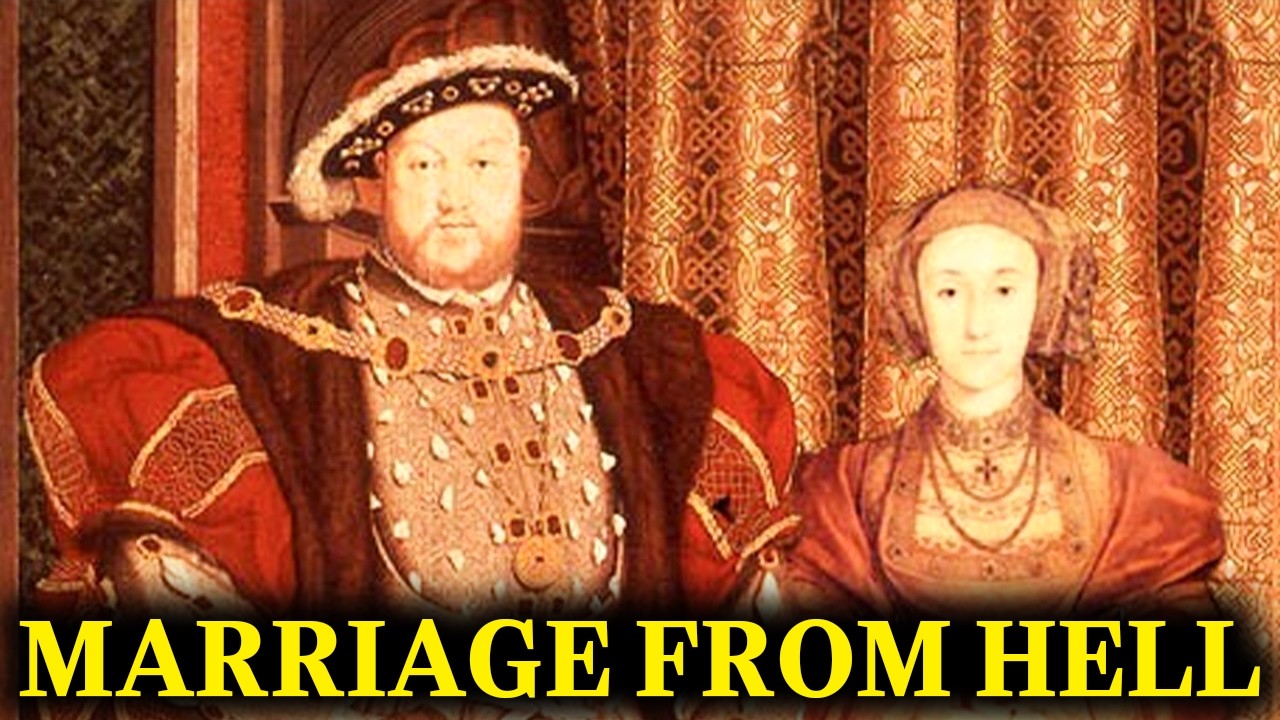
Everyone remembers the punchline. The Flanders Mare. The phrase appears nowhere in 1540. It does not show up in any letter, dispatch, chronicle, or deposition from the year of the marriage.
It first surfaces in a bishop’s history published 130 years after Anne died. What actually survives from 1540 is uglier, procedural, legal, written down and signed. A king’s sworn statement about handling her body, read aloud to clergymen. A minister writing his version from the Tower of London.
Her replacement coming from among her own maids of honor. Start with the phrase, because the phrase is the whole problem. The Flanders Mare is the only thing most people can tell you about Anne of Cleves. It is in the school books, the quiz shows, the musicals.
It comes from Gilbert Burnet, an Anglican bishop who published his History of the Reformation of the Church of England in volumes between 1679 and 1715. Anne died in 1557. Burnet never met anyone who met her. He was writing more than a century after the fact, inside a polemical project about English Protestantism, and he attributed the insult to Henry without producing a single document.
No contemporary letter, dispatch, chronicle, or deposition from 1539 or 1540 calls Anne of Cleves ugly. Not the French ambassador, who had every reason to sneer at a German match. Not the imperial agents who hated the alliance. Not Henry’s own diplomats.
What they said was something else entirely, and it is more revealing. In August 1539, Henry’s envoy Nicholas Wotton was in Düren getting a look at the woman his king had agreed to marry sight unseen. His report back is still readable in the state papers, and it is not the letter of a man covering up a disaster. He described her as having a sober, grave manner, which in the vocabulary of the period was praise.
Then he listed what she lacked. She had no French, no Latin, no Italian. She could not sing and did not play any instrument, because in Cleves, he explained, music was not considered a proper occupation for a noblewoman. She had been raised closely by her mother and rarely left her side.
She was skilled at needlework. Nobody flagged her face. They flagged her training. Hold on to that.
Every single one of those deficiencies would later be recycled into an argument about why the King of England could not bear to touch her. And the same court that recorded them without alarm in 1539 would, within a year, be asked to write down the most intimate possible claim about her body and sign their names to it. The nastiness in this marriage was not a joke about a nose. It happened on paper in July 1540, when Henry VIII gave a formal account to a commission investigating his own marriage.
That account was about having handled Anne’s body in bed and concluding, from what he felt, that she was no virgin. The physicians Dr. William Butts and Dr. John Chambre were brought in to confirm what the king had told them privately about the royal bedchamber.
Her ladies-in-waiting were questioned about what she had said to them about her nights. Thomas Cromwell, locked in the Tower of London and writing to save his life, produced a long letter recounting the king’s complaints to him month by month, starting from the first day. That document was read by bishops and lawyers. Copies circulated.
A woman who had been in England for six months, who still barely spoke the language, became the subject of a sworn, archived, officially examined debate about whether she had ever been a maid. And then she signed her agreement to it. That is the part that stops people, because Henry VIII did not generally need permission. He had broken with Rome rather than ask it.
He had executed a wife four years earlier rather than negotiate with her. Anne had no English relatives, no faction at court, no dowry to reclaim, no money of her own, and no way to physically leave the country without the king’s ships. On paper, she was the most powerless adult in England. So why did the most dangerous man in Europe need her consent, and keep paying her generously for it for the next seventeen years?
To answer that, you have to go back to what she actually was when she arrived. Not a bride. A clause. In late 1537, Henry’s third wife, Jane Seymour, died days after giving him a son.
For two years he was a widower with a male heir, an excommunication hanging over him, and a diplomatic problem that got worse every month. In January 1539, Charles V and Francis I signed the Treaty of Toledo, agreeing not to make separate alliances with England. The Pope had published the bull of excommunication. For a brief, genuinely frightening window, the two great Catholic powers of Europe looked aligned against an England that had no friends.
Thomas Cromwell’s answer was Germany. Not Lutheran Germany exactly, but the Duchy of Cleves, which sat on the lower Rhine, had thrown off papal authority in its own idiosyncratic, Erasmian way and had a live territorial fight with Charles V over Gelderland. Cleves also had a family connection to the Protestant Schmalkaldic League. Anne’s older sister Sibylle had married John Frederick, Elector of Saxony, back in 1527.
Marry into Cleves, and England acquired a northern hedge against a Catholic coalition without formally joining a heresy. Anne’s father, Duke John III, died in February 1539. Her brother Wilhelm inherited, and Wilhelm wanted English protection badly enough to accept terms that today look almost insulting. There was essentially no dowry in the normal sense.
England was buying a relationship, not a fortune. Henry, who had just had a very bad experience being handed a picture, sent Hans Holbein the Younger to Düren in the summer of 1539 to paint the sister in question from life. Holbein produced a small circular portrait on parchment, mounted on a playing card, and housed in a turned ivory case carved to look like a white rose. It is in the Victoria and Albert Museum today, and you can look at it in about ten seconds.
It shows a young woman, hands folded, looking directly out at the viewer, wearing an elaborate Cleves headdress. Keep that little rose box in mind. The most durable accusation in this entire story, that Holbein flattered her and committed a fraud on his king, collapses the moment you check what happened to Holbein afterward. The treaty was signed on the 4th of October 1539.
Nobody consulted Anne. There is no record of her opinion of the match, no courtship correspondence, no documented moment where she chose anything. She was twenty-four. She had barely left her mother’s household, and she was told she was going to England to be queen.
It was a courtship conducted entirely between men. The negotiation files are full of Wilhelm’s advisers, Cromwell’s agents, Wotton’s reports, and arguments about Gelderland. Anne appears as the object of the sentence. There was one loose thread, and it would matter more than anything else in her life.
In 1527, as a child, Anne had been betrothed to Francis, the son of the Duke of Lorraine. Such arrangements were routine and were routinely dissolved. The English negotiators asked for the documents proving the betrothal had been properly revoked. The Cleves envoys said the papers existed, promised to send them, and then did not.
Not in time, anyway. They offered themselves as hostages for the document’s eventual arrival, which gives you a sense of how awkward the moment was. Henry married her anyway. The King of England, who had spent six years and an entire schism trying to prove that his first marriage had been invalid from the start, agreed to a wedding while an unresolved pre-contract sat in the file.
He had just been handed, in advance, the exact legal instrument he would use to escape. Whether he saw it that way in October 1539 is not something the record establishes. Cromwell certainly did not. He had built his policy on this marriage, and he was about to find out what it cost.
Anne’s journey to England was slow and enormously expensive. She traveled overland through Cleves territory and the Low Countries with a train of more than two hundred people. She reached Calais around December 11th, 1539, and then sat there for roughly two weeks because the Channel would not let her cross. The Earl of Southampton, William FitzWilliam, was in charge of receiving her, and what he did with that fortnight tells you something about her.
She asked him to teach her a card game the king liked. Contemporary accounts name it as the game of sent. She also asked to sit at supper with him and his officers so she could watch how Englishmen ate at table and learn the manners. That is a woman doing homework.
No French, no music, no court training, and she had worked out that the gap was a problem and was closing it with the only tools available in a Calais winter. Southampton wrote home praising her. He said she had a manner he thought the king would like. He was so enthusiastic that he would later be criticized for it, for having written approving letters instead of warning the king.
She landed at Deal on December 27th and moved up through Canterbury and Rochester. On New Year’s Day 1540, Henry VIII decided to do something romantic. He rode to Rochester in disguise with a small group of gentlemen in matching cloaks carrying New Year gifts, to surprise his bride before the official state reception. It was a chivalric set piece, the kind of thing he had done for twenty-five years.
The kind of thing where the lady is supposed to recognize the king through the disguise by the sheer force of his presence. What happened in that room at Rochester is the most consequential ten minutes in Anne of Cleves’s life. And almost everything we know about it was written down six months later by men trying to help the king end the marriage. She was at a window watching a bull baiting in the courtyard below when he came in.
According to the account given later, she greeted him politely and then turned back to the window. She did not recognize him, because why would she? She had never seen his face. She spoke no English, and a group of men in cloaks had just walked into her chamber unannounced.
Henry withdrew, changed into his own clothes, came back as himself, and she received him properly. The disguise is solidly documented. Her reaction is not quite as solid as the retellings suggest. The detail comes principally from testimony and recollections gathered in the summer of 1540 by people whose job at that moment was to establish that the king had been repelled from the first instant.
Charles Wriothesley’s chronicle records the visit. Sir Anthony Browne, who was present, later deposed that he saw the king’s countenance change and heard him speak with discontent. Cromwell from the Tower wrote that Henry came back to Greenwich and said he liked her not. Treat all of it as what it is: evidence assembled for a purpose.
The core of it is probably true. Something went wrong at Rochester. But notice what the complaint was never about. Not one of these accounts says the king said she was ugly, or that the portrait had lied.
Browne’s version is about disappointment and dislike. Cromwell’s version is about the king being unable to summon desire. The word that recurs in the 1540 depositions is not ugly. It is variations on provoked.
Henry’s claim that he could not be provoked to do his duty by her. Two days later, England put on the show anyway. On January 3rd, 1540, she was received at Blackheath outside Greenwich in front of the assembled nobility, the mayor and aldermen of London, and an enormous crowd. She changed into a gown in the Dutch fashion, cloth of gold, with a headdress set with pearls.
Henry rode out to meet her in a coat of gold embroidered with diamonds. They embraced in front of everyone. Cannons fired from the Tower. The chroniclers described the barges on the river, the trumpeters, the tents of gold cloth.
Three days after that, on January 6th, Thomas Cranmer, Archbishop of Canterbury, married them at Greenwich. That morning, Henry is reported by Cromwell in the Tower letter to have said that if it were not to satisfy the world and his realm, he would not do that day what he must do. The quotation comes from an interested witness writing under threat of death, so it carries the appropriate asterisk. But the behavior around it is independently documented and points the same way.
The king went to the altar in front of the court of England in a marriage he had already told at least two men he did not want, because the alliance required it and because withdrawing at that point would have been a public humiliation of a foreign duke whose soldiers England might need. He married her to satisfy the world. That is the whole relationship in a sentence, and it is from day one. The ring she received was engraved with a motto: God send me well to keep.
Remember it. It comes back. Now look at the household that formed around her, because this is where she became something other than a wife. She became a position with staff.
She arrived with a German retinue, including a woman the English records call Mother Lowe, who had been her attendant from Cleves and ran her private apartments. Around that core, Henry’s council installed English noblewomen. Eleanor, Countess of Rutland. Jane Boleyn, Lady Rochford, who had already survived the destruction of the Boleyns and would be executed two years later for her role in Catherine Howard’s affairs.
Lady Edgecombe. Lady Browne, wife of the same Anthony Browne who had watched the Rochester disaster. These women were her company. They were also the only people who could speak to the king’s council about what happened in the queen’s chambers.
In June and July 1540, they were called on to do exactly that. And the evidence they gave is the most quietly devastating material in the entire file. Rutland, Rochford, and Edgecombe testified about a conversation they had with Anne about her marriage nights. Anne, by their account, described the king coming to bed, kissing her hand, saying “Good night, good night, sweetheart,” and in the morning kissing her and saying “Farewell, darling.
” The ladies asked her whether she thought she was still a maid. She said she believed she was no more a maid, because she had slept beside the king. One of them said words to the effect that there must be more than that, or there would be no Duke of York. The record presents Anne as someone who did not fully understand what was supposed to have happened and was told so by her attendants.
Whether she was genuinely that uninformed, or whether, as several historians have argued, she was being extremely careful about what she admitted to in a court where the wrong answer had killed people, is not settled. Retha Warnicke has made the case that her position was far more calculated than it looks. What is certain is the use the testimony was put to. Her own description of affectionate nothings, passed on in private to her ladies, was carried to the commission and entered as proof that her marriage had never been consummated.
She gave them the evidence herself, in confidence, to women the council had placed in her rooms. And the medical men gave the rest. Dr. Chambre had been receiving Henry’s private reports on the bedchamber and confirmed them.
The king’s line circulated in the depositions was that he had felt her body and concluded she was not a virgin, and that this had killed his desire and left him unable to proceed. This is the cruelty people do not know about, because it is not funny and does not fit the Flanders Mare joke. A foreign woman in her mid-twenties who had been in the country for six months had her body described by the king to a committee in writing, and the description was preserved. She had no right of reply, no representative, no language.
The claim also neatly served Henry’s reputation. It made the failure her fault rather than his. Meanwhile, the public timeline looked fine. Within weeks of the wedding, the court was told the king was content.
Letters went out reporting the marriage as settled. The couple appeared together. In February and into the spring, she was publicly queen, with a household, a rank, and a place at ceremonies. Underneath, the escape hatch was being quietly cleaned out.
The question of the Lorraine pre-contract was reopened. The documents from Cleves that should have closed it had still not satisfied the English council. And by the spring of 1540, Henry had noticed one of the queen’s own maids of honor. Catherine Howard was somewhere around eighteen or nineteen, a niece of Thomas Howard, Duke of Norfolk, and she was serving in Anne’s household.
That placement matters. Norfolk and Bishop Stephen Gardiner had been fighting Cromwell’s whole religious and diplomatic program, and a Howard girl in the queen’s rooms was an opportunity. By April, the king was granting her gifts of land. The woman who would replace Anne was in Anne’s service, under Anne’s roof, visible every day.
Then the structure came apart in six weeks, and the dates are worth hearing in order. On June 10th, 1540, Cromwell was arrested at the council table and taken to the Tower. The charges included heresy and treason. The real offense, in the part that concerns this story, was the marriage.
The alliance had become useless almost immediately, because Charles V and Francis I had fallen out again by the spring, and Cleves was now not a hedge but a liability, dragging England toward war over Gelderland. Cromwell had sold the king a wife to solve a problem that no longer existed. On June 24th, Anne was ordered to leave the court for Richmond Palace. The stated reason was the plague and the good air.
Henry was to follow. He did not follow. On July 6th, a delegation came to Richmond to inform her that her marriage was being examined and to ask for her agreement. On July 9th, the clergy in Convocation at Westminster pronounced the marriage null on the grounds of the pre-contract, non-consummation, and the king’s lack of inward consent.
Parliament confirmed it. On July 28th, 1540, Thomas Cromwell was executed on Tower Hill. That same day, Henry VIII married Catherine Howard at Oatlands. The man who built the marriage and the woman who replaced the wife were dealt with on a single afternoon.
No one planned a symbolic coincidence. The court simply moved that fast once the king had decided. Which brings us back to Holbein and the ivory rose, and to the most repeated lie in this story after the Flanders Mare. The legend says Holbein flattered Anne, deceived the king, and was disgraced for it.
Check the record. Hans Holbein the Younger remained the king’s painter. He kept his annual salary of £30. He went on painting for Henry’s court and for English clients until he died in London in late 1543, still in royal service.
Henry punished the men who had argued for the marriage, and he destroyed the minister who arranged it. He did not touch the painter, because the painter had not done anything. Anne looked like her portrait. That was never the problem.
And here is the question the executions and the fast wedding leave hanging. Henry had just annulled the marriage through his own clergy and his own parliament. He had the Convocation ruling, the depositions, the physicians, the pre-contract. He did not need anything else from her.
So why did a delegation sit at Richmond Palace in July 1540 and negotiate? And why, when she agreed, did the king hand a rejected foreign bride three substantial properties, a royal income, and a rank above every woman in England except the new queen and his own daughters? The answer is Düsseldorf and a war nobody in England wanted to fight. If Anne had refused, if she had written to her brother that she was being cast off, or simply declined to sign, then the annulment became a contested international dispute.
Wilhelm of Cleves would have been publicly dishonored, and Wilhelm was already in an armed quarrel with Charles V over Gelderland. A furious Cleves could have pushed the Schmalkaldic League and the emperor into one of those temporary accommodations that European rulers made when they agreed on nothing except that England was behaving intolerably. Henry had just spent two years terrified of exactly that combination. Her signature converted a scandal into a settlement.
That was the only commodity she had, and it was worth a very large amount. What she got by patent and grant in the summer of 1540: an income reported at around £4,000 a year, Richmond Palace, the manor of Bletchingley in Surrey, Hever Castle in Kent, and the right to be styled the king’s sister, ranking at court above all ladies save the queen and the king’s daughters. She kept her German servants. She was to remain in England.
She also returned the ring. The surviving account has her sending it back and asking that it be broken in pieces, as a thing of no force or value. That is a woman who understood exactly what the object was. She had arrived with God send me well to keep on her finger.
Eight months later she handed it over to be destroyed and took the deeds instead. Then she wrote to her brother. The letter is in the state papers. She told Wilhelm that she was content, that she was treated as a sister, that she had no desire to return, and that she would remain in England.
The council had certainly seen the letter before it left. Several historians read it as dictated in substance, if not in words. But she wrote something very similar more than once over the following years, including after the pressure had lifted, and she never went home. At some point, the explanation that she was coerced stops covering the behavior.
Hever Castle, incidentally, was Anne Boleyn’s childhood home. The crown had taken it after the Boleyns were destroyed. Henry gave it to the next wife he discarded. Nobody in 1540 appears to have remarked on it.
And then something genuinely strange happened. For a while, the arrangement looked almost warm. At New Year 1541, Anne came to Hampton Court. She dined with Henry and with Catherine Howard, the girl who had been her maid of honor.
Contemporary reports describe her greeting the new queen respectfully and the king speaking with her pleasantly. Gifts were exchanged. She visited the court again. In the surviving accounts of these months, she is not sulking in the country.
She is a fixture, a slightly odd one, an ex-wife with a title and an income who shows up at Christmas. It held for about ten months. In November 1541, Catherine Howard’s past and present conduct came out. She was stripped of the title of Queen in late November and executed on the 13th of February 1542, along with Jane Boleyn, Lady Rochford, one of the women who had testified about Anne’s bedchamber conversations eighteen months earlier.
Cleves moved immediately. Wilhelm’s agents began pressing for Anne’s restoration, arguing that the annulment had been a nullity and that the king should take her back. The French ambassador, Charles de Marillac, reported the lobbying, and reported something else: a rumor circulating that Anne had borne a child. Marillac passed it on without endorsing it.
There is no supporting evidence of any kind. No record of a pregnancy, no child, no subsequent trace. It should be treated as what it was, an ambassador’s dispatch of court gossip in a season when Anne’s name was suddenly useful to several parties. It was also dangerous to her.
A woman whose non-consummation had been legally established could not have a child without the whole settlement, and possibly her safety, coming into question. Henry refused restoration flatly. His council told the Cleves envoys that the marriage had been judged by the clergy and would not be revisited. In July 1543, he married Katherine Parr.
Eustace Chapuys, the imperial ambassador, wrote that Anne would be grieved by the Parr marriage and that her mother was vexed. Chapuys was a skilled and interested observer who had spent a decade reporting what suited his master. Treat the emotional reading as diplomatic color, not evidence of her feelings. What the structure shows, regardless of feelings, is this.
After 1543, Anne of Cleves could never be Queen of England again, and no European prince would marry a woman whose body had been the subject of an English ecclesiastical finding. She was unmarriageable, unemployable, and unreturnable. She was also, for the first time in her life, in possession of property. Watch what she did with it, because this is where she stops being the object of the sentence.
She ran her own household. She kept her German attendants, including Mother Lowe, for years, which cost money and served no political function. It was simply the arrangement she wanted. She managed her estates, and she negotiated.
When Henry wanted Richmond and Bletchingley back for other purposes, she traded them, and she traded for replacements rather than cash, among others Penshurst Place in Kent, close to Hever. Henry died in January 1547. Her income depended on grants from a dead king, and the regime around the boy Edward VI was chronically short of money and not sentimental about a German ex-queen. Her payments slipped.
She petitioned. The surviving correspondence has her writing to the privy council and to figures around the protector about arrears and about estates being taken from her, pressing her case with a persistence that produced partial results. She had to do it more than once. By the end of the reign, she had lost ground financially and was living mainly at Hever and at Chelsea, the old manor house where Katherine Parr had died.
No faction protected her. She protected herself, in a second language, through administrative letters for eleven years. Then in July 1553, Edward died. Mary Tudor took the throne against Northumberland’s coup, and Anne of Cleves did the last publicly visible thing of her life.
At Mary’s entry into London and her coronation procession in late September and October 1553, Anne rode in a carriage with the Lady Elizabeth. Those two women together in the same chariot behind the new queen. Think about what that display asserted. Mary’s claim rested on the validity of her mother’s marriage.
Elizabeth’s existence rested on its invalidity. And seated beside Elizabeth was the wife whose own marriage Henry had annulled by the same machinery, who had signed the paperwork, taken the land, and stayed. The Tudor regime’s answer to its own tangle of nullified marriages was to put the surviving products of them in a carriage and drive them through the city. Anne had been imported as a clause in a treaty.
Thirteen years after the treaty was dead, she was still being used as a visible argument, but now she was in the procession rather than in the file. She was a Catholic again under Mary, or at least she conformed. She asked Mary during the Wyatt crisis of 1554 to be allowed to stay away from the trouble. She was granted a continued income.
Her correspondence from these years is mostly estate business and requests. She made her will on the 12th of September 1557 and died at Chelsea on the 16th of July 1557. The will signed and the death following within weeks, of a long illness. Read the will, and the whole story reorganizes itself.
She left Mary a ring and asked her to be good to her servants. She left Elizabeth a ring and asked her to take one of her gentlewomen into service. She distributed her gowns, jewels, and furs by name to the women who had served her. And she asked that her servants be paid their wages in full and found places.
She named Mary and Philip among those she hoped would employ her people. She was not grieving. She was placing her household, item by item, like a woman settling accounts she had taken seriously. Mary ordered her buried in Westminster Abbey with a requiem mass, the first such funeral of the reign.
The monument on the south side of the high altar was begun with her initials, the lion and bull of Cleves, and a skull and bones in the Renaissance manner, then abandoned unfinished. There is no record of who stopped the work. The money and the attention went elsewhere. Mary had sixteen months left to live, and then England changed religion again, and nobody had a reason to finish a stone tomb for a Catholic German duchess.
That unfinished tomb is why the Flanders Mare won. Anne left no memoir, no apologia, no partisan chronicler. Her brother’s court kept its defense of her in German in its own archives, where no English writer read it. The English documents that survived in bulk were the ones generated by men building a legal case against her body.
Cromwell’s Tower letter. The depositions. The ladies’ testimony about good night, sweetheart. Her own voice survives mainly in letters saying she was content, which read out of context like a woman who did not mind.
So the vacuum sat there for 130 years, until a bishop writing a Protestant history needed a line for the German marriage and supplied one that was vivid, memorable, and unsourced. It stuck because it was funnier than the truth, and because nobody who could contradict it had written anything down in English. Look at the little ivory rose in the V&A again. The painting inside it was accurate.
The man who made it was never punished, kept his salary, and died in royal service three years later. The portrait was not the crime. The crime was a king who married a woman to satisfy the world, told a committee what he had felt of her in bed, had her own waiting women repeat her confidences as evidence, and then bought her silence with three houses because her signature was the only thing standing between him and a war. She asked for the wedding ring to be broken up.
God send me well to keep. She kept the land, the rank, the servants, and the grave in the coronation church. What she could not keep was the account of herself.
And that is the one thing she never tried to buy.






