In the darkness of a concrete bunker in 1943, as Allied bombers roared over Herzogenaurach, Adolf Dassler spat out a single sentence. “The dirty bastards are back again. ” He meant the Royal Air Force. His brother Rudolph, huddled nearby and poisoned by a decade of domestic hatred, heard something else entirely.
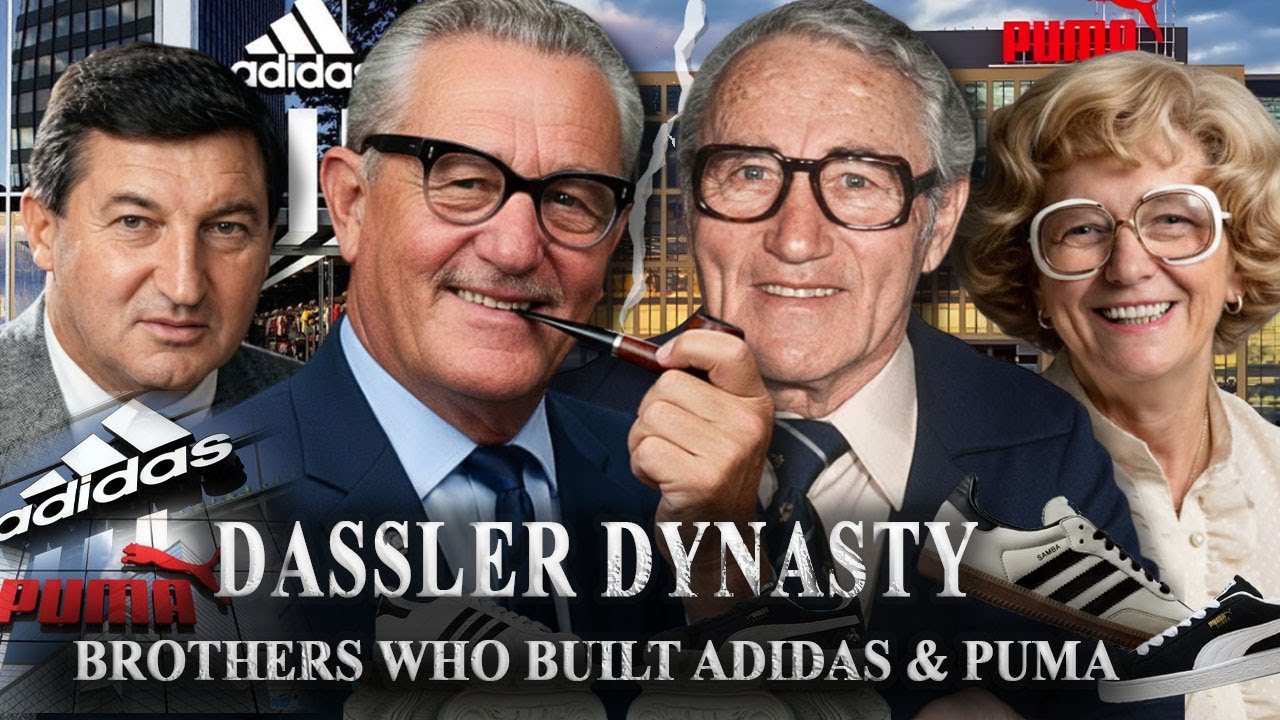
He decided his brother was calling him and his family dirty bastards. They climbed out of the bunker alive, but the brothers were dead. From that moment on, they were enemies. The Dassler fratricide was a domestic crime before it was a political one.
The family villa in Herzogenaurach was a three-story structure that functioned less like a home and more like a vertical prison. The parents, Kristoff and Paulina, occupied the ground floor. Rudolph and his family lived above, and Adolf and his family lived in the middle. They shared one bathroom, one kitchen, and the laundry lines in the garden.
The walls were thin. Every argument, every moment of weakness was audible to the entire clan. Minor irritations were amplified into existential threats. The equilibrium of this dysfunctional household was shattered in 1934, when Adolf committed the unforgivable sin of marrying an outsider.
Käthe Martz was from the Pirmasens region, a shoe manufacturing hub. She was elegant, sharp, and refused the role of the silent German housewife. She looked at the factory operations and saw inefficiency. She looked at Rudolph and saw a loudmouth who took credit for her husband’s work.
Rudolph’s wife, Friedel, was a quiet, traditional local girl whose entire identity was built on pleasing the matriarch Paulina. Käthe’s identity was built on power. The conflict between the women was total. They turned the domestic sphere into a battlefield, each fighting for the soul of her husband.
Paulina, the mother, adored Rudolph, tolerated Adolf, and loathed Käthe. She formed a strategic alliance with Friedel and launched a campaign of psychological attrition against Käthe. Adolf retreated into his workshop, and his silence infuriated Käthe. She stopped trying to win Paulina’s approval and started trying to destroy Paulina’s favorite son.
The rise of the Third Reich provided new ammunition. Both brothers joined the NSDAP in May 1933, standard for German businessmen wanting to survive. But their commitment differed vastly. Rudolph was a true believer who loved the pageantry and became a recognizable figure in the local party hierarchy.
Adolf was a pragmatist who cared about sports, not race laws. In the villa, Friedel used Rudolph’s party status as a bludgeon, implying Rudolph was the patriot and Adolf the parasite. Käthe, conversely, saw Rudolph’s political posturing as a liability and began documenting his excesses. She was building a mental dossier long before the Americans arrived.
The children, Horst and Armin, were conscripted into the war before they could walk. The mothers used them as status objects. The cousins were forbidden from playing together and were taught to view the family on the other floor as the enemy. Horst grew up in this toxic petri dish, learning that survival meant manipulation and that information was a weapon.
Beneath the screaming and the silence, a brutal economic reality festered. The factory was the only source of income for everyone. As the war approached, leather was rationed and workers were drafted. Käthe began to audit the family, realizing Rudolph was an economic drain.
She started cutting him out of decision-making, hiding designs and intercepting mail. Rudolph felt the loss of control viscerally. He believed Adolf and Käthe were conspiring to steal his birthright. He was right.
The boiling point was the bunker incident of 1943. That single sentence did not just echo off the concrete walls. It shattered the psychological foundation of the family. Rudolph swore he would never forgive Adolf.
The Third Reich did not end with a bang in Herzogenaurach. On April 16, 1945, the tanks of the US Third Army rolled into the cobbled streets. The Dassler villa was immediately requisitioned as headquarters, and the family was displaced into the servant quarters. Rudolph, the true believer, was paralyzed by the psychological collapse of his idol.
Adolf, guided by Käthe’s intelligence, underwent an instant metamorphosis. He saw the Americans not as soldiers but as customers. While Rudolph sat in the dark stewing in humiliation, Adolf and Käthe were charming the officers. Adolf produced a pair of track spikes and presented them to a high-ranking officer, explaining he was a humble shoemaker who had shot Jesse Owens in 1936.
He omitted the years spent manufacturing Panzerschreck anti-tank weapons and the French forced laborers. The Americans bought the lie. The Counterintelligence Corps began denazification. The Dassler factory was a prime target.
The whispers that reached the CIC painted a specific picture: Rudolph was the ardent Nazi, Adolf the quiet craftsman who followed orders to save his business. In late July 1945, Rudolph was arrested by the American military police, handcuffed, and thrown into the back of a truck destined for the internment camp at Hammelburg. As he was hauled away, he looked back at the villa and saw Adolf and Käthe watching from the window. He knew his arrest was not solely about party membership.
Someone had provided the CIC with a specific damaging dossier, painting him as a Gestapo security threat. There was only one person with the motive and the knowledge. His brother. Adolf stood at the window impassive.
He let Rudolph go. Rudolph arrived at Hammelburg stripped of his name and dignity, interned as number 1438. Conditions were medieval. Men crammed into lice-infested barracks, rations reduced to watery cabbage soup.
The once proud officers begged for cigarettes. Rudolph’s mind turned inward. He did not blame Hitler or the Americans. He blamed the man sitting in the warm kitchen of the family villa.
He began to analyze the accusations against him. He had been charged with working for the SD, the intelligence agency of the SS. He knew with absolute certainty he had never served there. Someone inside the inner circle had fabricated a lie tailored to destroy him.
He realized it was Adolf. Rudolph decided to weaponize the American bureaucracy against his brother. He dictated a counter-dossier, painting Adolf as the true mastermind of the factory’s war effort. He detailed the production of Panzerschreck weapons, described speeches Adolf had given rallying the workforce, and mentioned the French forced laborers.
He was willing to burn the house down to ensure Adolf burned with it. The CIC reopened the investigation into Adolf. The war was now fought via stenographers. Rudolph spent a year in the camp.
By the time he was released in July 1946, he was unrecognizable, with a limp and sunken eyes. He returned to Herzogenaurach as an avenging ghost. The denazification trial became a gladiatorial arena. Rudolph unleashed a torrent of testimony.
Käthe countered with surgical precision, mobilizing the workforce to collect signed affidavits painting Adolf as a benevolent protector and Rudolph as a fanatical Nazi. The judgment, delivered in 1948, was asymmetrical. Adolf was classified as a Mitläufer, a follower, allowed to retain control of the business, subject only to a fine. Rudolph was classified as a Belasteter, a major offender, later downgraded after appeals, but the damage was done.
He was barred from management. The brothers could no longer breathe the same oxygen. In early 1948, the company was split. The craftsmen and technicians walked to Adolf’s side.
The salesmen and administrators walked to Rudolph’s. Adolf kept the original factory by the train station. Rudolph marched across the river Aurach to an empty factory on the other side. Adolf’s company was registered as Adidas.
Rudolph’s as Ruda, soon rebranded as Puma. The brothers never spoke again. The town of Herzogenaurach became a dual-state psychological war zone. The river was transformed into the iron curtain of the footwear industry.
If you worked for Adidas, you lived in the north, drank in the Adidas pubs, and bought meat from the Adidas butcher. Crossing the river was seen as an act of treason. The town earned its infamous nickname, the town of bent necks, because before speaking, a citizen would instinctively look at the other person’s feet to check the brand. The brothers had weaponized fashion, turning leather and rubber into gang colors.
The cold war between the factories was fought with spies. Waitresses were paid to listen to conversations. Disgruntled employees were bribed to smuggle out blueprints. Rudolph was particularly aggressive, maintaining a network of informants.
Adolf forbade his designers from writing things down and tested new shoes in the dead of night to avoid Puma binoculars. The summer of 1954 was the decisive pivot. West Germany was preparing for the World Cup in Switzerland. The German coach, Sepp Herberger, first went to Rudolph, but Rudolph scoffed at his demands for financial support and shoe design.
Insulted, Herberger crossed the river to Adolf. Adolf opened his workshop and offered a technological revolution: the screw-in stud, a boot with interchangeable studs for dry and wet ground. On the day of the final against Hungary, torrential rain turned the Wankdorf Stadium into a quagmire. The Hungarians slid while the Germans, wearing long metal spikes screwed into their boots by Adolf himself, could turn and accelerate.
Germany won 3-2. The photographs showed Adolf sitting on the bench next to the coach, part of the team. The press dubbed him the nation’s cobbler. Adidas exploded overnight.
Rudolph realized he had held the contract in his hand and thrown it away out of pride. Rudolph could not beat Adolf on engineering or reputation, so he changed the rules. He began aggressively bribing athletes to wear Puma. He paid sprinters to wear Puma in the warm-up and switch to Adidas for the race.
By the late 1960s, the financial attrition was unsustainable. The brothers were bidding against each other for every star athlete. In 1970, they agreed to the Pelé Pact, a non-aggression treaty swearing neither company would sign the Brazilian god of football. It held for months.
Then the Puma side conspired. Rudolph’s son, Armin, dispatched an agent to Brazil’s training camp before the 1970 World Cup. Armin shattered the pact, offering Pelé $120,000 to wear the Puma King boot with a specific instruction. During the quarterfinal against Peru, Pelé stopped the game, knelt down, and tied his shoelaces on live global television.
The cameras zoomed in for agonizing seconds, filling millions of screens with the unmistakable white form stripe of Puma. Adolf, watching from home, recognized the tactic instantly. Rudolph had broken the pact. The million-dollar pause was the final nail in the coffin of their humanity.
The fallout was absolute. Adolf never spoke to Rudolph again. The feud passed from the fathers to the sons. Horst, Adolf’s son, watched with cold clarity.
He realized his father’s code of ethics was a liability. He decided he would not just cheat, he would rewrite the rules of corruption. He would own the organizations. He would own FIFA and the IOC.
By the autumn of 1974, Rudolph was dying of lung cancer. The local priest, attempting one final exorcism of hatred, visited his bedside, then crossed the river to deliver the message: Rudolph is dying and asks for you. Adolf refused. He would not go.
He told the priest the betrayal was too deep. He chose to let his brother expire without the comfort of absolution. Rudolph died on October 27, 1974. Adolf did not issue a public eulogy.
He sent a wreath with a card of formal condolence. Adidas staff were prohibited from attending the funeral. The noise of the stitching continued without pause. Adolf had decided the death of his brother was not significant enough to interrupt the production of a single shoe.
Adolf survived his brother by four years. Without Rudolph to fight, he became a ghost in his own factory. He died on September 6, 1978, of heart failure. The final act of the war was played out in the municipal cemetery.
Adolf was buried at the absolute opposite end from Rudolph, the maximum physical separation possible. If you stand at one grave, you cannot see the other. The distance is a spatial manifestation of the unsent letter. Even in death, they have their backs turned to one another.
Horst Dassler continued the dynasty. In the 1970s and 80s he founded ISL, a marketing firm that was forensically a global operation for purchasing sports officials. He bought the rights to the World Cup and the Olympics, turning them into corporate billboards. In 1987, at the peak of his power, he was diagnosed with cancer.
He died on April 9, 1987, at 51. Without him, Adidas began to bleed. Nike and Reebok tore chunks out of the German giant. By 1990, the heirs made the decision that would have made Adolf turn in his grave.
They sold Adidas to Bernard Tapie, a French businessman and convicted fixer, for approximately 1. 6 billion francs. The Dassler family took the money and ran. Puma followed a similar trajectory.
The town of Herzogenaurach today is reunited. The bent necks have straightened. But if you walk to the cemetery, the geometry of hate remains. The graves are still separated.
The silence between the brothers is still absolute. They proved that hate is a more powerful fuel than love, but it burns the engine out before the race is won. The shoes conquered the world, but the family lost its soul in the bunker of 1943.






