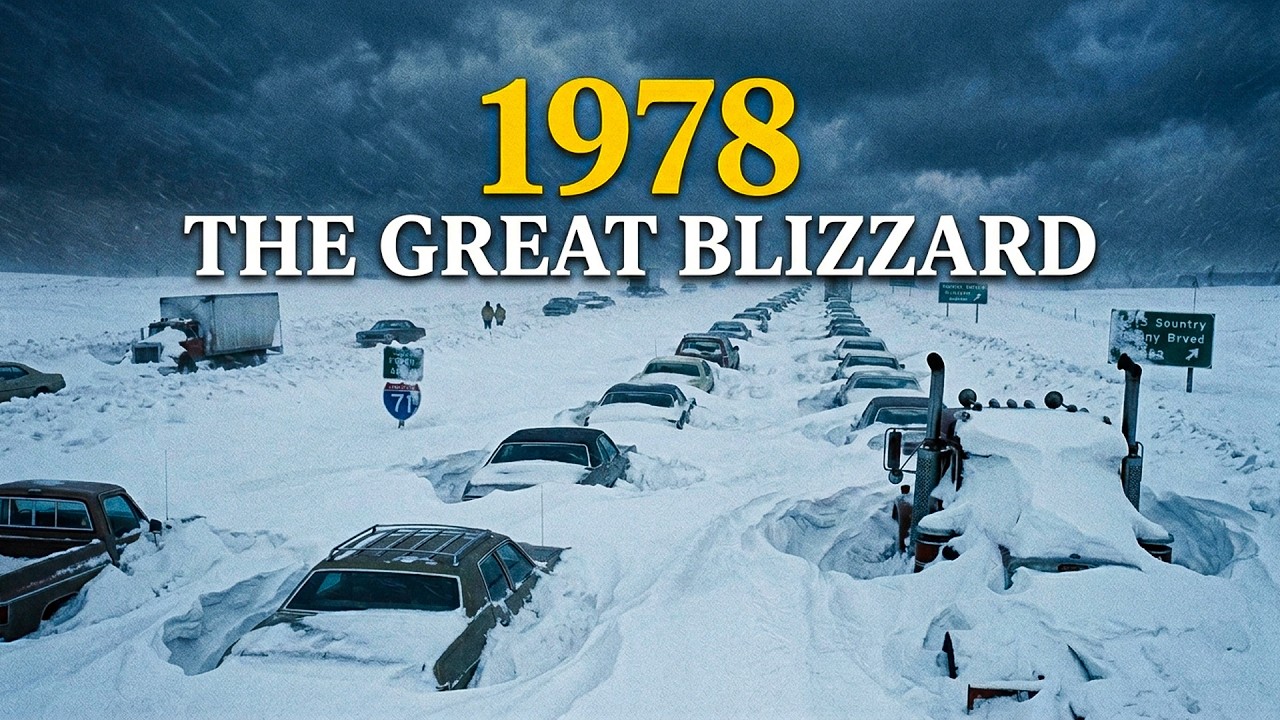
Thursday, January 26th, 1978. A car sits buried on a highway in the middle of Ohio, exhaust pipe lost under two feet of snow, the cabin filled with a sweet, heavy smell that forces the driver to crack a window against sixty-mile-an-hour winds in thirty-below temperatures. The radio went to static twenty minutes ago. Nobody is coming.
Thousands of people faced the same reality at the same moment. The morning before had been a lie. Wednesday, January 25th, in the Ohio Valley began ordinarily enough: dark mornings, percolators bubbling, newspapers on porches, forecasts calling for rain turning to snow. Nothing unusual for late January.
Millions of people scraped windshields and headed to work. There were no weather apps, no phones screaming alerts. There was only the AM radio, the morning paper, and whatever the sky looked like from the kitchen window. The weeks leading up to the storm had been full of false alarms, warnings of big storms that never came.
People had stopped believing the forecasters. So when the National Weather Service flagged a major winter system moving into Ohio that Wednesday night, most people shrugged. It was raining. Cold, miserable January drizzle.
You could see the road. The wipers handled it fine. Five hundred miles to the south, something else was building. A massive plume of warm air surged up from the Gulf of Mexico while a wall of Arctic air dropped down from Canada so cold it collapsed barometric pressure to levels normally seen only inside a category three hurricane.
The two systems were racing toward each other, about to collide directly over the Ohio Valley. By noon, the trap was set. By one o’clock, it was closing. By two, it was too late to get out.
The temperature fell off a cliff, dropping thirty degrees in two hours. The rain that had fallen all morning flash-froze into a sheet of black ice. On top of that ice, snow began piling up at three, four, five inches an hour. First came the sleet, hammering windows like handfuls of gravel.
Then came the wind, not gusting but sustaining at fifty, then sixty, then seventy miles per hour. People in Cleveland reported their ears popping from the pressure change. The National Weather Service recorded 956 millibars at Mount Clemens, Michigan, the lowest non-tropical pressure reading ever measured over the continental United States. They called it a super bomb.
Because it was a Thursday, the roads were full. Offices were full. Factories were running. When the sky went black and the snow blinded the windows, everyone made the same decision at the same time: get home.
Millions of cars flooded the highways simultaneously. On the Ohio Turnpike, traffic slowed, then stopped, then disappeared. The snow buried cars faster than plows could clear them. A plow would open a lane, and ten minutes later it was gone.
Semi-trucks jackknifed across all lanes, forming walls of steel that blocked every escape route. Drifts built against those trucks: ten feet, fifteen, twenty, even twenty-five feet high. Inside the cars, gas gauges dropped, heaters died, and snow crept past hubcaps, past door handles, sealing doors shut. People had to choose: stay and risk carbon monoxide from a buried exhaust pipe, or open the door into a whiteout where they could not see their own hands, and try to walk toward a house, a barn, anything with a light on.
Many walked. They tied themselves together with scarves and jumper cables, forming human chains, stumbling toward whatever glow they could see in the distance. They left their cars sitting in the snow like headstones. Strangers who lived near highways opened their doors and pulled in frostbitten refugees they had never met.
Living rooms became shelters. Kitchen floors became triage. On the highway, the engines died one by one. As daylight disappeared into a gray swirling nothing that faded to black, the Ohio Turnpike went quiet for the first time in its history.
The storm then came for the houses. The power went first; lines could not take the wind and ice together. Transformers blew in flashes of blue-green light, plunging whole counties into darkness. In 1978, homes were not insulated the way they are now.
There was no triple-pane glass, no high-efficiency foam. When the furnace died, the cold came in through the walls, the windows, the gaps under the doors. People could see their breath in the bedroom within an hour. Temperatures dropped room by room: sixty, fifty, forty degrees.
Water pipes cracked in the walls with a sound like a rifle shot, flooding basements that then froze solid. Families pulled mattresses into the living room, hung quilts over doorways to trap whatever heat remained, and abandoned everything upstairs. The whole house shrank to one room. Grocery stores were closed, roads gone.
People opened cans of soup and heated them on wood stoves if they had one, or ate cold beans from the can if they did not. The wind did not stop for three days, battering siding, shaking shingles, sounding like a freight train parked on the roof. People could not open front doors, not because they were locked, but because ten-foot walls of snow were packed against them like concrete. Some crawled out of second-story windows just to check if the world was still there.
In the dark, under piles of blankets, the radio became the only proof that civilization had not ended. Local DJs stayed on the air for twenty-four, forty-eight, seventy-two hours straight, reading lists of shelters, taking calls from people trapped in their homes. For adults, it was a disaster. For kids, it was something else entirely.
School was canceled, not for a day but for a week or two. The drifts were not obstacles; they were architecture. The wind had packed the snow so hard people could walk on top of it without sinking. You could stand on a snowdrift and look down at the street signs.
Kids dug tunnels through front yards, elaborate multi-room systems lit by the strange blue glow that filters through snowpack. They sledded off garage roofs because the drifts had built perfect ramps. They walked down the middle of main streets that were usually choked with traffic, now silent white canyons where a ten-year-old was king of the world. Adults were paralyzed by the storm; kids were liberated by it.
By the third day, help was running out. Police cruisers were buried, fire engines frozen solid. Mayors and governors realized they had lost control of their own territory. They called in the National Guard.
In the suburbs of Cleveland, Indianapolis, and Boston, M60 tanks and armored personnel carriers rolled down residential streets, tracks rumbling over frozen ground that had not been touched by a tire in days. They were not looking for a fight; they were delivering bread. Helicopters landed in high school football fields to evacuate heart attack victims. Soldiers in full winter gear rode on the backs of trucks, handing out gallons of milk and prescription medicine to people who had not left their houses in four days.
The military could not be everywhere. Anyone who owned a snowmobile became a first responder. These were not government employees; they were just neighbors. They carried doctors to hospitals, weaving between buried cars.
They brought insulin to diabetics and baby formula to new mothers. They strapped toboggans to their sleds and moved groceries, firewood, and people. For a week, the snowmobile was the most important vehicle in America. There was no social media to post a request for help; you had to physically walk next door, and people did.
If you had a wood stove and your neighbor did not, your house became the neighborhood shelter. Strangers slept on living room floors. People shared cans of tuna, batteries, candles. If a car was stuck, ten people appeared out of the mist to push it.
Nobody asked for money. Nobody hesitated. The storm stripped away ordinary barriers between people, and what remained was something simple and good. Everyone was cold, and everyone needed each other.
On the third day, the wind finally stopped. When the sun came out, it hit the snow with a glare that hurt the eyes. The silence was broken by the sound of shovels, metal on concrete, on every street, on every block. People dug for hours, unsure whether the white lump in front of them was their car or their neighbor’s fence.
In Muskegon, Michigan, fifty-two inches fell in four days. Across Indiana and Ohio, drifts reached twenty-five feet. In Rhode Island, some towns reported over forty inches in a single storm. As the snow was cleared, the cost was counted.
At least seventy people died in the Midwest and one hundred more in the Northeast. On I-95 near Boston, fourteen people were found dead in their cars; the exhaust pipes had been buried, and carbon monoxide took them while they slept. More than 3,500 vehicles were abandoned across the Northeast. Economic damage exceeded $500 million in 1978 money.
In some shaded corners, the snow did not fully melt until May. Two storms hit that winter, one in January across the Midwest and one in February across the Northeast. Together they buried half the country and killed 170 people, catching America completely off guard. Not because the science was bad, but because people had stopped believing the warnings.
The cry-wolf winter that came before had made the real wolf invisible. They called it the white hurricane. Those who survived it called it the winter they walked out of the second-story window, and they never forgot it.






