On December 4, 1926, a rural road worker in the Surrey Hills stumbled upon an abandoned Morris Cowley car perched at the edge of a chalk pit known as Nuland’s Corner. The front wheels hung over the frozen incline, the doors were thrown open, and the headlights still glowed faintly in the winter fog. Inside lay a fur coat, an expired driving license, and a small suitcase. The driver was gone.
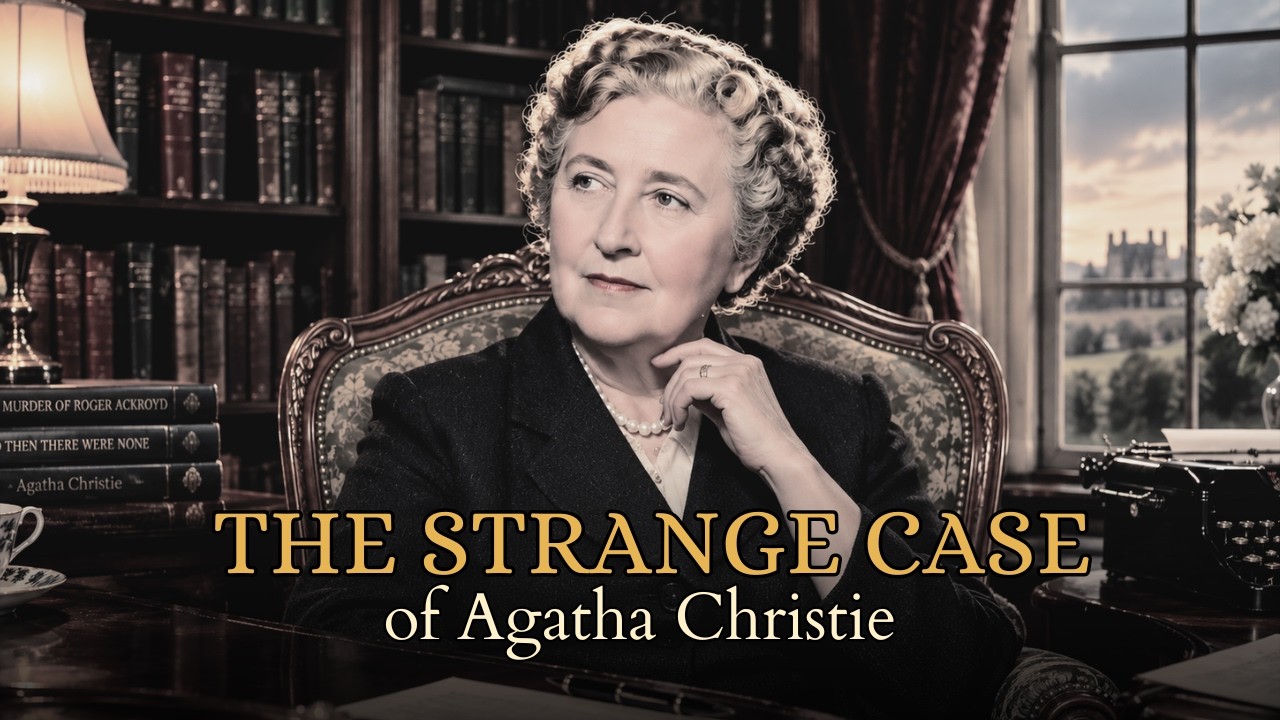
Within hours, police identified the car’s owner as 36-year-old Agatha Christie, the celebrated author whose novel The Murder of Roger Ackroyd had made her one of the most famous writers in Britain. Her disappearance triggered the largest manhunt in British history, involving more than a thousand police officers, bloodhound packs, civilian search parties, and aircraft. But the search for the missing novelist exposed something far more private: a marriage collapsing under betrayal, grief, and psychological ruin. Agatha Christie was born Agatha Mary Clarissa Miller in 1890 in Torquay, Devon.
Raised in a comfortable Victorian household, she was educated largely at home and deeply attached to her mother, Clara. The sudden death of her father when Agatha was eleven left the family financially strained and instilled in her a lasting fear of instability. During the First World War, she worked as a nurse and hospital dispenser, acquiring the precise knowledge of poisons that would define her mysteries. She married Archibald Christie, a Royal Flying Corps officer, on Christmas Eve 1914.
After the war, they settled into London society, and Agatha began writing to supplement the family income. Her first novel, The Mysterious Affair at Styles, introduced Hercule Poirot and was published in 1920 after years of rejections. By 1926, her success had brought financial rewards but also heavy pressure. The immense popularity of The Murder of Roger Ackroyd came with tax burdens, publisher deadlines, and the costly upkeep of Styles, a large Berkshire home the couple had purchased.
In the spring of 1926, Agatha’s mother died. The loss shattered her. While she struggled alone to clear out her mother’s estate, suffering from insomnia, exhaustion, and severe depression, Archie withdrew into his career and his weekends at golf clubs. The final blow came in August 1926, on their daughter Rosalind’s seventh birthday.
Archie told Agatha he was in love with a 24-year-old woman named Nancy Neele and wanted a divorce. He offered no remorse and no comfort. Over the following months, he continued seeing Neele openly while Agatha’s condition deteriorated. Friends described her as pale, unkempt, and prone to weeping.
She suffered memory lapses and episodes of dissociation. Her doctor warned that her nervous system was on the verge of collapse. On Friday, December 3, 1926, Archie told Agatha he was leaving for a weekend house party where Nancy Neele would also be present, and that he intended to finalize the divorce on his return. He drove away that afternoon.
That evening, Agatha kissed her sleeping daughter, wrote three sealed letters, and left the house shortly before 9:30. She drove off in her Morris Cowley without her wallet, her handbag, or any identification. Sometime in the small hours, on a foggy road near Nuland’s Corner, the car left the road and plunged down an embankment. The impact caused a head injury and concussion.
Dazed and bleeding, she abandoned the vehicle, leaving her fur coat behind, and vanished into the freezing night. By morning, the abandoned car had been found. The immediate assumption was murder or suicide. Over a thousand police officers, mounted units, and civilian volunteers searched the Surrey countryside, dragging ponds and sweeping forests.
Radio broadcasts described the missing author to the nation. Sir Arthur Conan Doyle consulted a medium with one of her gloves. Dorothy L. Sayers visited the crash site to study the scene.
The press, hungry for sensation, began suggesting the disappearance was a publicity stunt to sell books. Suspicion quickly turned toward Archie. He had been with his mistress on the night of the disappearance, his answers to police were evasive, and he admitted to burning the letter Agatha had left for him. Scotland Yard placed him under surveillance.
The public vilified him. Detectives prepared to search lakes and buildings connected to his associates, convinced that the missing writer had been murdered by her husband. But Agatha was not dead. On the morning of December 4, the same day her car was discovered, a quiet, well-dressed woman arrived by train in Harrogate, Yorkshire, more than two hundred miles north.
She registered at the Swan Hydro Hotel under the name Teresa Neele, using the surname of her husband’s mistress. For eleven days, she dined, played billiards, and sang at the hotel piano. Staff noticed she had almost no belongings and showed strange gaps in memory. She appeared entirely detached from her identity, her daughter, and her past.
On the evening of December 13, a musician in the hotel’s dance orchestra recognized her from newspaper photographs. He alerted the manager, who contacted the police. Scotland Yard was notified, and Archie Christie traveled north with senior officers. When Agatha descended the staircase at the Swan Hydro Hotel, she greeted her husband politely, without recognition or emotion, remarking that she was waiting for her husband to arrive from South Africa.
She introduced Archie to other guests as her brother. Archie took control of the situation immediately. He summoned two Harley Street psychiatrists, who declared that Agatha was suffering from psychogenic amnesia, a condition in which extreme shock erases personal identity. He held a press conference announcing the diagnosis.
The reaction was fiercely skeptical. Newspapers demanded to know how a woman who had forgotten her own identity had managed to travel two hundred miles, check into a hotel, and choose the exact surname of her husband’s mistress. Many accused her of staging an elaborate act of revenge or a cynical sales campaign. Those who knew her understood otherwise.
Agatha was a deeply private woman who loathed public attention. She was quietly removed from the hotel and taken to the Cheshire estate of her sister, where she received round-the-clock psychiatric care. She was emaciated, suffering from headaches and panic attacks, and unable to process the hostile press coverage. She never spoke publicly about those eleven days again.
She refused all interview requests, ignored offers from syndicates, and when she later published her autobiography, the episode was entirely omitted. In 1928, she finally granted Archie the divorce he demanded. He married Nancy Neele shortly afterward. Agatha took control of her finances and literary contracts, sold the Sunningdale estate, and wrote with fierce discipline to pay off her debts.
Later that year, she boarded the Orient Express for the Middle East. On an archaeological expedition in Iraq, she met Max Mallowan, a young archaeologist fourteen years her junior. They married in 1930 and remained together for the rest of her life. The desert landscapes of the Middle East inspired some of her greatest work, including Murder on the Orient Express and Death on the Nile.
Her later novels were darker and more psychologically acute, shaped by her direct experience of betrayal, grief, and collapse. She died in 1976 at her beloved Greenway estate, her silence about 1926 unbroken. Modern clinical assessments have largely concluded that she suffered a genuine fugue state brought on by depression, grief, and head trauma. Her books have sold over two billion copies in more than a hundred languages, and The Mousetrap remains the longest-running play in history.
The eleven missing days remain the one mystery she never allowed anyone to solve.






