She was not identified by her face or her fingerprints. She was identified by a small metal bracelet bearing two readable words: Dark Angel. Nineteen-year-old Pam Pitts vanished from a forest clearing outside Prescott, Arizona, in 1988. Thirteen days later, investigators made a devastating discovery in those same woods.
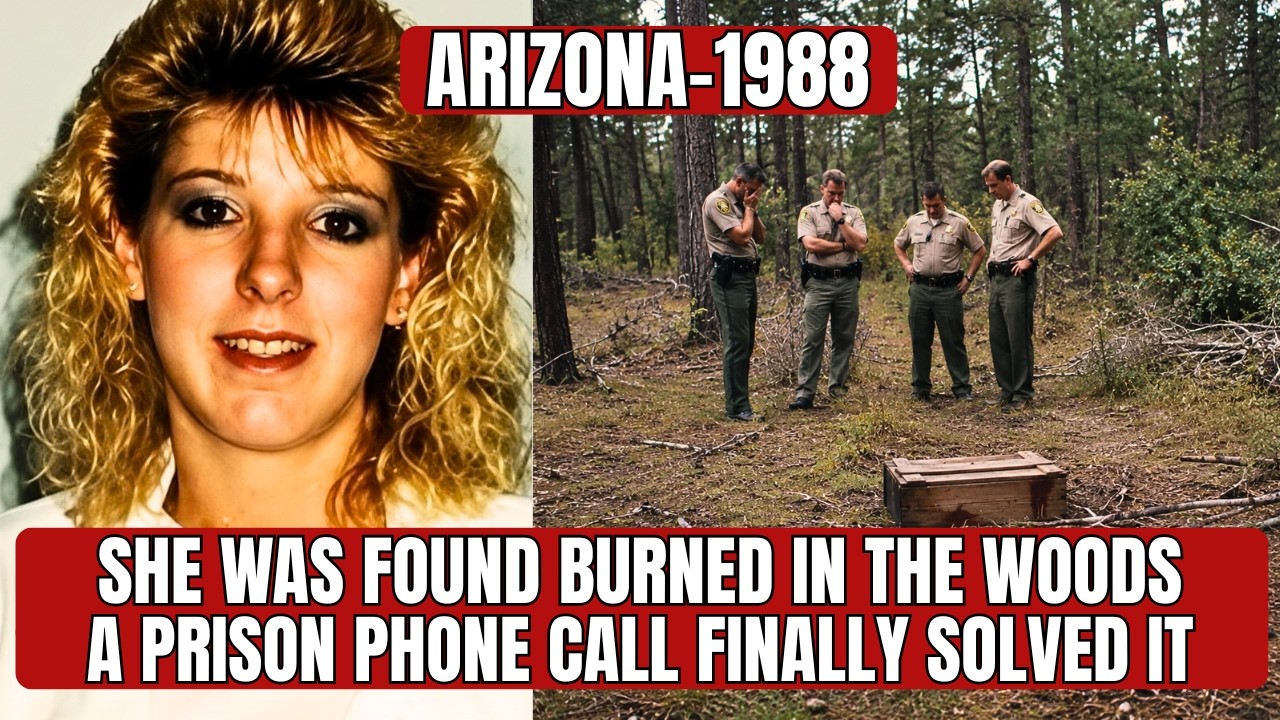
This is the case of the Dark Angel of Prescott. Pamela Pitts, known as Pam, was born on June 25, 1969, at K. I. Sawyer Air Force Base in Michigan while her father, Paul, was still in the military.
When he left service, the family settled in Prescott, a small mountain town in central Arizona known for its pine forests, granite outcrops, and the world’s oldest rodeo. Pam grew up there as the oldest of four children. Outgoing and protective, she made friends easily and kept them. She had one defining hobby: in the 1980s, before cell phones, teenagers in towns like Prescott talked over CB radio, and every user picked a handle.
Pam chose Dark Angel. That detail would matter later, far more than anyone could have predicted. At nineteen, Pam worked as a bookkeeper for McCabe’s Sandwiches in nearby Prescott Valley. In June of 1988, she moved out of her parents’ house into a small home on Lincoln Street with her best friend, a young woman named Shelley Norgard.
Money was tight almost immediately, so the two brought in a third roommate, a young man named Jeremy Anderson. For a few months, they got along fine. But independence came with a bill Pam was not sure she could keep paying. On the evening of September 14, 1988, Pam had dinner with her father at Murphy’s Restaurant in Prescott.
She told him the truth: rent was hard, money was tight, she was tired. She asked if she could move back home. Paul said of course. They agreed she would come by Saturday to start moving her things and do a load of laundry.
He did not know it yet, but that dinner was the last time he would ever see his daughter alive. Saturday, September 17, came and went. Pam never showed up. Sunday passed the same way.
Monday morning changed everything. Paul called her workplace; her boss told him she had not shown up for her shift and had not called in. For a young woman dependable almost to a fault, that silence was its own alarm. Paul went to the police.
Sergeant Bill Hobbs responded to the house on Lincoln Street. Shelley Norgard answered the door. Inside, officers found Pam’s purse, her driver’s license, her medication, all sitting exactly where she would have left them if she had only stepped out for an evening. Her car was parked outside, untouched.
Shelley told officers Pam had gone out to party, and she had not worried much about it. She also mentioned, almost as an aside, that the two shared a joint checking account for rent, and that Pam had emptied it without paying her share. She said she was a little upset about that. Nobody in that kitchen could have known how much weight that detail would eventually carry.
For nearly two weeks, Prescott held its breath. Then, on September 29, 1988, thirteen days after anyone had last seen her, two people passing through Gordo’s Pit noticed something on top of a pile of garbage bags at the edge of the clearing. It was Pam. Physical evidence made visual identification impossible.
One responding officer documented the scene plainly: evidence found near a pile of garbage bags where a fire had cleared the surrounding area. Another investigator later said the sheer brutality of what had happened to her was the single most striking thing about the scene, more than the isolation of the clearing, more than the fire itself. Dental records confirmed what the bracelet had already suggested. The medical examiner faced an impossible task.
The fire had destroyed too much to establish a precise cause of death. But forensic evidence could establish that Pam had not lost her life at that location. Investigators determined she was killed elsewhere and brought to the clearing only after a delay. The official finding was simply this: homicidal violence.
Separately, during the search of the Lincoln Street house, an officer made a strange discovery: a photograph of Pam hidden inside the wood stove. No one has ever explained why it was there. The killing moved through Prescott fast. A tourist town built on small-town safety suddenly had a burned body in a popular party spot and no explanation.
Parents started asking their kids where they had really been that weekend. Investigators from the Yavapai County Sheriff’s Office and the Prescott Police Department worked the case together with what 1988 offered: no national DNA database, no genetic genealogy. They had a burned scene, a handful of surviving physical items, and whatever people were willing to tell them. Detectives began with those closest to Pam.
Jeremy Anderson said he had been at a football game that night, then out with friends. His account held up. He was cleared. Shelley Norgard said she had gotten off work, picked up her boyfriend, Raymond Clark, and gone with him to a friend’s house until the early morning hours.
Raymond confirmed it and passed a polygraph. For the moment, Shelley’s story held together. Then the town filled in the blanks on its own. Rumors spread about a local individual allegedly claiming responsibility in connection with an extremist group; investigators tracked him down, he denied it, and nothing supported the claim.
Other names floated through town: a drug dealer, an old boyfriend, a local cowboy. Nothing substantiated. There was Melinda Perry, a young woman with a reputation for a temper, whom witnesses said had fought with Pam that night. She denied being at the party at all and offered an alibi, saying she had spent the night at a motel with a local band.
Investigators could not confirm it, while more witnesses kept insisting she had been at Gordo’s Pit. The Yavapai County Attorney convened an investigative grand jury and put her under oath. She held her story. The grand jury did not believe her, and in December of 1989 she was sentenced to forty-one days in jail.
Not for murder, but for contempt of court tied to a perjury indictment. The perjury charges were dropped the following year. She left the state and never returned to the spotlight. None of it led anywhere.
Not the rumors, not Melinda Perry, not even the roommate who had emptied a joint bank account and whom friends said had been overheard in the days around Pam’s disappearance saying she would kill Pam if she found her. Over those same years, Shelley’s account of that night kept shifting. At different points she said she had never even been at Gordo’s Pit. At other points she suggested a different roommate might have been responsible.
More than once she said flatly, “I never killed my roommate. I never wanted to kill anyone. I loved her dearly. ” A story that changes every time it is told is not proof on its own, but investigators noticed.
They kept noticing for thirty-two years that the story never once stayed the same. The case went cold, and the break, when it finally came, would not come from a lab or a lucky witness. It would come from an entirely separate murder. Nearly three years after Pam vanished, on May 25, 1991, a group of Embry-Riddle Aeronautical University students exploring an old mine off Iron Springs Road found a body in a vertical shaft.
It was a man wrapped in thick lining who had suffered a fatal gunshot wound. He was identified as Raymond Clark, twenty-four, an aspiring pilot who had recently earned his flight license, Shelley Norgard’s boyfriend, the same Raymond Clark who had given Shelley her alibi three years earlier. In the weeks before his body was found, Raymond’s family had been growing uneasy. He had told them he was heading to California to find flight instructor work.
Then he abruptly came back to Arizona to collect his things, and after that, nothing. His family called Shelley repeatedly; her answers kept moving. First, he was simply busy; later, he had found work out of the country and could not be reached. When Raymond failed to show up for a family wedding, his relatives went to police themselves.
Investigators traced backward from the mine. Tire tracks near the shaft matched a pickup Shelley had recently borrowed from a friend. When detectives searched her home, they found forensic evidence leading toward the garage. They followed the trail to her car, where they immediately detected signs of severe decomposition inside the trunk.
Inside, significant physical evidence was recovered, later confirmed to match Raymond’s blood type. Under the front seat, a nine-millimeter handgun. Ballistics matched it to the murder weapon. A flashlight recovered near the body in the mine carried a single fingerprint.
It belonged to Shelley. On June 4, 1991, Shelley Norgard was arrested. She told Raymond’s worried family the same kind of story she had told police about Pam three years earlier: that he had simply gone out of town for work and was too busy to call. This time, the physical evidence did not let the questions stop.
For nearly two years, she held to her denial. Then, in June of 1993, she pleaded guilty to second-degree murder. In her account, Raymond had wanted to end the relationship and take their dogs to California. She said the confrontation happened while the two were lying on the roof of a car watching planes pass overhead, and that she shot him there.
Investigators did not fully believe that part; blood evidence at the apartment suggested the shooting actually happened inside their home. What they believed was that Raymond’s body sat in the trunk of her car for roughly two weeks before she borrowed a four-wheel-drive truck and drove him up the mountain to the mine shaft. They suspected she had had help moving him. No one else was ever charged.
Shelley Norgard was sentenced to twenty years, no parole. Investigators saw the pattern immediately. A young woman, dead, her body hidden and then dumped outside the city limits, her death following her decision to leave. Now a young man, dead, his body hidden and then dumped outside the city limits, his death following his decision to leave.
Two people in her life said they were going, and both of them ended up dead. But there was no physical evidence connecting Shelley to Pam’s death. Nothing recovered from Gordo’s Pit. Nothing from the Lincoln Street house.
Police offered immunity to anyone who had helped move or burn Pam’s body if they would come forward. Nobody ever did. The case went cold again for the second time, and it would stay that way for another twenty years. During that time, Paul Pitts kept living in a town small enough that he almost certainly crossed paths with people who quietly suspected exactly who had killed his daughter.
In May of 2011, Shelley Norgard completed her sentence and walked free. She moved to Nevada, settled near Carson City, remarried, and became Shelley Harmon. Bookkeeping, tax work, managing rental properties, a life that looked from the outside like nothing at all. She never registered as a convicted felon in her new home state the way the law required.
But in Yavapai County, a detective named Victor Dart had just picked up Pam’s file. Before Shelley’s release in February of 2011, he interviewed her in prison about Pam’s murder. She denied it as she always had. When he pressed her directly, she grew upset and began to cry, and the interview was cut short.
Not a confession, but not nothing. For six years, Dart kept working the file. The witnesses who remembered Shelley driving around Prescott that night saying she would kill Pam if she found her. The ones who remembered her talking before Pam ever died about how to make a body disappear, whether that meant fire or a mine shaft.
When police had put those comments to her directly years before, she admitted saying something like it but insisted she was only talking theoretically. Dart needed something that did not depend on anyone’s thirty-year-old memory. He needed something in Shelley’s own voice. In nearly every American prison, phone calls are recorded as a matter of routine.
Somewhere in that archive was a call between Shelley and her father, not long after she had been questioned again about Pam. Her father tells her he is worried that the moment she walks free, she will be arrested. He tells her he has always wondered what really happened that night because she never told him. And Shelley answers him.
“I had a moment,” she says. “I had a huge moment. ” Then the line goes quiet. For Dart, it was the moment everything changed.
Not a confession in so many words, but an admission that something had happened, something she had never once been willing to name, not even to her own father. On June 4, 2017, fifty-year-old Shelley Harmon was arrested outside Carson City, Nevada, and charged with the first-degree murder of Pamela Pitts. She still had not registered as a felon under Nevada law, which meant local authorities had to be told what she had actually done before they even understood who they had taken into custody. She was extradited to Arizona and held on a three-million-dollar bond.
What followed was not the swift reckoning her family had waited three decades for. Shelley’s defense argued that her twenty-year sentence for killing Raymond should never be mentioned to a jury, that it would unfairly prejudice a case that on its own had no physical evidence at all. The judge agreed. A jury would never be told that the woman on trial for Pam’s murder had already been convicted of killing someone else under strikingly similar circumstances.
For prosecutors, it was close to fatal. Witnesses from 1988 had died or forgotten. Records were incomplete after three decades in storage. The medical examiner had never established a specific cause of death, which meant a defense attorney could argue almost anything.
Prosecutor Dennis McGrain later admitted the choice weighed heavily. “It weighed heavily on us,” he said afterward, “guaranteeing an outcome versus taking a chance at trial. ” They found another way. With the difficult, painful consent of Pam’s family, prosecutors offered Shelley a deal: plead guilty to second-degree murder, describe what happened, and walk free on time already served.
The twenty years for Raymond plus the years already spent in county jail awaiting this trial. It was not justice in any traditional sense. It was a trade. Pam’s family made it anyway because after thirty-two years, they had decided that knowing mattered more than punishing.
On March 1, 2021, Shelley Harmon stood in a Yavapai County courtroom and told the truth for the first time in her adult life. Pam’s family filled the gallery behind the prosecution table. Shelley said she had been upset about the overdrawn account. Upset that Pam was moving out and leaving her to cover rent alone.
She admitted to a physical confrontation, stating that Pam fell during the argument and ceased breathing, causing her to panic and flee the scene. What she never explained, what the plea deal never required her to explain, was everything after that moment. How Pam’s body came to be hidden for days, maybe weeks. How it came to be carried to a pile of trash at Gordo’s Pit and set on fire.
Prosecutors were not permitted to ask. Shelley Harmon walked out of that courtroom having admitted to a killing, while the desecration of her victim’s body stayed, officially, a mystery. Pam’s sister, Kerry Tarver, said afterward she did not believe it was the whole truth, that Shelley’s story stopped exactly where the hardest details would have started. Investigators had long suspected she had had help, both with Raymond’s body and possibly with Pam’s.
No one else was ever charged in either case. Shelley Harmon walked free the same day she confessed, taking the identity of whoever might have helped her at the crime scene to her grave. The photograph of Pam hidden in the Lincoln Street wood stove never got answered, either. It is still sitting there in an old case file, a small locked door nobody ever found the key to.
For Pam’s father, Paul, the day brought something that was not quite relief and not quite peace. A confession, and nothing resembling the punishment he believed the crime deserved. He put it more simply than anyone. Shelley Harmon, he said, was now a two-time convicted killer.
His advice to her husband: “Sleep with one eye open. ”
There was no press conference announcing new laws, no institutional reckoning for the three decades it took to get this far. What changed was smaller and more human. A family that had lived thirty-two years without an answer finally had one, even an incomplete one, even one wrapped in a deal that let her walk free the same afternoon she confessed.
Closed and solved were never quite the same thing here. She was nineteen. She talked for hours on a CB radio under a name that ended up being the only word investigators could read off her body. She had just worked up the honesty at nineteen to admit she was not ready for the independent life she had chased, and she was already planning her way back home.
Two men in Shelley’s life told her they were leaving. Two of them ended up dead. It took a burned bracelet, a mine shaft, a fingerprint on a flashlight, and one unguarded sentence into a prison telephone to finally say that out loud in a courtroom. It never fully explained who else might have known.
It never explained the photograph in the stove. Some cases end with a name. This one ends with a name and a list of things that name will never have to answer for.






