In 1922, a British archaeologist digging in a heap of sand in southern Iraq pulled out something that was not supposed to exist. Golden headdresses, musical instruments inlaid with deep blue lapis lazuli, the bones of an entire royal court buried together in a single grave, and clay tablets covered in a writing system older than the pyramids. The people who built all of it he called the Sumerians. They invented the city, the written word, the wheel, the first laws ever codified.
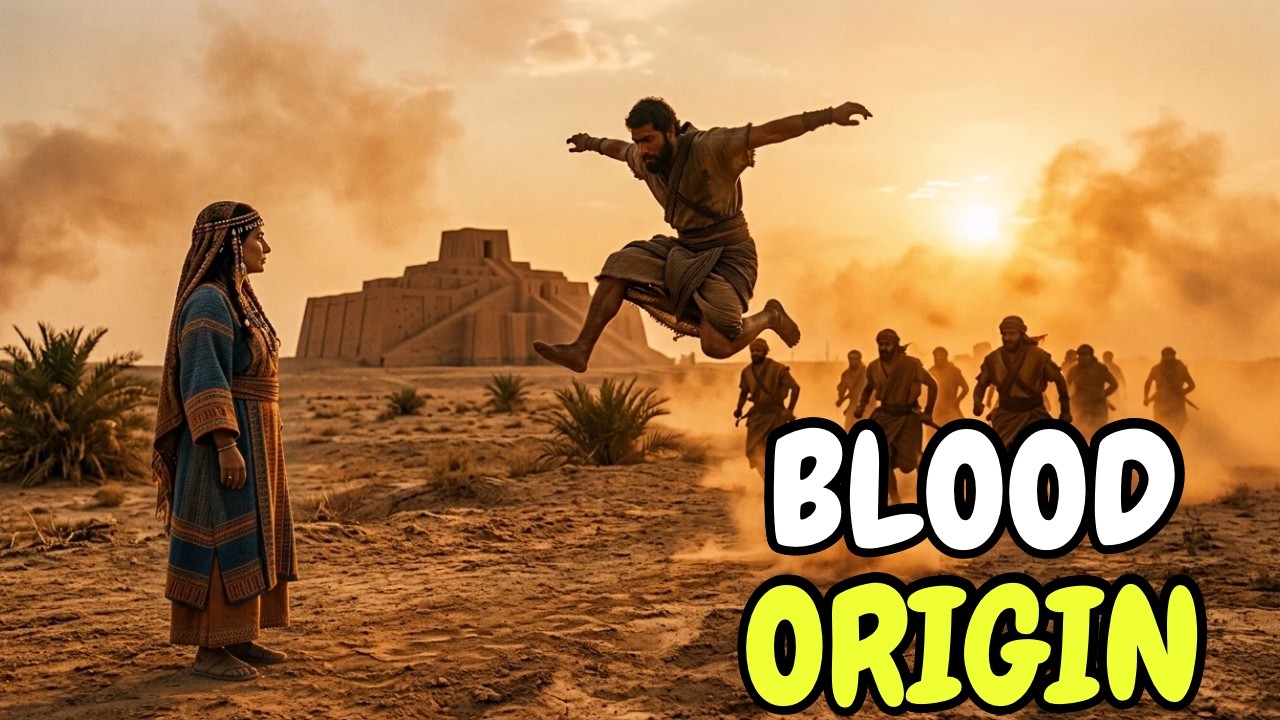
And then, somewhere between the sand and the centuries, they seemed to vanish. But here is the part almost nobody talks about. When modern scientists looked for their descendants, when they tried to trace the Sumerian line through DNA, they hit a wall. Because the deeper they dug, the stranger the story became.
Some geneticists now believe that a tiny number of people alive today, perhaps one in a billion, still carry a genetic imprint that leads straight back to a civilization that is not supposed to have any survivors at all. To understand why that lineage is a mystery, you first have to understand how strange the Sumerians were for their time. Imagine southern Mesopotamia about six thousand years ago. A flat, harsh land squeezed between two rivers, the Tigris and the Euphrates.
Almost no stone, no timber, no metal in the ground. By every logic of the ancient world, this should have been one of the last places on earth for a great civilization to appear. And yet it was the first. Out of that mud, people built cities like Uruk, which at its height may have held tens of thousands of inhabitants behind walls stretching for miles.
They dug canals to tame the rivers. They organized labor on a scale the world had never seen. And most importantly, they did something no human society had done before. They learned to write.
Pressing reeds into wet clay, they created cuneiform, the oldest known writing system on the planet. At first it was just bookkeeping, tracking grain, cattle, and debts. But it grew into something much larger. Poetry, law, astronomy, myth.
For the first time in history, humans could speak directly to the future. And thousands of those clay tablets survived, baked hard by the same sun that made their land so unforgiving. That means we can actually read what the Sumerians said about themselves. And what they said is where the real puzzle begins.
The tomb from 1922 was part of a vast royal cemetery at the city of Ur, uncovered by a man named Leonard Woolley. Inside he found kings and queens buried with their entire households, servants, soldiers, and musicians laid down beside them as if a whole royal court had walked willingly into the dark. The craftsmanship was breathtaking, gold worked with a precision to match anything from ancient Egypt, made a thousand years before the famous pharaohs whose names still fill our history books. The Sumerians also used a counting system based on the number sixty, and that single choice still governs your life today.
It is why an hour has sixty minutes, why a circle has 360 degrees. Six thousand years later, you still tell time the Sumerian way. And when they recorded their own history, they left behind a king list reaching back before a great flood, with rulers said to have reigned for thousands of years each. Historians have argued over that list for a century.
Where does legend end and memory begin? It sounds as if the Sumerians themselves were trying desperately to remember a beginning they could no longer see clearly, because they did not believe they had always been there. Their own records describe a time before civilization, when people lived, in their words, like animals, and then something changed. According to their myths, knowledge was not discovered.
It was given to them, delivered by beings who came from somewhere else. There is another clue buried inside those tablets, and it may be the most important of all. The Sumerian language itself. When linguists first deciphered cuneiform, they expected the language beneath it to belong to a known family.
Perhaps it would be related to the Semitic tongues spoken all around Mesopotamia. Or something connected to the languages of Persia or Anatolia. Instead, they found nothing. Sumerian is what scholars call a language isolate.
It is related to no other known language on earth, to no language at all. It stands utterly alone in human history, with no ancestors, no siblings, no surviving descendants. And a language related to nothing raises an obvious and unsettling question. If these people were not linguistically connected to any of their neighbors, then who exactly were they?
And where did they come from? For more than a hundred years, that specific question has haunted archaeology. It even has a name. Scholars call it the Sumerian problem.
The reason it has never been fully solved is that the evidence keeps pointing in different directions at once. It is hard to overstate how strange that language really is. Languages are like family trees. English has relatives in German and Dutch.
Spanish has siblings in Italian and French. Even tongues separated by entire continents can often be traced back to a shared ancient root. An isolate is a tree with no roots we can find and no branches we can follow. That means the people who spoke it either came from a people who vanished completely, leaving no other trace, or they arrived from somewhere so far away that every relative they ever had was lost along the way.
For the language of the world’s first civilization to be orphaned like this is not merely odd. It is a genuine mystery that has defeated scholars for over a century. One group of researchers looked at the culture that preceded the Sumerians in southern Iraq, a farming people we call the Ubaidians. The Ubaidians lived in the same marshy land, built in the same style, and seemed to blend slowly over thousands of years into the Sumerians we know.
If that is true, the Sumerians were never newcomers at all. They were locals who stayed in place and grew more complex over time. No migration, no mystery, just deep and patient continuity. But other researchers were never convinced, because parts of Sumerian culture appear fully formed, as if the ideas came from outside rather than developing slowly on site.
Some pointed east toward the Zagros Mountains and the highlands of what is now Iran, where early farming communities flourished long before the cities of the plain. Others looked south toward the Persian Gulf and suggested the earliest Sumerians may have arrived by water, following the coastline into the delta. The Sumerians even had a name for a distant homeland that sounded like paradise. They called it Dilmun.
In their poems it was a pure and gentle place, a land without sickness or sorrow, lying somewhere toward the sunrise and the waters of the gulf. Some scholars believe Dilmun was a real trading partner, an island in the Persian Gulf. Others think it was a memory dressed up as myth, a faint echo of where their ancestors lived before coming to the delta. Just to the east of Sumer lived another ancient people called the Elamites, who spoke a language that was also unlike almost anything around it.
Two isolated languages side by side in the cradle of civilization. A coincidence? Or evidence that both peoples came from a place history has forgotten. And here the words of the Sumerians themselves break back into the story.
Because their myths do not describe a long march over land. They describe knowledge arriving from the sea. There is a legend preserved by a Babylonian priest named Berossus, centuries later, about a being called Oannes. In the story, Oannes rose from the waters of the Persian Gulf.
He had the body of a fish, but beneath it the form of a man. He came ashore to teach the people of Mesopotamia everything that made them civilized. Writing, agriculture, law, mathematics, city building. Then he would return to the sea each evening.
The Sumerians had their own version of these teachers. They called them the Abgal, seven sages sent before the great flood to carry wisdom to humanity. Their carvings still survive today, strange figures with wings or fish scales standing guard in temples and palaces for thousands of years. You can read that story two ways.
You can take it as pure myth, a poetic way of explaining where their knowledge came from. Or you can notice something unsettling. A people who cannot be linguistically connected to anyone around them, telling a story about strangers who arrived by water and taught them how to build the first civilization on earth. It proves nothing.
But it lines up very neatly with the idea that the Sumerians came from somewhere else. There is one more thread worth following. The Sumerians wrote the oldest flood story we know, centuries before the version that ended up in the Bible. In it, the gods decide to wipe out humanity with a great flood, and one man is warned to build a boat and save life on earth.
That story traveled across the ancient world and never really stopped. It makes you wonder how much of what we consider later mythology actually began here, on the tongues of a people we still cannot fully identify. Some researchers take these stories seriously, not as literal history but as condensed memory. Oral traditions can carry the echo of a real event for a very long time before anyone writes it down.
A flood that drowned early settlements near the gulf. A journey across open water. A moment when scattered villages first gathered into something larger. Strip away the fish creatures and the gods, and what remains may be a genuine memory of the Sumerians’ own beginnings, polished by a hundred generations of retelling.
Whether that memory points inland or to the sea, it denies the comfortable idea that they were simply there since time immemorial. For a long time, this was where the trail stopped. Archaeology could bring us to the edge of the answer but no further. You cannot excavate a language to find its source.
You cannot dig a memory of migration out of the ground. To go deeper, science needed a different kind of evidence, something that did not depend on pottery patterns or scholarly guesses. It needed something written in the body itself, a record carried by every human being, whether they know it or not. It needed DNA.
In theory, this should have solved everything. Take an ancient Sumerian skeleton, read its genome, compare it to people living around the world today. Find their closest living relatives, and trace the bloodline directly. That was the theory.
The reality turned out to be far more frustrating, because Mesopotamia, the land that gave us the first written records in history, is one of the worst places on earth to recover ancient DNA. DNA is fragile. Over thousands of years it breaks into smaller and smaller fragments. What destroys it fastest is heat.
Southern Iraq is brutally hot, constantly. The same climate that baked those clay tablets and preserved Sumerian words for six thousand years did the exact opposite to Sumerian bodies. It cooked their genetic code until, in most cases, nothing readable remained. For decades, this created a huge gap.
We could read everything the Sumerians wrote. But we could not read the one thing that might finally tell us who they actually were. And every attempt to trace the bloodline forward, to find the living descendants of the first civilization, ran into the same silence. Until scientists changed their approach entirely.
Instead of chasing only the ancient dead, they began to look at the living, at the people who never left. In far southern Iraq, where the Tigris and Euphrates finally meet, there is a world unlike almost anywhere else in the country. It is not desert. It is water.
Vast wetlands of reed beds and shallow lakes dotted with islands and houses built entirely from bundles of reeds. The people who live here are called the Marsh Arabs, or the Ma’dan. For a very long time, outsiders considered them poor, isolated, and unimportant. But a few scholars looked at them and wondered something entirely different.
What if these were the people who stayed? Sumerian cities grew out of exactly this kind of marshland. The oldest images we have show reed houses almost identical to the ones Marsh Arabs still build today, thousands of years later. Their entire way of life, raising water buffalo, fishing the shallows, moving through the reeds by boat, matches descriptions of southern Mesopotamia from the dawn of history.
If any population on earth had a real chance of carrying the Sumerian line, it was them. So a team of geneticists finally did what no one had been able to do before. They tested them. The results were quietly stunning.
When researchers analyzed the DNA of the Marsh Arabs, they found deep genetic roots reaching straight back into the Middle East, not into newcomers from somewhere distant. In the male line, passed from father to son, one particular genetic marker dominated. Geneticists call it haplogroup J, a lineage with ancient ties to the Fertile Crescent, the very region where farming and cities were born. And in the female line, passed from mother to child, they found some of the oldest maternal imprints in the entire region, lineages rooted in Mesopotamia for a very, very long time.
Simply put, the DNA indicated that the Marsh Arabs are not strangers to this land. They are, at least in part, a living thread of continuity stretching back to the ancient populations of southern Iraq. The people the world ignored for so long may be the closest thing we have to the descendants of Sumer. But here is what makes this discovery almost unbearable.
That living link to the ancient world almost did not make it to our century. In the early 1990s, after an uprising in southern Iraq, Saddam Hussein’s government set out to destroy the marshes deliberately. Engineers built massive dams and canals that drained the wetlands, turning a landscape of water and reeds into a cracked, salty desert. The goal was to break the will of the people who lived there, and it almost worked.
Wetlands the size of a small country shrank to nearly nothing. Hundreds of thousands of Marsh Arabs were driven from their homes, scattered into cities, refugee camps, and across borders. If these DNA studies had come a little later, some of the oldest genetic threads connected to the earth might have been dispersed and lost forever. The descendants of the first civilization came close to being erased, not six thousand years ago, but within the memory of the living.
After the fall of the regime, something remarkable happened. Local people began breaking the dams, and the water flowed back. Life returned to parts of the marshes. The reeds grew again.
The buffalo came home, and the families who still remembered the old ways returned to them. The land that witnessed the birth of the first cities on earth came back to life. And with it came a second chance to study the people who had lived there all along. Now, it is important to be honest about what this proves and what it does not.
It does not mean the Marsh Arabs are pure Sumerians, frozen perfectly across time. No people on earth are pure. Six thousand years is a very long time. Armies have marched across this land.
Empires rose and fell. Peoples mixed again and again. What the genes show is not a flawless copy of the past. It is continuity.
A signal that held on and survived. Faint, but real. Sitting beneath everything that came after. That faint signal is exactly why this lineage is so hard to pin down.
It did not stay in one place. It scattered everywhere. And that is why many living people may carry a piece of it without ever knowing. To answer the larger question of where the Sumerians ultimately came from, geneticists had to trace ancestry much further back than six thousand years.
Slowly and painstakingly, those broader efforts began to bear fruit. Not in Sumer itself, where the heat had won, but in cooler sites scattered across the region, researchers began pulling fragments of ancient genomes out of the ground. Bone by bone, tooth by tooth, a rough map of the ancient Near East began to take shape. Every living human outside Africa descends from a small group of people who left that continent tens of thousands of years ago.
Those early travelers spread across the Middle East, and some settled in the highlands and valleys around Mesopotamia long before any city existed. When scientists study the region’s ancient ancestors, they always find the imprints of these early inhabitants. One group in particular stands out. A population of early farmers who lived in the Zagros Mountains along the border of modern Iran.
Thousands of years before the first Sumerian temple was built, their genetic signature spread across the Near East, and it appears to be the major component in the ancestry of the people who eventually built Sumer. The old theories about Sumerian origins pointed east, west, and south, to local roots, to the mountains, to the gulf. But genetics does not crown a single winner. Instead, it points to something stranger, and frankly, far more human.
Perhaps the Sumerians were a mixture, a meeting point. The original marsh inhabitants of the delta mixed with newcomers carrying highland ancestry from the east. All of them collided on a strip of land that was incredibly fertile and incredibly harsh. Not a single origin, but a collision of origins.
And from that collision, the first civilization on earth was born. The word descendant is more complicated than it sounds. When people imagine a lineage, they picture a single line running neatly from one ancestor to one living heir. But real ancestry is not like that at all.
If you go back six thousand years, you do not find a single ancestor. You find millions of them, a vast, tangled web of lines that cross and merge in every direction. So the Sumerians are not the private property of one family or one modern nation. If their genes survived at all, they survive thinly distributed across populations of enormous size.
A little here, a little there, showing up in people who never thought to look for it. In a strange way, the first civilization did not leave behind a chosen few. It left a scattered imprint among millions, most of whom will live and die without ever knowing it is inside them. There is no single door labeled Sumer that you can open with a cheek swab.
There is only a faint pattern, recurring markers, deep roots that keep pointing to the same corner of the ancient world. Scientists are not searching for one lost prince. They are reading a message that has been shattered into a million pieces and distributed among a million strangers, slowly and carefully trying to put it back together. Genetic lineages are fragile.
Most family lines that existed six thousand years ago are completely extinct. A single line can end in one generation if there are no children to carry it forward. Think about what has to happen for one line to survive that entire distance. A father must have a son, who has a son, who has a son, in an unbroken chain for about three hundred generations.
Miss one link, one generation without a surviving child, and the whole line goes dark forever. Wars, famines, plagues, migrations, sheer bad luck, all of it has gnawed at those fragile chains for six thousand years. Most lines were lost. A rare few survived.
Somewhere, there are individuals whose direct genetic line, unbroken, reaches back to that ancient Sumerian community. They may not realize it. They may carry a passport from anywhere on the planet, but inside their cells is an imprint that was already ancient when Rome was still a village. That is the real meaning of being one in a billion.
Not a secret royal family, but something rarer and quieter than that. A single unbroken thread that simply refused to snap. Here the scientists really reach the limit of what they can explain. Not because anything supernatural is going on, but because the picture is not complete yet.
We still do not have a well-preserved genome of a person we can confidently call Sumerian. The heat took most of that from us. We have their language, and it is related to nothing else. We have their myths, and they speak of teachers who came from the sea.
We have living communities carrying an ancient signal, but it is blurred and overlapped with everything that came after. Every piece points toward some answer. No single piece completes the picture. When you hear that scientists cannot explain the Sumerian lineage, this is what it actually means.
We can see the shape of the truth. We can trace its outlines in DNA, clay, and myth. We just cannot fill in every detail yet. But think about how far we have already come.
A hundred years ago, the Sumerians were barely more than a rumor, a name barely mentioned in the records of later empires. Their language was unreadable. Their cities were just buried mounds of dirt. Their descendants, as far as anyone knew, had vanished forever.
Today we can read their poetry. We can name their kings. We can watch a Marsh Arab paddle his boat between the reeds and recognize in his DNA a whisper of the people who invented the written word. We can trace a genetic thread from the mountains of Iran to the delta of Iraq across six thousand years, all the way to a living person somewhere in the world right now.
That is not a failure of science. It is one of its quiet miracles. The people who dug the first canals and wrote the first words did not simply go extinct and disappear. They became parents, and their children became parents in turn.
That invisible chain has never been broken.






