In 1009, in the province of Cheoksong, the royal guards killed the king they were escorting. They claimed he had slit his own throat, and they used a door plank as his coffin. He had left the Goryeo capital with his mother on two borrowed horses—one from the general who had overthrown him, the other taken from the house of a stranger. The royal pharmacy official had offered him poison first, but he refused it.
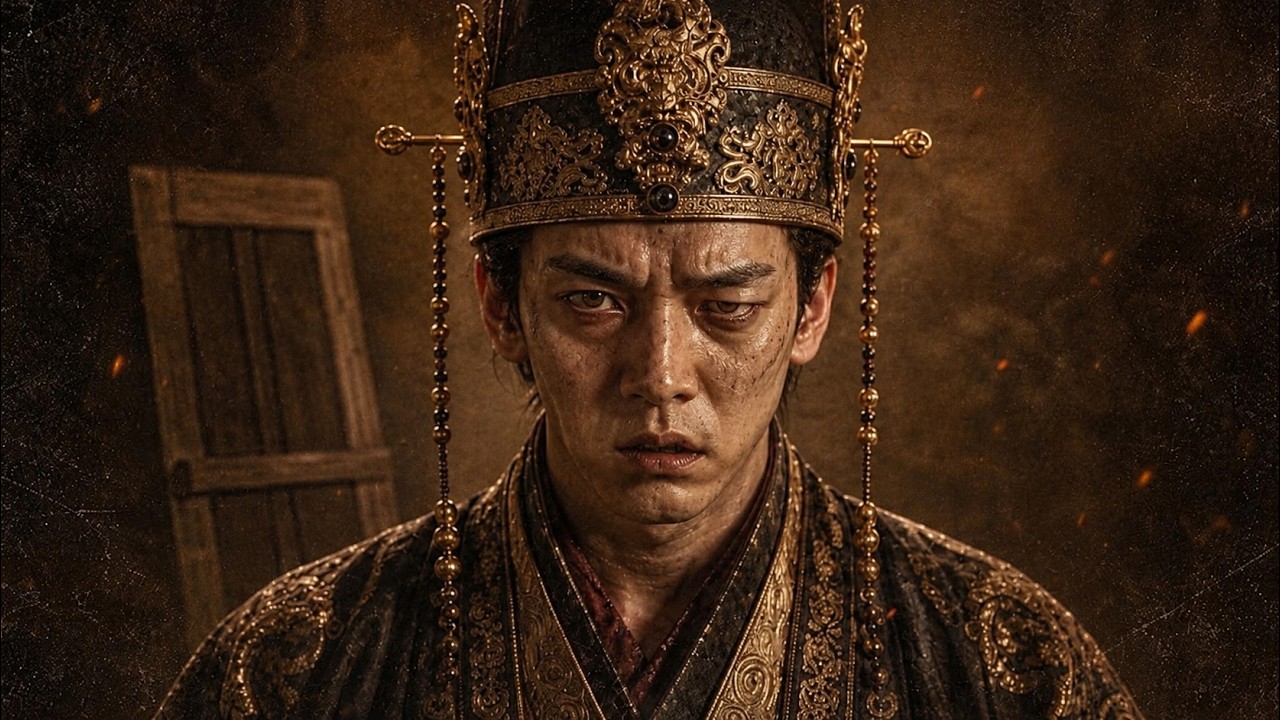
His name was Mokjong, and on paper, he may be the most inbred Korean king who ever lived. So how did he end up in a coffin made from a door? And the door was only the beginning of what happened to his body. The corpse was left at a provincial inn, burned more than a month later, and moved to a new grave three years after that.
Even the name he was buried under was chosen by the man who ordered his death. And Mokjong was the one who had summoned that man himself. If you came for the story of a corpse, you would expect it to begin long before his death. All four of Mokjong’s grandparents were children of the same man, Wang Geon, the founder of the Goryeo dynasty.
His own parents were first cousins. Calculating his family tree, his inbreeding coefficient comes to about 16 percent. That is a rough estimate, not a number published by any historian. For comparison, a child born to two half-siblings would be around 12.
5 percent. So open the Goryeo History, the official record, and search for the damage. You will not find it. The record describes a calm, resolute young man who had behaved like a king since childhood.
An accomplished archer and a skilled horseman who loved wine and hunting. The record mentions no deformity of any kind. Whatever the bloodline did to Mokjong, no one wrote it down. What they did write was something he said near the end, and it explains much about why he ended up in Cheoksong.
“I have no son. ”
Mokjong took the throne in 997, still a teenager, and married Queen Seonjeong, his cousin. They never had children, and the record never connected that to his blood. The record was more interested in a handsome young courtier named Yu Haenggan.
The record says the king was fond of him, using an old Chinese phrase that refers to a male lover. Consider who wrote that. The Goryeo History was compiled in 1451 by the dynasty that replaced Goryeo. So it is fair to wonder how kind those writers wanted to be.
And almost everything else in this story comes from that same book. In the absence of a male heir, the question of who would succeed the throne hung open, and Mokjong’s mother had her own answer. Queen Mother Cheonchu was having an affair with a relative named Kim Chiyang. The story goes that he had been flogged and exiled earlier for sneaking into her palace with his head shaved like a monk.
Under Mokjong’s reign, he returned, and soon it was said that every appointment at court passed through his hands. In 1003, Cheonchu gave birth to her lover’s son, and the historical records indicate they wanted to place that boy on the throne. But one heir stood in their way. Wang Sun, known as Prince Daeryang, was another grandson of the founder.
At twelve years old, he was forced to shave his head and live as a Buddhist monk, surviving more than one assassination attempt. Which brings us to the first month of 1009. Mokjong went out to visit a Buddhist temple, and on his way back, a fierce wind broke the handle of the royal umbrella. Two days later, as he watched the lantern festival, a fire broke out in the palace oil warehouse and spread to Cheonchu Hall, named after his mother.
The records say Mokjong looked at the ashes, grieved until he fell ill, and stopped attending to matters of state. The palace gates were closed, and monks held ceremonies to save the king’s life. When ministers begged to see him, the answer came back through the gates. The king is improving.
Come back another day. Now, if you have watched the KBS drama Korea–Khitan War, you might remember Cheonchu’s lover ordering that fire set. The historical records never say that. They simply describe it as a fire, and your comment section would expose me if I claimed otherwise.
But behind the closed palace gates, the sick king was planning something. One day, Mokjong summoned a senior official, Chae Chung-sun, to his bedside and ordered everyone out. What happened next is recorded in Chae’s own biography within the records. At that moment, the king picked up two sealed letters from under his pillow.
The first was from a member of the royal entourage, warning that the queen mother’s lover was distributing gifts throughout the palace to win allies. The second was from the prince-monk himself. In it, he wrote that the traitor faction’s men had surrounded his temple, and that someone had sent him wine and food. Suspecting poison, he fed the food to crows and sparrows instead.
The birds died. Chae told the king that the situation was urgent and dangerous. Mokjong agreed. “My illness is getting worse, and I may be buried any day,” he said.
“Among the founder’s descendants, only that prince remains. Help him, so that the kingdom does not pass to another family. ” Then he said the phrase around which this entire story turns. “I have no son, and the succession has not been settled, so the whole court is worried.
This is my fault. ”
The annals say the king began to weep, and Chae wept with him. Think about who is saying this. For three generations, his family had intermarried.
Now, the man at the end of that line lay in his bed apologizing because he had no one to hand the torch to. He insisted on grinding the ink himself. When Chae offered to do it, the king said he was too anxious to feel tired. The letter told the prince to come quickly, so that the king could hand over the kingdom face to face and die without regret.
At the bottom, he added a warning that the roads were dangerous and traitors might be lying in wait, so he should travel carefully. He made Chae swear to keep it secret. Then he sent for Gang Jo, the military commander of the northwestern border, and ordered him to come to the capital to protect the palace. It seemed like the safest move a sick king could make.
Within weeks, that order would put Mokjong on the road to Cheoksong. Gang arrived at a postal station in Tongju, where two men came to meet him. Both had been expelled from government and carried grudges. They told him the king was dying, that the queen mother and her lover were about to seize the kingdom, and that his summons was a fake to get him out of the way.
They said: Return to your base and raise an army. Gang believed them and turned back. Then a second message reached him. His father had hidden a letter inside a bamboo walking stick, shaved a servant’s head, and sent him disguised as a monk.
The letter said the king was already dead, and the traitors were the ones taking power. The servant ran day and night to deliver it. When he reached Gang, he collapsed and died. So Gang returned with 5,000 armored soldiers, believing he was marching on behalf of a dead king.
In Pyeongju, he learned that Mokjong was still alive. The annals say he lost hope and hung his head for a long time. His officers told him they had come too far to turn back. Gang agreed and decided to overthrow the king he had been summoned to protect.
The next morning, Gang’s soldiers stormed one of the palace gates shouting. Mokjong panicked and ordered Yu arrested and handed over to the general. Gang set up a folding chair at the gate. Choe Han, one of the officials who had helped plan the succession, came out and asked him a single question.
Has anything like this ever happened before? Gang did not answer. Mokjong and his mother looked up at the sky and wept, then left for a temple inside the capital. Gang sat below the empty throne, and his soldiers began to shout: “Manse!
Ten thousand years! “—the acclamation reserved for the king. Gang jumped up and knelt, saying, “The new king has not arrived yet, so what is all this noise about? ” The prince-monk came from his temple and was crowned as King Hyeonjong.
Gang stripped Mokjong of his title and called him Duke Yangguk—roughly, the duke who abandoned his country. Then he sent soldiers to kill Cheonchu’s lover, her young son Yu, and others—seven people in all. Mokjong asked for horses. Gang sent one horse, and someone took a second from a nearby house.
The dethroned king and his mother left through the Seonin Gate, followed by a few servants on foot. At a temple on the road, he took off his royal robes, and according to one reading of the records, traded them for food. He sent a final message to Choe, saying: “The fire and this sudden disaster all stem from my lack of virtue, so why should I resent it? I only want to grow old in the countryside.
Tell the new king, and serve him faithfully. ” Then they headed toward Cheongju. When his mother wanted to eat, Mokjong carried her bowl himself. When she wanted to ride, he held the reins.
This is the king the records say neglected rule for wine and hunting. On his last journey, he is the one taking care of his mother. Cheongju was still far away. Mokjong never saw it.
In Cheoksong, Kang’s envoy caught up with them, and Gang’s own biography in the records names the men involved. Kim Gwang-bo, an official from the royal pharmacy, brought the poison and offered it to the king. Mokjong refused to drink. So the pharmacy official turned to the royal guards traveling with the procession, including a man named An Bae, and relayed Gang’s orders.
If the king will not take the poison, let the guards do it and report that he stabbed himself. He warned them: If you do not do it, your families and mine will be wiped out entirely. That night, the guards killed the king. They sent word that Mokjong had cut his own throat.
Then they took a door plank to serve as his coffin and left his body at the provincial inn. Gang ordered rice cooked from the provincial storehouse and offered at the memorial service. More than a month later, they burned the body south of the province. And Gang chose every name the dead king would be known by.
His tomb would be Gungneung. His temple name, the name history would remember him by, would be Minjong, derived from a character meaning “pitiable. ”
The new king did not know. According to the records, Hyeonjong only learned of Mokjong’s death when the Khitan demanded accountability for it.
In 1010, the Khitan emperor of the Liao dynasty, the empire on Korea’s northern border, announced he would punish Gang for killing his king. At least, that was the reason he gave. Late that year, he crossed the Yalu River with 400,000 soldiers and described them as a righteous army. Gang met him near Tongju with 300,000 men and won the first battles.
The records say he grew careless afterward, depicting him playing a board game while the Khitan broke through his lines. At that moment, it is said Gang seemed to see Mokjong standing behind him and shouted: “You slave, it is over. Can you escape heaven’s punishment? ” Whether it happened or a later writer added it, that is how the records tell it.
Gang removed his helmet, knelt, and repeated that he deserved to die. The Khitan bound him, wrapped him in felt, and took him away. When asked to serve the Khitan emperor, he refused, even as they cut at his body. So they executed him.
In early 1011, the Khitan army entered the capital and burned the royal shrine, the palaces, and the people’s homes. The court books turned to ash. Later, a scholar named Hwang Juryang was sent to rebuild early Goryeo history by tracing whatever could be found. The account we have of Mokjong’s reign comes from that rebuilt history.
And not all historians accept the records’ version of the coup. In a 2013 study, Korean historian Chang Jong-jin questioned whether the lovers’ conspiracy happened as the records describe, arguing that allies of the new king played a larger role in seizing power than Gang did. Either way, someone had to decide what to do with what remained of him. In 1012, three years after his murder, Hyeonjong moved Mokjong’s remains to a new burial ground.
He annulled the names Gang had chosen. The tomb became Aereung, and the temple name became Mokjong—the name we have used throughout this story. Two years later, the murdered king finally took his place in the royal ancestral rites. If the bloodline had left any mark on Mokjong’s body, that evidence went up in flames.
What remains is a record of what others did to him once he was no longer a son standing in their way. We have seen now how a king who may have been the most inbred in Korea left no body to examine. But the royal families of Egypt married brother to sister for generations, and for one pharaoh, the evidence did not burn.






