The bicycle wobbled slightly as the girl stood on the pedals, gaining speed through the Harlem afternoon. Her dark hair was woven into two long braids that swung gently behind her, and her wicker basket, covered with a cloth, held what appeared to be groceries. She looked perhaps twelve, the kind of child you’d see running errands for her mother, innocent and harmless. Nazi soldiers manned checkpoints along the route, scanning pedestrians and cyclists for anything suspicious.
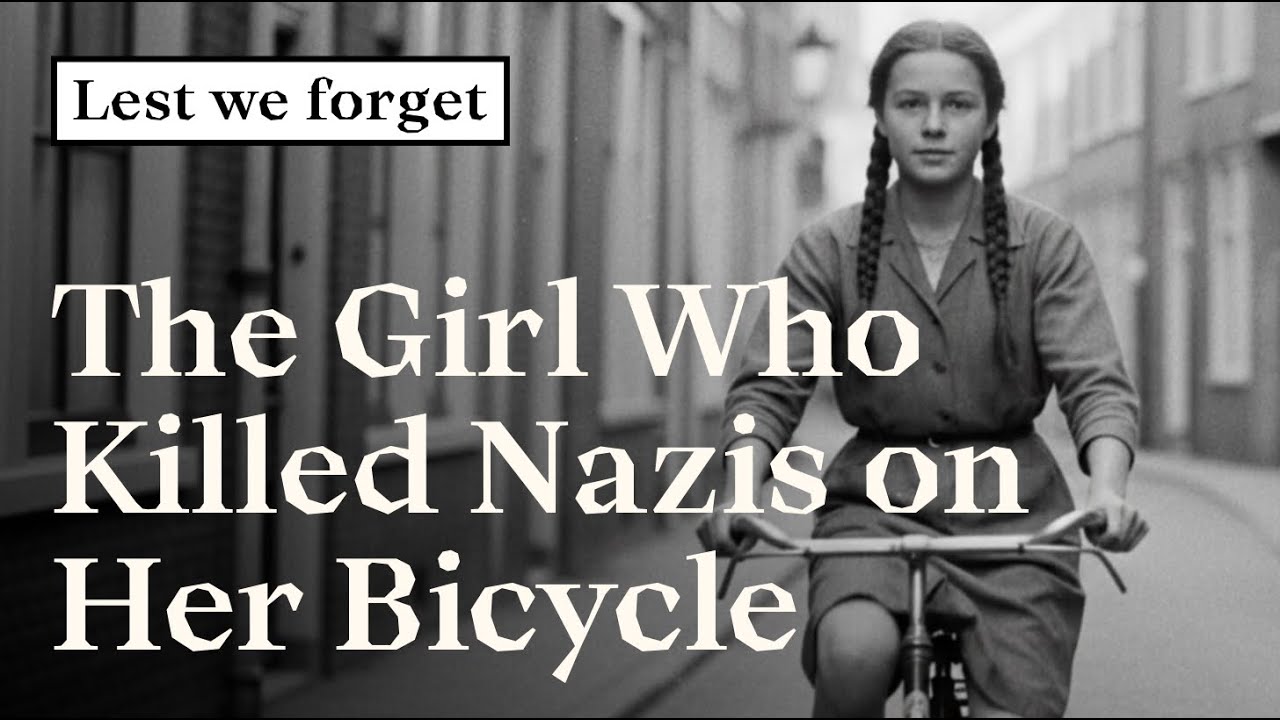
They glanced at her and waved her through without a second thought. They never checked the basket. Hidden beneath the cloth, nestled among what might have been vegetables or personal belongings, lay a handgun. The girl knew exactly how to use it.
Her name was Freddie Oversteegen, and she was fourteen years old. She was already a trained killer, a member of the Dutch resistance, and arguably the most daring of the war’s legendary trio of female fighters. That handgun and that bicycle would become the instruments of her first kill — the moment she crossed a line that could never be uncrossed. The details of that first shooting remain unclear.
It might have been a planned assassination, an opportunistic attack, or a drive-by-style operation with Truus pedaling while Freddie shot from behind. What is certain is that Freddie pulled the trigger, watched a man fall, and felt something inside her break even as she knew it had been necessary. Years later, she would always return to the same memory, not of the trigger or the kick of the gun, but of what happened afterward. “Yes, I’ve shot a gun myself and I’ve seen them fall,” she said.
“And what is inside us at such a moment? You want to help them get up. ” That instinct never left her. Every time she killed, her immediate impulse was to run to the fallen man and undo what she had just done.
It was her humanity asserting itself in the midst of horror. It was the thing her mother had asked her to hold on to, and it tortured her for the rest of her life. Freddie Mende Oversteegen was born on September 6th, 1925, in Schoten, a small village that would later become part of Harlem in the province of North Holland. She was not born into privilege.
Her family lived on a barge, one of those working-class canal boats that served as both home and livelihood. Her father, Jacob Oversteegen, rarely made enough money. The family struggled constantly. There was an older sister, Truus, born two years earlier in 1923.
The two girls became inseparable, bound together by circumstance and later by the most intense experiences human beings can share. Their mother, Trijn van der Molen — called Trijn by those who knew her — was a woman of strong convictions. She was a communist, a believer in social justice, and someone who put her principles into action even when it cost her. She and Jacob were both members of International Red Aid, a social service organization connected to the Communist International.
These were not just political beliefs written on paper. Even in the depths of their poverty, the Oversteegen family took in refugees. People fleeing persecution in Lithuania hid in the hold of their barge. The girls learned early that when someone needs help, you help them, regardless of the risk.
The marriage between Jacob and Trijn did not last. As Freddie would later recall, her mother simply got fed up one day. Jacob never made any money. He couldn’t pay for the barge.
The situation became unsustainable. But the divorce was not bitter. Jacob loved his daughters, and when the family left, he stood on the bow of the barge and sang them a farewell song in French. It was romantic and sad and utterly impractical, which probably summed up Jacob Oversteegen well enough.
After the divorce, Freddie did not see her father much. That absence was one of many losses in a childhood defined by hardship. Trijn moved with her two daughters to Harlem proper, into a small apartment where the sisters shared a bunk bed, sleeping on straw mattresses. The apartment was cramped and cold in winter.
Money was always tight. But Trijn worked hard to provide for her girls and, more importantly, she taught them — about justice and injustice, about standing up for what is right even when it is difficult, about the importance of fighting fascism. She enrolled her daughters in the Dutch Youth Federation, a communist youth organization. The girls made dolls for children caught up in the Spanish Civil War, learning that their actions, however small, could help people suffering far away.
Trijn later remarried and had a son, giving Freddie and Truus a half-brother they called Robbie. The family remained poor. There wasn’t much to go around, but they had each other and their principles. Those principles were about to be tested in ways no one could have imagined.
The late 1930s brought ominous news from Germany. The Nazi party had taken control. Jewish people were being persecuted, stripped of their rights, driven from their homes. Some fled west, seeking safety in the Netherlands, hoping the Dutch would remain neutral as they had in the First World War.
Trijn did not hesitate. She opened her home to Jewish refugees from Germany and Amsterdam. A Jewish couple lived with the family for a time, and it was through them that young Freddie first began to understand what was really happening under Nazi rule. The stories they told were horrifying — systematic cruelty, dehumanization, growing danger.
In 1939, when Freddie was just thirteen and war had officially erupted across Europe with Germany’s invasion of Poland, the Oversteegen household became a center of quiet resistance. Even before the Netherlands was invaded, the family printed illegal anti-Nazi magazines right in their living room. The printing press was so loud they had to post lookouts to warn them if anyone was coming. Freddie and Truus would sneak out at night and daub resistance slogans on walls.
“Don’t go to Germany,” they wrote. “For every Dutch man working in Germany, a German man will go to the front. ” They pasted their messages over German propaganda posters calling for Dutch workers. It was dangerous work.
If caught, the consequences could be severe. But the girls were fast and clever, and at their age authorities were less likely to suspect them. On May 10th, 1940, Germany launched a massive invasion of the Netherlands. The Dutch fought, but they were overwhelmed.
German planes bombed Rotterdam, killing hundreds of civilians and destroying the city center. It was terror bombing designed to break Dutch will, and it worked. Five days later the Dutch Royal Army surrendered. Queen Wilhelmina fled to London to form a government in exile.
The Netherlands was occupied. The Oversteegen family immediately burned all their radical literature. They had to protect the refugees still hiding with them. But the danger had multiplied exponentially.
Being caught harboring Jews under Nazi occupation meant death for everyone involved. The refugees had to be moved to other locations. It was a heartbreaking process. These were people the family had come to know and care about, and they all understood what was at stake.
Many of those refugees were later discovered in their new hiding places. They were all deported. They were all murdered. Decades later, when Freddie talked about this, she would still be moved to tears.
“We never heard from them again,” she said. “It still moves me dreadfully whenever I talk about it. ”
But the two sisters could not sit by and do nothing. They continued distributing illegal anti-Nazi newspapers and pamphlets.
They kept posting their warning messages over German propaganda. They were only fourteen and sixteen years old, but they were committed to resistance, and their activities were about to attract some very important attention. His name was Frans van der Wiel, and he was the commander of the Harlem Council of Resistance. He had heard about these two young sisters who were fearlessly spreading anti-Nazi material around the city, and he decided to pay them a visit.
One day in 1941 he knocked on the Oversteegens’ door. He was quite formal, taking off his hat and shaking hands with both girls. To Truus’s embarrassment, he sat down in the lumpiest chair in their modest living room. Their mother excused herself and left the girls alone with their guest.
Frans got straight to the point. He was putting together a resistance group — not just people distributing pamphlets. He needed fighters. He needed people willing to commit acts of sabotage.
He needed people willing to use weapons. The tasks he had in mind were subversive, violent, and extremely dangerous. He was asking two teenage girls if they were willing to risk their lives fighting Nazis, and he wanted their mother’s permission to recruit them. Freddie and Truus looked at each other.
This was the moment when resistance went from being about posters and pamphlets to being about life and death. Truus asked the question they were both thinking. Would they have to kill people? Frans did not sugarcoat it.
Yes, they would. But he emphasized that the targets would be carefully chosen — Gestapo officers, traitors, people who were actively hunting down Jews and resistance members. Not just any German soldier, but real fascists, real criminals. The girls went to their mother for guidance.
Trijn’s response stayed with them for the rest of their lives. She gave her permission, but she gave them one rule, one principle they had to carry with them no matter what they did. Always stay human. Always remember your humanity.
Never let the violence turn you into the monsters you’re fighting. Hold on to your conscience. Hold on to your compassion. Never lose sight of why you’re doing this.
It was an impossible ask in some ways. How do you kill people and stay human? But it was the challenge Trijn set before her daughters, and they accepted it. Freddie was fourteen.
Truus was sixteen. They officially joined the Council of Resistance. At first Frans did not tell them everything they’d be doing. He started them off with what seemed like straightforward sabotage work — blowing up bridges and railway lines to disrupt German military operations.
“We told him we’d like to do that,” Truus recalled years later. Then Frans announced they would learn to shoot — to shoot Nazis. Freddie’s response, according to her sister, was perfectly matter of fact. “Well, that’s something I’ve never done before.
”
The training began. The girls were taken to an underground potato shed where they learned to handle firearms, to shoot, to throw grenades, to plant explosives. They practiced until they were proficient. The resistance could not afford mistakes.
When you’re a teenager going up against the Nazi war machine, you don’t get second chances. You either do it right or you die. Their first major operation was not an assassination. It was arson.
The target was a Nazi-occupied warehouse, and the method was clever in its simplicity. Freddie and Truus dressed up, put on makeup, made themselves look pretty. Then they approached the SS guards at the warehouse and flirted with them. The guards, seeing two young, attractive girls paying attention to them, were completely distracted.
While they were preoccupied, resistance members set the warehouse on fire. It burned. Two warehouses, actually, both destroyed. The mission was a success, and the sisters learned something important.
Their youth and their femininity were weapons. The Germans did not see them as threats, and that made them incredibly dangerous. But burning warehouses was one thing. What came next would haunt Freddie for the rest of her life.
She was the first of the three famous female fighters to actually shoot someone — the first to cross that line that can never be uncrossed. She shot a Nazi soldier while riding her bicycle. The tactics evolved. The honey trap became one of their signature methods.
Here is how it worked. Freddie or Truus, dressed nicely, wearing makeup, would enter a tavern or bar where German officers were drinking. They’d make eye contact, smile, start a conversation, flirt. The officer, flattered by the attention of a pretty young woman, would relax.
Eventually, one of the girls would suggest a stroll in the woods. The officer, thinking he was about to have a romantic encounter, would eagerly agree. They’d walk into the forest together, and then, in a secluded spot, one of two things would happen. Either the girl would pull out a gun and shoot him herself, or a male resistance fighter would appear, as if by coincidence, and do the killing while the girl made her escape.
Sometimes they’d stage an argument. The male fighter would say something like, “Girl, you know you’re not supposed to be here. ” The girl would apologize, turn around, and walk away. As soon as they were out of sight, gunfire.
The officer would fall, and by the time his body was discovered, the resistance fighters were long gone. It was cold-blooded and calculated. The resistance called it liquidation. Freddie later described feeling a kind of dissociation during these operations.
You had to shut off part of yourself to do it. You couldn’t think about the fact that this man might have a family, might have children waiting for him to come home, might be somebody’s son or brother or husband. You had to think of him as a symbol, as the enemy, as someone who was part of a machine that was murdering millions. Otherwise, you couldn’t pull the trigger.
But afterward, in the quiet moments, in the dark of night, the humanity came flooding back. The sisters both struggled. They cried about it. They had nightmares.
“We did not feel it suited us,” Truus said later. “It never suits anybody. Unless they are real criminals, one loses everything. It poisons the beautiful things in life.
”
But they kept doing it, again and again, and they became some of the most effective assassins in the Dutch resistance. Then, in 1943, the trio became complete. A young woman named Jannetje Johanna Schaft, called Hannie by her friends, joined the resistance cell. Hannie was different from the Oversteegen sisters in some ways.
She came from a more educated background, had been studying law at the University of Amsterdam, dreaming of becoming a human rights lawyer. She had close Jewish friends. When the Nazis ordered all students to sign a loyalty oath to Germany, Hannie refused. She quit university rather than compromise her principles.
She wanted to fight back, she wanted to use weapons, and she found her way to Frans van der Wiel and the Council of Resistance. Hannie had one very distinctive feature: bright red hair. It would later make her famous. The Nazis, not knowing her identity but having seen her at several attack sites, put her on their most wanted list as “the girl with the red hair.
” Eventually she would dye her hair black and wear glasses to disguise herself, but that red hair became iconic. Even Adolf Hitler himself reportedly ordered her capture. The three women worked beautifully together. They had complementary skills and personalities.
Hannie was the intellectual. She spoke fluent German, which made her valuable for infiltration. She was thoughtful and strategic. Truus was the leader — decisive, pragmatic, down to earth.
She made the tough calls and kept everyone focused. Freddie was the planner. She would map out their missions in advance, think through the details, anticipate problems. She was also the most feminine and fierce, a combination that made her exceptionally effective at the honey trap operations.
Together they became a standalone unit within the larger resistance cell. They trusted each other completely. Their lives were literally in each other’s hands every single day. They were the only women in a seven-person cell, and they proved that women could do everything men could do in combat operations — and sometimes do it better, because no one suspected them.
Their work went far beyond assassination. Sabotage was a regular duty. They used dynamite to blow up bridges, cutting off German supply routes. They destroyed sections of railroad track between IJmuiden and Harlem, disrupting troop movements and military logistics.
These were real tactical operations that materially impacted German military capabilities in the region. They also worked as messengers and couriers, transporting weapons and illegal documents hidden in their bicycle baskets. Freddie would pedal through the streets of Harlem with firearms concealed under a cloth, right past German checkpoints. The soldiers would see a young girl with braids on a bicycle and wave her through.
They never imagined that this child was carrying guns to resistance fighters or transporting forged identity papers that would save Jewish lives. Perhaps the most important work they did was saving Jewish children. The operation was brilliantly simple. Freddie or Truus would walk hand in hand with a Jewish child through the streets, acting like an older sister taking a younger sibling on an errand.
To any observer they looked like a normal family scene. Who would question two sisters out for a walk? The girls would escort these children to safe houses or to contacts who could get them out of the country entirely. They saved dozens of children this way, maybe more.
The exact number is not known, because so much resistance work went unrecorded for security reasons. But the work was not without its terrifying moments. Sometimes they were caught in air raids while transporting children, and some of those children died in the bombings. Imagine the trauma of that: you are trying to save a child’s life, and despite your best efforts, they are killed by bombs while in your care.
The guilt would be crushing. But the women kept doing it, because for every child they lost, there were others they saved, and every saved life mattered. They worked at the emergency hospital in Ede, on the German border in eastern Holland, which gave them cover for their activities and allowed them to gather intelligence on German military movements. They could observe a German military airport and report back to the resistance about troop strengths and activity patterns.
They distributed illegal newspapers and anti-Nazi posters throughout the region. Every day brought new risks, new close calls, new chances to be caught. The psychological toll was immense. They witnessed horrors no one should ever have to see, let alone teenagers.
German and Dutch SS troops would randomly seize innocent people off the streets — men, women, children — line them up against walls, and shoot them, forcing their families to watch. Freddie and Truus saw this happen and were forced to witness it, helpless to intervene. The rage and disgust they felt fueled them, but it also scarred them deeply. Truus once witnessed something that pushed her beyond her breaking point.
She saw a Dutch SS soldier snatch a baby from its father’s arms and smash the infant against a wall, killing it instantly. The father and the baby’s older sister had to watch. They were hysterical. Without a second thought, without waiting for orders, without considering the consequences, Truus walked up to that SS soldier and shot him dead right there.
It was not a planned liquidation. It was pure human reaction to inhuman cruelty. These were the kinds of experiences that filled their days and nights. They lived in constant danger.
The Germans offered enormous rewards for the capture of resistance fighters. By the end of the war, 50,000 guilders was being offered for the capture of the Oversteegen sisters — a fortune. Anyone who betrayed them would be set for life. Yet somehow they survived.
They were careful, they were smart, they changed their appearances, they trusted almost no one. And they kept fighting. But the darkness was always there — the nightmares, the intrusive thoughts, the way violence becomes normalized when you live with it every day. They both suffered from what we would now recognize as post-traumatic stress disorder.
At night they would scream in their sleep, fight invisible enemies, wake up in cold sweats. Truus would later spend time in a mental institution. Freddie would experience periods when she could not get out of bed for days at a time. But during the war there was no time for processing trauma.
You just kept going, and you hoped you’d survive long enough to deal with the psychological damage later. Then they lost one of their own. March 21st, 1945. Hannie Schaft was stopped at a military checkpoint in Harlem.
She was carrying illegal communist newspapers and a pistol concealed on her bicycle. It should have been a routine stop — she had passed through countless checkpoints before — but this time something went wrong. Maybe the guard was more thorough than usual. Maybe someone had tipped them off.
Maybe it was just bad luck. Whatever the reason, they searched her. They found the gun and the papers. Hannie was arrested and taken to prison in Amsterdam.
The Gestapo knew they had someone important. They just did not know who. They interrogated her. They tortured her.
They kept her in solitary confinement. By this point Hannie had dyed her black hair back to its natural red, but they still did not make the connection that she was the girl with the red hair they had been hunting for so long — at least, not at first. Then, tragically, a former colleague named Anna Linhof identified her by her red roots. Anna had been captured and was being used by the Nazis to identify resistance members.
Whether she intended to betray Hannie or was coerced is unknown. But once Hannie was identified, her fate was sealed. The resistance tried desperately to rescue her. Truus disguised herself as a German nurse and went to the prison with a fabricated story about needing to take Hannie for a medical examination.
She cried, she pleaded, she was convincing — but it turned out Hannie had already been moved. The rescue attempt failed. Hannie’s parents were arrested and sent to Herzogenbusch concentration camp near Den Bosch, also known as Camp Vught. This was a deliberate strategy to break Hannie psychologically, to force her to give up information about her fellow resistance fighters.
The distress of knowing her parents were suffering because of her, combined with grief over the recent death of another resistance friend, temporarily broke her spirit. Her parents were eventually released after nine months of imprisonment, but Hannie never got the chance to see them free. By then the war was in its final weeks. The Nazis were losing.
Liberation was coming. But they still had time for one more murder. April 17th, 1945. Two Nazi officials — a Dutchman named Maarten Kuiper and a German named Christiaan Hines Schmidtz — were her executioners.
According to later testimony, they shot her at close range. The first bullet, fired by Schmidtz, did not kill her. It grazed her, causing terrible pain. Hannie, even in her final moments, showed her courage.
According to the story that became legend, she told her executioners, “I shoot better than you. ” Then Kuiper took out a submachine gun and fired a burst of bullets. One of them hit her in the head. Hannie Schaft, twenty-four years old, died in those dunes.
Her body was buried right there in a mass grave with hundreds of other resistance fighters. She was not discovered until after the liberation. Four hundred and twenty-two bodies of resistance members were eventually found in those dunes. Four hundred and twenty-one of them were men, and one was a girl with red hair.
On November 27th, 1945, Hannie was given a state funeral. Queen Wilhelmina herself attended and called Hannie the symbol of the resistance. Hannie was reinterred with full honors at the Dutch honorary cemetery in Bloemendaal, where she rests to this day. The location of her final moments is now marked by a memorial, one of several throughout the dunes commemorating where the Nazis executed resistance fighters.
For Freddie and Truus, losing Hannie was devastating. They had been through so much together, relied on each other completely, and now their friend — the girl with the red hair who had fought so bravely beside them — was gone, murdered just weeks before liberation. The guilt was crushing. The survivor’s guilt would haunt them for the rest of their lives.
May 5th, 1945. The Netherlands was finally liberated. The German forces in the country officially surrendered. The nightmare was over.
Freddie was nineteen years old. Truus was twenty-one. They had spent their entire adolescence at war. They had killed more people than they could count.
They had saved lives. They had witnessed horrors. They had lost friends. And now, suddenly, it was over.
What do you do with that? How do you go back to normal life after experiencing what they had experienced? The answer is you don’t. Not really.
You can’t. Freddie later said the war did not really end for her until she died. That might sound like hyperbole, but it is the truth of trauma. You carry it with you forever.
In the immediate aftermath, Freddie spent a few months healing at the Loo Palace. Queen Wilhelmina had opened the palace to veterans and resistance fighters for recovery. It was a gesture of gratitude, a recognition of what these people had sacrificed. But a few months in a palace could not undo years of psychological damage.
After that, Freddie went to work for the Political Investigation Service, the agency responsible for tracking down and arresting Nazi collaborators. It seemed like a natural continuation of her resistance work, and she was good at it. She arrested collaborators all over the country. But she started noticing something disturbing.
The wealthy collaborators, the high-ranking ones, the ones with connections — they were not being arrested. Only poor people faced consequences. When she reported this discrepancy, she was told to ignore it. Freddie resigned immediately.
She could not stomach the hypocrisy. After everything she had done, everything she had sacrificed, to see justice applied selectively based on class was too much. She married an engineer named Jan Dekker. They had three children together.
By all outward appearances, Freddie settled into a normal, quiet domestic life. She focused on being a wife and mother. When people asked her later how she coped with the trauma of the war, her answer was simple: by getting married and having babies. Creating life after being surrounded by death.
Building a family after losing so much. It was her way of moving forward, of trying to be normal, of trying to forget. But you cannot forget. The memories do not fade.
Every year on May 4th — Remembrance Day in the Netherlands — Freddie would wake up filled with dread. The anniversary of the liberation should have been a day of celebration, but for her it was a day when all the ghosts came back. She struggled with insomnia her entire life. Depression would hit her in waves.
Sometimes she could not function. Her son, Remy, would later say he believed the war never truly ended for his mother. She was fighting it in her head every day for the rest of her life. And there was another source of pain, one that had nothing to do with combat or killing.
In the decades after the war, Freddie lived in the shadow of others. Hannie Schaft became a national icon. Schools were named after her. Streets.
There were books, and a movie in 1981 called The Girl with the Red Hair. Hannie’s story was taught to school children across the Netherlands. She was the symbol of female resistance. Truus also gained recognition.
She married a fellow resistance fighter named Piet Menger in November 1945. She became an artist, a sculptor and painter whose work was heavily influenced by the war. She wrote a memoir called Not Then, Not Now, published in 1982, about her resistance experiences. She spoke publicly, gave lectures at universities and secondary schools about war, anti-Semitism, tolerance, and indifference.
She was honored as Righteous Among the Nations by Yad Vashem in 1967. She received the Order of Orange-Nassau in 1998 on her seventy-fifth birthday. She founded the National Hannie Schaft Foundation to preserve her friend’s memory. She was a public figure, respected and honored.
And Freddie lived quietly. She raised her children. She served on the board of the foundation her sister created, supporting Hannie’s legacy. But she felt sidelined, overlooked.
She admitted later that she was jealous of Truus. “I have always been a little jealous of her because she got so much attention after the war,” Freddie said in an interview. “But then I just think I was in the resistance as well. ”
Part of the problem was political.
Freddie and Truus were communists. Their mother had raised them that way. They had been members of communist youth organizations. They had distributed communist newspapers during the war.
And in the postwar period, with the Cold War beginning and anti-Soviet sentiment running high, the Dutch government did not want to give too much credit to communists — even communists who had fought the Nazis, even communists who had saved lives and risked everything. When other resistance fighters were awarded pensions for their service, Freddie and Truus were initially refused. The government was soundly anti-Soviet. Orders came down, possibly from Queen Wilhelmina and Prince Bernhard themselves, to minimize recognition of left-wing resistance members.
It was not until well into the 1960s, more than twenty years after the war ended, that the sisters finally received their resistance pensions. There was no back pay for those two decades. This was the bitter reality Freddie lived with. She had been arguably the most daring of the three famous female fighters.
She had been the first to kill. She had pulled off some of the most dangerous operations. She had smuggled children, transported weapons, planted bombs, executed traitors. She had done everything asked of her and more.
And for most of her life, almost nobody knew about it. “Women don’t count,” Freddie said. “They still don’t. That hasn’t changed.
”
But in the final years of her life, something did change. In 2014, when Freddie was eighty-eight and Truus was ninety, they finally received proper recognition from their government. Dutch Prime Minister Mark Rutte personally awarded them the Mobilization War Cross, a significant Dutch military honor usually awarded by mayors. For the prime minister himself to present it demonstrated how important the government now recognized their service to be.
According to Freddie’s son Remy, that ceremony was a highlight of his mother’s life. After decades of feeling invisible, of living in shadow, she was finally being honored publicly for what she had done. Streets in Harlem were named after both sisters — not just after Hannie, but after Freddie and Truus too. Their names became part of the city’s geography, ensuring future generations would remember them.
In 2016, a Dutch television documentary titled Two Sisters in the Resistance told their story to a new audience. Freddie appeared in it, speaking about her experiences more openly than she ever had before. The documentary brought renewed attention to their contributions. International media began covering their story.
They were finally getting the recognition they deserved, even if it came so late in life. But time was running short. Truus died in June 2016 at the age of ninety-two. For Freddie, losing her sister was like losing a part of herself.
They had been through everything together, from their childhood on the barge to the war years to the long decades of postwar life. According to Truus’s daughter, one word was enough for them to understand each other. They had relied on each other completely during the war. Their lives were in each other’s hands.
That bond never broke. And now Truus was gone. Freddie had suffered several heart attacks in her later years. Her health was declining.
She spent her final years in a nursing home in Driehuis, about five miles from Harlem. On September 5th, 2018, one day before her ninety-third birthday, Freddie Oversteegen died. The last surviving member of the legendary trio was gone. The obituaries that followed told her story to the world.
The Washington Post ran a lengthy piece that drew huge reaction. Major international news outlets covered her passing. People around the world learned about the girl with the braids who had killed Nazis from her bicycle, the teenager who had seduced German officers and led them to their deaths in the woods, the young woman who had walked hand in hand with Jewish children to safety, the resistance fighter who had planted bombs and smuggled weapons and executed traitors. But more than the individual acts of bravery, what struck people was the larger story — the story of how women’s contributions to the war effort had been systematically minimized and ignored, how Freddie had spent most of her life in shadow despite her extraordinary courage, how even in death it took international media attention to bring her story into full light.
It was validation of what she had said. Women don’t count. They still don’t. Freddie Oversteegen did not want to be a hero.
She did not want to kill anyone. She wanted to live a normal life. But when her country was invaded and her neighbors were being murdered, she made a choice. She chose to fight, and she fought with everything she had — with her youth, with her innocence, with her appearance, with her courage.
She fought until liberation came. Then she spent the rest of her long life trying to reconcile what she had done with who she wanted to be. She was right about one thing. Women’s contributions to history, especially military history, are still minimized, still ignored.
Women’s stories are still treated as footnotes to the real history made by men. That needs to change, and the way we change it is by telling stories like Freddie’s — by insisting that her life mattered, that her courage mattered, that what she did and what it cost her deserves to be remembered. The girl who rode her bicycle through occupied Harlem with a gun in her basket. The teenager who seduced Nazis and led them into the woods.
The young woman who walked Jewish children to safety. The resistance fighter who planted bombs and executed traitors. The soldier who never told anyone how many she killed. The survivor who spent her whole life haunted by what she had seen and done.
The mother who tried to heal by creating life after being surrounded by death. The woman who lived in shadow while others were celebrated. Freddie Oversteegen deserves to be remembered not as a footnote, not as a supporting character in someone else’s story, but as a hero in her own right — as someone who did what had to be done, as someone who paid the price for courage, as someone who never lost her humanity even in the midst of inhuman circumstances.
As someone who counted, even when the world tried to say she did not.