The Earl of Lovelace had heard his wife’s confession, and it had been enough to drive him from the room. He did not look back. He did not return. In the days that followed, he could barely put his devastation into words.
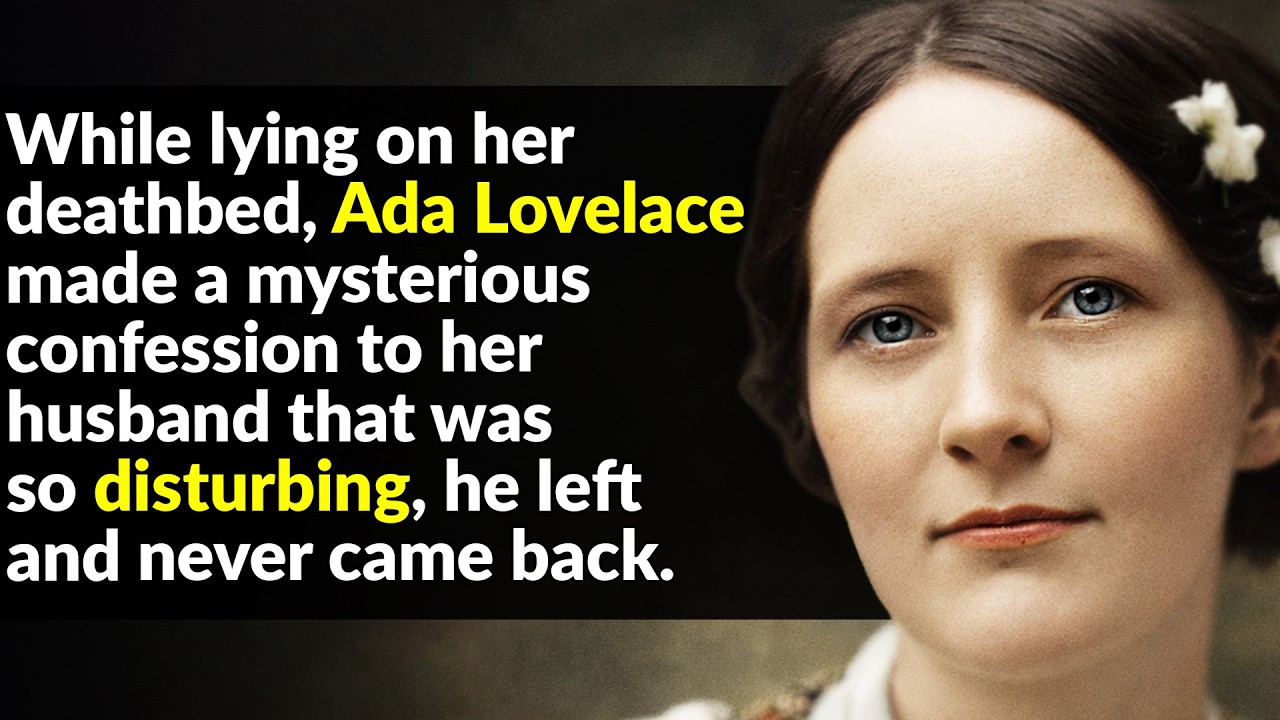
“For the past week,” he wrote, “I have been prey to the utmost wretchedness of mind. Every cherished conviction of my married life has been unsettled. ”
The woman who had just told him such a terrible secret was dying. Her name was Ada Lovelace, and she was only thirty-six years old.
She had been born Augusta Ada Byron on December 10th, 1815, and from the very first moment of her life, scandal had followed her. Her father was the poet Lord Byron, a man whose name was already synonymous with affairs, gossip, and ruinous reputation. She was his only legitimate child. Every other child Byron had fathered was born out of wedlock, but even being born inside a marriage could not protect Ada from the tragedy of her early years.
Byron’s marriage to Anne Isabella Milbanke had surprised everyone who knew either of them. Byron was an incorrigible scoundrel, while Annabella, as she was called, was his exact opposite: stiff, moral, and deeply educated in science. It was from her mother that Ada inherited her gift for numbers. Byron himself had nicknamed his wife the Princess of Parallelograms, but affectionate nicknames could not hold the marriage together.
Byron’s wild behavior was famous across the world, whether he was keeping a bear in his rooms at Cambridge or leading troops in the Greek fight for independence. By the time Ada was born, her conservative mother was tired of it all. There was also the matter of disappointment. Byron had assumed his first legitimate child would be a son, a glorious boy who would carry on the family name.
When he learned he had a daughter, he made no effort to hide his displeasure. Just one month after Ada’s birth, her parents separated. Soon after, debts forced Byron to flee England for mainland Europe. He never saw his homeland or his daughter again.
Byron did not forget her entirely. He asked his family to keep him informed of her health, he wrote about her often in his poetry, and he kept a portrait of her on his desk for years. But these were hollow gestures. Under English law at the time, Byron could easily have claimed custody of his daughter if he had truly wanted her.
He never did. Ada was eight years old when her father died of a violent illness at thirty-six. She had never spoken a single word to him, and she did not even see a portrait of him until she was twenty. Her mother, bitter and angry after Byron’s departure, spread scandalous rumors about him and never hesitated to criticize him in front of their daughter.
She was determined that Ada would never follow in her father’s footsteps. From the time Ada was a little girl, her mother drilled her in mathematics and logic, hoping that strict schooling in numbers would suppress her daughter’s imagination. Annabella feared that if Ada ever tasted the creative arts, she would fall into the same madness that had consumed Byron. But Annabella was far more concerned with shaping her daughter than with loving her.
The girl suffered horribly for it. In public, Lady Byron appeared to be the perfect, doting mother. Behind closed doors, it was a sham. Perhaps Ada reminded her too much of the husband she hated.
Lady Byron spent as little time with her daughter as possible. Yet she was aware that if anyone discovered her neglect, Ada might be taken away from her. Whenever Annabella’s own mother wrote to ask about Ada, Annabella made sure to include specific instructions on the envelope: keep every letter, so that she could prove she had been a caring mother. In one letter, she referred to her own daughter as “it.
” “I talk to it for your satisfaction, not my own,” she wrote, “and shall be very glad when you have it under your own. ”
Ada spent her childhood alone at her mother’s country house while her mother traveled. Even then, Annabella’s close friends watched the girl like hawks, making sure she never showed any sign of moral deviation. Ada also suffered from terrible illnesses.
She endured headaches so severe they made it hard to see, and as a teenager she came down with measles so bad that they left her paralyzed. She was confined to bed for almost a year, and even after she recovered she needed crutches to walk. Her mother’s paranoia was not entirely unfounded. At seventeen, Ada began a secret affair with one of her tutors, and the two of them planned to elope.
When Ada presented herself to the tutor’s family, they instantly recognized her as the infamous daughter of Lord Byron. They contacted her mother immediately. Annabella dragged her daughter home and covered the whole thing up. But destiny had other plans.
On June 5th, 1833, fresh from her failed elopement, seventeen-year-old Ada made her debut to London high society at a lavish ball. There she met a man named Charles Babbage. He was not the most impressive man at the party. In his early forties and unemployed, he made ends meet by giving public lectures, publishing unremarkable scientific papers, and drawing on the sizable sums he had received after the deaths of his father and his wife.
Not many people found Charles Babbage particularly interesting. Ada saw him for what he was: a visionary whose ideas would change the world, and her life. In their day, a computer was a human being, someone who performed computations. A team of these human computers would split a complex problem into parts and write out each piece by hand, eventually arriving at an answer through laborious mathematics.
It was slow, work-intensive, and inefficient. Babbage was certain there had to be a better way. He and Ada began discussing his difference engine, an intricate machine that could perform complex calculations. Ada was rapt.
Babbage soon recognized her mathematical genius and began calling her his Enchantress of Numbers. Even so, Ada was young, and the charms of high society kept calling. She became a regular in the London party scene, earning a reputation as a charmer who loved to dance and never hesitated to speak her mind. Byron’s old friends noticed the resemblance, not only in her face but, as one put it, particularly in the mouth.
London gossips were desperate to learn who the scandalous daughter of Lord Byron would marry. Ada could be extremely secretive, which is why she shocked all of England when she suddenly announced her marriage to William, the 8th Baron King, a wealthy English noble. She became Lady King, and the couple lived a charmed life, dividing their time among three extravagant homes. William was a man her mother approved of: by all accounts a total gentleman, though rigid and deliberate.
Like any good Victorian couple, they set about having children immediately. They wed in 1835, and Ada gave birth in 1836, 1837, and 1839. Soon William became the new Earl of Lovelace, making Ada the Countess of Lovelace, the name that would go down in history. In the early years of her marriage, Ada was too busy to think much about mathematics or Babbage’s machine.
But after the birth of her third child, she became restless. With the help of a math tutor, she dove back into complex problems and imagined ways they could be applied to the real world. In a letter to Babbage, she wondered whether a mathematical formula could be used to play card games like solitaire. It was the kind of thinking nearly unheard of at the time, and exactly the kind of idea that would earn Ada her place in history.
Babbage suggested that Lovelace translate an Italian paper on his Analytical Engine by Luigi Menabrea into English. She did, and she added notes that were three times longer than Menabrea’s original work. When it came to her translation, Note G was the masterpiece. Lovelace understood Babbage’s machine better than almost anyone, and in Note G she explained one of its practical uses.
She described in perfect detail how to use the Analytical Engine to calculate a sequence of Bernoulli numbers. In effect, Note G was the first computer program ever written, and Ada Lovelace became the world’s first computer programmer. Her translation was by far the best explanation of the concept ever written, and it introduced the idea of the mechanical computer to the world. She even predicted that a computer could be used for far more than mathematics, such as composing music.
That brilliant work almost destroyed her friendship with Babbage. After she had spent countless hours writing and translating, Babbage tried to add a preface that amounted only to complaints about his lack of government support. Ada objected. Babbage then declared that without the preface, she should not bother publishing the article at all.
Furious that her friend would scrap her work over a petty squabble, Lovelace published the paper anyway, without the preface. Their friendship was strained for years afterward. Ada knew her worth, even in a Victorian society that expected women to have no aspirations beyond the home. In a letter to her mother, she wrote of her insatiable, restless energy to create something of substance.
She was not humble. “I believe myself to possess a most singular combination of qualities exactly fitted to make me preeminently a discoverer of the hidden realities of nature,” she wrote. Lady Byron’s response to her daughter’s happiness was vicious. At the height of Lovelace’s career, her mother revealed that Ada’s cousin, Elizabeth Medora Leigh, was actually her half-sister: Byron had fathered a child with his own half-sister.
It was a bombshell, and it was meant to be. But Ada was not surprised in the least. She claimed she did not blame her father for being seduced. Ada Lovelace was no innocent.
Science was not the only scandalous pursuit she enjoyed. She also gambled, and it eventually got out of control. In the 1840s she spent over three thousand pounds on horses, then tried to create a mathematical model to game the system and swindle her gambling friends. The model failed spectacularly.
Ada bet it all and lost. She had managed to keep her gambling losses secret from her husband, but now she was forced to come clean. Perhaps because of this and other habits, her mother, still meddling, hired a man named William Benjamin Carpenter to tutor the children and to serve as Ada’s moral instructor. But instead of showing Lovelace how to be a proper lady, Carpenter fell head over heels for her brash personality.
He grew more and more obsessed, spending all his time with her and always assuring her that, as a married man, his intentions were pure. When his advances became obvious, Lovelace kicked him out of the house. Her relationships with her own children were strained, just as her relationship with her mother had been. Her eldest son, Byron, left her to join the Navy but deserted soon after.
He never contacted his family again. Lovelace held out hope that he had gone to America and was living a good life there. She never learned the truth: after deserting, he worked in a dingy shipyard in England and died unmarried and childless at just twenty-six. Her daughter, Anne, fared a little better.
She moved to the Middle East and became one of the world’s best-known breeders of Arabian horses. Only the youngest, Ralph, stayed close to home and eventually inherited the family title, becoming the second Earl of Lovelace. Ralph utterly hated Lord Byron. In 1905 he published a book about his family’s history in which he wrote, “Lord Byron’s life contained nothing of any interest except what ought not to have been told.
”
Ada would have precious little time with any of her children. In her thirties, the health problems that had plagued her all her life returned, and she spent months traveling from one doctor to the next. This was Victorian England, where medicine was more of an art than a science. One cure her mother suggested was the mystical practice of mesmerism.
Ada tried everything, but her health kept worsening. The pain was constant, and she depended on opiates, a common prescription at the time, to numb the agony. By the 1850s her doctors had run out of options. Lovelace had uterine cancer and was dying.
By 1852, nothing could be done. In one of her final letters, she wrote mournfully: “I begin to understand death, which is going on quietly and gradually every minute and will never be a thing of one particular moment. ”
Despite being little known, Ada had made some impressive friends, and some tried to visit her on her deathbed. A couple of months before she died, she received a visit from Charles Dickens.
She implored him to read her an account of death from one of his books. But Dickens was one of the few allowed to see her. Lady Byron completely took over in those final months. Ada spent her last days as she had spent her childhood, almost entirely alone.
Her mother had never approved of any of her friends and refused to let many of them say goodbye. Meanwhile, Lady Byron worked to convince her daughter to repent her sinful life and devote herself to God. Perhaps it was these urgings that provoked Ada’s confession. On August 30th, 1852, she called her husband William to her bedside and told him something.
He left and never returned. According to historians, she told him she had been unfaithful throughout their marriage. As for the identity of the other man, she had been close to a man named Andrew Cross for several years, and the two had been strangely secretive about their relationship. As Ada lay dying, one of the few people she demanded to see, despite her mother’s protests, was Cross.
When she died, she left all of her father’s possessions to him. Her husband abandoned her and her mother isolated her, yet Ada held on for three more agonizing months. She finally died on November 27th, 1852. Her close friend and longtime correspondent Florence Nightingale later wrote: “They said she could not possibly have lived so long were it not for the tremendous vitality of the brain that would not die.
”
Lovelace was buried in an extremely small ceremony. Neither Charles Babbage, her longtime collaborator, nor her own mother attended. One of her last requests was to be buried next to Lord Byron, the father she had never met.






