In October 1911, thick autumn fog settled over the remote valleys of Kanawha County, West Virginia, when the first reports emerged of something deeply wrong at the Cranshaw farm. The property sat about fifteen miles from the nearest settlement, Cedar Falls, reachable only by a narrow dirt road winding through dense oak and pine forests. The Cranshaw family had called this land home for three generations. What happened there during that fateful month would not be fully understood for decades, when preserved documents and witness testimony painted a picture so disturbing that many who knew the truth chose to carry it to their graves.
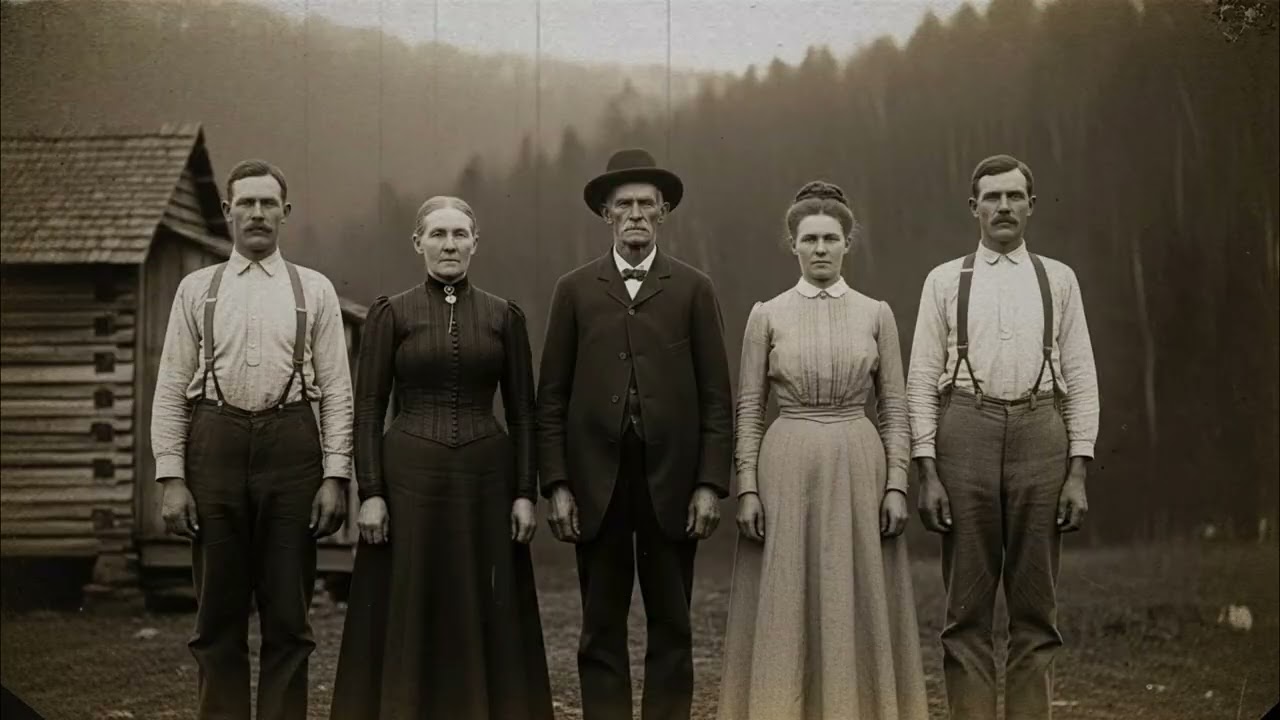
The family consisted of Ezekial Cranshaw, a sixty-two-year-old patriarch who had inherited the two-hundred-acre plot from his father, his wife Cordelia, aged fifty-eight, and their three adult children: Silas, thirty-four, Manorva, thirty-one, and the youngest, Thaddeus, twenty-nine. Unlike many families in the region struggling with poverty, the Cranshaws maintained an almost complete self-sufficiency. They raised cattle, pigs, and chickens, cultivated extensive vegetable gardens, and operated a sophisticated distillery producing corn whiskey of exceptional quality. Occasionally they traded with passing travelers for essential supplies.
Ezekial was known throughout the county as an intensely private man who discouraged visitors and imposed strict control over his family’s interactions with the outside world. Born in 1849, he had witnessed the horrors of the Civil War in western Virginia and the subsequent years of Reconstruction that reshaped the social fabric of Appalachian communities. According to the records of Reverend Moses Blackburn, the local circuit preacher, the family rarely attended services, perhaps three or four times a year during major religious holidays. Even then, they sat apart from the congregation in the back pews and left immediately after prayers ended.
The isolation was so complete that when Franklin Hobbs, the mail carrier, attempted to deliver a letter to the Cranshaw home in late September 1911, he discovered the road leading to their house had been covered with thorns and fallen branches, making it appear deliberately blocked. Hobbs called out several times from the main road but received no response, although smoke was clearly rising from the stone cabin’s chimney. Dr. Ambrose Kittrell, the county’s only physician, was the first to express concern about the family’s welfare.
In his carefully kept medical journals, dated October 3, 1911, he wrote that he had not seen any member of the Cranshaw family for medical consultation in over eighteen months, which he found strange given the harsh winter of 1910 and the various illnesses that typically afflicted isolated mountain families during seasonal changes. His concern grew after reports from traveling merchants noted the conspicuous absence of any Cranshaw from the autumn trading gatherings in Cedar Falls. These seasonal meetings were crucial opportunities for mountain families to exchange surplus goods, share news, and maintain social bonds necessary for survival through the long winters. Silas had historically handled the family’s whiskey trade, and his absence was particularly noted.
Samuel Brennan, who had run the Cedar Falls trading post for nearly two decades, expressed his worries to Dr. Kittrell. Silas had not been seen since late July, which was completely out of character. Other families had specifically asked about him, and Brennan had been forced to admit he did not know when, or if, the man would come to town again.
When Sheriff Marcus Dunaway finally decided to investigate in mid-October, he enlisted two local men familiar with the rugged mountain terrain: Isaiah Murdoch, a professional hunter who knew every trail and valley within fifty miles of Cedar Falls, and Jeremiah Howell, a cattle trader who had done business with the Cranshaws. The three men set out on horseback on the morning of October 16, carrying supplies for what they expected to be a prolonged investigation. The journey took far longer than expected due to the severe deterioration of the trail. Fallen trees blocked the path at multiple points, forcing the men to dismount and lead their horses around obstacles.
Heavy September rains had washed out portions of the road entirely. Most troubling was the complete absence of any trail maintenance, suggesting the family had made no effort to keep their main route to the outside world passable, something unusual for mountain families who treated accessible trails as literal lifelines during medical emergencies. Murdoch, whose hunting experience had taught him to read signs others missed, noted several troubling details as they approached the Cranshaw property. There had been no regular traffic on the road for weeks, perhaps months.
Animals were using it more than humans. And the branches crossing the path had been placed deliberately, not fallen naturally. Someone was trying to make the road harder to follow. As they approached the clearing where the Cranshaw cabin stood, Sheriff Dunaway noticed a suffocating silence unnatural for a working farm.
Mountain farms were typically bustling with activity even in quieter autumn months: cattle lowing, axes splitting firewood, voices calling across the property, dogs barking at approaching visitors. The Cranshaw property was eerily quiet, broken only by wind rustling through surrounding trees. The main cabin appeared structurally sound but showed signs of neglect. Weeds grew unchecked around the foundation, reaching heights suggesting months of abandonment.
Tools lay scattered and rusted in the yard. Several broken window panes had been hastily covered with wooden boards rather than repaired with glass, giving the building a fortified appearance that seemed more ominous than practical. The extensive vegetable garden, which should have been at the peak of its autumn harvest, showed clear evidence of weeks of abandonment, with crops rotting where they fell. Most concerning was the condition of the livestock barns.
The Cranshaws had always relied on a substantial number of animals, but the barns were now empty, bearing signs of hasty abandonment. Gates hung open, water troughs were dry and filled with leaves, and scattered feed lay rotting on the ground. Sheriff Dunaway called out several times, announcing their presence and official purpose. His voice echoed strangely in the clearing, absorbed by the surrounding forest rather than reaching the cabin.
When no response came, he approached the front door and knocked firmly. The sound reverberated oddly, as if the interior of the house was larger or more empty than expected. After several more minutes of waiting, he tried the door handle and found it unlocked, another unusual detail, as mountain families typically kept their homes secured. The three men exchanged worried glances before Dunaway pushed the door open.
The inside of the cabin disturbed the visitors deeply, though they initially struggled to explain why. The main room was arranged with an almost compulsive orderliness, everything placed with a mathematical precision that seemed unnatural for a working family’s living space. Firewood was stacked in perfectly straight lines beside the stone hearth, every log cut to identical lengths with the bark facing the same direction. Chairs surrounded the dining table at precise distances, as if measured with a ruler.
But what troubled them more than this excessive order was what was conspicuously absent: no personal belongings anywhere. No family photographs, no decorative pieces reflecting individual personalities, no clothes draped over chairs, no evidence of hobbies or personal interests. The cabin looked less like a family home and more like a carefully maintained exhibition. In the kitchen area, they found evidence of a meal prepared and partially consumed, but the dishes and utensils were arranged unnaturally on the wooden table.
Five place settings were clearly visible, yet only three showed actual signs of use: crumbs, stains, slight messiness indicating real people had eaten from them. The remaining two places were immaculate, as if prepared for people who never came. Jeremiah Howell, whose trade required careful observation skills, noted that the food preparation area told an illogical story. Flour was scattered on the counter as if someone had been baking bread, but no bread existed anywhere.
A jar of jam was open with a spoon inside, yet only a small amount had been taken. It seemed as if someone had begun preparing a meal and then stopped abruptly mid-task. Isaiah Murdoch noticed that a thin layer of dust covered most surfaces in the main room, suggesting the space had not been touched for weeks. Yet the kitchen table and surrounding area were completely dust-free, indicating very recent activity.
The house seemed simultaneously abandoned and recently inhabited, as if different parts of the building existed in different time periods. The bedrooms showed the same excessive order, but with additional elements that gave Sheriff Dunaway an instinctive chill he could not rationally explain. Every bed was made with hospital-like precision, sheets pulled so tight a coin might bounce off. Personal items were arranged in neat rows on dressers and nightstands, organized by size and function with an attention to detail suggesting either severe mental disturbance or absolute terror of disorder.
In what appeared to be Ezekial and Cordelia’s room, Jeremiah Howell noticed something that made him call the others over immediately. On Cordelia’s side of the bed, the white pillow clearly bore the indentation of a head, as if someone had recently been lying there. Yet the impression was too deep and permanent to result from a single night’s ordinary sleep. It was as if someone had lain in that exact position for days or weeks without moving.
The bedding around the head impression showed stains that could have been sweat from prolonged illness, but the patterns were inconsistent with natural sleeping arrangements, suggesting someone had lain there in severe physical distress, perhaps unable to move or change position for extended periods. The most disturbing discovery came when Murdoch examined a large wardrobe. Inside, women’s clothing hung with the same precise organization found throughout the house, but many garments showed damage that appeared deliberate rather than accidental. Dresses had been cut in specific patterns, not torn randomly.
The cuts were precise, made with sharp instruments, apparently following some systematic plan none of the investigators could understand. When they examined the cellar, accessible through a heavy wooden door in the kitchen floor, they expected to find the family’s winter provisions: preserved vegetables in ceramic jars, salted meat wrapped in cloth, barrels of grain and flour, cheese molds, all the supplies necessary for surviving a harsh mountain winter. Instead, they found the cellar nearly empty, containing only a few scattered jars of jam and one barrel appearing to hold corn mash for whiskey production. More alarming was the evidence of recent extensive digging.
The packed dirt floor showed clear signs of having been excavated on a large scale and then carefully smoothed over with tools. The disturbed soil formed several rectangular patterns of varying sizes, though determining depth was impossible without proper excavation equipment. The largest area measured approximately six feet long and three feet wide, dimensions suggesting possibilities none of the investigators wished to voice aloud. Sheriff Dunaway knelt and examined the soil closely.
The digging was recent, he told his companions, evidenced by the visible difference in soil color and texture from undisturbed areas. Tool marks remained clearly visible. The work had been done within the past few weeks, perhaps even days. In one corner of the cellar, partially hidden behind stored farming tools, Murdoch found what appeared to be a collection of personal belongings belonging to all the adult family members: folded clothing, a woman’s hairbrush with long gray hair tangled in its bristles, a man’s pocket watch that had stopped, a pair of spectacles with one cracked lens, a leather wallet containing a small amount of money, and what appeared to be family photographs.
Sheriff Dunaway made an immediate decision to return to town to gather additional men and proper excavation equipment. Before leaving, the three conducted a final survey of the property. Behind the main cabin, partially hidden among dense vegetation that appeared deliberately planted for concealment, Murdoch discovered what seemed to be a temporary workshop that immediately alarmed all three investigators. Crude wooden tables bore dark stains deeply embedded in the wood grain, stains that might have resulted from livestock slaughter but showed patterns inconsistent with normal meat processing.
The tables surrounded a central area whose floor was permanently stained dark, indicating repeated washing with large quantities of water. Scattered throughout this workshop were tools that seemed inappropriate for ordinary farm work, even for specialized livestock processing tasks. Knives had been sharpened and shaped in unusual ways, some blades curved in manners making them ineffective for standard cutting tasks but potentially useful for other purposes. Lengths of rope showed signs of intensive use and staining similar to that on the tables.
Several iron implements had no discernible original purpose, but their appearance and context suggested they had been used to inflict suffering rather than accomplish any productive work. The men left the Cranshaw property in troubling silence. That evening, Sheriff Dunaway sent an extended telegram to the state capital requesting immediate assistance from experienced investigators. His message was diplomatically worded but urgent in tone: the Cranshaw family was missing under highly suspicious circumstances, evidence at the scene indicated potential violent criminal activity of a serious nature, the property showed signs of systematic disturbance and possible burial activity, and the situation required resources beyond local capabilities.
The reply came two days later, informing Dunaway that Investigator Roland Pierce would arrive by train the following week to lead a comprehensive investigation. Pierce had gained a reputation throughout West Virginia and neighboring states for his methodical approach to complex criminal cases and his ability to uncover evidence other investigators had missed or misinterpreted. His involvement signaled that state authorities were taking the Cranshaw disappearance with the utmost seriousness. While awaiting Pierce’s arrival, Sheriff Dunaway conducted extended interviews with locals who had prior connections to the family.
These conversations revealed a pattern of increasingly strange behavior observed by numerous witnesses over preceding months but dismissed as mere eccentricities of a mountain family. Samuel Brennan recalled that Silas Cranshaw’s last visit in July had differed completely from his usual behavior. He had purchased an enormous quantity of rope, far more than any family would need for ordinary farm work, and had seemed nervous throughout his time in the store, constantly looking behind him as if expecting to be followed or watched. When Brennan asked if everything was alright at home, Silas had stared at him silently for a long moment before saying that things were changing, and sometimes a man had to do what was necessary to protect his family, even if it was difficult.
When asked what he meant, Silas had shaken his head and said he had already said too much, then left town immediately. Margaret Tolbert, whose family farm was the closest to the Cranshaw property though still about five miles away across rugged terrain, gave a more alarming statement. She reported hearing strange sounds coming from the direction of the Cranshaw property during nighttime hours throughout late summer. These were not ordinary farm sounds, she explained.
What they heard sounded like someone digging, hard digging work, but continuing for hours at a time. Sometimes other sounds mixed in, like arguing or angry voices, but too distant to make out specific words. The digging sounds were what truly worried them, starting after dark around nine or ten in the evening and continuing past midnight. Sometimes they would hear them for three or four consecutive nights, then the sound would disappear for a week, then return.
Her husband had told her to mind her own business, that mountain families had their ways and it was not their place to interfere, but those sounds kept her awake many nights, wondering what could possibly require all that nighttime digging. Reverend Moses Blackburn provided perhaps the most detailed account of the family’s psychological state in the weeks before their disappearance. He had attempted to visit the Cranshaws in early September to check on their spiritual welfare. Thaddeus, the youngest son, had intercepted him at the edge of the property, positioned across the road with a rifle, making clear visitors were unwelcome.
He had not pointed the weapon directly at the reverend but held it in a manner that made his intentions unmistakable. The reverend had dealt with private mountain families before, but this was different. There was something in Thaddeus’s demeanor suggesting desperation rather than mere preference for isolation. His appearance was shocking.
The reverend had known Thaddeus since childhood, and the young man had always been neat and well-mannered. But that day he looked as though he had not slept properly for weeks, his clothes dirty and torn, his hair unkempt, dark circles under his eyes indicating either serious illness or extreme exhaustion. When asked if he could speak with his father, Thaddeus had said he was busy with family matters that strangers could not interrupt. There was something in his eyes that frightened the reverend more than the rifle itself, a kind of wild desperation suggesting a man pushed beyond his natural limits.
During this brief conversation, the reverend heard sounds coming from the direction of the cabin that seemed strange for normal family activities: a regular hammering sound, but with a rhythm inappropriate for construction work, too fast and irregular, and what sounded like a woman’s voice rising in distress, though he could not distinguish specific words at that distance. Investigators arrived on October 25, bringing experienced assistants and specialized equipment entirely lacking from local law enforcement. Pierce, a methodical man in his early forties, believed every crime scene told a complete story if examined with sufficient care and scientific precision. His first action was establishing an organized methodology for examining the Cranshaw cabin.
Using magnification equipment and chemical testing materials, he discovered traces of what chemical analysis later confirmed as human blood on multiple surfaces throughout the cabin, cleaned but not sufficiently to remove microscopic residue. The distribution pattern indicated significant bleeding in multiple rooms and that someone had made considerable effort to clean up afterward. In the main room, the team found scratch marks on the wooden floor, examination revealing they were caused by heavy objects being dragged across the surface, likely under significant weight. The scratches formed patterns extending from the central area of the room toward the kitchen, where the cellar door was located, strongly suggesting large objects, possibly bodies, had been moved through the house toward the underground storage area.
The cellar investigation proved the most revealing and disturbing aspect of the team’s work. Using proper archaeological excavation techniques, his team carefully removed the disturbed soil in each rectangular area, sifting every layer for evidence. At three feet below the surface of the largest area, they uncovered evidence confirming their worst fears about the fate of the Cranshaw family members. Pierce described the findings in his official report as personal belongings and physical remains matching those of the missing family members, along with clear evidence of violent trauma before death and burial.
Among the items recovered were clothing fragments identified by locals as matching outfits typically worn by Cranshaw family members, plus other physical evidence Pierce considered too graphic and detailed for inclusion in his public reports. His private investigative journals, discovered only in 1962 when his possessions were donated to the West Virginia State Historical Society, revealed more detailed information. According to these journals, the team found several human remains hastily buried in the cellar’s dirt floor. The remains showed clear evidence of violent trauma, including what forensic examination confirmed as deliberate mutilation occurring before death.
The positioning of the remains and accompanying physical evidence indicated family members had been killed at different times over several weeks, each murder occurring after the previous victim’s burial. The team’s conclusion regarding the identity of the perpetrator was based on comprehensive analysis of evidence found throughout the site, the pattern of events leading to the disappearances, and the systematic nature of the crimes themselves. They concluded the murders were committed by Ezekial Cranshaw himself, who systematically killed his entire family before disappearing into the mountain wilderness to avoid capture and prosecution. The systematic preparation of the crime scene, the precise arrangement of physical evidence, and the organized cleanup efforts indicated someone intimately familiar with the family’s routine and property layout.
Only a family member would possess the detailed knowledge necessary to commit such complex crimes while avoiding detection throughout the extended period during which the murders apparently occurred. Pierce’s investigation also uncovered extensive evidence of what he called preparation for prolonged concealment of criminal activity. In a shed behind the cabin not thoroughly examined during the initial investigation, his team found provisions and equipment suggesting someone had been planning to remain hidden on the property for an extended period while continuing their criminal activities. Large quantities of preserved food, multiple water storage containers, additional tools and rope, and other survival supplies were carefully organized and hidden under agricultural equipment and stored hay.
The discovery that disturbed Pierce most deeply, and that haunted him throughout his investigative career, was found beneath loose floorboards in Ezekial’s bedroom: a leather-bound journal containing detailed entries spanning several months, written in handwriting later analysis confirmed beyond doubt was Ezekial’s distinctive script. The journal began with seemingly ordinary documentation of routine farm activities and family matters but revealed a gradual descent into paranoid obsessions and violent delusions escalating throughout the summer of 1911 into careful planning for the systematic murder of his entire family. Early entries from spring 1911 expressed growing frustration with what Ezekial perceived as his family members’ dangerous desire for increased contact with the outside world beyond the safety and control of the family home. Cordelia had apparently begun expressing interest in attending church services more regularly and participating in community social activities.
Silas and Thaddeus showed increasing enthusiasm for participating in community gatherings and developing business relationships with other families. Manorva had even begun corresponding with a young man from a neighboring valley and mentioned the possibility of marriage and leaving the family home. Ezekial’s written responses to these perfectly natural desires became increasingly irrational and violent as the summer months progressed. He wrote at length about the necessity of protecting the family from external corruption that would destroy their way of life, preserving the purity of their family unit against those who would infiltrate and destroy it from within.
His writings revealed a man whose decades of isolation had so warped his thinking that he viewed any contact with the broader community as an existential threat, not merely to his authority as family patriarch but to his family’s very survival. Late August and early September entries described increasingly specific and detailed plans for permanently solving the problem of family members who refused to accept his absolute authority over their lives and decisions. He wrote about the necessity of making difficult but essential choices for the family’s greater good, ensuring its secrets and loyalties remained forever within its walls, beyond any external interference. The final series of entries, dated in early October, provided a horrifying chronological account of the murders of his wife and adult children.
Ezekial described killing Cordelia first after she threatened to leave the home and seek help from authorities regarding his increasingly erratic and controlling behavior. According to his detailed written account, he used deception to lure her to an isolated area of the house where he could commit the act without alerting other family members. He then described his decision to kill Manorva after she discovered evidence of what had happened to her mother and threatened to report the crime to outside authorities. He wrote of the necessity of preventing her from betraying the family to strangers who would never understand the importance of maintaining family unity and loyalty above all else.
Silas and Thaddeus were killed when they finally confronted Ezekial directly about the disappearance of their mother and sister. Rather than attempting to deceive them as he had the women, Ezekial described using elaborate planning and preparation to confuse them during what he called a final test of family loyalty. Most disturbing was Ezekial’s description of his psychological and emotional state during these horrific events. Rather than expressing remorse, horror, or even regret, his journal revealed a man who viewed his crimes as noble sacrifices necessary to preserve a distorted vision of family honor and independence.
He wrote of feeling cleansed and purified after each killing, describing elaborate rituals he performed to honor the sacrifice of his victims while simultaneously justifying their deaths as necessary to preserve what he called the sacred integrity of our family unit. The journal’s final entry, dated October 12, just four days before Sheriff Dunaway’s party discovered the abandoned home, revealed that Ezekial was planning to disappear into the vast mountain wilderness rather than face justice for his crimes. He wrote of spending months preparing survival provisions and identifying remote locations deep in the Appalachians where he could survive indefinitely while avoiding capture by law enforcement. The entry concluded with a statement that affected everyone who read it: he had done what was necessary to keep his family together forever, united in death as they should have remained united in life.
No stranger would threaten their unity or corrupt their purity again. The family was complete and eternal now. The systematic investigation revealed that Ezekial had indeed vanished without a trace, leaving behind a carefully arranged crime scene designed to delay discovery and conceal evidence for as long as possible. Despite extensive searches of the surrounding mountains using teams of experienced trackers and hunting dogs, no trace of Ezekial Cranshaw was ever found.
The vast, rugged terrain of the Appalachians provided countless hiding places for someone possessing extensive wilderness knowledge and sufficient supplies to survive indefinitely without contact with civilization. The case received significant attention throughout West Virginia and neighboring states, with newspapers describing it as one of the most horrific family murders in the region’s history. However, the remote location and appalling nature of the crimes led local authorities to deliberately restrict public disclosure of the most gruesome details. Many residents preferred to forget the case entirely, viewing it as an aberration reflecting poorly on their mountain community and way of life.
In the months following Pierce’s investigation, several organized attempts were made to find Ezekial in the remote wilderness areas of West Virginia and neighboring states. Large groups of volunteers, many experienced hunters and trackers familiar with mountain terrain, conducted systematic searches of hidden valleys, caves, and abandoned settlements. They followed sporadic reports of sightings of a solitary figure on ridges, smoke from unauthorized campfires, and evidence of someone living primitively in areas with no legitimate settlements. Yet the vast terrain offered endless hiding places for someone with Ezekial’s extensive wilderness knowledge and sufficient determination to avoid capture.
By 1913, organized active searching had largely ceased due to prohibitive cost and apparent futility. Sporadic unconfirmed reports continued for several years afterward: a hunter claimed to have encountered what appeared to be a feral-looking hermit near the Virginia border in 1915 who fled immediately upon seeing another human; a traveling family in remote eastern Kentucky reported seeing smoke rising from a hidden campfire in an area with no known settlements; railroad workers in southwestern Virginia reported finding evidence of someone living in abandoned mining camps for years. These unconfirmed sightings gradually diminished in frequency and credibility until ceasing entirely by the early 1920s, leading most people to assume Ezekial had either died of natural causes in the wilderness or somehow established a new identity in a distant location where his crimes were unknown. The Cranshaw property was sold at public auction in 1914 to settle accumulated debts and provide funds for burying the murder victims in the Cedar Falls cemetery.
The cabin was dismantled and usable lumber sold to other families for construction projects. The land itself was absorbed into a larger farm owned by a family newly arrived from Pennsylvania. By 1920, little remained of the physical traces of the farm that had witnessed those horrific events, and the new landowners made determined efforts to remove any reminder of its dark history. The case had lasting effects on law enforcement practices throughout rural West Virginia.
Sheriff Dunaway, deeply affected by his role in uncovering the crimes, implemented new procedures requiring periodic welfare checks on isolated families, particularly those known for extreme seclusion or hostility to outside contact. County authorities established better communication networks between neighboring jurisdictions to ensure concerning behavioral patterns could be identified and addressed before escalating into criminal activity. These procedures proved valuable on numerous occasions in subsequent years when families exhibiting similar patterns of increasing isolation and disturbing behavior were identified early enough for successful intervention. While none of these later cases approached the scale of the Cranshaw murders, many instances of domestic violence, severe mental illness, and dangerous living conditions were discovered and addressed before developing into more serious problems.
In 1955, nearly half a century after the original crimes, Dr. Helena Marks, a sociology professor at West Virginia University, attempted a comprehensive academic study of the Cranshaw case as part of broader research on social isolation and criminal behavior in rural communities. Her work involved interviewing surviving witnesses, analyzing preserved documents from Pierce’s investigation, and comparing the case to similar instances of family violence in isolated communities throughout Appalachia. Marks identified several environmental and social factors that combined to create what she called a closed psychological system where natural social controls were absent and increasingly distorted, allowing thinking to develop unchecked by external reality.
Her analysis revealed the Cranshaws’ isolation had been gradually increasing over many years before the murders rather than developing suddenly in the months immediately preceding. Interviews with surviving neighbors revealed Ezekial had become increasingly hostile toward visitors and actively discouraged family members from maintaining social relationships outside the immediate family throughout the decade before 1911. This gradual withdrawal progressively removed the family from the informal support networks that typically provided early indications of emerging problems. Most concerning to Marks was her identification of several other families in remote mountain areas of West Virginia exhibiting similar patterns of extreme isolation combined with authoritarian parental control.
While none had developed into criminal behavior at the time of her research, her interviews revealed disturbing levels of psychological control and social dysfunction mirroring many elements of the Cranshaw case. Her recommendations for community intervention programs were largely ignored by local authorities who continued to prefer viewing the case as an isolated anomaly rather than recognizing it as symptomatic of broader social problems requiring systematic attention. The academic interest generated by Marks’s research led to preservation of extensive documentation that might otherwise have been lost or destroyed as original participants aged and died. The complete investigation files were officially transferred to the state archives in 1960, ensuring future researchers would have access to comprehensive primary sources.
In 1962, the discovery of Pierce’s private investigative journals added new dimensions to understanding both the specific details of the crimes and their broader significance for law enforcement and social work. His personal notes revealed the profound psychological impact such investigations have on law enforcement personnel required to confront evidence of extreme human cruelty, particularly cruelty committed within family relationships supposed to represent safety and care. Pierce documented his personal struggles maintaining professional objectivity and emotional stability while processing evidence of systematic family murder, writing at length about the difficulty of maintaining focus on factual evidence collection while confronting daily proof of deliberate torture and killing of innocent people by someone supposed to protect them. His notes also included professional theories about Ezekial’s likely survival in the wilderness and probable ultimate fate.
Based on his extensive knowledge of mountain terrain and the survival provisions found at the farm, Pierce believed Ezekial could have lived for many years as a hermit, especially if he had prepared additional caches in remote locations before committing the murders. However, Pierce also speculated that the psychological stress of his crimes, combined with the physical challenges of wilderness survival and constant fear of capture, would likely have resulted in either death from natural causes or suicide within five to ten years of his disappearance. The most disturbing aspect of Pierce’s private writings was his detailed description of the psychological atmosphere encountered while working the crime scene. Despite extensive experience with violent crimes throughout his career, Pierce wrote that the Cranshaw house case affected him more deeply than any previous investigation.
He described a constant sense of evil permeating the place, as if the violence committed there had contaminated the location itself in ways remaining detectable long after physical evidence had been collected. This feeling was shared by other investigators and volunteers who worked the case, many reporting persistent unease about the site continuing long after their official involvement ended. Many men involved in the excavation work reported recurring nightmares about the work for months afterward. Others described reluctance to spend time alone in isolated places, as if the case had fundamentally altered their sense of safety in rural environments.
Local folklore gradually incorporated elements of the Cranshaw case into a broader collection of cautionary tales passed down through mountain families, though the stories became increasingly distorted and mythologized over time as they moved further from original facts. These folktales served important social functions, providing informal education about the dangers of excessive isolation and the importance of maintaining community connections, even when some families preferred privacy and independence. The stories emphasized the importance of neighbors watching out for one another and being willing to intervene upon noticing concerning behavioral patterns rather than ignoring problems out of respect for family privacy. The case influenced literature, journalism, and popular culture in the region and beyond.
Numerous authors drew elements from the Cranshaw murders for fictional works addressing themes of isolation, family violence, and the potential for evil to arise in seemingly ordinary domestic settings. Journalists continued citing the case for decades when covering other instances of family violence, using it as a benchmark for measuring severity. The term Cranshaw Syndrome entered informal usage among law enforcement officers, social workers, and mental health professionals to describe cases involving severe family isolation combined with authoritarian control and increasingly paranoid thinking patterns. Though never officially recognized as a diagnostic category, the term provided a useful shorthand for identifying cases requiring careful monitoring and potential intervention.
As decades passed, physical evidence of the case gradually disappeared from the natural landscape. Locating the former homesite became increasingly difficult as forest reclaimed cleared land and the access road became entirely overgrown. The psychological and social impact of the case, however, continued affecting regional development and character. Families in remote mountain areas became more aware of the importance of maintaining connections with neighbors and community institutions.
Churches and community organizations made special efforts to reach out to isolated families. Law enforcement agencies developed better protocols for responding to concerns about family welfare in remote areas and recognizing warning signs of growing problems. In 1967, the fiftieth anniversary of the case generated renewed academic and media interest throughout West Virginia and the broader Appalachian region. A team of historians, criminologists, and sociologists from several universities collaborated on a comprehensive analysis examining both the case’s specific details and broader implications for understanding family violence in rural communities.
Their research, published in 1969 as a detailed study, provided the most thorough examination of the case to date and established its importance as a case study in the emerging academic field of family violence research. Their study attempted to trace Ezekial’s fate during the years following his disappearance. Researchers examined official records from throughout the Appalachian region, searching for documentation of unidentified men whose physical descriptions and behaviors might match Ezekial’s. They investigated reports of hermits, mysterious deaths, and unexplained disappearances potentially connected to the fugitive killer.
Several intriguing possibilities were identified but none conclusively confirmed, including reports of a hermit who lived in extremely remote areas of eastern Tennessee for several years after 1911 before vanishing again around 1918, the discovery of unidentified human remains in a southwestern Virginia cave system in 1920, and various reports of mysterious figures appearing in wilderness areas throughout the region during the decade following the murders. More importantly, researchers identified patterns in other mysterious disappearances and family tragedies throughout the Appalachian region showing disturbing similarities to elements of the Cranshaw case. While none involved systematic family murder on the scale of the Cranshaw killings, several cases featured isolated patriarchal families in which one or more members disappeared under suspicious circumstances suggesting possible family violence. The researchers argued the Cranshaw case might represent an extreme example of a broader pattern of family dysfunction and violence largely hidden by the geographic isolation of mountain communities and cultural emphasis on family privacy and non-interference.
They suggested improved communication networks and social services might reveal family violence was more common in isolated rural areas than official records indicated. Their conclusions emphasized the critical importance of community support networks in preventing the development of dangerous family dynamics that might escalate into criminal violence. They argued Ezekial’s transformation into a killer of his family members was facilitated by the family’s complete disconnection from external social controls and support systems that could have provided early warning indicators and intervention opportunities. Their recommendations included developing better outreach programs maintaining regular contact with isolated families, improving training for community leaders and law enforcement personnel in recognizing indicators of family dysfunction, and establishing support services specifically designed to address the unique challenges facing families in remote rural areas.
These recommendations proved influential in shaping social service policies throughout West Virginia and other rural states, leading to development of programs specifically designed to reach isolated families and provide accessible support services to people living in remote areas. While implementation was often limited by funding constraints and geographic challenges, these efforts represented important steps toward addressing the social isolation that contributed to tragedies like the Cranshaw case. The Cranshaw case remains an integral part of Appalachian history, a reminder that evil may arise from the simplest circumstances when the usual safeguards of community oversight and social interconnection have completely faded, leaving families vulnerable to the worst impulses of those presumed to protect them. The physical evidence of the crimes has long since vanished or been deliberately removed.
All original witnesses have passed away, and the mountain forests have reclaimed the land that witnessed those horrific events over a century ago. Yet the story lives on, passed down through generations as both historical record and cautionary tale about the dangers that may flourish in isolation, and about the critical importance of community bonds in maintaining our shared humanity.






