In the American cities of the 1850s, a third to half of all urban residents lived in boardinghouses or ran them. For roughly three dollars a week, a working person received a private room, two meals a day, laundry, and a seat at a common table with a dozen strangers who slowly became something close to family. The arrangement was not a fringe desperation move. For the better part of a century, it was the dominant way a working person found a place to sleep in urban America.
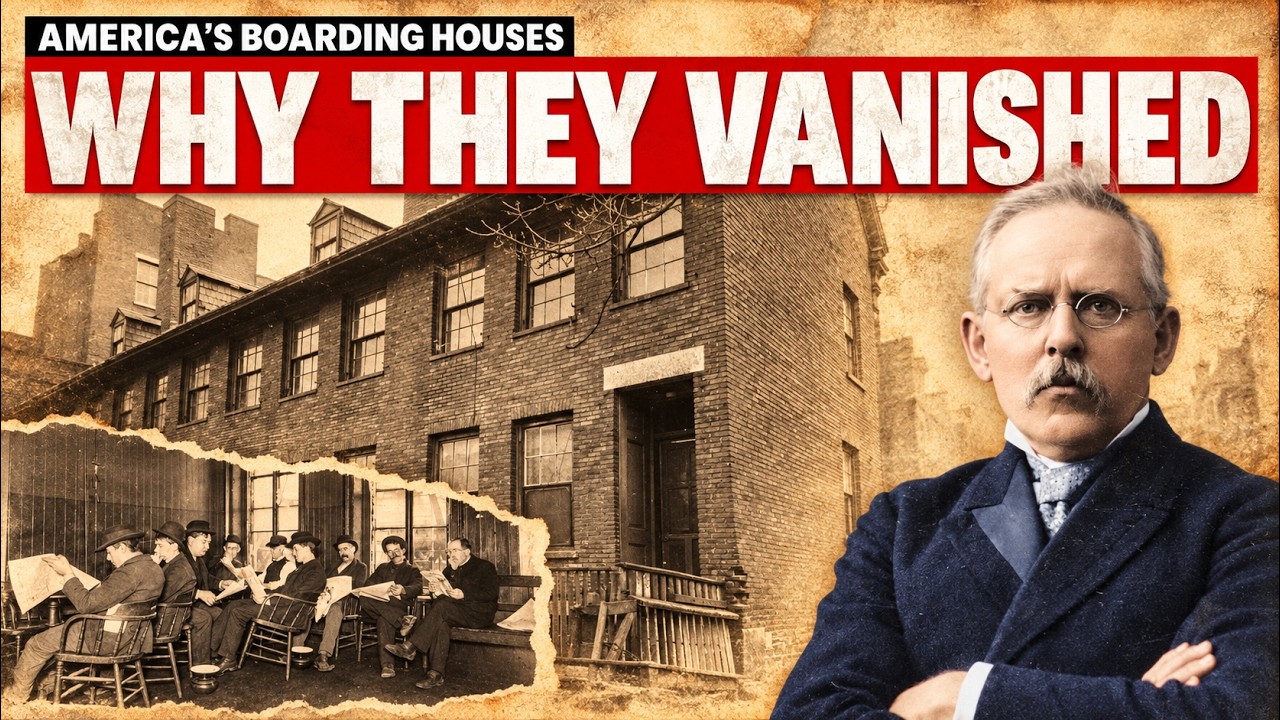
According to historian Wendy Gamber, whose study of the boarding house in nineteenth-century America remains the definitive account of this vanished world, this system was not an exception but the rule. In Boston in the 1830s, between a third and half of the entire population lived under this arrangement. By 1860, the city had 583 licensed boarding establishments concentrated in the West End and South End. In Philadelphia, roughly one in four houses took in boarders.
In New York, boardinghouses accounted for a staggering share of all available housing stock for a century. The reality of these establishments varied enormously. There were respectable middle-class houses where young clerks and bookkeepers in starched collars dined alongside widowed matrons. There were elegant establishments catering to visiting lawyers and merchants, with silver in the dining room and a piano in the parlor.
There were working-class houses where Irish longshoremen or German brewers crammed four to a room and ate stew by lantern light. There were houses for actors, sailors, medical students, young women seeking marriage, Chinese laborers, Jewish immigrants, and black workers in the segregated North. In New York in 1869, the cost ranged from $2. 50 a week at the low end to $40 a week at the high end.
There was something for everyone because almost everyone used them. The structure was simple and ingenious. A proprietor, usually a woman, usually a widow, usually operating out of a converted single-family home, rented individual rooms to tenants. In exchange for a weekly fee, boarders received a private sleeping space, shared bathrooms, two meals a day served family style, and often cleaning and a watchful eye on their comings and goings.
Lodging houses provided only the room without meals. Rooming houses, which emerged later, were more impersonal and transient. Together they formed what housing scholars now describe as a complete ecosystem of affordable urban living, a layered market where a newcomer with almost nothing could still find a dignified place to sleep. The system worked because it matched the shape of urban life.
The population of the United States quadrupled over the course of the nineteenth century. Immigrants poured off ships, and the Industrial Revolution pulled young men and women out of the countryside into cities where they knew no one. Most had no savings, no credit, no family nearby, and no interest in signing a year-long lease on an apartment they could not afford to furnish. The boardinghouse solved all of that in one stroke.
You showed up, paid a week’s rent, and got a bed and dinner that night. If you lost your job, you moved out the next week. If you got a better one, you moved up to a nicer house across town. Flexibility was the point.
Affordability was the point. Community was the point. The women running these houses were not peripheral figures. They were, in many cases, the first large wave of female entrepreneurs in American urban history.
Boarding housekeeping was, as Gamber put it, women’s work. Landladies met prospective tenants, collected rent, enforced house rules, planned menus, and presided over the dinner table every night. In an era when a woman could rarely own property outright or find a respectable path to earning real money, running a boardinghouse was one of the only ways a widow or single woman could support herself and her children without becoming a domestic servant or mill worker. One study of nineteenth-century New York State found that women who kept boarders earned between 18 and 23 dollars per boarder annually, often enough to pay the rent on the entire house with margin to spare.
Around the same time, a related form of cheap housing emerged: the single-room occupancy hotel, or SRO. Where boardinghouses operated in converted private homes with meals included, SROs were purpose-built or converted hotels and apartment buildings where a tenant rented one small room, usually without a private kitchen or bathroom, with communal facilities down the hall. By 1950, SROs made up roughly 10 percent of all rental housing in some major cities. New York alone had more than 200,000 SRO units at that peak.
San Francisco may have had as many as 90,000 at the start of the 1930s. For millions of Americans, especially single working men and women, elderly people on fixed incomes, recent immigrants, and seasonal laborers, the boardinghouse and the SRO were the main housing market. They were the floor. They were the entry point.
They were the safety net. Then the entire ecosystem came apart, dismantled by zoning laws, building codes, tax policy, federal subsidies, and cultural pressure stacked together over the course of about seventy years. The first wave began in the 1880s with the Progressive Era urban reform movement. Reformers in cities like New York, Boston, Philadelphia, and Chicago looked at the overcrowded tenements, saloons, and disease outbreaks and decided the solution was moral and architectural uniformity.
The ideal, laid out in the writings of influential reformers like Lawrence Veiller, was the detached single-family home occupied by a nuclear family. Everything else, in Veiller’s words, had a very bad effect on American life. Multi-family dwellings were suspect. Shared housing was suspect.
The culture of the boardinghouse, with its unmarried men and women living under the same roof, its women earning independent income, its communal meals, and its mixing of social classes, was reframed as a social and moral problem. The 1905 book The Lodging House Problem in Boston called shared living a grave and far-reaching social problem. One mid-century New York critic sneered that there were not ten boardinghouses in the city that did not contain improper characters. The moralistic language covered an anxiety about class, immigration, race, and the growing economic independence of women.
Moral disapproval alone could not kill a housing form that served millions. For that, the reformers needed law, and in the 1910s they found it in zoning. The first comprehensive American zoning code was enacted in New York in 1916. By the mid-1920s, with the publication of the Standard State Zoning Enabling Act, drafted with Veiller’s involvement, cities across the country rushed to adopt their own laws.
These laws were almost universally written to protect single-family residential districts from everything the reformers disliked, including boardinghouses, lodging houses, SRO hotels, and apartment buildings. Vast swaths of American cities and almost all of their suburbs were designated single-family only zones. In these zones, you could not legally build a boardinghouse, operate a rooming house, run an SRO, or even subdivide an existing large home to take in paying tenants. In many cases, even letting a cousin or lodger live in a spare room was technically illegal.
Then came the second wave, this time from the federal government. In 1934, in the depths of the Great Depression, the Roosevelt administration created the Federal Housing Administration. The stated purpose was to revive the construction industry and make home ownership accessible to middle-class families. The actual effect was to pour an avalanche of federal subsidy into one very specific type of housing: the detached single-family home in a newly built suburb.
Between 1934 and 1962, the FHA and the Veterans Administration financed more than $120 billion worth of new housing. By 1972, the FHA had helped roughly 11 million families purchase homes. Before this subsidy, about 45 percent of American housing units were owner-occupied. By the end of the post-war boom, that number had climbed above 60 percent.
But the FHA’s underwriting guidelines strongly preferred new suburban single-family homes and disfavored multi-family buildings, older urban structures, and anything in a racially diverse neighborhood. The FHA’s manuals institutionalized redlining, with the result that only around 2 percent of the $120 billion in federally backed post-war housing went to non-white families. The federal government placed its enormous financial weight in favor of exactly the housing type zoning had already designated as the only acceptable kind. In 1947, the first Levittown opened on Long Island, with mass-produced houses sold at a scale and price that had never existed before.
The young workers and veterans who in a previous generation would have rented a room in a boardinghouse were now handed the keys to their own front door, backed by federal subsidy. Boardinghouse proprietors watched their most desirable tenants vanish. By the 1950s, the women who had run boardinghouses for decades were getting out of the business, partly because their core clientele were now homeowners and partly because the operation was becoming economically marginal. The third wave hit in the mid-1950s, as policy makers turned their attention to what remained of urban SROs and decided to finish them off.
In 1954, New York City’s housing maintenance code was amended to effectively prohibit any new privately built SRO construction. The following year, the city formally banned the creation of new SRO units. That same year, the city launched a tax abatement program called J51, which created direct financial incentives for landlords to convert existing SRO buildings into market-rate commercial hotels or office space. The economic calculation for owners became obvious.
The city was paying you to get rid of your low-income tenants. By the time the city tried to slow the process in the mid-1980s, more than 100,000 SRO units had already been lost in New York alone. Since 1955, roughly 175,000 SRO units have been eliminated from the city. New York went from about 200,000 SROs in 1950 to around 19,000 residential SRO rooms by the early twenty-first century.
Other cities followed the same arc, often more aggressively. In Chicago, 81 percent of the SRO housing stock disappeared between 1960 and 1980. In San Francisco, studies estimate that 40,000 residential hotel rooms were destroyed by urban renewal programs, with more than 6,000 lost in just five years. In Seattle, half of the downtown SRO stock, 16,200 units, was demolished between 1960 and 1973.
Minneapolis bulldozed its entire Gateway District in the nation’s first federally funded urban renewal project, launched in 1959. In Boston, SRO stock dropped from 35,000 units in the early 1950s to just 9,500 by 1968. Between 1955 and 2013, researchers estimate that nearly one million SRO units were eliminated nationwide through regulation, conversion, or demolition. This was not an accident of market forces.
The urban renewal programs of the 1950s and 1960s, backed by billions in federal dollars through the Housing Act of 1949, explicitly targeted the neighborhoods where SRO hotels and cheap lodging houses were concentrated. The buildings were condemned, the residents scattered, and the land handed to private developers for convention centers, luxury hotels, office towers, and high-end residential projects. What disappeared was not just buildings but social infrastructure. These neighborhoods had cheap single rooms, cheap diners, informal labor markets where a man without a permanent address could still find a day’s work, bars, missions, pawn shops, and the small ecosystem of institutions that let people living on the margins hold on to some version of normal life.
When urban renewal demolished them, it erased the network that had kept hundreds of thousands of marginal Americans housed, fed, and connected to work. The bill arrived in the 1980s. With the SRO stock gutted, zoning making it illegal to build cheap new shared housing almost anywhere, federal housing subsidies cut to roughly a tenth of their late 1970s level, and the deinstitutionalization of psychiatric hospitals pushing thousands of mentally ill Americans into communities with nothing left to catch them, modern mass homelessness erupted. The homeless population grew from a little over 100,000 in 1980 to around 200,000 in 1984, to roughly 400,000 by 1987 and 1988.
In the 1970s, there had actually been more rooms in flop houses than people who needed to rent them. By the early 1980s, the demand for cheap single rooms during the recession exceeded the dramatically shrunken supply, and the people who could not get in ended up on the sidewalks. A 2025 Pew Charitable Trusts analysis put it bluntly: as the nation’s least expensive source of housing disappeared, homelessness soared in major cities across the United States. One New York housing advocate summarized the loss: the people you see sleeping under bridges used to be valued members of the housing market.
They are not anymore. Most of the land in most American cities is still legally restricted to single-family housing. In many metropolitan areas, more than 70 percent of residential land is zoned exclusively for detached homes on individual lots. Building anything denser, cheaper, or more communal is illegal across the vast majority of residentially zoned terrain.
The lowest rungs of the housing ladder were removed by law. The story reads like a transfer of wealth. Suburban homeowners won because single-family zoning protected the market value of their houses by restricting supply. Developers of high-end housing won because prime downtown land was handed to them at bargain prices through urban renewal.
Banks and mortgage insurers won because the federal subsidy pipeline for suburban home loans turned residential real estate into one of the most profitable sectors in the economy. Local governments won in the short term because converting cheap SRO buildings into luxury apartments generated far more property tax revenue per square foot. The people who lost are the ones still visible on the streets: single working people, immigrants, women who lost one of the few paths to independent urban income, elderly people on fixed incomes, the mentally ill, and low-wage workers who lost the possibility of walking to work from a cheap room near downtown. A slow reckoning is underway.
In 2024, Washington state passed a law requiring cities and counties to permit single-room occupancy or co-living housing in areas zoned for multi-family use. Philadelphia has pushed to legalize single-room residences across the city. Boston is studying whether a return of SROs could help address its housing crunch. A nonprofit in Los Angeles has created dwellings for more than 2,000 formerly homeless people in what used to be condemned residential hotels.
But reversing a century of policy is slow and politically brutal. Every attempt to legalize cheap shared housing runs into fierce opposition from existing homeowners using the same language the progressive reformers used in the 1890s: these are the wrong kind of residents, property values will fall, the character of the neighborhood will change. The fingerprints of Lawrence Veiller and the Standard State Zoning Enabling Act are still visible on every planning commission meeting where a modest proposal to legalize a few duplexes goes down by three votes to two. The infrastructure of exclusion is still in place.
The ladder is still broken. The vanished boardinghouses of nineteenth-century America are not just a lost chapter of history. They are a reminder that the country once had a working model for cheap urban living, that it served millions of people for over a hundred years, and that it was destroyed on purpose.
Whether something like it can be built again is now one of the most consequential questions facing American cities.






