Maria Anna of Spain died on the morning of May 13, 1646, bleeding to death after doctors cut her sixth child from her womb in a desperate attempt to save the infant. The child lived only a few hours. Mother and son were buried together in the Imperial Crypt in Vienna. She was thirty-nine years old, and the Thirty Years’ War that had defined her adult life would drag on for two more years.
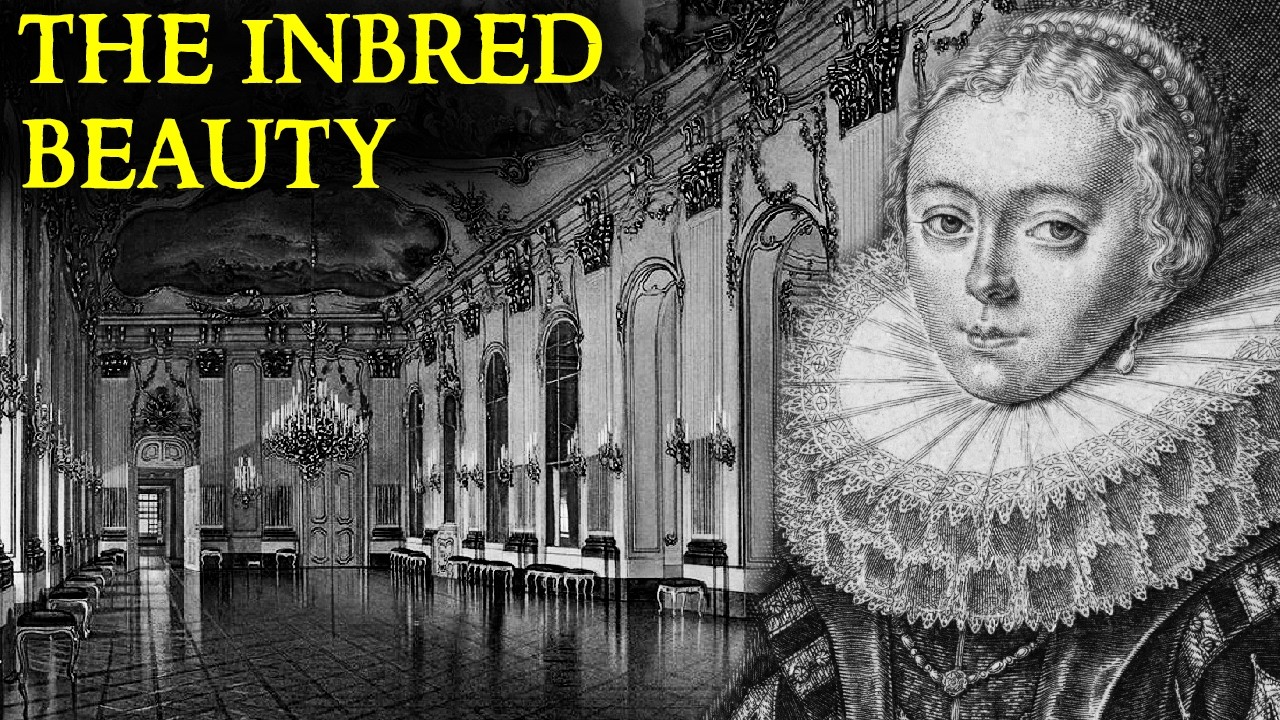
Her death was the final tragedy in a life shaped by a dynasty’s obsession with keeping power within the family. Born at El Escorial on August 18, 1606, Maria Anna was the daughter of King Philip III of Spain and Margaret of Austria, his first cousin once removed. The match was typical of the Habsburgs, who ruled two vast branches of the family and reinforced their power by marrying each other again and again. The Spanish Habsburgs controlled an empire stretching from Madrid to the Americas, the Low Countries, and parts of Italy.
The Austrian Habsburgs dominated central Europe. But generations of intermarriage had turned the bloodline into a genetic time bomb. Maria Anna’s parents both descended from Philip II of Spain and his niece, Archduchess Anna of Austria. Her mother’s parents were also uncle and niece.
Maria Anna was related to herself through multiple branches of the same twisted family tree. Remarkably, she showed no visible signs of the famous Habsburg deformities. Later generations would not be so lucky. She was the fourth child of her parents.
Her older sister Anna became queen of France, and her older brother became King Philip IV of Spain in 1621 after their father died prematurely at forty-two, likely from typhus or influenza. With Philip III gone, the new king took control of Maria Anna’s fate, and her marriage became a major diplomatic affair in European politics. The most dramatic proposal was the so-called Spanish Match. The idea was to marry Maria Anna to Charles, Prince of Wales, heir to the thrones of England, Scotland, and Ireland, uniting two historic rivals through marriage.
Negotiations began in 1621, and in 1623 Prince Charles and the Duke of Buckingham traveled to Spain in disguise to advance the talks. At first things seemed to go well, but the negotiations broke down. Charles felt he had been treated poorly and returned to England. The marriage plans did not simply collapse; they imploded, triggering outrage and scandal that led to open war between England and Spain by 1625.
The conflict lasted five years. Philip IV now needed a new husband for his sister, and he found one within the family. In 1626, Maria Anna was betrothed to her cousin, Archduke Ferdinand of Austria, son and heir of Emperor Ferdinand II. Ferdinand was the younger brother of Archduke John Charles, who had once been proposed as Maria Anna’s husband before his death in 1618.
The marriage negotiations dragged on for two years over disputes about the dowry and succession rights. Finally, in late 1629, Maria Anna left Spain for Vienna. The journey took more than a year, delayed by a devastating outbreak of bubonic plague in Italy, one of the worst the region had seen in early modern history. Before the wedding, Ferdinand, wary of the idealized portraits he had received, decided to inspect his bride in secret.
Only after this private viewing did he agree to proceed. On February 20, 1631, Maria Anna married the future Emperor Ferdinand III in Vienna. At twenty-four, she was considered an old royal bride, but her husband was just a year younger. Despite the political nature of the match, the marriage proved genuinely warm and affectionate.
Ferdinand remained faithful to her throughout their union, a rarity among royals of the era. Her cheerful, lively nature balanced his more solemn personality. But their marriage unfolded against the brutal backdrop of the Thirty Years’ War. Germany had been divided over religion since the Protestant Reformation began in 1517, and intermittent wars between Catholics and Protestants had simmered throughout the sixteenth century.
The conflict boiled over again in 1618 when the Protestants of Bohemia resisted Habsburg efforts to reimpose Catholicism in Prague. The Bohemian War expanded into a wider European conflict. In the early 1620s, the Habsburgs won victory after victory and seemed close to imposing their authority over all of Germany. But to prevent a Habsburg triumph, other Protestant powers intervened.
Denmark entered the war in 1625, followed by Sweden in 1629. Their armies pushed the Habsburgs southward from Germany toward Austria and Bohemia. Entire cities were reduced to rubble. By the time Maria Anna arrived in Austria, the war had already claimed hundreds of thousands of lives, and the worst impact was felt by the civilian population.
Farms were burned, towns were destroyed, famine spread. Estimates put the total death toll between four and ten million people, making it the most destructive war in early modern Europe. Even inside the gilded walls of the Habsburg palaces, the suffering outside could not be ignored. From the moment of her marriage, Maria Anna became queen consort of Hungary and Bohemia.
In 1637, following the death of her father-in-law, her husband was elected Holy Roman Emperor, and Maria Anna became Empress at one of the most critical moments in European history. France, though broadly Catholic, had intervened directly in the war from 1635 onward to keep the Protestant German states alive and reduce Habsburg power. The Austrian Habsburgs needed their Spanish cousins more than ever. Maria Anna became a vital point of contact between the two governments, writing regularly to her brother, King Philip IV, urging him to continue the war against the French and keep aiding the Austrian side.
With her husband frequently away leading military campaigns across Germany, Ferdinand entrusted her with real power, appointing her as regent on multiple occasions. It was a rare honor that reflected his trust in her judgment and political skill. But another royal duty loomed as well. Royal women were expected to produce as many children as possible, since one in three died in infancy and others were claimed by diseases like measles and smallpox.
The only way to secure the royal line was to have many children, preferably sons. Maria Anna was regularly pregnant. The eventual heir, the future Ferdinand IV, was born in September 1633. A daughter, Mariana, followed in December 1634.
In a worrying escalation of inbreeding between the Austrian and Spanish Habsburgs, she would later marry her uncle, King Philip IV of Spain. A second son, Philip Augustus, was born in 1637 but died before his second birthday. A third son, Maximilian, did not reach his first. Finally, a healthy second heir was born in 1640.
Named Leopold, he would eventually succeed to the Habsburg domains in the late 1650s and become one of the longest-reigning and most successful Habsburg rulers in the family’s nearly nine-hundred-year history. As the 1640s went on, Maria Anna and Ferdinand most likely believed Leopold would be their last child. Maria Anna was nearing forty. So when she unexpectedly became pregnant again in late 1645, it came as a shock, a final twist in an already turbulent life.
This sixth pregnancy would end in tragedy, in part because of the disordered state of Austria in 1646. The Swedes, with French aid, had gained the upper hand in the war and were advancing southward into Bohemia and Austria. Maria Anna and her family were at a royal residence in Linz when word arrived of the rapid advance of enemy forces into lands previously considered beyond their reach. In a panic, the royal family fled to Vienna as the enemy closed in.
The court was in turmoil. The empire was crumbling at the edges, and Prague would eventually fall to the Swedish army before the war’s end. Amid this chaos, Maria Anna became pregnant with her sixth child. Then the plague arrived in Vienna.
The safest way to avoid it was to escape the city and take up residence in a country house away from other people. Maria Anna and her children headed back to Linz despite the dangerous military situation. Shortly after arriving, she became ill. Her condition deteriorated over the following weeks, and on May 12, 1646, she began to bleed heavily.
The doctors concluded that the only chance of saving the child was to cut it out of her, a dreadful practice all too common in the early modern world. Maria Anna died from blood loss early the next morning. She was buried with her infant son in the Habsburg Imperial Crypt in Vienna. The Thirty Years’ War continued for two more years, ending with peace negotiations at Westphalia and Osnabrück.
The Habsburgs had to accept defeat, and a principle was established that European states could no longer intervene in the religious affairs of other countries. Despite their love, Maria Anna’s husband would marry twice more. But it was the sons and daughters he had with Maria Anna who would go on to rule in Austria and produce the future kings of Spain.