Some men haul a story around the way other men haul an injury. They steer wide of it. They choose their clothes to conceal it. And when a stranger knocks, they take their time coming to the door, because an injury has to be set in order before anyone can look at it without flinching.
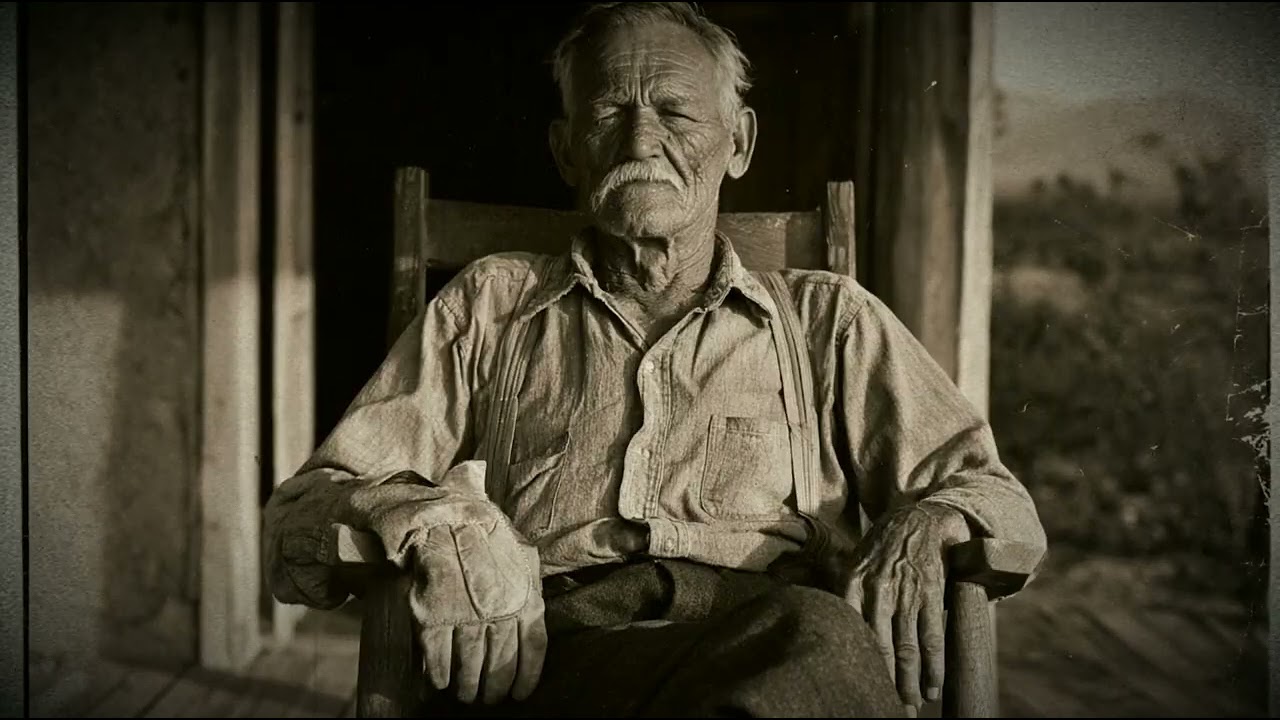
The man I am about to describe to you hauled his for seventy-one years. He was ninety-five when he finally spoke of it, and he spoke of it only once. The house stood on a dry rise above the Santa Cruz River, three miles south of Nogales, Arizona. Cinder block walls painted the shade of a mourning dove, a tin roof turned brown by thirty summers of desert weather.
A rocking chair waited on the porch, and in that chair, when I pulled up that morning, sat the man I had come to meet. He was ninety-five years old. His name was Absalom Kettering. A woman from the county nursing service had given me his name.
She had been calling on him twice a week for two years, ever since his sister died. One afternoon he had asked her, seemingly from nowhere, whether she believed a man could carry something to his grave and be forgiven for keeping it. She had told him she thought so. She had told him she believed God accepted a man’s silences the same way he accepted his prayers.
He had shaken his head at that, and said, “I do not believe it works that way for what I am carrying.”
That is how I came to be on that porch in the middle of July 1960, with a tape recorder in a canvas bag, a notebook, and a very old man who took a long while to look at me because his eyes had gone milky at the rims and needed a moment to make out a new shape. When he finally found me, he said in a voice smaller than his body, “You are the one who wants to hear about the canyon.” I told him I was.
He said, “Sit down.” And I sat. Absalom Kettering was born in Tucson in the Arizona territory in the summer of 1865. His father was a wheelwright out of Pennsylvania who had followed the war west and never returned home.
His mother was a Sonoran woman from a family that had lived in the same valley beneath the Baboquivari peaks for six generations. She spoke Spanish and English and a little Tohono O’odham, and she taught all three to her son, along with something else that would matter later: the habit of listening when the land asks a person to keep quiet. By the age of twenty-two, Kettering was a civilian scout attached to the 10th Cavalry, stationed out of Fort Huachuca. He was not a soldier.
He was a man on a horse, paid a modest wage to ride ahead of soldiers and to know what the country was going to do before the country did it. He was quiet. He was patient. He was good at the work.
In the summer of 1889, he was twenty-four years old. That was the summer of the canyon. You have to understand something about that border in those years. The line drawn on a piece of paper in Washington did not amount to much on the ground.
Men crossed it back and forth as if it were the shadow of a fence. Cattle crossed it. Silver crossed it. Trouble crossed it.
Under an agreement signed in 1882 between the United States and Mexico, patrols on either side were allowed to cross in pursuit of raiders. Officially, there were rules. Unofficially, out there among the ridges of the Sierra Madre, there were only the rules a captain invented as he went. That July, a small band of raiders had hit a ranch outside the town of Patagonia.
They had taken horses. They had taken silver. They had left one of the ranch hands dead, wrapped in a blanket, laid out at the door of the main house with his hat on his chest. That last detail — the hat, placed with care — was the part that troubled Captain Osgood Merryweather more than any of the others.
It was the part that made him say, when he ordered the patrol out, “This is not the usual thing.”
The patrol was small: five soldiers, a civilian scout, a local guide. Kettering was the scout. The soldiers were four Buffalo Soldiers of the 10th Cavalry, commanded by Sergeant Wharton Blazedell, a slow, careful man from Kentucky with a beard the color of wet ash and hands so large they seemed to belong to a bigger person than the one he was.
Under him rode Corporal Emmitt Doss, a man of about thirty who had come up from Louisiana and had a soft, slightly whistling voice from a jaw that had been broken at a place called Beecher Island. Private Vernon Radlaw, twenty-three, freckled across the bridge of his nose, quiet, homesick, always writing letters to a sister in St. Louis. And Trooper Callum Isby, an Irishman from New York, forty and going gray, who never talked about how he came to be there and who read a small leather-bound Bible each night by the fire without moving his lips.
The guide was a man named Donaciano Talamantes. Donaciano was Opata, from a village east of Bacuachi in Sonora. He was somewhere between sixty and seventy years old — no one, including him, knew exactly. He had guided American and Mexican patrols across those mountains for thirty years.
He had a face the color and texture of old saddle leather, and eyes the color of riverbed stones, and he wore on a thin cord around his neck a small carved thing that Kettering never got a good look at and never asked about, because Donaciano did not invite that kind of question. Those seven men left Fort Huachuca on the morning of the 12th of July, 1889. Six days later, only two of them were still alive. I want to slow down there for a moment, because if you are already leaning in a little, I want to ask you something before I take you into what happened.
I want you to tell me whether you have ever been in a place that felt wrong. Not haunted. Not scary. Just wrong.
The way a room feels wrong when the pictures have all been rehung an inch off from where they were. A place where nothing was happening, but something was watching what was not happening. Because Kettering used almost exactly those words on that porch seventy-one years later. He said it was not that anything was wrong.
It was that nothing was wrong. And it should have been. The trail south of the border led through the low grass country first — flat, dry, dotted with mesquite and yucca, the ground crackling under the horses’ feet. They followed the raiders’ sign for two days without seeing anything unusual.
The sign was plain to read. Eight horses, one of them hurt, two carrying heavier loads, all headed southeast in the direction of the Sierra. Donaciano took the lead. Kettering came after him.
Behind them the soldiers followed in a straggling line, rifles resting across their thighs, canteens tapping the saddle horns in a gentle, steady beat that a man stops noticing within the first hour and only recalls afterward, as though the land itself had made the sound. On the second afternoon they reached the town of Mineral de Ánimas. I should tell you about that town. Twenty years before, Mineral de Ánimas had been a silver camp of maybe two thousand people.
For a time the vein ran rich. There had been a hotel, two cantinas, a little stone church, a Chinese laundryman, and a woman from Zacatecas who kept a boarding house said to be the cleanest place between the border and Hermosillo. Then the vein grew thinner and thinner, and at last it ran out, the way veins do, into a wall of rotten quartz that yielded nothing. The town died along with it.
By the summer of 1889, Mineral de Ánimas held maybe forty people. Most of them were old. A few had drifted back once the mine failed because they had nowhere else to go. A handful scratched a little placer gold out of the arroyos when the rains came.
The others simply waited. They waited for the town to be finished. The patrol rode in from the north along a road that had once been wide enough for freight wagons and was now scarce wide enough for two horses side by side. The buildings flanking it had no roofs.
The doorways were black and hollow. In one of them a gaunt dog watched them pass without raising its head from its paws. In another an old woman in a black shawl sat on a low stool, grinding something in a stone bowl, and never looked up. The church was still standing.
It was small, whitewashed long ago, gray now. A wooden cross at the roof’s peak had lost most of its paint. Next to the church stood a small adobe that had served as the priest’s house. The priest came out to meet them.
He was a man of about fifty, short and thick-set, wearing a dusty black cassock patched at the elbows. His hair was thin and white at the sides and gone on top. His eyes were very dark and very weary, and nothing escaped them. His name was Padre Anselmo Vergara.
He greeted them in Spanish. Kettering translated for Blazedell. Blazedell explained politely that they were trailing a band of raiders who had hit a ranch in the Arizona territory and that they believed the tracks ran south. Padre Anselmo listened.
He nodded. He did not break in. When Blazedell had finished, Padre Anselmo asked Kettering in Spanish, “How far south? ” Kettering answered, “Into the Sierra.
” For a long moment Padre Anselmo said nothing. Then he asked, “Where in the Sierra? ” Kettering gestured vaguely southeast toward the ridges standing dark against the afternoon. Padre Anselmo shut his eyes.
Still speaking Spanish, and quietly, he said, “Do not go beyond the second ranch. ”
Kettering said, “Padre? ”
Padre Anselmo said, “There is a second ranch two days south. A man named Ochoa lived there with his wife.
If they are still there, they will feed you. Speak to them gently. They have lost animals. They have lost a hand who worked for them.
Do not go beyond that ranch. If your tracks lead past that ranch, let them go. Turn your horses. Come back.
Tell your captain he lost the trail. He will not be pleased, but he will be alive to be displeased. ”
Kettering translated only part of it. Blazedell asked what the Padre believed lay south of the ranch.
Kettering put the question to the Padre. For the first time since the conversation began, Padre Anselmo looked directly at Blazedell. His eyes rested on Blazedell’s face for a long while. Then in careful English, slow and thick with accent, he said, “I do not know, sir.
I have been a priest in this town for twenty-two years. I have buried men who died of the fever, of the drink, of the mine, of the knife, of the horse. I have seen what men do to one another in this country. I know how that looks.
What lies south of the second ranch, I do not know. I know only that in twenty-two years I have baptized every child, married every couple, and buried every dead person in this parish — except the men who went south past that ranch. Those men I did not bury, because those men did not come back to be buried. ”
He said there had been nine of them in twenty-two years.
Some were soldiers, some vaqueros, and one an American in 1879 who was hunting mountain lions. “I buried none of them. I said nine masses. That was all I could do.
”
Blazedell was silent. Then, in the gentle way he had with old men and horses, Blazedell said, “Padre, we thank you for the warning, but we have our orders. ”
Padre Anselmo nodded slowly. He did not appear surprised.
In Spanish he said to Kettering, “Tell your sergeant I understand. Tell him too that tomorrow morning I will say a mass for seven souls. If in a week no one has come to correct me, I will say another for seven bodies. ” Kettering did not translate that.
They watered the horses at the well behind the church. Padre Anselmo brought them beans and tortillas from his own kitchen and would take no payment. As they were mounting to leave, he came to Kettering’s stirrup and laid a hand on the boy’s knee — for Kettering at twenty-four was still a boy to him — and said softly in Spanish, “You have the look of your mother’s family. Are you from Baboquivari?
” Kettering said, “My mother was. ” Padre Anselmo said, “Then you were raised to listen. Listen to the guide. When the old man says stop, stop.
Whatever the sergeant says, stop. If you cannot make the others stop, at least stop yourself. Do you understand me? ” Kettering said, “Yes, Padre.
” Padre Anselmo said, “Go with God, son, and with more than God if you can. ”
They rode out of Mineral de Ánimas in the last hour of the afternoon. At the top of the rise Kettering glanced back once, and Padre Anselmo was still standing before his church in his patched black cassock, watching them. He watched them the way a man watches a coffin being carried out of a house.
On the third day they entered the foothills. The country altered. It reared up on its hind legs. Great red cliffs climbed on either side of them, split by dry washes and ancient riverbeds.
The air carried the scent of sun-baked rock and creosote, and now and then, so faintly that no one could trace it, a trace of woodsmoke. Kettering swept his eyes along the ridgelines. Nothing met his gaze. Donaciano did the same.
Donaciano likewise saw nothing, but he went about it more silently, in a manner that made Kettering glance at him a second time. On the afternoon of the third day, they reached a ranch. It was a modest place — three low adobe structures, a corral, a well. It stood abandoned.
Not lately, and not so very long ago. The doors gaped open. The corral held nothing but a scattering of dry bones within it, laid out in a fashion that Kettering first took for the ordinary handiwork of scavengers. He swung down from the saddle, walked into the corral, and stood over the bones, studying them for a long while.
Then he called Donaciano over. Donaciano entered through the gate, took his place at Kettering’s side, and said nothing. The bones belonged to cattle. Four complete skeletons.
The skulls had been set in a row, every one turned the same way — toward the east. The ribs were piled in order, the longest at the bottom and the smallest on top. The leg bones in each case were laid in a square about the skull, four sides meeting at the corners. No flesh remained on any of them.
There was no odor. The bones were clean and dry and pale and aged, and their arrangement was too deliberate to be chance and too peculiar to be a prank. Donaciano examined the bones. He examined the ranch buildings.
He examined the eastern ridge above them, where the sun was beginning to slip down behind a jagged skyline of stone. In Spanish he said, “We should not sleep here.”
Sergeant Blazedell was inclined to. The well held water.
The buildings offered shade. The horses were worn out. Blazedell was no fool, but he was a man of practical bent, and to his mind a set of arranged bones was a curiosity rather than a caution. Donaciano shook his head a single time and would say nothing further.
They slept there. Nothing occurred that night. That was the part, Kettering said, that stayed with him most vividly seventy-one years afterward. Not a sound.
Not a howl. Not a breath of wind. The horses did not startle. The fire did not flicker.
Nothing occurred. And when he woke in the gray hour before dawn, he lay on his blanket, gazing up at the adobe ceiling, and he thought: something did occur, and I cannot say what. They rode out at first light. By midday they had climbed high enough to look down upon the country they had crossed, and from that height it resembled a vast yellow-brown sea, and the ranch had already vanished into its folds, and Kettering felt, for reasons he could not name, relief.
He glanced at Donaciano, who rode a few paces ahead of him, and Donaciano did not turn but said in Spanish, quietly enough that only Kettering caught it, “Do not look back at it again.” Kettering did not look back. They came upon the second ranch late that afternoon. This one was inhabited — or had been until very recently.
Fresh coals lay in the fire pit outside the main building. A pot half full of beans, cool but not cold. A door stood open with a shirt half tucked into a laundry basket. Two milk cows in the corral, alive, unmilked, lowing.
And beside the water trough, three dogs — big brown dogs of the sort Sonorans kept for guarding. All three dead. Not a single mark on them. Not a single drop of blood.
Their necks were unnaturally straight. Their eyes were open. Doss knelt beside them. He was not a man easily unsettled.
He had grown up on a farm outside Baton Rouge, and he knew what a dead dog looked like. He turned one of them over gently. He looked up at Blazedell. He said, “Sergeant, I do not know what killed these animals.”
Blazedell asked what he meant by that. Doss said, “There is nothing wrong with them. They are just dead.”
Donaciano would not go near the dogs.
He remained at the edge of the yard, holding the reins of his horse and Kettering’s, and he watched the ridge above the ranch with a stillness that was not the stillness of a calm man. It was the stillness of a man who has resolved not to move, because moving would betray to something above him where he was. Blazedell wanted to bury the dogs. Donaciano said in Spanish, so quietly that Kettering had to lean toward him to catch it, “Do not touch them.
Do not touch anything in this place. We ride.”
They rode. They did not sleep that night either.
They rode until moonrise. And then, in a shallow arroyo well clear of any building, they made a cold camp. No fire. Blazedell set double watch.
The horses stood in a tight little cluster, ears twitching. And in the darkness, somewhere out beyond the arroyo, Kettering heard a sound he never forgot. It was a voice. His mother’s voice.
His mother had died in 1882, of the same fever that had taken his sister seven years before. She had been buried in a cemetery outside Tucson. Kettering knew her voice the way a man knows the sound of his own breathing. And out there in that darkness, somewhere past the mesquite, someone was speaking with his mother’s voice.
She was saying his name. Not calling. Speaking the way she used to, standing at the back door of their house on Meyer Street when she wanted him to come in for supper. Absalom.
Absalom. He did not move. He did not answer. He lay very still on his blanket with his rifle across his chest, and he looked up at the stars, which had never before in his life seemed so far away.
And he listened to a voice he had loved and buried speak his name, over and over, from a place where it had no business being. At some point it ceased. He did not sleep. In the morning, Doss came over to him, sat down, and said nothing for a while.
And then Doss said very quietly, “Kettering.” Kettering looked at him. Doss said, “Last night. Did you hear anything?”
Kettering said, “Yes.” Doss said, “Whose voice was it?” Kettering said, “It was my mother’s.” Doss looked at his boots for a long time.
Then he said, “Mine was my father.”
Kettering asked quietly, “How long?” Doss said, “I do not know. A while.”
Kettering asked, “What did he want?” Doss did not answer at first. Then he said, “He wanted me to come to him. He said he was cold.
He said he had been cold a long time, and if I would come, he would not be cold anymore. He said he was just past the mesquite. He said I would find him if I walked a little.” Kettering asked, “Did you know his voice?”
Doss said, “Kettering. My father passed when I was eleven years old. That was nineteen years ago. I did not believe I still carried his voice in my memory.
I was mistaken. Every word of it was still there. I recalled precisely the way he spoke my name. I have not heard that sound since 1870.
And last night I heard it out beyond the fire, as plain as I hear yours right now.”
Kettering remained silent. Doss said, “Do not let me leave camp at night. Do you hear me?
I do not know whether I will have the strength. Do not let me go.” Kettering said, “I hear you.” Doss said, “Say it back to me.
So that I know.” Kettering said, “I will not let you go, Emmitt.” Doss nodded. He rose.
He left the fire and went to check on his horse, and he never mentioned it again. Later that same morning, Isby approached Kettering. Isby was never a man of many words. He sat down on a rock beside Kettering, drew out his small leather Bible, opened it without reading, closed it once more, returned it to his coat pocket, and said in his flat New York voice, “Kettering.
My mother’s name was Ailene. She has been gone thirty-one years, and she wants me to visit her in a stand of ocotillo roughly a hundred yards from where I slept last night. What do we do?” Kettering said, “We do not go.
” Isby said, “That is what I figured.” Isby rose. He returned to his own spot beside the horses. From that moment on, he never slept more than an hour at a time — until the day he failed to come out of the adobe.
They said nothing to Blazedell. They could not say why. Kettering pondered it afterward for a long while, and the nearest he ever got to an answer was this: all of them had understood, without putting it into words, that telling the sergeant would force him to make a choice, and they did not want to put him in that position. Because a sergeant confronted with a tale like that has only two choices before him.
He can order the patrol to turn back, or he can act as though the tale means nothing. And Blazedell was too honest a man to act, and too dedicated a man to turn. They did not want to compel him. So they kept silent.
They saddled their horses and rode on. Radlaw, the young private, they learned midway through the fourth day, had heard nothing whatsoever — which seemed odd to Kettering at the time, and which afterward seemed to him the first faint sign of what was going to befall Radlaw in particular. By the close of the fourth day, they had climbed far enough into the Sierra that the raiders’ trail had begun to fade. Tracks remained, but they were older now than they ought to have been.
It was as though the men they pursued had been slowed, or had halted, or had been carried somewhere off the visible path of their journey. Donaciano said that evening at their fire, “We should turn back.” Blazedell said, “We have orders.” Donaciano said, “Then let me leave you here.
I will wait at the second ranch. I will go no further.” Blazedell studied him for a long moment across the fire. Then he said gently, because he was a decent man in his unhurried way, “You have brought us this far, old friend.
I need you a little longer.” Donaciano made no reply. He stayed. That was the night Radlaw vanished.
He had walked to the far side of a boulder about thirty yards from the fire to relieve himself. It was well inside the ring of the pickets. There was nothing amiss about any of it. Doss watched him go over his shoulder, the way a man watches a friend do a thing that requires no watching.
Doss then turned back to the fire and said something to Isby, some trifle, some jest about a plate of beans. And when he looked back, Radlaw was not returning. He waited a moment. Then he called out softly.
The name belonged to a young man, and it sounded loud in the darkness. Radlaw. Nothing. Radlaw.
Nothing. The soldiers spread out in a line, rifles at the ready. They located the spot. They found the boot prints in the sand.
They found nothing besides. No struggle. No blood. No trail.
His footprints ended as though he had risen into the air and remained there. They searched for him two hours. They fired signal shots. They shouted his name until their voices gave out.
They found him just before dawn. He was walking slowly back into camp from a direction that was not the one he had gone in. His trousers were properly fastened. His rifle hung correctly on his shoulder.
His hat was on his head. He walked steadily. He did not falter. His eyes were wrong.
Doss noticed it first. He placed a hand on Radlaw’s shoulder and turned him gently toward the firelight and studied his face. Then Doss stepped back and said nothing, and looked toward Blazedell instead. Blazedell came over.
He examined Radlaw’s face. Radlaw said, in a voice that was Radlaw’s but slower than usual, “I saw my brother.” Blazedell said, “Your brother.” Radlaw said, “He was walking through the mesquite.
He was calling me. He asked me to come with him.” Blazedell said, “Radlaw, you do not have a brother.” Radlaw looked at him.
Radlaw said in the same slow voice, “I do now.”
He would say nothing more. He drank water. He sat by the fire.
He stared into the fire without blinking for the remainder of the morning. When they saddled the horses and mounted, he mounted correctly with them and rode in his place in the column and did not speak for the whole of that day. Donaciano would not look at him. That afternoon they reached the canyon.
It was not on the map. They knew the map. They had pored over it three nights in a row. There was no canyon in that place.
The map showed a ridge and a dry wash beneath the ridge, and the wash was meant to curve south and empty into a wider valley. What they found instead was a tear in the earth — a narrow, deep, straight-walled cut running west to east, with dark stone on both sides, and a floor of pale, dry sand that in the late light seemed to hold almost no shadow at all. The mouth of the canyon opened directly before them. The raiders’ sign led into it.
Every hoofprint they had trailed for six days. Every mark left by every horse and every man crossed the sand without hurry and vanished into the canyon and emerged nowhere else. Donaciano reined in his horse. He said, “I will not go into this place.
” Blazedell said, “Isidro. ” Donaciano answered in Spanish, and for the first time on that patrol his voice trembled: “Sergeant, I have crossed these mountains for thirty years. I have been through canyons no white man has walked. I have slept in caves where the paintings were older than my grandmother’s grandmother.
And I am telling you, I will not go into this place, and neither should you. What lives here does not want your dead men. It wants your names. ”
Blazedell said nothing for a long while.
Then he said, “Wait for us at the mouth. If we are not out by tomorrow evening, ride. ” Donaciano shut his eyes. He said in Spanish, so quietly that Kettering thought he might have imagined it, “I will wait for one of you.
I will not ride until I see one of you again. It is what a man owes. ”
The soldiers rode into the canyon. Kettering rode with them.
Donaciano held his horse at the mouth and did not turn to watch them go. Inside the canyon, the light shifted almost at once. It was not that the sun failed to reach the floor of it. It did.
It came down slantwise from above and lit the pale sand and cast a hot white glare against the eastern wall. But the light seemed thinner somehow, as if much of it were being consumed by something that could not be seen. Kettering, riding second behind Blazedell, felt the horse beneath him shorten its stride and drop its head, and halt once, and then go on reluctantly when he pressed his heels to it. The canyon curved.
They followed it. They saw no one. They saw no bones, no fire, no trace of the men they had been following, though the tracks were now, if anything, sharper — as if the ground here held prints better, as if the sand were kinder to whatever passed over it. After about half a mile, they came around a bend, and they saw the building.
It was an adobe. Small. Old. Half fallen in.
It stood against the north wall of the canyon in a wide place where the floor opened out. It had a door and it had a window, and the window and the door were the same shape — a shape Kettering could not, seventy-one years later, describe accurately. He said only that it was not right. The angles were not right.
They were close to right. That was the worst of it. There was a smell. Not a bad smell.
Not decay. Not smoke. Not blood. A smell of something clean and old and mineral — like a deep well, like a stone floor in a cellar that has not been opened in a hundred years.
Blazedell dismounted. Doss and Isby dismounted. Radlaw dismounted. Kettering dismounted because he had been told to, and because he did not know what else to do.
They approached the building. The door stood ajar. Blazedell went first, rifle up. Doss went second.
Kettering went third. Isby stayed outside with the horses at Blazedell’s order. Radlaw stood in the sand and looked at the sky. The inside of the adobe was one room.
It was empty of furniture. It was empty of belongings. It was empty of any sign that any human being had ever lived in it. The floor was hard-packed earth, swept clean.
The walls were bare, and though the roof had partly fallen in, no debris lay on the floor. Everything that should have been there had been taken away — or had never been there at all. In the center of the room was a slab. A rectangular block of dark stone, waist high, flat on top, perhaps six feet long, perhaps three feet wide.
It had not been carved. It looked as though it had been quarried from a single piece of the canyon wall and set there, though there was no seam or scar in the walls to suggest where it had come from. On the slab lay a body. It was the body of a man.
He was naked. His hands were crossed on his chest. His feet were pressed together. His head lay on the stone without any pillow at all.
His eyes were closed. His mouth was closed. His hair was dark and long and fell down around his shoulders and over the edge of the slab, and it seemed, in the dim light of that room, to be the only part of him that had any color at all. The rest of him was pale — not the pale of a corpse, the pale of a candle, of a moth’s wing, of something that had never been under a sun.
Doss made a soft sound in his throat. Blazedell said very quietly, “Kettering. ” Kettering did not answer. Blazedell said, more firmly, “Kettering.
You have the languages. You have the eye. Go and look. ” Kettering said, “Sergeant.
” Blazedell said, “Look. ”
Kettering — who was twenty-four years old, and who had ridden into a canyon that was not on the map, and who had heard his dead mother speak his name, and who had watched Vernon Radlaw walk in from the wrong direction with the wrong eyes — took a step forward toward the slab. He looked at the body. He looked at the face.
The face was hard to hold in his mind. That was the thing that struck him first. He looked at the nose, and the nose was there. And then he looked at the mouth, and when he looked back at the nose, it was as if the nose was a slightly different nose.
Not a different shape. A different nose. As though the face were a face that had not yet decided which face to be. The longer he looked, the harder it was to say what the man had looked like a moment before.
He said softly, in Spanish, without knowing why he had chosen Spanish, “Who are you? ” The body did not move. He reached out. He put his right hand, palm down, on the body’s left shoulder.
The skin was cold. It was cold in a way he could not later describe. Not the cold of a stone. Not the cold of a body that had been dead for a long time.
It was cold in the way that a deep place is cold — as though the shoulder were a hole into somewhere far below, and cold was leaking up through it. And the skin — the skin was not skin. It yielded under his fingers softly, the way clay yields when it has been left overnight in a damp cellar. Not the give of muscle.
Not the give of flesh. The give of a thing that was imitating skin, and imitating it convincingly, though it had not quite settled into the imitation. Kettering’s hand would not move. He tried to make it.
At first he did not choose to pull it back. His hand simply gave him no reply. It rested on the shoulder as though the shoulder had put a question to it and it was still puzzling out the answer. Then the body opened its eyes.
Those were not human eyes, he told us on the porch seventy-one years afterward. I will not describe them. Not to you. Not to anybody.
They were the last thing I owed to Radlaw, to Doss, to Isby and to Blazedell — that I would never tell what gazed out at me from that face. I owe it to them yet. I will not tell. This much he did say.
He said: “They knew me. ” And then he said: “They were very glad. ”
What came next in that room he could not rightly recall. He could recall standing outside the adobe.
He could recall running. He could recall being on his horse. He could recall the horse going down. He could recall rising to his feet.
He could recall, far off, a noise like a great door shutting — not loud, but final, the way a heavy oak door shuts when the wind catches it. He could recall Donaciano’s face at some other hour above his own, the sky behind it, Donaciano’s hand beneath his head, and Donaciano’s voice saying softly in Spanish, over and over, “You are here. You are here. You are here.
”
The others he could not recall. He never recalled the others. Blazedell. Doss.
Isby. Radlaw. None of them came out of the adobe. None of them came out of the canyon.
He did not see them emerge. He did not hear them emerge. Nor did he, in all the years after, have any word of them from any quarter. They were never found.
Their bodies were never recovered. Their horses were never recovered. In the regimental record their names were set down beneath a single line: “Killed in action. Ambush, Sonora, July 21st, 1889.
Bodies not recovered. Presumed lost. ”
That line was written by Captain Osgood Merryweather. Before he wrote it, Captain Osgood Merryweather had spent four hours alone in a room with Absalom Kettering and Donaciano Talamantes, hearing what the two of them told him.
While they spoke he wrote nothing down. He drank a great deal of coffee. At one point he walked to his office window and stood there a long while with his back to them, and said, without turning, “You will not speak of this to anyone. Not to your wife, if you have one.
Not to your priest. Not to a comrade in a bar. Not to your grandchildren, when you have them. You will carry it.
If it gets out, it will not be believed. And if it is believed, it will do us all a harm I cannot measure. You will carry it. I am sorry to ask it of you, but I am asking.
”
Kettering said, “Yes, sir. ” Donaciano said in Spanish, “It is already carrying me. ”
They left the office. Kettering collected his pay.
The next month he resigned from the service. He rode south, back down to Nogales, and never once in his life returned to Fort Huachuca, though from then on he lived less than a day’s ride from it. Donaciano Talamantes went back to his village near Bacuachi. He never guided for the army again.
He never guided for anyone. He lived quietly. In the winter of 1912 a nephew who had come bringing him firewood found him dead in his own house. There was no mark on him.
He had died sitting upright in a wooden chair, a small carved thing in one hand and the other hand pressed flat against the wall beside him, palm down — as though he had been leaning on something for support. That last detail — the palm against the wall — Kettering learned from a letter months later. The letter came from the nephew, whose name was Reyes Talamantes. Reyes had been a boy when his uncle guided the cavalry patrol, and had grown into a rancher in the country between Bacuachi and Fronteras, and at his dying uncle’s request he had written to Kettering in Nogales.
The letter said, in careful, slow Spanish, that Donaciano had spoken of Kettering through that final winter; that some nights he had sat in his chair and said the name “Absalom,” as though it were a knot he was working loose with his fingers; that once, in a fever, he had told his nephew there had been a boy in Sonora once who had been marked by the same thing that would come for him, and that the boy was still alive in Arizona, and that if Reyes ever needed to find a man who understood what was in the Sierra, he should find that boy before the boy became a very old man. “That boy,” said the letter, “is you. ”
At the end of the letter Reyes had asked, in his own words: “What was in the Sierra, Señor Kettering? Please, if you know, write to me.
My uncle would not say. ”
Kettering never wrote back. On the porch he said he had been wrong not to write; that he had been afraid, not for himself, but for Reyes and for anyone who read the answer; that the not-writing had been a kindness — or so he had told himself — and that most of the small evil in a man’s life comes from telling himself that the not-doing of a thing is a kindness. He kept the letter.
He kept it forty-eight years. He showed it to me on that porch in July of 1960. The paper was so thin from folding and unfolding that the creases had started to split. He said, “You see?
”
And then he said, “Do you want to see it? ”
All morning, as he had been, he wore a soft cotton glove on his right hand. It was clean and old and had been mended at the seam of the thumb. He drew it off slowly.
He set the glove on his knee. He turned his right hand palm up. There was a mark on it. It covered most of the palm.
It was pale — paler than the rest of his skin, which was itself thin and pale with age. It had the shape of a hand. A left hand, mirrored — as though a palm had once been pressed down against his palm and left its print. The fingers of the mark were long.
The thumb’s pad sat where it ought to sit. The knuckles fell where knuckles belong. Yet at the wrist of it — the point where the hand-mark joined the wrist of his own hand — the wrist was not exactly where it should have been. It was a little off true.
A little rotated. As if the hand that had pressed the mark there had been reaching in from an angle no living hand could manage. He said, “It is warm.”
I had no idea what to say.
Without glancing my way, he said, “It has been warm for seventy-one years. It has not once cooled down to the temperature of the rest of me. Not through the heat of a Sonoran August. Not through the winter of 1929, when frostbite nearly took two of my toes in the Chiricahuas.
Not through the fever I ran in 1943, when they expected me to die. It is warm. It has always been warm. It is warm now.
“
He said, “Some nights, when the wind drops down off the Sierra, I can feel it stir. Not much. Just a little. The way a sleeping animal shifts in its sleep — not to go anywhere, only to remind itself that it is still there.
“
He said, “I have never let a soul touch it.” I did not touch it. I did not ask to. He drew the glove back on.
He turned his face toward the light spilling across the porch. He gazed out at the Santa Cruz River — dry along that reach in July, flowing only in his memory. He stayed silent a long while. Then he said, “I have told you now.
” I said, “Yes, sir. You have.” He said, “You will write it down.” I said, “I would.
” He said, “Do not write it kindly. Do not soften what happened to Radlaw. Do not tidy it up. Do not close it.
It is not closed. Nothing about it is closed. Do not lie to the people who will read it and tell them there is an ending.” I said, “No, sir.
I will not.” He said, “Good.”
He rocked forward slowly, reached down beside his chair, lifted a small tin cup from the porch boards, drank from it, and set it back. His hand — the gloved one — was very steady as he did it.
Steadier than the other hand. He said, “There is one more thing I want to say, and then I would like you to go.” I waited. He said, “It knew my name.
” He said it quietly. “It did not learn my name. It did not read my name off my collar. It did not hear it from Blazedell.
It knew my name the moment I walked into that room. It had been waiting to say it. It had been waiting in that canyon for a very long time. And when I touched it, it was very glad.
“
He said, “I did not go back to that country. But that country did not forget me. And every year in July, when the heat lifts off the desert and the light thins out, I feel it lean toward me from somewhere very far away. Somewhere south.
Somewhere down in the Sierra Madre, where a canyon that is not on the map runs west to east, and a small adobe stands empty, and a stone slab waits for the next hand foolish enough to touch it.”
He said, “Do not go there. If ever in your life you hear a story that sounds like the start of that story, do not go and see for yourself. Turn your horse.
Turn your truck. Turn your feet. Go home. Bar the door.
Say the prayers of your grandmother. Do not go and see.”
He was quiet. Then, very softly, he said, “It is still there.
It is still waiting. And when I am dead, in a little while, it will still be waiting for someone else.”
I left the porch about an hour later. I drove back to Tucson through the dusk, the tape recorder on the seat beside me, my notebook on my lap, my hands on the wheel cold in a way that had nothing to do with the July evening.
Absalom Kettering died three weeks after I saw him, in his sleep, on the porch, in the rocking chair, on the 5th of August 1960. The county nurse found him that morning. She said his gloved hand lay palm up on his lap, his other hand was closed around the wooden armrest, and his face was calm. When I spoke with her afterward, she said she had wanted to remove the glove and check one last time on the mark she had never asked about and never seen.
She had not done it. She had said it did not feel like her place. She had left him as he was. He was buried without the glove being removed.
He rests now in the Catholic cemetery on the south side of Nogales beneath a plain stone bearing only his name and his dates. There is no mention of the 10th Cavalry. There is no mention of a canyon. There is no mention of a summer in the Sierra in 1889, when six men rode in and two rode out.
I have driven past his grave a number of times over the years. Once, in the July of a very hot year, I stopped and stood there, and I did not know what I was doing there, and after a while I left, and I did not go back. I do not know what he touched. I do not know whether the word he used for it later — a word he learned only in his fifties, from a man who had come up out of the reservation country to the north and who had spoken it once in a bar in Nogales and never again — is the right word for it.
The man had called it a skinwalker. Kettering had not corrected him. He had never used the word himself in all his life, except once: the last time, when he spoke it quietly to me, on that porch in July of 1960. He said the word once.
He said it as though he were setting a stone down at the head of something. And then he did not say it again. I have told this to you as he told it to me. I have not softened it.
I have not tidied it. I have not, at the end, closed it — because it is not closed. Something is still waiting somewhere south of the border, in a canyon that is not on any map I have ever seen. In an adobe with a door and a window whose angles are not quite right.
Upon a slab of dark stone that no one cut from the earth, no one set in place, and no one will ever shift. It waits for the next hand. And it will be very glad. Suppose a man arrived at your door tomorrow and told you a tale like this one, and displayed a mark on his palm that had stayed warm for seventy-one years — would you believe him?
I did. I believed him then, on that porch in the middle of July. And I believe him now.
