The gunfire came first. Then the knock. The men at Princess Alice’s door in Athens were Gestapo officers, and they were not paying a social call. Behind them, the machinery of the Holocaust had reached Greece with brutal efficiency: since 1943, the occupiers had been rounding up the country’s Jews for deportation to the camps.
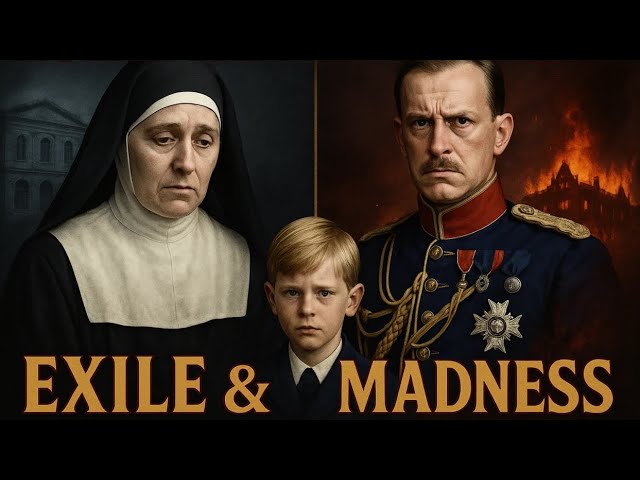
Alice stood in the doorway, a slight, gaunt woman in a gray habit that made her look like a nun, and pretended to understand nothing. She spoke only in French, waved her hands, furrowed her brow, played the confused old aristocrat to perfection. The officers searched her apartment. They found nothing.
And when they left, the Cohen family—Rachel Cohen and her two children—remained hidden inside the walls, where they would stay until the liberation of Athens in October 1944, protected by a princess the world had long since written off as mad. How she came to that doorway is a story that stretches back through exile, war, betrayal, and the slow collapse of the world into which she had been born. It begins with two children of Europe’s tangled royal web, neither of whom was meant to matter much, and both of whom would shape the man who would one day marry Britain’s Queen Elizabeth II. Prince Andrew of Greece and Denmark entered the world on February 2, 1882, in the Grand Royal Palace of Athens.
His arrival was met with polite celebration, but little true excitement. He was the fourth son of King George I of Greece and Queen Olga, a Russian grand duchess and granddaughter of Tsar Nicholas I. In a dynasty where power passed to the eldest and duty was assigned by birth order, Andrew occupied what courtiers sometimes cruelly dubbed the position of a spare among spares. His future was never clearly defined: he would not inherit a throne, would not be groomed for statecraft.
He was raised, like most royal children of the age, at an emotional distance from his parents, passed between governesses and tutors, seeing his mother and father mainly at ceremonial occasions and stiff family dinners. His education was heavily military, the natural choice for a prince with no immediate role but the looming prospect of army service. He would take a career in the Hellenic Army, and those early cold, formal years set the tone for a life lived on the periphery of both family and power. Across Europe, in the heart of the British Empire, another royal life was unfolding.
On February 25, 1885, a baby girl was born at Windsor Castle, the favored residence of Queen Victoria herself. She was named Princess Alice of Battenberg, the first daughter of Prince Louis of Battenberg, a German prince serving in the British Royal Navy, and Princess Victoria of Hesse, a granddaughter of Queen Victoria. By blood, Alice was linked to nearly every royal house in Europe. She was a beautiful child, with pale blond hair, large expressive eyes, and a precocious intelligence.
But within her first few years, something became apparent: she was slow to speak and struggled to respond when called. In an age with little understanding of disabilities, her condition went undiagnosed for years. Only later was it discovered that Alice was born profoundly deaf. The condition might have consigned another child to a life of isolation.
Alice refused it. Through sheer willpower, she learned to lip-read in multiple languages and became adept at speech. Her mother encouraged her education and fostered a fierce independence. Alice would later credit much of her inner resilience to those early battles against her own limitations.
As she grew, courtiers praised her beauty, her serene heart-shaped face and delicate features earning comparisons to princesses of old fairy tales. But beneath the graceful surface lay a depth of thought and a spiritual yearning that the court could not satisfy. Even as a teenager, Alice was drawn to religion, mysticism, and charitable work. She found the endless rituals of court life tiresome, preferring the company of nuns and philosophers to gossipy ladies-in-waiting.
Palace corridors carried whispers that the princess possessed a mystical streak, sometimes claiming to experience visions or prophetic dreams. Whether born of a vivid imagination or a deeper calling, those tendencies would resurface dramatically later in her life. The two first met in 1902 at the coronation of King Edward VII in London, a gathering of Europe’s elite that turned the British capital into a parade of crowns and sashes. Alice was seventeen, in the full bloom of youth, her pale beauty and gracious manners catching the eye of many suitors.
It was Andrew, a dashing Greek prince in military uniform, who captured her attention. He was twenty years her senior, with dark, penetrating eyes and a confident air. By then he had established himself as a career officer, a position of both prestige and danger in a country perpetually on the brink of conflict. Handsome and charismatic, Andrew had a reputation as something of a flirt at court gatherings, yet he seemed genuinely taken by Alice’s gentle demeanor and unassuming intelligence.
Their courtship was swift by royal standards. Within a year the engagement was announced. Courtiers approved: a British-descended princess marrying into the Greek royal family, further entwining the already convoluted web of European aristocracy. On October 6, 1903, they wed in a lavish ceremony in Darmstadt, Germany, attended by Europe’s most illustrious monarchs, including King Edward VII, Kaiser Wilhelm II, and Tsar Nicholas II of Russia.
The wedding was a spectacle of pomp and protocol. Beneath the glitter, tensions already simmered. For Alice, marriage promised both escape and entrapment. She had grown up navigating the rigid structures of British and German courts, and perhaps hoped to find freedom in Greece, land of sun and antiquity.
The reality was far less idyllic. Athens was a city of sharp contrasts, ancient ruins shadowed by modern discontent. Greece was a young nation still finding its footing, plagued by territorial disputes and the constant threat of war. The royal family, despite their titles, occupied a precarious position in a country whose loyalty to the monarchy was at best conditional.
Alice’s new home was a gilded cage. The court was smaller, less sophisticated than the British one, and bound by strict social codes. As a foreign princess, she struggled to find her footing, expected to learn Greek swiftly, attend endless ceremonial functions, and produce heirs. The language barrier, combined with her deafness, still largely misunderstood, made court life isolating.
Worse was the culture clash between Alice’s contemplative nature and Andrew’s increasingly hedonistic lifestyle. While Alice sought solace in religion, charitable work, and her growing brood of children, Andrew immersed himself in the pleasures of military life, gambling, and court intrigue. He spent long stretches away from home, posted to military garrisons or attending to diplomatic duties. His fondness for affairs became an open secret among Athenian high society.
Alice bore these indignities with stoic grace, retreating further into her spiritual devotions. Yet amid the discord, they built a family. Between 1905 and 1921, they welcomed five children: Margarita, Theodora, Cecilia, and Sophie, and finally, in 1921, a son, Philip. The birth of Philip would mark a pivotal point, though neither parent could know it then.
By the time of his arrival, the world around them was unraveling. The Balkan Wars, in which Andrew served with distinction, had destabilized the region. Greece’s victories in 1912 and 1913 came at great human cost, and Andrew’s military career left him emotionally scarred and increasingly disillusioned. The outbreak of World War I shook the very foundations of Europe’s monarchies.
Greece, divided between pro-German and pro-British factions, became a battleground of diplomacy and treachery. The royal family’s German ties placed them under suspicion. King Constantine I, Andrew’s brother, was forced to abdicate, and the monarchy teetered on the brink. Alice, fiercely loyal to relatives on both sides, struggled to reconcile her divided loyalties.
The war years brought personal loss: close relatives executed in Russia, palaces reduced to rubble, a way of life irreversibly shattered. The toll on Alice’s mental health was severe. Always prone to introspection, she began to experience signs of emotional and psychological strain. She claimed to hear the voice of God, believed she had healing powers, and immersed herself in religious mysticism.
Modern interpretations suggest she may have suffered from schizophrenia or bipolar disorder, but at the time such conditions were poorly understood, particularly among the aristocracy. Andrew, increasingly detached, sought distraction elsewhere. His absence, physical and emotional, left Alice to bear the burdens of motherhood, court obligations, and her own deteriorating mind largely alone. By the dawn of the 1920s, the political situation in Greece had reached a boiling point.
The nation, exhausted by the Balkan Wars and World War I, was gripped by instability. The royal family, once hailed as national heroes, had become symbols of foreign influence. At the heart of the turmoil was Prince Andrew. As a high-ranking officer, he played a direct role in the ill-fated Greco-Turkish War of 1919 to 1922.
The conflict, driven by dreams of reclaiming historic territories in Asia Minor, quickly devolved into disaster. The Greek army was overextended, poorly supplied, and met fierce resistance from Turkish nationalist forces under Mustafa Kemal Atatürk. Andrew, assigned to command the Second Army Corps, found himself overseeing a hopeless campaign in Anatolia. Troops mutinied, supplies ran dry, and defeat loomed.
His military decisions, including controversial orders to retreat, would later be twisted into accusations of treason and cowardice by political rivals eager for scapegoats. In Athens, Alice endured agonizing months of uncertainty. Already fragile, she immersed herself in religious devotion, convinced divine intervention might spare her husband and family. The court whispered about her eccentric behavior, how the princess would wander the palace corridors clutching icons, claiming to receive heavenly visions.
Then came the final blow. In September 1922, after the catastrophic defeat of the Greek army and the loss of Smyrna, a revolution erupted in Athens. The monarchy was overthrown, and King Constantine I was forced to abdicate. A revolutionary tribunal swiftly convened trials to punish those deemed responsible for the national humiliation.
In what became known as the trial of the six, several top military leaders and politicians were executed by firing squad. Prince Andrew, by virtue of his command position, was arrested and charged with dereliction of duty and endangering the nation. His trial was swift and brutal. Though spared execution, likely due to pressure from Britain and other European powers, he was stripped of his military titles and banished from Greece for life.
But amid the bloodletting, a desperate rescue mission was unfolding. The British royal family, alarmed at the prospect of Andrew’s execution, intervened. King George V, Alice’s cousin, personally dispatched a Royal Navy ship, HMS Calypso, to evacuate the family. In a scene more fitting for a war film than a royal memoir, Princess Alice, Prince Andrew, and their four daughters, along with the infant Philip, were spirited out of Greece under cover of night.
Legend has it that little Philip, just a toddler, was smuggled aboard in an orange crate to shield him from the revolutionary mobs. The family reached Corfu, boarded the British vessel, and sailed into exile. From there their lives scattered across Europe. Andrew, stripped of titles and honor, settled briefly in France, bitter and disillusioned, seeking solace in gambling dens and the company of mistresses.
His relationship with Alice, already strained by years of neglect and infidelity, deteriorated further. He showed little interest in fatherhood, leaving Alice to care for the children as best she could. For Alice, exile brought both relief and tragedy. Freed from the rigid confines of the Greek court, she might have rebuilt her life.
But the toll of years of upheaval proved too great. By the mid-1920s, her religious fervor deepened into delusions of grandeur. She claimed to hear the voice of Christ, believed she possessed healing powers, dressed in nunlike robes, gave away her possessions, and declared she had been divinely chosen for a sacred mission. In 1930, following a series of incidents, psychiatrists diagnosed her with paranoid schizophrenia.
In a decision that would haunt the family for decades, she was forcibly institutionalized in a sanatorium in Switzerland. Andrew, fully detached by then, made no attempt to intervene. For young Philip, this period was one of chaos and heartbreak. Separated from his mother, abandoned by his father, shuttled between relatives in France, Germany, and Britain, he was a child without a stable home.
His sisters married into German aristocracy. As Philip would later remark, “It’s simply what happened. The family broke up. My mother was ill.
My sisters married. My father went off to the south of France. I was left to it. ”
After nearly two years confined in the Swiss sanatorium, where she endured ice baths, electric shock therapy, and forced separation from her family, Alice began to show signs of recovery.
In 1932, defying medical advice, she insisted on leaving the institution. She rejected the diagnosis of schizophrenia and turned her back on the psychiatrists who had labeled her a danger to herself and others. With no royal title, no fortune, and her marriage effectively over, she sought solace in her faith. Returning to Greece, she found a nation much changed, the monarchy briefly restored under King George II but the country still wracked by unrest and poverty.
For Alice, the return was not about reclaiming status. It was about redemption. Dressed in gray habits, she dedicated herself to charitable work, walking the impoverished streets of Athens, tending to the sick, feeding the hungry, comforting the destitute. She established a nursing order, the Christian Sisterhood of Martha and Mary, though it never achieved formal recognition.
To those who met her, she was no longer a princess, but a compassionate, if eccentric, figure whose kindness transcended her troubled past. Then came April 1941, and the Nazi invasion of Greece. The occupation brought horror to Athens: food shortages, mass arrests, public executions. By 1943, the Gestapo began rounding up Greek Jews for deportation to concentration camps.
It was in this crucible of terror that Alice performed her most extraordinary act. Rachel Cohen and her two children, prominent Greek Jews and longtime acquaintances of the royal household, sought refuge. At great personal risk, Alice took them in, hiding the family in her modest Athens apartment, directly under the noses of the Nazi occupiers. Her deafness, long a source of isolation, became an unlikely shield.
When the Gestapo came to search, she played the confused, frail old aristocrat, speaking only in French and pretending not to understand their questions. The Cohen family remained hidden until the liberation of Athens in October 1944. Alice, who had lost her family and her reputation, risked her own life to save others. Andrew’s own story ended quietly.
In 1944, marked by illness and loneliness, he died in France, an unremarkable end to a life that had begun in the marble halls of the Grand Royal Palace in Athens. His disgrace followed him to the grave: in Greece he was remembered as a disgraced officer, in Britain as a footnote to a more famous son. Alice, meanwhile, lived on. She remained in Greece until 1967, when political instability once again forced her to leave, and she accepted an invitation from her son and his wife, now Queen Elizabeth II, to live at Buckingham Palace.
She died there in 1969 at the age of eighty-four. In 1993, Yad Vashem recognized her as Righteous Among the Nations for sheltering the Cohen family. In 1994, her son Prince Philip, the boy in the orange crate, traveled to Jerusalem to accept the honor on her behalf, and her remains were later moved from Windsor to the Church of Mary Magdalene at Gethsemane, a final return to the faith that had sustained her through madness, exile, and war. The world had once called her mad and locked her away.
In the end, it called her a heroine.






