At dawn on July 26, 1892, a crew of ten men stood around a tree so vast that it had been alive when Rome fell. For thirteen days they had sawed into its trunk from four different angles, driving wedges deeper with every pass, working until their hands blistered and their backs gave out. Now they drove the final wedges. The tree shuddered.
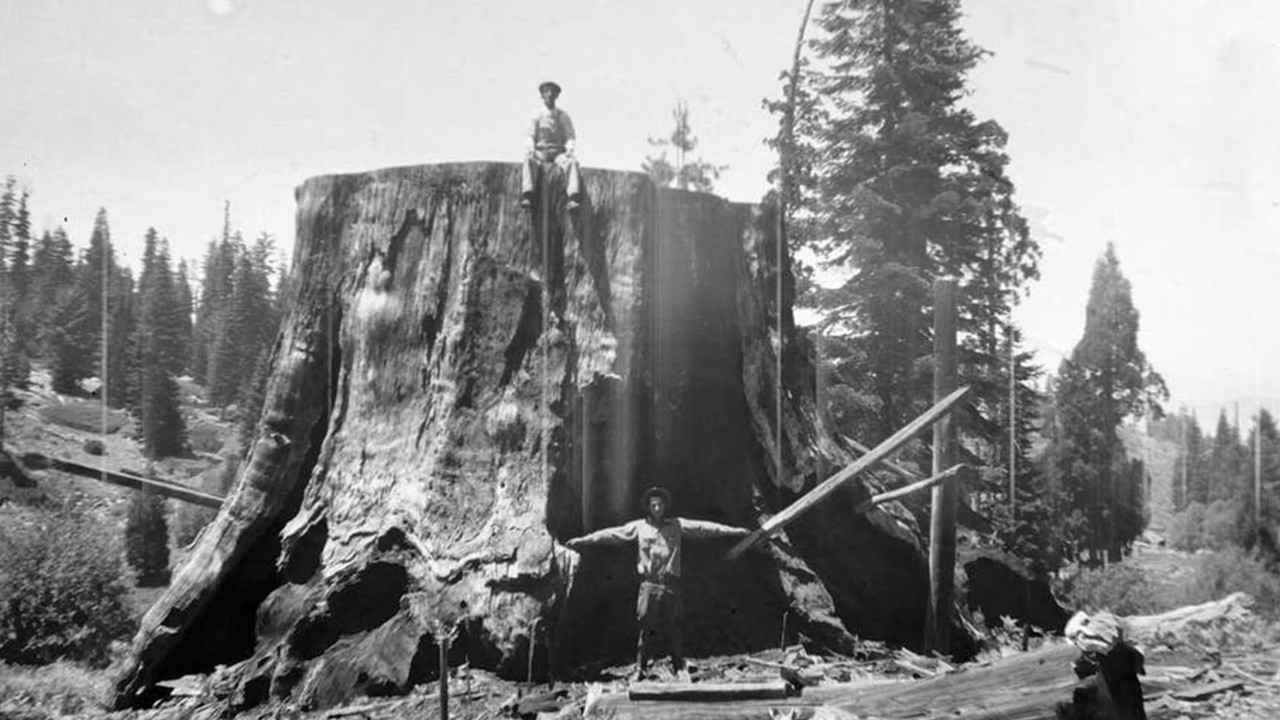
A crack split the air like a cannon shot. Then the General Noble Tree—300 feet tall, roughly 3,000 years old, the largest tree ever recorded in American history—began to fall. It did not fall like a normal tree. A sequoia that size tips in slow motion, the trunk flexing for a long moment before gravity takes hold.
Then hundreds of tons of wood accelerated toward the ground. The impact shook the earth hard enough to knock men off their feet a hundred yards away. The sound echoed off the mountain ridges for miles. The upper 150 feet shattered into pieces.
Branches larger than ordinary trees broke and scattered. The crash cratered the ground beneath the trunk, burying the lower sections in dirt and debris. And in the center of the destruction lay the section they had come for: 40 feet of intact trunk from about 50 feet above the base. It had taken two weeks to kill the tree.
It would take months to move what was left of it. The men who cut down the General Noble Tree were not building houses. They were not making lumber. They were not even working for profit.
They were working for the California World’s Fair Commission, which had decided that the best way to show the people of Chicago what a giant sequoia looked like was to cut one down, hollow it out, and ship it across the country as an exhibit at the 1893 World’s Columbian Exposition. America in 1892 was obsessed with spectacle. The World’s Columbian Exposition was being planned as a massive showcase of American achievement and progress, and every state wanted an impressive exhibit. California’s problem was simple: how do you prove to the East Coast that you have the biggest, tallest, most extraordinary trees on Earth when most Americans have never seen a sequoia?
A photograph would not do. A painting would not do. The answer they settled on was to bring the real thing—the biggest specimen they could find—even if bringing it meant destroying it. Giant sequoias, *Sequoiadendron giganteum*, grow nowhere else on Earth naturally except in a narrow band on the western slopes of the Sierra Nevada in California.
Roughly 75 groves are scattered across about 250 miles, remnants of a species that once covered far more ground but survived only where the conditions were exactly right: elevations between 5,000 and 7,000 feet, specific amounts of rainfall, particular soil composition, regular fire cycles. The trees are so large that they are hard to comprehend. The General Sherman tree, which still stands in Sequoia National Park, is the largest living thing on Earth by volume—275 feet tall, more than 100 feet in circumference at the base, containing enough wood to build 40 average houses, an estimated 2. 7 million pounds, growing for somewhere between 2,000 and 3,000 years.
The General Noble Tree was bigger. Contemporary accounts described it as 300 feet tall with a circumference of 95 feet at the base—a diameter of about 30 feet. Stand on one side of the trunk and you could not see a person on the other side. The tree was so large that most loggers considered cutting it down impossible.
The standard two-man crosscut saws, even the biggest at 8 feet long, would not reach to the center. The operation would require specialized equipment, techniques never tried, and weeks of work. The California World’s Fair Commission was determined anyway. Authorized by the state legislature and equipped with funding and political support, they had decided that the centerpiece of California’s exhibit would be a section of the largest tree ever cut.
They would take a 40-foot section from the trunk, hollow it out, and reconstruct it in Chicago as a room where fair visitors could walk inside and feel the scale of California’s giant trees. The man in charge was George W. Stewart, secretary of the California World’s Fair Commission. Stewart was a newspaper editor and politician, not a lumberjack or forester.
He knew almost nothing about logging. What he knew was publicity. He understood that a giant tree section would generate newspaper coverage, draw crowds, make California famous. Whether cutting down a 3,000-year-old tree to accomplish that was ethically questionable did not appear to factor into his thinking.
Stewart hired a logging contractor named John Larson, one of the few loggers in California with experience cutting giant sequoias. Larson had worked in several groves, including Converse Basin, and knew how to handle the massive trees. But even Larson was skeptical about the General Noble Tree. He told Stewart it would take at least three weeks to cut it down, and the cost would be enormous.
Stewart told him to do it anyway. The state would pay. The cutting operation began in July 1892. Larson assembled a crew of ten men and hauled equipment up to Converse Basin Grove, at about 6,000 feet elevation, reachable only by rough mountain trails.
Everything had to be packed in: saws, axes, wedges, ropes, food, camping supplies. The crew set up a base camp near the tree and began preparing for the cut. The first problem was figuring out how to cut through a trunk 30 feet in diameter when the longest saws available were 8 feet long. Larson’s solution was to cut from multiple sides: start a cut from one side, work as far as the saw would reach, then start another from a different angle, until the cuts met in the middle.
In theory. First the crew cleared the area around the base. Giant sequoias have relatively shallow root systems spread over a wide area; the roots of the General Noble Tree extended out 50 feet in all directions. The crew had to dig around them and cut through them to make sure the tree would fall cleanly when the trunk was severed.
That alone took three days. Then they began on the uphill side, the direction they wanted the tree to fall. Two men worked a crosscut saw, pulling back and forth, slowly grinding through wood. The work was brutally hard.
Sequoia wood is relatively soft, but the tree was so massive that even softwood felt like cutting through stone. The saw bound constantly; the men drove wedges into the cut to keep it open and stopped every few minutes to sharpen the blade and clear the sawdust. The cut advanced at about 6 inches per hour—six inches of depth for every hour of sawing, and they had to get through a 30-foot diameter. That meant roughly 60 hours of continuous sawing just to get halfway through from one side.
They did not work continuously. The crew worked in shifts, two men sawing while the others rested, cleared sawdust, or prepared the next phase. They worked from dawn until dark, about 14 hours a day in July, which gave them maybe 8 to 10 hours of actual sawing time, and 4 to 5 feet of progress per day. The physical toll was immense.
Men rotated out of the sawing position every hour, but even with breaks they were destroyed by the end of each day, working at 6,000 feet in thin air, arms burning, backs aching, hands blistering even through gloves. The cutting took 13 days: thirteen days of sawing and wedging, driving cuts from four different angles around the trunk, until the morning of July 26th, when the final wedges went in and the tree came down. But felling a tree that size does not allow you to control where every part ends up. The section they wanted was intact but partially buried.
It took another week to dig it out, cut it free from the rest of the tree, and prepare it for transport. That was when the full insanity of the project began to sink in. The trunk section weighed approximately 200 tons. Two hundred tons of wood had to be moved from 6,000 feet in the Sierra Nevada down to a railroad, then shipped across the country to Chicago.
There were no roads that could handle that weight, no wagons. Moving it would require building specialized equipment and essentially creating a road as they went. Larson spent the next two months on the trunk section. The crew cut it to a manageable 40-foot length, then began hollowing it out—removing the center of the trunk to reduce weight while leaving the outer shell intact.
It was delicate work. Cut too deep and the structure would collapse; not deep enough and it would remain too heavy to move. Men worked inside the trunk with axes, adzes, and chisels, carving away the heartwood and passing pieces out through openings cut in the side. It was hot, cramped, and dark, the interior smelling of pitch and sawdust, the men constantly aware that they were inside a 200-ton piece of wood that could shift or collapse if something went wrong.
By October, they had reduced the weight to about 50 tons by hollowing it out. Still impossibly heavy, but manageable if they could get it to a railroad. They built a massive sled—a platform on wooden runners—and used a combination of horse teams and manual labor to drag the section down the mountain. The journey covered 12 miles and took three weeks.
They built temporary bridges over streams. They cut new trail where existing paths were too narrow. In several places, they rigged block-and-tackle systems anchored to trees to lower the section down steep slopes. The trunk reached the railroad at Sanger, California, in early November.
It was loaded onto a specially reinforced flatcar—standard cars could not handle the weight—and shipped to Chicago. The rail journey took two weeks. The section arrived in late November 1892, four months after the tree was cut down. The cost of the entire operation was approximately $15,000, about $450,000 in modern currency.
The average annual salary in California in 1892 was about $500. The state had spent the equivalent of 30 years of a working man’s salary to cut down a tree for a display. The trunk section was installed in the California building at the World’s Columbian Exposition, which opened in May 1893. The display was exactly what Stewart had envisioned.
The hollowed trunk was set up vertically, and visitors could walk inside. There was room for 40 people to stand inside at once. The walls were polished to show the grain. Informational plaques explained that this was a section of the largest tree ever cut, that it had been 300 feet tall, that it was approximately 3,000 years old.
The California building itself was an elaborate structure designed to showcase the state’s resources, costing $150,000 to construct—ten times what they had spent cutting down the tree. It featured exhibits on agriculture, mining, wine production, and natural wonders. But the General Noble Tree trunk section was the centerpiece, positioned in the central hall where it was impossible to miss. The exposition staff installed electric lights inside the trunk so visitors could see the wood grain clearly even in the hollow interior.
They placed a measuring tape on the floor showing the full diameter of the original tree. They hung photographs on the exterior showing the tree before it was cut and during the felling. The line to enter the trunk often stretched outside the building. Visitors waited an hour or more for their turn to walk inside.
Newspapers across the country published stories about the display. The *Chicago Tribune* called it the most remarkable exhibit of natural history at the exposition. *Harper’s Weekly* published illustrations showing the trunk towering over fair visitors. The General Noble Tree became one of the defining images of the 1893 fair.
Thousands of people visited the display daily. By that measure, the project was a success. But there was another reaction, one that Stewart and the Commission had not anticipated. A lot of people were horrified.
As soon as word got out that California had cut down the largest tree in the world just to display it at a fair, the backlash began. Environmental advocates called it vandalism. Naturalists called it a tragedy. Newspapers not on California’s payroll published editorials condemning the destruction of a natural monument for the sake of publicity.
Many ordinary fair visitors were disturbed once they learned the truth. They had assumed the tree had died naturally or been cut for timber with a section saved for display. When they learned that a living, healthy 3,000-year-old tree had been deliberately destroyed to create the exhibit, many felt betrayed. There are accounts of visitors leaving the California building upset, some in tears.
A woman from Boston named Clara Endicott Sears wrote in her journal: “I went expecting to be awed by the magnitude of nature’s creation. Instead, I was sickened by man’s arrogance. That tree stood for 3,000 years and we cut it down to make a curiosity. What have we become?
”
John Muir, the naturalist and founder of the Sierra Club, was particularly outraged. He had spent years advocating for the protection of California’s forests, fighting timber companies that wanted to log the sequoia groves, and now the state itself had cut down one of the largest trees in existence for an exhibition. In 1895, Muir wrote an article for *Century Magazine* calling the cutting of the General Noble Tree “the worst case of tree murder I have ever witnessed. ”
The controversy contributed to a shift in American attitudes toward conservation.
Before the 1890s, the prevailing view was that natural resources existed to be used: trees were lumber, land was property to be developed. The idea that some things should be preserved simply because they were remarkable or irreplaceable was not widely accepted. The outrage over the General Noble Tree helped change that. People saw photographs of the enormous trunk section and realized that cutting down a 3,000-year-old tree for a temporary display was fundamentally wrong.
In 1890, just two years before the General Noble Tree was cut, Congress had established Sequoia National Park specifically to protect giant sequoia groves from logging. The General Noble Tree was not in the park—Converse Basin Grove was outside the protected boundaries—but the cutting created momentum for expanding protection. In 1893, Congress established the Sierra Forest Reserve, which eventually became part of the National Forest System, protecting the remaining trees in Converse Basin Grove. The destruction of one tree helped save the rest.
That protection came too late for most of Converse Basin. The grove had been one of the most magnificent concentrations of giant sequoias anywhere. Estimates suggest there were over 2,000 mature sequoias in the basin before logging began in the 1880s, many over 200 feet tall, some approaching 300 feet. The grove was so dense with giants that loggers could stand at one point and see dozens of enormous trees in every direction.
Then the commercial logging companies arrived. Between 1885 and 1905, they cut down over a thousand giant sequoias in Converse Basin. Not for exhibitions—for lumber. Sequoia wood is brittle and tends to shatter when the trees fall, and it is not particularly valuable, but there was so much of it and the trees were so accessible that the companies made money anyway.
Thousands of years of growth were reduced to water tanks, fence posts, and shingles. The General Noble Tree was cut in the middle of this logging boom. What made it unique was the reason. The other trees were at least being cut for economic purposes, however wasteful.
The General Noble Tree was cut purely for spectacle. It was killed to be looked at, not used. That distinction made its destruction somehow more offensive. There is a pragmatic brutality to cutting down a tree for lumber.
There is only hollow vanity in cutting one down to show it off. The trunk section remained in Chicago after the fair ended. It was too expensive to ship back to California. For a while it was stored in a warehouse, then moved to a park.
Eventually, sections of it were sold to lumber dealers who cut it up for souvenirs. You can still find pieces of the General Noble Tree in private collections—small chunks of wood bought as curiosities. Three thousand years of growth reduced to collectible objects. Today, if you visit Converse Basin Grove, you can see where the General Noble Tree stood.
A massive stump about 30 feet in diameter is still there, weathered and deteriorated after more than 130 years, the cut marks still visible. Next to it is a plaque installed by the National Park Service in the 1970s, titled “The Tree That Should Not Have Died. ” It tells the story of the tree and acknowledges the tragedy of its destruction. Muir wrote: “Any fool can destroy trees.
They cannot run away, and if they could, they would still be destroyed, chased and hunted down as long as fun or a dollar could be got out of their bark hides. ” He was writing about the timber industry, but his words apply equally to the mentality that led to cutting down the General Noble Tree for a World’s Fair exhibit. The really tragic thing is that the General Noble Tree was not even the most impressive sequoia. It was the tallest that had been measured at the time, but there were trees of greater volume that are still standing today.
They could have built a replica. They could have created a detailed model. They could have used photography. Instead, they chose the most destructive option possible because they wanted authenticity—real sequoia wood, the experience of walking inside an actual trunk, proof that California really had trees this big.
Today, the remaining giant sequoias are protected by federal law. You cannot cut them down or damage them. They are national treasures, living links to ancient history, protected regardless of their economic value. That protection exists in part because of the outrage over trees like the General Noble Tree.
Sometimes you have to lose something to understand its value. The tree that had stood for 3,000 years, that had survived countless fires and storms and droughts, that was alive when the pyramids were built, when Rome fell, when Columbus reached America, was destroyed in two weeks by men with saws because California wanted an impressive exhibit at a fair. The stump is still there in Converse Basin Grove: a monument to human shortsightedness, a reminder that not everything should be cut down, that some things are too valuable to destroy no matter how impressive the display might be. The General Noble Tree deserved to stand for another 3,000 years.
Instead, it is gone, and all that is left is a stump, some pieces of wood scattered in museums and private collections, and the knowledge that the largest tree in American history was killed just to show people what a big tree looked like.






