At approximately ten o’clock on the morning of August 9th, 48 BC, Julius Caesar gave a slow, deliberate pull at the bridle of his horse and turned to watch the 3,000 men of his hidden fourth line rise from the tall grass of the Thessalian plain. They moved as one, veterans of the 10th Legion, men who had marched under his command for eight years, and they rose with their javelins held low, not as throwing weapons, but as nine-foot spears pointed directly at the faces of the approaching horses. Across the field, the 7,000 cavalry of Pompey the Great were thundering toward Caesar’s exposed right flank, certain that their charge would end the civil war in a single, crushing blow. Within four minutes, that cavalry force would be in ruins, and within four hours, the greatest army the Roman world had assembled in a generation would be shattered, its commander fleeing for his life.
Caesar knew what his men did not yet know: that 3,000 disciplined infantry, held in reserve and hidden from the enemy’s sight, were about to destroy the tactical doctrine of the entire ancient world. To understand how Caesar arrived at this moment, it is necessary to go back to the banks of another river, nineteen months earlier. On January 10th, 49 BC, Julius Caesar stood on the banks of the Rubicon with a single understrength legion, roughly 5,000 men of the 13th Legion, and faced an impossible choice. Behind him lay Gaul, conquered and pacified after eight years of brutal warfare.
Ahead lay Italy, Rome, and Pompey the Great, the Senate’s champion, Caesar’s former ally, and now his mortal enemy. Roman law forbade generals from bringing armies into Italy. This law existed for a single reason: to prevent military coups. The Rubicon marked the boundary between Cisalpine Gaul and Italy proper, and for 500 years, no general had crossed it with armed troops without declaring war on the Republic itself.
If Caesar crossed, he became a traitor. If he returned to Rome without his army, his political enemies would destroy him through the courts, strip his wealth, exile him, or possibly execute him. Roman courts were political theaters where wealthy senators bribed juries and predetermined verdicts. Conviction meant exile at best, execution at worst.
Caesar had spent the last decade building the most loyal, battle-hardened army Rome had ever seen. Now that army would march against Rome itself. The die is cast, Caesar reportedly said, and led his men across the river into civil war. Pompey the Great was not merely a rival.
He was a living legend, the most decorated general in Roman history, a man who had conquered more territory than anyone since Alexander. At age 23, he had raised his own army and crushed an enemy rebellion. By 30, he had defeated Sertorius in Spain, eliminated the pirates who terrorized the Mediterranean, and conquered the East: Syria, Judea, Armenia. In 67 BC, the Senate gave him extraordinary powers, 500 ships, 120,000 soldiers, and authority over the entire Mediterranean, to crush the pirates who were strangling Rome’s grain supply.
Conventional wisdom said it would take years. Pompey did it in three months, dividing the Mediterranean into 13 sectors and coordinating simultaneous operations across thousands of miles of coastline without any communication faster than a horse or a sail. From 66 to 63 BC, he waged war against Mithridates VI of Pontus, chased him across Asia Minor, and drove him to suicide, then conquered Armenia, Syria, and Judea, reaching the Euphrates River and doubling Rome’s treasury. When he returned to Rome in 61 BC, his triumph lasted two full days, with cartloads of gold and silver, exotic animals, captured enemy kings walking in chains, and placards listing his achievements: 1,000 fortresses captured, 900 cities taken, 12 million people brought under Roman rule, three continents pacified.
He had never lost a major battle in 35 years of continuous warfare. Even Caesar had married his daughter Julia to Pompey to secure their alliance. But Julia died in childbirth in 54 BC, and the bond between Rome’s two greatest generals died with her. By 49 BC, Pompey commanded the loyalty of the Senate, the wealth of the Eastern provinces, and the respect of Rome’s military establishment.
He had one more advantage that seemed insurmountable: legitimacy. Caesar was a rebel, a lawbreaker. Pompey was the Senate’s chosen defender, fighting to preserve the Republic against a would-be tyrant. Every soldier who joined Pompey could tell himself he was fighting for Rome, not against it.
Against this, Caesar had something Pompey could not see coming: an army that had spent the previous eight years becoming the most lethal fighting force the ancient world had ever known. From 58 to 50 BC, Caesar’s legions conquered Gaul, a territory roughly the size of modern France, Belgium, and parts of Germany. They fought the Helvetii, crushed Germanic tribes, invaded Britain twice, built a bridge across the Rhine in ten days just to prove he could, and besieged Alesia, where 80,000 Gauls defended a hilltop fortress while 250,000 more came to rescue them. Caesar trapped them all by building a wall completely encircling Alesia, 11 miles of fortifications, then a second wall facing outward, another 14 miles, when the relief army approached.
His 60,000 legionaries dug ditches 15 feet deep, planted thousands of sharpened stakes in concealed pits, built wooden towers every 80 feet, and held both walls against attacks from 250,000 Gauls outside and 80,000 inside. When the Gallic relief army finally broke and fled, they left 150,000 dead on the field. Vercingetorix surrendered. Gaul was conquered.
Caesar’s legionaries didn’t just respect him, they loved him. He fought alongside them, slept in the same camps, ate the same food. When his men were hungry, Caesar went hungry. When they marched 30 miles in a day, Caesar marched with them.
He knew their names, their families, their fears. He made them wealthy through captured plunder and promised them land when they retired. In eight years, his army engaged in over 50 major battles and hundreds of smaller skirmishes, and won virtually every encounter. Roman historians estimate that during the Gallic Wars, Caesar’s legions killed or enslaved over 1 million Gauls.
When Caesar crossed the Rubicon, Pompey’s strategy was simple: abandon Italy, retreat to Greece, raise a massive army from Rome’s eastern territories, then return and crush Caesar with overwhelming force. It required time. Caesar didn’t give him time. In 60 days, Caesar’s legions swept through Italy like a wildfire, marching 40 miles on some days, twice the normal pace for a Roman army.
Towns that might have resisted if they’d had time to prepare simply opened their gates. By February 17th, 49 BC, just 38 days after crossing the Rubicon, Caesar controlled everything from the Alps to Rome itself. Pompey withdrew to the port of Brundisium and, on the night of March 17th, evacuated his last 25,000 troops and hundreds of senators under cover of darkness, slipping past Caesar’s incomplete blockade and sailing east across the Adriatic. Caesar had won Italy without fighting a single major battle, but his strategic situation was worse than before.
Rome’s population was roughly 1 million people, consuming 400,000 tons of grain annually, and virtually all of it came from overseas: Egypt, North Africa, Sicily, provinces that Pompey now controlled. Pompey’s strategy was patient and brutal: blockade Italy, control the grain, wait for hunger to destroy Caesar’s popular support, then return. Instead of staying in Rome, Caesar went on the offensive. In April 49 BC, he marched to Spain, besieged Ilerda, trapped Pompey’s lieutenants Afranius and Petreius with 60,000 troops, and forced their surrender without a major battle.
Then, in January 48 BC, he did something that shocked the Roman world. With virtually no naval experience, against Pompey’s hundreds of warships, he loaded seven legions, approximately 35,000 men, onto a hastily assembled fleet of transport ships and sailed directly into the teeth of Pompey’s naval blockade. The crossing took three days. Pompey’s ships missed them.
Caesar landed on the coast of Epirus, in what is now Albania, with half his army. Mark Antony had been left behind with the other half because there weren’t enough ships for a single crossing. Caesar was now trapped in hostile territory with 35,000 men, no supplies, and no reinforcements, facing Pompey’s rapidly assembling army of over 50,000. What happened next was one of the strangest sieges in military history.
Caesar besieged Pompey at Dyrrachium, a coastal fortress in what is now Albania, despite being outnumbered and outgunned. In four weeks, Caesar’s legionaries built 15 miles of fortifications, ditches, wooden palisades, and watchtowers, while under constant harassment from Pompey’s superior cavalry, built by soldiers already hungry and exhausted from forced marches. The strategic logic was insane: Caesar was trying to besiege an army that had access to the sea, naval supply lines, and twice his numbers. He might as well have tried to besiege the ocean itself.
Mark Antony finally arrived with four legions, bringing Caesar’s force to about 35,000 men, but without supplies. By early July, Caesar’s soldiers were surviving on cara, a marsh grass that, when ground into flour and mixed with water, produced a barely edible bread that caused severe intestinal distress. Ancient sources report that when Caesar’s soldiers showed Pompey’s troops this bread, the Pompeians were horrified and reportedly said, We are fighting wild beasts, not men. Men were fainting during sentry duty.
Cavalry horses were dying from lack of fodder. On July 10th, Pompey attacked. His scouts had found a weak point in Caesar’s southern wall where two fortification lines didn’t quite connect, a gap of perhaps 600 yards. Pompey sent 60 cohorts, approximately 24,000 men, in a coordinated assault supported by cavalry and archers.
Caesar’s 9th Legion, holding that section, broke under the pressure. The cohorts fled. Panic spread. In less than two hours, Caesar’s entire southern fortification line collapsed.
Nearly 1,000 of Caesar’s best soldiers died, including 32 centurions, and hundreds more were wounded. It was the worst defeat of Caesar’s military career. Caesar himself rode into the chaos, reportedly grabbing fleeing soldiers by their standards, trying physically to stop the rout. It didn’t work.
Pompey ordered his troops to halt and consolidate the captured fortifications. He didn’t pursue. Ancient sources suggest Pompey suspected a trap. More likely, he was simply cautious.
He had won the engagement; why risk his advantage by chasing a defeated enemy into uncertain terrain? Caesar would later say, Today, the enemy would have won if they had a commander who knew how to win. Caesar’s shattered army retreated 30 miles south, then withdrew to Thessaly, a fertile plain in central Greece, desperately seeking food. Pompey followed cautiously, his army now swollen to over 50,000 men.
The two armies met near the town of Pharsalus, on a plain approximately 3 miles wide, bordered by the Enipeus River to the south and rolling hills to the north. The ground was flat, firm, and completely open: ideal for cavalry maneuvers, disastrous for an outnumbered infantry force. Pompey commanded approximately 45,000 heavy infantry organized into 110 cohorts, 7,000 cavalry, plus archers and slingers, roughly 52,000 combatants total. Caesar had 22,000 infantry in 80 cohorts and 1,000 cavalry, perhaps 23,000 men total.
Pompey outnumbered Caesar more than two to one in infantry and seven to one in cavalry. Pompey’s officers were already arguing about how to divide Caesar’s estates after the victory. For weeks, the senators traveling with his army had been demanding he engage Caesar in battle, mocking his caution, accusing him of prolonging the war to maintain his political importance. Are you enjoying being surrounded by kings and senators?
one officer reportedly sneered. On August 7th, Pompey finally agreed to give battle. His scouts had located Caesar’s army camped on the plain near Pharsalus. The terrain was perfect.
His supplies were abundant. His camp had fresh bread, wine, meat. Caesar’s camp was subsisting on foraged grain and whatever livestock they could requisition from terrified local farmers. During the week both armies spent maneuvering around each other, Caesar had been watching Pompey’s formations.
He noticed a pattern: Pompey massed his cavalry on his left wing, always the left, positioned to sweep around an enemy’s right flank and attack from the side and rear. It was textbook Roman tactics. On August 8th, the night before the battle, Caesar called his senior officers to his tent and revealed a plan that made them stare in disbelief. He would pull 3,000 of his best men, veterans from the 10th Legion, out of the main battle line and hide them as a fourth line behind his cavalry, angled obliquely toward where Pompey’s cavalry would attack.
The officers protested. Pulling 3,000 men from the main line would weaken it further. Caesar would be facing Pompey’s 45,000 infantry with only 19,000. The math was suicide.
But Caesar’s logic was coldly precise. Pompey’s cavalry will sweep our right flank. When they do, the fourth line will destroy them. Without his cavalry, Pompey loses his flanking advantage.
Then we fight infantry against infantry, and our infantry is better. The fourth line consisted entirely of veterans from the 10th Legion, men who had fought at Alesia, built the bridge across the Rhine, stormed fortified Gallic hill forts in driving rain, and held the line against Germanic warriors twice their size. Caesar had drilled them in a completely new tactical doctrine. Standard Roman infantry doctrine said you threw your pilum, your heavy javelin, at the enemy when they were 20 to 30 yards away, then drew your gladius and charged into close combat.
Caesar ordered the fourth line to do the exact opposite. Don’t throw your javelins, he told them repeatedly. Hold them. Use them like spears.
When the cavalry charges, wait until they’re close, ten yards, five yards, then stand up and stab upward. Aim for the horses’ faces. Aim for the riders’ eyes. It was a radical departure from standard tactics, and it only worked because these were veterans who trusted Caesar absolutely.
As dawn broke on August 9th, Pompey’s army formed up on the northern side of the plain. His 45,000 heavy infantry were organized into the traditional three-line formation, with his 7,000 cavalry massed on his left wing. His cohorts were arranged 10 men deep, a formation designed to absorb punishment and keep fighting. Caesar’s formation looked anemic by comparison.
His 22,000 infantry had to cover the same frontage as Pompey’s 45,000, which meant his lines were thinner, only six men deep in most places. Caesar stood before his exhausted legionaries and reportedly said, Today we fight not for glory, but for survival. We are outnumbered, but we are not outmatched. Remember Gaul.
Remember what we’ve overcome. They have the numbers. We have each other. At approximately 9:45 a.
m. , Pompey gave his final orders to his cavalry commander, Titus Labienus, Caesar’s former officer who had defected to Pompey and who knew Caesar’s army intimately. The cavalry advance would begin in 15 minutes, coordinated with the infantry’s forward movement. Their right flank will collapse in the first charge, Labienus reportedly told Pompey.
We’ll be in their rear within an hour. The senators and nobility surrounding Pompey watched the deployment with growing excitement. Marcus Cato, Caesar’s bitter political enemy, reportedly remarked, By nightfall, we’ll be dining in Caesar’s camp. At approximately 10:00 a.
m. , Pompey gave the order. His entire line began to advance, 45,000 men moving forward in formation, shields raised. Caesar’s men advanced halfway across the field, then stopped, reformed their lines, caught their breath, then advanced again.
When they reached javelin range, 22,000 arms drew back and released. The sky went dark as thousands of heavy iron javelins arced through the air and came down like steel rain on Pompey’s front ranks. The pilum was seven feet long with a four-foot iron shank topped by a pyramidal point, weighing between four and nine pounds, designed to punch through a shield, through the armor behind it, and into the man holding it. The iron shank was designed to bend on impact, rendering the enemy’s shield useless.
Modern military historians estimate that a well-executed pilum volley could disable 10 to 15 percent of an enemy formation, meaning Pompey’s front line took between 4,000 and 7,000 casualties or equipment losses in the first 30 seconds of contact. But Pompey had ordered his men to stand and receive the charge, so they held their javelins. When Caesar’s legionaries, having thrown their pila, drew their gladii and charged, they ran into a wall of men who still had javelins ready. Pompey’s front ranks released their pila at point-blank range, less than 15 yards, and men simply fell.
The two lines collided at approximately 10:07 a. m. with a sound that eyewitnesses compared to thunder. Despite being outnumbered more than two to one, despite being exhausted and half-starved, Caesar’s infantry held.
The center held. The left wing held. Pompey’s numerical advantage meant constant pressure, but Caesar’s experience meant disciplined resistance. The battle in the center became a brutal stalemate.
But the center was never meant to decide this battle. The real fight was happening on the flanks. At 10:15 a. m.
, Pompey’s 7,000 cavalry completed their approach toward Caesar’s right wing. Caesar’s 1,000 Germanic and Gallic horsemen tried to meet them, lasted minutes, and were simply swept aside. Pompey’s horsemen wheeled inward, exactly as planned, and prepared to roll up Caesar’s exposed flank. The cohorts on the right wing, while still maintaining pressure against Pompey’s front-line infantry, angled their rear ranks outward, creating a refused flank, a desperate measure that might buy seconds.
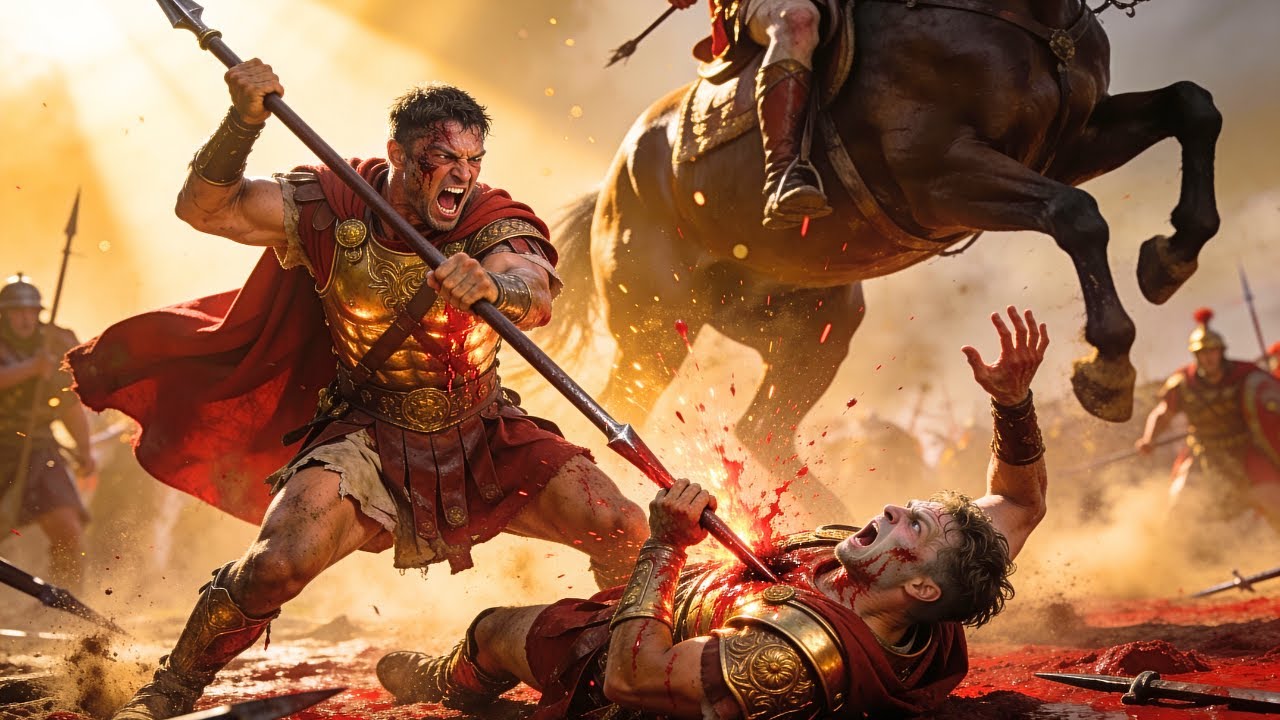
Then Caesar sprang his trap. The 3,000 men of the fourth line, who had been lying flat in the tall grass, invisible to Pompey’s scouts, rose to their feet in perfect formation, positioned at a 45-degree angle to the cavalry’s approach. They advanced aggressively toward the horses, javelins extended like pikes, aimed at the horses’ faces and the riders’ eyes. A horse running at full gallop can’t stop on command.
When a horse sees a sharp object pointed directly at its face, animal instinct overrides training. The horse rears violently, turns sharply, or panics and tries to stop. When a horse rears at full gallop with an armored rider aboard, the rider is thrown forward over the horse’s head or sideways as the horse turns. The front squadrons of Pompey’s cavalry hit Caesar’s fourth line and disintegrated within seconds.
Horses reared, screaming. Riders fell. Wounded animals panicked and bolted. Behind them came the second wave, another thousand riders moving too fast to stop, who collided with the chaos ahead of them.
What should have been a coordinated cavalry charge became a traffic jam of panicked animals and confused, dismounted riders. Caesar’s veterans from the 10th Legion exploited this chaos with brutal, practiced efficiency. A horse rears, stab the rider while he’s off balance. A rider falls, surround him, multiple spear thrusts.
A horse turns to flee, stab its haunches, bring it down, then kill the helpless rider. In four minutes, from 10:15 to 10:19 a. m. , Pompey’s cavalry suffered catastrophic losses.
Conservative historical estimates suggest at least 800 to 1,000 riders killed or wounded in the initial contact. The remaining 5,000 or more simply fled in genuine terror, many not stopping until they reached Pompey’s camp two miles away. In four minutes, 3,000 infantry had destroyed a 7,000-strong cavalry force. The fourth line didn’t stop to celebrate.
They pivoted 90 degrees and looked at Pompey’s left-wing infantry, approximately 12,000 men who had been advancing to support the cavalry attack. These cohorts suddenly found themselves attacked from two directions simultaneously, front and side. Roman infantry formations were designed to fight in one direction, forward. When attacked from the side, those formations became death traps.
Soldiers on the flank couldn’t turn to defend without breaking ranks. At 10:17 a. m. , the leftmost cohorts broke, entire units of hundreds of men at once.
The collapse spread like fire through dry grass. Within two minutes, Pompey’s entire battle line, 45,000 soldiers, was in full retreat toward their camp. From the moment Caesar’s fourth line hit Pompey’s flank to the moment Pompey’s entire army was routed was 17 minutes. Caesar’s legionaries pursued with merciless efficiency.
Between 10:20 and 10:40 a. m. , Pompey’s army suffered 6,000 casualties during the retreat, 300 men dying every minute. At 10:50 a.
m. , Caesar’s forces reached Pompey’s fortified camp and assaulted it. The defenders didn’t fight. In 15 minutes, Caesar’s men breached fortifications that should have required hours to overcome.
Inside, the slaughter was indiscriminate. Officers killed mid-sentence. Soldiers stabbed while surrendering. Among the dead were dozens of Roman senators who had come to watch Caesar’s defeat.
By 11:20 a. m. , Caesar personally entered the camp and forcibly stopped his men from killing. Pompey the Great stood frozen on his command post, watching his cavalry disintegrate.
When officers physically dragged him away, he removed his general’s cloak, mounted a horse, and fled, abandoning 25,000 soldiers and the Senate. He sailed to Egypt, desperately seeking sanctuary from the boy king Ptolemy. On September 28th, 48 BC, when Pompey stepped off his ship, Ptolemy’s advisers murdered him and cut off his head as a gift for Caesar. The man who had never lost a major battle in 35 years died in a fishing boat without drawing his weapon.
Final casualties: Pompey’s army, 15,000 dead, 24,000 captured. Caesar’s army, 200 dead, perhaps 1,000 wounded, a kill ratio of roughly 75 to 1. Caesar then did something shocking. He showed clemency.
The 24,000 prisoners were offered a choice: join his legions or go home. No executions. No slavery. Roughly 8,000 joined Caesar’s ranks.
The rest were released with safe passage. He pardoned senators who had fought against him, including Cicero and Marcus Brutus. Approximately 150 to 200 senators and equestrians who supported Pompey were forgiven, welcomed back to Rome, their property restored. Every pardoned soldier became proof that Caesar wasn’t a tyrant.
But there was a fatal flaw. You can’t buy loyalty with forgiveness. On March 15th, 44 BC, four years after Pharsalus, 60 senators surrounded Caesar and stabbed him 23 times. Among the assassins were men Caesar had pardoned: Brutus, whom he treated like a son, and Cassius, forgiven after Pharsalus.
The assassination didn’t save the Republic. It triggered more civil wars. By 27 BC, Caesar’s heir Octavian became Augustus, Rome’s first emperor. The Battle of Pharsalus lasted less than four hours.
In those four hours, Caesar destroyed the Republic’s last legitimate army and secured absolute power over Rome. The tactical innovation was brilliant, using heavy infantry to devastate cavalry through aggressive pike formations. But the strategic consequences were far greater. Pharsalus proved that Rome’s republican system had become irrelevant.
Power belonged to whoever commanded the most loyal legions. The Senate was fiction. The Constitution was theater. The Roman Republic, which had stood for 500 years, died on a plain in Thessaly.
Caesar’s fourth line, those 3,000 men who stood from the grass and destroyed Pompey’s cavalry, did more than win a battle. They killed a political system that had governed the Mediterranean world for five centuries. The casualty disparity told the whole story: 15,000 dead versus 200. That wasn’t just tactical skill.
It was the difference between soldiers fighting for abstract political principles and soldiers fighting for a commander they believed was invincible. Personal loyalty defeated institutional loyalty. And that outcome doomed the Republic forever.






