In the autumn of 1904, the small mining town of Shadow Creek, West Virginia, was a settlement of roughly six hundred people, nearly all of them dependent on the Blue Ridge Coal Company for their livelihood. The town was unremarkable, a cluster of wooden buildings at the edge of the forest. What made it notable was not its architecture but the events that unfolded inside the Petri family home on October 17th, a date remembered by locals for generations as the day every door stayed closed. The Petri household consisted of Samuel Petri, a forty-three-year-old mine foreman known for his steady, sober character; his wife Martha, thirty-nine, who had suffered three miscarriages in the previous four years; and Samuel’s brother Edward, forty-one, who had moved in with the family after a back injury left him unable to work.
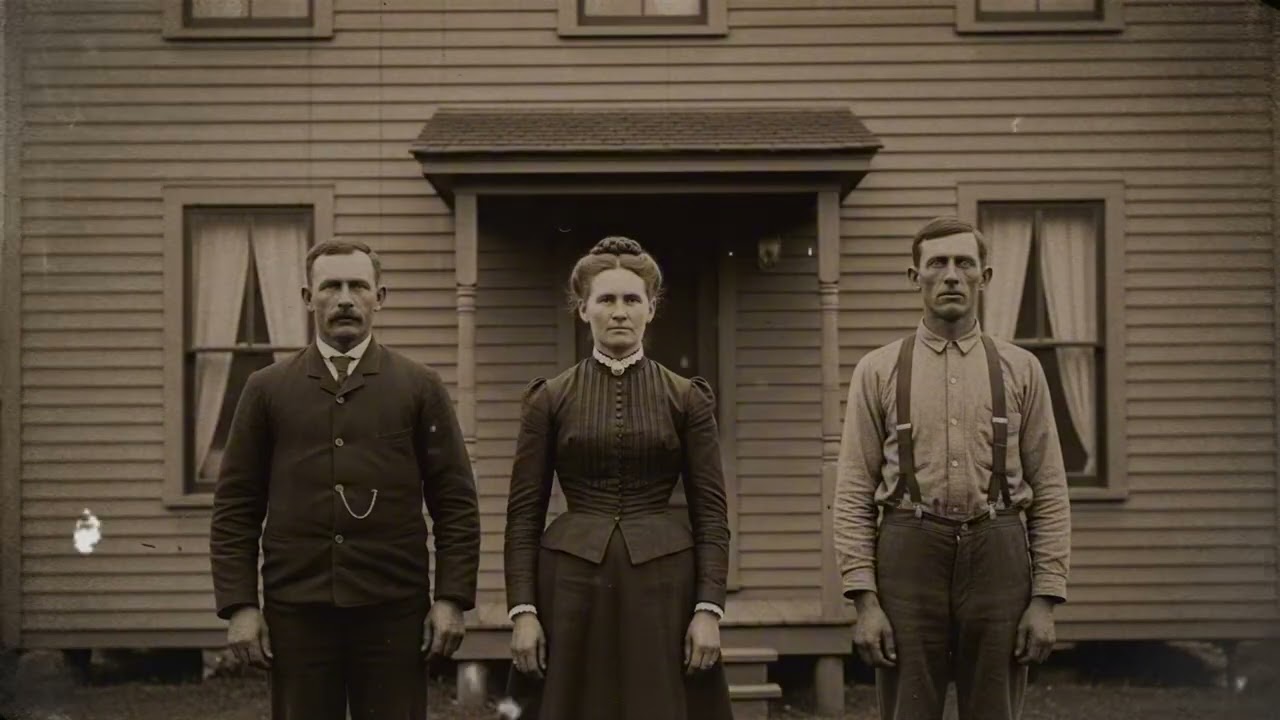
In April 1904, Edward was trapped for nearly six hours in a partial collapse in a deep section of the mine known as the “deep cut. ” When rescuers reached him, he was sitting calmly amid the rubble. Dr. Thomas Harrington, the town’s only physician, noted in his journal that Edward displayed an unusual calmness given the severity of his injuries.
When questioned about the hours spent in the dark, Edward only said that it had been peaceful down there and that the darkness had spoken to him. In the weeks after the accident, Edward moved in with his brother and sister-in-law to recover. Samuel and Martha were initially attentive caretakers. But by June, Martha, a regular at the local Methodist church, began attending services sporadically.
By July she had stopped altogether. When the pastor’s wife called on her, she found the house altered, the curtains drawn, a peculiar odor of damp earth and chemicals in the air. Martha was nervous and insisted her visitor leave before sundown, saying of Edward, “He’s not himself after dark. None of us are anymore.
”
Dr. Harrington’s journal, discovered decades later during a renovation of the Shadow Creek Medical Clinic, provides the most detailed record of the household’s decline. In late August, he was called to the Petri home for Martha’s recurring headaches and disorientation. Samuel reported that she complained of voices in the walls.
In September, Samuel came to the doctor’s office requesting more laudanum and reluctantly admitted that Edward had taken to nocturnal wanderings, standing motionless in doorways for hours, and spending time in the root cellar surrounded by jars containing what Samuel described as “collections. ” He asked about having Edward examined at the Greenbrier Asylum, then asked the doctor a strange question: whether a person could appear physically unchanged while being fundamentally altered inside. He added that Edward spoke to Martha when Samuel was at the mine, “not as a brother should speak to his sister-in-law, but as something else, something that’s wearing Edward like an ill-fitting suit. ”
A former employee of the company store later provided a private ledger documenting the Petri family’s purchases in the months before the incident.
Beginning in July, Samuel bought excessive quantities of salt, twenty to thirty pounds at a time, unusual amounts of lye soap, multiple locks and chains, and heavy canvas tarpaulin. In early October, he purchased six new padlocks, twenty pounds of nails, several hammers, and enough laudanum “to put a horse to sleep. ”
On October 10th, Dr. Harrington was summoned to the Petri home past midnight.
Martha was found sitting on the front porch in the cold, refusing to enter the house. She was feverish and disoriented, with rope marks on her wrists. She whispered that Edward was no longer Edward. Samuel refused to allow the doctor to examine his brother.
In a supplementary note added later that day, Harrington recorded that Samuel returned to his office and asked whether a person could appear physically unchanged while being fundamentally altered. He then mentioned that there were things in the root cellar that proved he and Martha were not imagining the situation. The events of October 17th must be pieced together from multiple accounts. Samuel reported to the mine at his usual time but requested leave to return home around noon, citing a household emergency.
The mine superintendent later recalled that Samuel had a look of “desperate determination,” like a man who had come to a terrible decision and was resolved to carry it through. That afternoon, a neighbor heard a commotion from the Petri home, the sound of furniture being dragged and urgent hammering. She heard shouting, including a third voice with a strange cadence, not like normal speaking but like chanting. The hammering continued for at least an hour, then everything went quiet.
By evening, miners returning from their shift saw smoke from the chimney and every window covered with blankets or heavy fabric. Around 9:00 p. m. , a night worker passing the house heard something being dragged downstairs.
He noticed that every door, front, back, and the root cellar entrance, was secured with new padlocks on the outside. He called out but received no answer. Then he heard heavy breathing just behind the front door, and a low, rough voice said, “The doors stay closed today. ” The voice made him hurry away.
At 2:00 a. m. , the night watchman passed the house and saw Samuel sitting alone on the front porch, as still as a statue, staring toward the mine. He did not respond to a greeting.
The watchman noticed Samuel was holding a mining pick, with a shotgun propped against the porch railing. He chose not to approach an armed man and continued his rounds, but he reported hearing a persistent scratching sound coming from the root cellar entrance. Dr. Harrington was called to the home the following morning.
He found Samuel still sitting on the porch, unresponsive, severely dehydrated, with self-inflicted lacerations on both palms. The keys to the padlocks were in his pocket. Inside, the walls of the entryway and parlor had been covered with pages torn from the family Bible, specifically passages from Revelation, affixed with a mixture of coal dust and blood. The kitchen contained a pot of boiled laudanum mixed with household substances, a potent sedative.
The root cellar door showed extensive scratch marks on the inside and had been reinforced with wooden planks nailed across its frame. Martha was found unconscious in the master bedroom, heavily sedated, with ligature marks on her wrists and ankles. Edward was nowhere to be found. His bedroom contained no personal belongings.
In the attic above his room, the family found his mining boots filled with soil, his pocket watch disassembled with the pieces arranged in a circle, and a journal written in an indecipherable symbolic language. Intermixed with the symbols were anatomical drawings and sketches of a human form with proportions deliberately wrong. The final dated entry, from October 16th, contained a single phrase in English: “The host is becoming inadequate. ”
When Samuel was finally responsive, he would only say that Edward had “gone back to where he came from” and that the doors had to stay closed to keep everyone safe.
Pressed further, he repeated, “Edward is in the walls now. ”
Samuel was taken into custody. During questioning, he claimed that Edward had changed after the accident, becoming increasingly nocturnal and speaking in a voice that was not his own. He described finding jars in the root cellar containing soil, insects, plant matter, and small amounts of blood taken from Samuel and Martha while they slept.
He claimed that on October 16th, Martha had barricaded herself in the bedroom, saying she had witnessed Edward shedding his skin in the root cellar. Samuel admitted to confronting his brother, at which point Edward allegedly spoke in a voice that echoed as if from the bottom of the mine shaft, saying, “We have existed in the deep places since before your kind crawled from the high sea. Your brother gave us passage to the surface through his broken form, but it has grown insufficient. We require better vessels.
”
Samuel claimed he subdued his brother, bound him, locked him in the root cellar, and began securing the house. When asked where Edward was, his answers were contradictory. He sometimes said Edward had escaped into the walls, sometimes that he had returned to the mine, and occasionally insisted that Edward was still in the root cellar, “just not in a form you would recognize. ” Authorities concluded that Samuel had suffered a psychological break brought on by caring for his injured brother and unstable wife.
He was committed to the Greenbrier Asylum in early November 1904. No charges were ever filed. Martha Petri remained institutionalized until her death in 1907, never having spoken another word after being found in her home. Her medical file recorded catatonic periods interspersed with episodes of extreme agitation, during which she attempted to remove her own skin.
The file noted that such episodes occurred exclusively between sunset and sunrise, regardless of whether she had any way to tell the time. Samuel was transferred to a state facility in Weston in 1906, but no admission record exists in the Weston archives. His death certificate, filed in 1911, lists his place of death as “unknown” and the cause as “presumed deceased. ” A single reference in the minutes of a Blue Ridge Coal Company board meeting from 1908 notes that the situation with former employee S.
Petri “has been resolved. He will not be returning to Shadow Creek. ”
The case might have faded into obscurity were it not for a series of later discoveries. In 1947, workers expanding the mine broke through into a natural cavity in the mountain.
They found personal effects matching Edward Petri’s possessions, including a pocket watch, wire-rimmed spectacles, and a wallet with his identification card. A letter from the mine supervisor, preserved by his family, revealed details deliberately excluded from official reports: the items were arranged in a circle, showed no signs of decay after more than forty years, and the cavity walls bore handprints pressed into solid rock, with fingers too long and tapering to points. Two of the men who discovered the cavity fell ill with a respiratory ailment and reported vivid dreams. One died three weeks later.
The cavity was sealed with concrete. In 1962, a sealed metal box was found in a wall cavity during a renovation of the Shadow Creek Medical Clinic. It contained Dr. Harrington’s journal and a letter dated November 30th, 1904, addressed to future inhabitants of the town.
In it, Harrington described finding preserved skin samples under the floorboards of Edward’s room that did not decompose and appeared to exhibit subtle movements under certain lighting. He also confessed that his examination of Martha revealed a dark particulate matter in her blood that was moving with purpose under the microscope. He wrote that he was leaving Shadow Creek and implored any future reader to leave the samples undisturbed. When those containers were opened in 1962, they were empty, containing only a fine, dark residue that dispersed into the air.
The doctor who opened them resigned three weeks later and left town without explanation. The Blue Ridge Coal Company continued operations until 1952. The town gradually diminished, and by the last census in 1960, only twenty-eight residents remained. Shadow Creek was removed from West Virginia maps in 1972.
The site was reclaimed by the forest, except for one notable feature: the foundation outline of the Petri home remained conspicuously barren, refusing to support vegetation, sixty-three years after the house was demolished. Soil samples taken in 1967 contained unidentified organic compounds that exhibited phosphorescence under ultraviolet light and measurable growth when maintained in dark, damp conditions. The follow-up study was denied funding, and the lead geologist left his position shortly afterward. In 1969, construction workers discovered a sealed tunnel near the former site of Shadow Creek, containing a chamber with glass jars arranged in a circle around a wooden chair.
On the chair sat a pair of wire-rimmed spectacles identical to those from Edward Petri’s identification card. The walls appeared melted and reformed, smooth and glassy. When a worker tried to force one of the jars free, it shattered, releasing a fine dark powder. The man who inhaled it later returned to the chamber alone and was found sitting in the chair, unresponsive.
The tunnel collapsed, sealing everything inside. The incident report and photographs were later reported missing from the state archives. Dr. Harrington’s final journal entry described the padlocks he had examined at the Petri home, noting the metal was deformed not from external force but as if altered from within.
He wrote that he left Shadow Creek hoping that whatever had been contained within those walls remained there, deep in the foundation soil, never to emerge again. What remains factually verifiable is this: three people lived in a house in Shadow Creek in the autumn of 1904. By the end of October, one had vanished without a trace, and the other two were institutionalized, never to return. For one October night, every door in that house was locked from the outside, allegedly to keep something in rather than to keep others out.
The eastern slopes of that mountain remain undeveloped to this day, avoided by local residents, who say the ground there sometimes moves in ways that ground should not move, as if something just beneath the surface is still trying to find its way out.






