The old woman had been dead for two years before anyone touched her cabin. It sat at the end of a gravel road in the Ozark Mountains of Missouri, buried among oak and sumac, one of those places people pass for decades without truly noticing. Her name was Ada Vance, and she had lived there alone for most of her life. The few neighbors who remembered her described her as quiet and watchful.
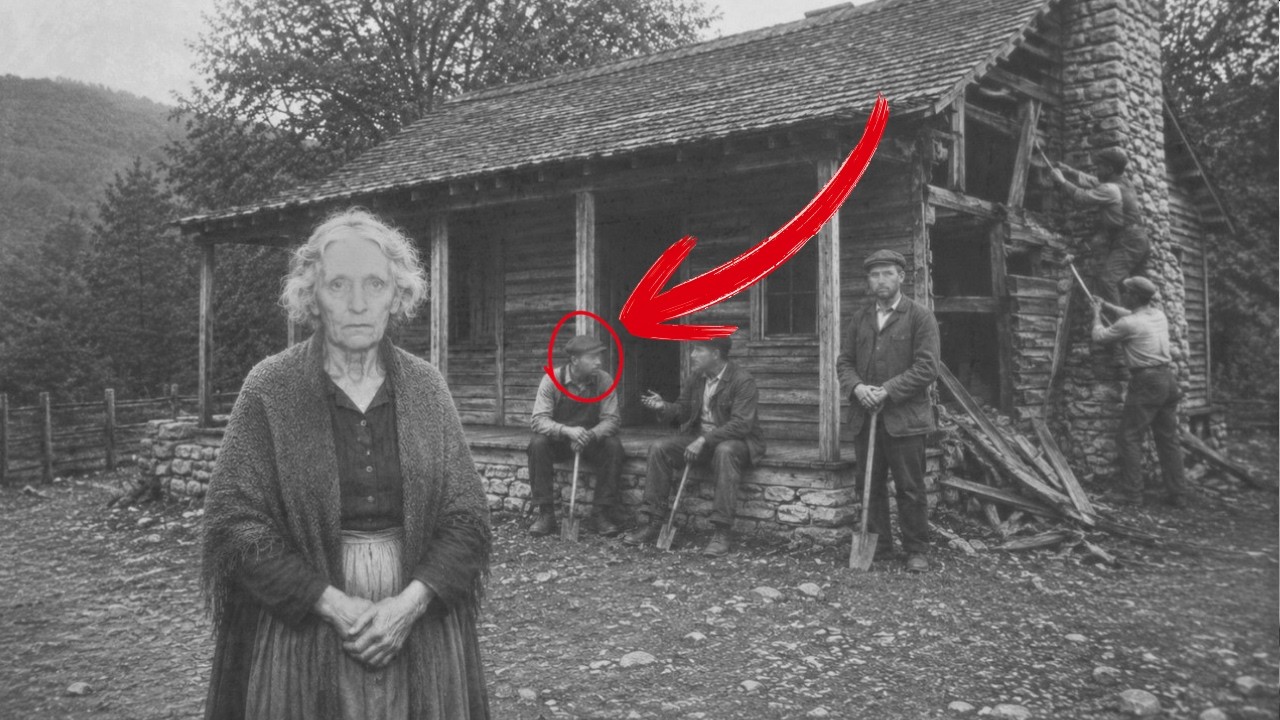
A woman who never left her property for more than a single day at a time, as if she could not bear to be away from it for long. When she finally died, the land passed to a nephew who wanted no part of it. He wanted it cleared. He wanted it sold, so he hired a small work crew.
That crew is where this story begins. Three men and a small excavator, a job that should have taken no more than two days. Tear down the cabin, haul away the debris, level the ground, and leave with a check. Simple work, the kind you do without thinking.
But on the third morning, when the machine bit into the foundation, the ground made a sound none of them had ever heard come from dirt. A hollow, rolling groan, so low they felt it in their chests before they heard it with their ears. The sound of a vast empty space finally giving way beneath them. Then a section of floor about six feet across fell straight into the darkness.
They killed the engine. They stood at the edge of that hole for a long time without saying a word, because what they were looking at was not a root cellar. It was not an old well, not a collapsed septic tank, not any of the ordinary things you expect to find beneath an old house. It was a precisely cut stone archway leading into a tunnel that had no reason to exist beneath a hundred-year-old cabin in the middle of nowhere.
And the longer they stared, the more pressing became one question that would not leave them alone. If Ada Vance built this cabin in 1911, then who built what was underneath it? To understand what they found there, you first have to understand the cabin itself. It was a modest structure.
Two rooms, a stone chimney, and hand-hewn logs chinked with clay. Everything about it suggested an early twentieth-century Ozark farmhouse. County records confirmed it. A building permit filed in 1911.
Property taxes paid every year after that, up until the year Miss Ada died. On paper, there was nothing strange about the place at all. It was one of ten thousand forgotten farms scattered across those hills, no different from any other. And now the crew believed that was exactly the point.
A place hidden by being ordinary, a door disguised as a farmhouse. But the foundation told a different story. Most cabins of that era sat on simple piers, flat fieldstones stacked at the corners to lift the logs off the damp ground. Nothing fancy, nothing engineered.
Ada’s cabin sat on something entirely different. A continuous foundation of dressed limestone blocks, each one cut so precisely that a knife blade would not slip between the joints. There was no mortar between them. Nothing at all, just stones set perfectly on top of each other with a precision you would expect from a machine shop, not from a lone settler working with a hammer and a mule.
They had walked over that foundation for two full days without giving it a second thought. Only after the floor collapsed did they finally understand what they had been standing on the whole time. The stones under Ada’s cabin were not the work of a settler at all. They were far older and far finer.
The cabin had not been built on the ground. It had been built over something that was already there, waiting long before the first settler climbed those hills. Ada had not chosen that spot by chance. Someone had chosen it for her, or for whoever came before her, and they had gone to great trouble to make sure the world above would never notice what lay below.
The first man down was Marcus, the youngest of them. He descended on a rope with a headlamp and a bad feeling in his gut. He described what he saw as he went down. The archway opened onto a passage, not a rough-hewn mine with timber sides and pick marks scarring the walls, but a finished corridor with walls of the same dressed stone as the foundation above.
The floor was paved in a pattern of interlocking blocks, worn smooth by something, sloping gently downward into the dark. The air rising up was cold and dry and perfectly still. It carried no smell of rot or earth. It had no smell at all, like the moment you open a sealed jar that has sat for years.
He kept talking as he went, partly to describe the place, and partly, the crew thought, to keep his nerve. He said the blocks were massive, far too large for any man to carry, some the size of coffins. Yet the joints between them were tighter than modern countertops. There was no trace of any tool on any surface, no chisel scar, no line of mortar, no sign of the human effort that must have gone into moving and shaping all that stone.
It was as if the passage had not been built at all, but poured or grown or raised whole from the bedrock by hands that did not tire. Marcus reached the bottom and called up a single word. Rooms. There were rooms down there.
They lowered the other lamps and climbed down after him. For the next hour, they walked through something the surface world above them had no memory of at all. The passage branched. It opened into chambers with vaulted ceilings, stone arches springing from the walls and meeting at the top in a way that suggested engineers, careful design, people who knew exactly what they were doing.
In one chamber, the ceiling had partially collapsed, and through the gap they saw not raw rock but row after row of laid brick rising high above, as if the tunnels were merely the basement of something that had once stood taller and been buried from the top down. Think about what that really means. A cellar is dug. A mine is dug.
A grave is dug. You start at the surface and go down, and the newest thing is always at the bottom. But this was the opposite. The building had not been dug into the earth.
The earth had risen over the building. Layers of soil had piled up from above until they swallowed completely a structure that had once risen toward the open sky, its roof becoming the floor on which Ada Vance would someday lay her wooden planks. That final detail is the one the crew always returned to, the one none of them could shake. Buried from the top down.
There is only one way that happens to any building. Something must have buried it. And whatever moved all that earth over that massive structure did not do it with shovels. It happened in a single event.
A wave of mud and water and debris coming from nowhere, swallowing a city, then receding, leaving behind the hills we see today, sitting quietly over the bones of an older world. At the brick, the matter stopped being mere curiosity and became something they truly could not explain. Modern brick, the kind Ada might have used for her chimney, is soft and porous, crumbling at the edges after a century of harsh weather. The brick in that buried roof was different.
It was dense and almost glassy, fired at a temperature no local nineteenth-century kiln could have reached. When Marcus tapped it with his steel bar, it rang. It rang like fine ceramic in an empty room, and the brick courses themselves were laid in a bonding pattern none of them recognized, an interlocking weave that carried weight in a way modern builders no longer used. Most of them no longer even knew how to imitate it.
It was not primitive. It was the exact opposite. It was the product of an architectural tradition that surpassed by every measure they could see the crude log cabin sitting above it. Older and somehow better.
And that detail has no place in the official story of history at all. We are taught from childhood that history moves in one direction. The deeper you dig, the more primitive things become. Those who came before us knew less, built worse, understood less than we do.
Every century was a small step toward a better present. It is a comfortable story. But standing in that chamber made belief in it impossible, because everything under Ada’s cabin ran in the opposite direction. The oldest layer, the deepest layer, was the most advanced of them all.
The stonework grew finer the deeper they went, not rougher. The engineering grew bolder, not simpler. It was as if they were digging backward through time to an age more capable than their own. An age that built with materials they could barely manufacture today, then vanished so completely that they had been told it never existed at all.
Someone had taken a civilization, stuffed it under the dirt, and written a property deed over the grave. At the lowest level, real fear began to creep in. The main passage led to the farthest point it could take them, and it ended in a door. Not just an entrance.
An actual door. A single slab of dark stone taller than all of them, set in a carved frame and sealed tight. Around its edges, the gap had been filled with a gray substance poured as a liquid and hardened like iron. Someone had closed this door, and that someone had made absolutely certain it would stay closed for a very long time.
On the surface of the slab, shallow inscriptions had been carved into the stone. They were marks, not exactly writing, not letters any of them could read, but deliberate, repeated, arranged in precise rows the way language is arranged on a page. Marcus ran his fingers slowly over them and asked the question they were all thinking, though none of them wanted to say it out loud. Who closes a door from the outside and then buries the whole building on top of it?
Think about the logic of it. You close a door from the outside to keep something inside. You bury a building to erase the fact that it ever existed. And you do both together when what lies behind that door is something you never, under any circumstances, want the surface world to find or free.
There was something else about that chamber none of them could ever shake. The air in front of the door was different. Colder than the rest of the tunnels and heavier somehow, the way the air feels heavy before a strong storm rolls over the hills. Marcus said his headlamp seemed to dim as he approached the slab, even though the batteries had been new that morning.
None of them wanted to be the one to say it, but they all felt the same thing standing there. The door was not just old. What it had been built to imprison was still there, in a way none of them could describe, waiting on the other side of the stone, just as patient as it had been the day the world was poured over it. They did not open it.
They stood before that sealed slab with three headlamps and one steel bar, and every instinct screamed at them to go back toward the daylight while they still could. That is what they did. They climbed the rope one by one and did not look down. What happened next is the part that turned a strange day into something the crew leader still thinks about almost every night.
They reported it. Of course they did. You find a stone complex under a demolition site. You pick up the phone and call someone.
So they called the county offices and told them what they had found. And the county’s response ended up being the strangest thing in the entire story. Within two days, before they had even finished packing their equipment, men they did not know arrived at the site in unmarked trucks. They were polite.
Professional. They wore no uniforms and gave no names. Very calmly, they told the crew the job was over, they would be paid in full for two weeks, and the site was now closed pending a survey. The crew leader asked the oldest of them, who seemed to be in charge, what agency he belonged to.
The man looked at him for a moment, smiled, and said only that they had done good work, and it would be best for everyone to forget the address. He did not say it as a threat. He said it the way you give directions to a stranger. Calm, confident, final.
That, more than anything else that day, convinced the crew they had stumbled onto something far larger than an old cabin in the woods. Because you do not send men like that in trucks like those, with paperwork already prepared before the crew had even climbed out of the hole, unless you knew exactly what lay below. Unless you had known for a long time, and were only waiting for the day the earth gave way and someone looked in. They were escorted off the site that same evening.
When one of them drove past a week later, the gravel road had been blocked by a gate with signs that had not been there before. A month after that, the hole had simply vanished. Filled in, leveled, and seeded with grass, as if the ground had never opened at all. And when the crew leader finally went to the county office to pull public records for the property, the survey map itself had been quietly redrawn.
The elevation lines near the cabin were different from the ones he had photographed with his phone during the week they started work. Someone had gone back into the official record and changed the shape of the land itself. The man cannot say he knows what lay behind that door. He does not know.
No one allowed them to find out. But he knows exactly what his eyes saw, and so do the two men who stood beside him. Precisely cut stone no settler on this continent ever produced. Brick fired at a heat no local kiln of that century could reach.
A building buried entirely from the top down, and a heavy door sealed from the outside and marked with a language no one could read. And he knows that the moment they told the simple truth of what they found, the truth itself was put behind a gate, filled in, and erased entirely from the public map. Ada Vance lived above that sealed door for more than a century. The crew leader spent a long time wondering whether she knew.
Whether that strange, impossibly precise foundation was something she chose by chance, or something she inherited without understanding, or something she was quietly placed there to guard and sit upon. She left behind no diary, no letters, no answers of any kind. Just a cabin over a tunnel, a tunnel over a door, and behind that door something three ordinary demolition workers were never meant to see. He learned one thing about her later, from an old man in the nearest town who remembered her family.
The old man told him that the Vance family had kept that land for four generations, and they had never sold a single acre of it, no matter how hard the times or how large the offers. He said it seemed like holding the land was the family’s only purpose, as if they had been given a task long ago and passed it from father to son and mother to daughter without ever writing down what that task was. Guard the ground. Do not dig.
Do not sell. Do not let anyone find what sleeps beneath it. When he heard that, the old neighbor’s memory of Ada began to make sense. The quiet woman who could not stand the thought of leaving, who watched the road and never strayed far from the place.
She was not hiding from the world. She was a guardian. The last in a long line of guardians who stood watch over a door they may never have understood. And when she died, the watch simply ended.
No one remained to take up the task. The nephew wanted the money, not the responsibility. And so the door that four generations of one family had spent their lives protecting was opened to daylight by a rented excavator on an ordinary Tuesday morning, because no one had told the last of the Vance family what they were really supposed to be guarding.






