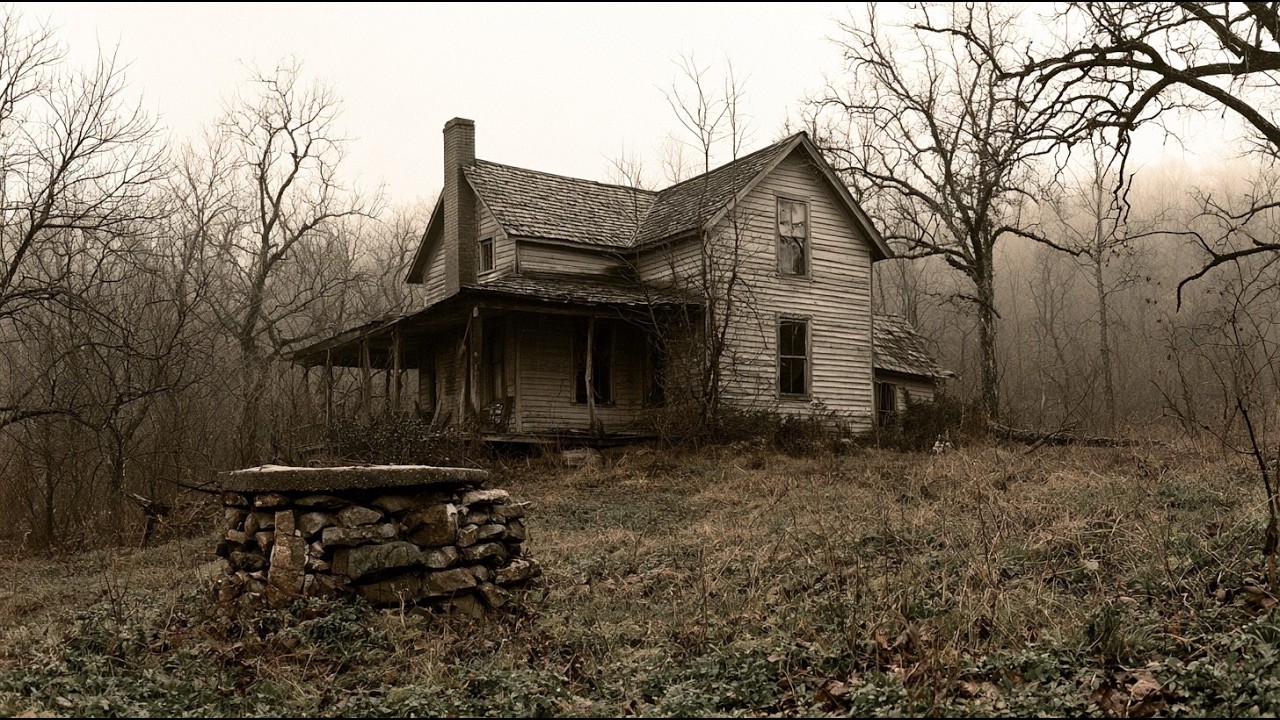
Alcott Frein knelt in the dead grass beside the sealed well, and the cold came up through the concrete slab into his hand. It was not the cold of autumn. It was a cold with weight, settling against the back of his neck like a hand placed there from behind. And beneath the slab, from the darkness, something was waiting.
He had heard it before, on his first visit to this place, and he would hear it again. But this time he had come prepared. This time he had brought the names. Frein was thirty-eight years old in the autumn he signed the contract on a house that no one in three towns had dared approach.
He appraised property for the county, which is a simple way of saying he walked through other people’s land and put a value on it, and he was good at it the way quiet men are good at things, by noticing what loud men overlook. He was tall, slightly stooped from years of studying deeds and boundary stones, and thin in the way that comes from forgetting to eat rather than from lack of money. His hands were stained with ink on the first two fingers, and rope burns crossed his palms, because the man who measures land in that country climbs as much as he writes. He had a long face, a nose broken once and set not quite straight, and eyes the color of stream water in shadow, hovering between gray and green depending on what stood beside him.
People who knew him said he never raised his voice and never forgot a number. Both would matter more than anyone could have predicted. And there is something else worth knowing about him, because it makes everything that follows possible. Frein did not believe in ghosts.
He was not a haunted man looking for the supernatural. He was quite the opposite. He was the kind of man who, if told a house was haunted, would first ask about the drainage and the age of the joists, because in twenty years of walking condemned land he had found that nearly every terrible story a place carries comes down eventually to bad water, or settling soil, or a family that ran out of money in a hard year and was too proud to say so. He had a quiet philosophy about it.
He used to say that most hauntings were accounts; that people invent a ghost when the real story is too boring or too shameful to say out loud, and that his true job behind the appraisal was to find that boring, shameful truth and write it in the proper box so the county could move on. All of this matters because of what it cost him later to write what he wrote. The house sat in a fold of the Ozark hills that the old survey maps called Harlow Vale, though the families who lived and died there called it only the Hollow, because in that country the word hollow is not just a description but a warning. It was a condemned property.
The county had classified it as such years before, nailed the notice to the door, and let the brush grow over the porch. The reason written in the official papers was the well. Not the roof, though the roof was failing. Not the foundation, though the foundation had shifted and cracked long ago.
The well. Someone had ordered the well sealed, capped with a concrete slab and a ring of field stone set deep in mortar, and the entire property was classified under a word Frein would come to hate. The word is abandoned. That is the word the law used.
As if the people had simply stood up and left, the way you leave a table when the meal is finished and there is nothing left to say. The price of that rotting house, with its sealed well and its nailed door and its ninety years of silence, was eighteen thousand dollars. Frein had been told the number would look like a bargain, and if you know anything about land, you are already doing the math. Sixty acres of timber, a creek bottom, and a house a patient man could rebuild with his own hands.
But the county had tried to sell Harlow Vale before. Four times Frein found it in the records, and four times the sale failed. And never once was the reason money. Frein did not go looking for the house.
He did not go searching for a mystery. The house came to him, the way these things always come, indirectly and with an ordinary appearance. His office was clearing old condemned properties from the rolls that autumn, the ones the county had kept so long they had become a burden on the books, and Harlow Vale sat at the top of the list because it was the oldest. He was told to go, walk the land, set a fair value, and write a report for the spring auction.
A morning’s work, maybe an afternoon if the road was bad. He drove out on a Tuesday in October, the gold light slipping through the walnut trees, a thermos of coffee on the seat beside him. By the time he found the turnoff, the gold had gone gray, though he could not say when it happened. That was the first thing he wrote in his notebook, the notebook that later came into my hands.
He wrote, “The light changed, and I did not see how it changed. ” Eight words. The first eight words of a matter that took the rest of his life. No one had walked the road to the house in years, and brush scraped and hissed along the undercarriage of the car the whole way.
When the trees finally parted, there it was. Gray boards, a sagging porch, a chimney standing straighter than the walls it was meant to hold. And it was cold. Not autumn cold, not the crisp cold of a fall morning that wakes you and makes you glad to be alive.
A cold with weight that you feel settle on the back of your neck like a hand from behind. Frein got out of the car, and the first thing he noticed, being a man trained by a lifetime of observation, was that there was no sound. Nothing. No birds.
In October, in those woods, the jays should have been screaming at him, squirrels should have been crashing through the branches. There was nothing at all. Only the ticking of the engine cooling behind him and the sound of his boots in the dead grass. Both seemed louder than they should have been, swallowed faster than they should have been.
He walked up onto the porch. The condemnation notice was still nailed to the door, faded now almost to the color of the gray wood behind it. Below it, when he came closer, he could make out the faint traces of other notices, layer upon layer. Shadows of old nail holes and old paper, years and years of them.
The county had nailed this notice to this door again and again. Someone had come here more than once and nailed the same warning to the same wood. As if the first one had not taken. As if a notice were something whose effect could wear off a place.
Frein filed that fact away in the part of his mind that keeps numbers. He told me years later that the repeated notices were the first thing that truly disturbed him, before the cold, before the absence of sound. Because they had disturbed him precisely because they were so ordinary. A ghost he could ignore.
But a real person, a flesh-and-blood county employee drawing a salary, had driven out to that desolate place again and again over the decades, hammer in hand, to nail a new warning over the remains of the last one. That was not superstition. That was hard work. That was a decision made over and over that this particular door needed to be constantly reminded that it was shut.
Then he went around back to see the cause of the condemnation, and he found the well. Someone had put real effort into that well. It was not a rotten board thrown over a hole and forgotten. It was a poured concrete cap a hand thick, surrounded by a collar of field stones set deep in mortar, and it had cost money and labor and someone’s serious, determined intention.
You do not seal a well that way to keep leaves out. You do not seal a well that way to keep the water clean for the next family. You seal a well that way for one reason only, because you want to keep something inside. Frein knelt beside it in the dead grass and ran his ink-stained fingers along the seam where the concrete met the stone, and felt the cold coming up through it, through the slab and into his hand.
And this is not the nature of wells. Frein knew it at once, and it was the second thing that would not let him leave. In that country, a well is warmer than the open air in autumn. Everyone who has ever drawn water knows this.
You go to the well on a cold morning, and the water gives back a little of the summer’s warmth that it has held in the dark. That is the quiet comfort of a deep well. But this well was breathing cold. A cold rising from a sealed hole in the ground in a way the earth itself could not account for.
The well was colder than the ground. He was still kneeling there when he heard the sound. And I must be careful how I tell you this next part, because Frein himself was very careful how he told it during all the years I knew him. He did not say he heard a voice.
He was exact about that, the way an appraiser is exact. He said he heard something his mind wanted to turn into a voice, the way a face forms from the knots and grain of an old board when you stare at it in dim light. He said that thing came from beneath the slab, from down in the sealed dark. And the only true quality it possessed, the only thing he could say without lying, was that it was patient.
That is the word he used. Patient. A sound with no hurry in it at all. No call, no cry.
Just waiting. The way water waits at the bottom of a well for the bucket to come down to it. Frein’s body stood him up before he could tell anyone why. He left that first day, drove back to town without setting a value, without writing the report, and told his supervisor the light was fading and he would finish the appraisal another day.
That was true, as far as words could carry it, but it was not why he left. Now, here is the crossroads where an ordinary man closes the file forever. The sensible man, the man who wants to sleep in peace, writes the word “abandoned” in the box like every clerk before him, puts in an approximate figure, goes home, and never sets foot down that road again for the rest of his life. Most men would do that.
Most men did do that, for ninety years. But I told you Frein never forgot a number. And there was a number working at him now, like a splinter under the skin. Four failed sales.
Four. Not one bad buyer, not two unlucky seasons. Four separate times over nearly a century that someone had bought that land and not kept it. The county had recorded all of it and never once asked why.
So Frein went to the records. Not the upper records, the clean ones the public sees, the plats and the tax rolls kept upstairs in order. He went to the deep records, the basement archive, where the light is a single bulb on a frayed cord and the paper is crumbling from damp, where the county keeps the things no one has looked at in fifty years because no living person has had a reason to. A low ceiling, the smell of old paper turning to pulp, boxes stacked to the joists, most unopened since the day they were closed, the twine still tied in a dead clerk’s knot.
Frein sat in that room and began to untangle the whole history of Harlow Vale, thread by thread. The property was first recorded in 1862 to a family I will give you the name of exactly as Frein found it written, because in this story, names are not decoration. The family was the Vayles, spelled V-A-E-L. A strange spelling even for that time and place.
The Vayles owned that land, farmed it, buried their dead in it, for thirty-one years. And then, in the bitter winter of 1893, the entire family ceased to exist. I choose that word deliberately. Ceased.
They did not die. No deaths were recorded. They did not move, did not sell, were not carried off by plague. None of the usual endings of families in that country.
The entry in the county ledger, in the clerk’s careful hand, was that the occupants were no longer in residence. And upon that, the property was deemed abandoned. Nine people. Nine people vanished from one house in one winter, and the county’s official response was to write that they had probably left, leaving a clean white space in the record exactly where an explanation should have been.
In 1893, the Vayles, nine adults working hard land in a lean, hard year. Then, in a bitter winter, the smoke stopped rising from the chimney. A neighbor, a full day’s walk away across two ridges, finally noticed the absence of smoke and came to check, as people did for each other there, because checking on a neighbor could mean the difference between life and death. He found the front door standing wide open.
The door swinging on its hinges, snow drifted a foot deep across the threshold into the front room. And inside, everything was in its place. That was the detail that stuck in Frein’s mind, and it is worse than any disorder. The table was set for a meal, the food still on it, spoiled long ago under a layer of frost.
The shoes by the door. All of them. Every pair lined up where feet had stepped out of them, which meant in that country, at the height of winter, one impossible thing: that no one had left on foot. You do not walk out in January in the Ozarks in your socks.
Not to the barn, not to the woodpile, not anywhere. The coats still hung on their pegs by the door. Coats and shoes of nine people, hung and lined up waiting for them, and no trace of them was found in the house, the barn, the yard, or the woods, however far the search went. The neighbor who made the discovery was named Aesop Carroll, a man in his sixties who raised hogs and was known throughout his district as not easily rattled.
Carroll gave a statement to the county afterward. It is strange in the extreme, because a hard old man in his sixties does not speak the way Carroll spoke unless something has taken that hardness from him completely. Carroll said the house was warm. He said he walked into a house that had stood open to the blowing snow, with no fire in the stove, cold ash, days of cold ash, no one home for God knows how long.
And yet the inside was warm. Warm as a living body. And it got warmer, not colder, the deeper he went, closer to the back room where the well was, because in the better-built places there, the well was inside a spring house of stone directly behind the kitchen, so the family would not have to go out in the weather for water. And Carroll said the warmth was rising from the water, and that the water was glad.
Glad. That is not a word a hog farmer in his sixties reaches for. It is not a word that comes easily to a hard man, if it comes at all, unless it is the only word left after all the other words have failed him. He did not say the water was warm.
He said the warmth was glad. Carroll did not stay in that house. He said he called out once, the way you do, into the back of the house, and something answered him from the well. Something that was not a voice, but that carried the shape of a voice, its rise and fall.
And Aesop Carroll, sixty years old, tough as a fence post, turned and left that house, leaving the door open behind him exactly as he found it, because he could not force his hands to go back and close it. He walked the full day home through the snow in the dark of dusk. He never went back, not once, in all the years he had left. He never spoke of it again after that single statement.
And when he died years later, the people who sat with him in his final days said the only thing that seemed to trouble him, the only unfinished thing, was that he had left a door open somewhere long ago and never gone back to shut it. The county, as counties do, sent a man. His name was Deputy Orin Halstead. He rode out to Harlow Vale in the early spring of 1893, as soon as the snow melted and the roads opened, to do the logical official work of combing the property, inventorying its contents, and filing a full report.
His report is in that same basement, in that same damp, and Frein found it. It is four lines long. Four lines from a man whose every other report in that drawer runs to pages, a man whose hand Frein knew from all the other pages, a precise, methodical, cautious, capable man. Four lines, this time only.
He wrote that he had inspected the dwelling. He wrote that the well must be sealed and sealed tight. He wrote that he recommended posting the property and leaving it. Then he wrote one additional line.
A line with no place in county files. A line that was not a report at all but a message left for any eye that might come after, and someone, a later clerk who understood what he was reading and did not want anyone else to read it, had tried to strike it out with a pen but failed, because you can still make it out under the strike-through lines if you tilt the page toward the dim basement light, which is exactly what Frein did. Halstead had written, “Do not let them lower the bucket. ”
A deputy in a formal report, breaking every habit of his cautious profession to leave a warning for a stranger he would never meet.
The warning is about the bucket. About the simple act of drawing water. About letting the well do the one thing it was dug to do. Do not let them lower the bucket.
Then Deputy Orin Halstead requested a transfer to another county on the far side of the state, and it was granted. And that was the last the county heard of him for forty years. Except that it was not really the last of him. The well was sealed that summer, not just covered but sealed tight.
The county wrote its word, abandoned, and closed the door. And by every logical expectation, that should have been the quiet end of Harlow Vale forever. But land does not stay unsold forever. That is the harsh economic truth that kept drawing people back to that land against every logic in the world.
Every so often, some official watching the rolls decides the time has finally come to be rid of it, the notice goes out, and a buyer comes along who does not know, or does not believe, or does not care. The first attempt was 1901, eight years after the Vayles. A buyer from out of state, a man with money and no local knowledge, the most dangerous combination that can exist for such land. He paid the deposit, took full title, moved his household that autumn.
By the following spring, the property had reverted to the county, the buyer was gone, and the only record of any reason is a single line in the return ledger, in the clerk’s dry hand, giving the reason for the reversion as the water. That is the entire explanation. Two words. Water.
A man crossed state lines, spent his savings, moved his entire life onto sixty acres, and gave it all back within a single winter, and the only reason anyone wrote, or perhaps the only reason he gave, was the water. Frein traced that man as he did everyone. He found a scrap in the correspondence file, a short note the returning buyer sent with the deed, and Frein copied it. The man wrote that he was returning the land and would not discuss it, and that he had one request, which the county could accept or refuse as it wished.
He asked them never to tell him if it was sold again. He wrote that he did not want to know who came after him, and did not want to spend his old age wondering if someone there was drawing the water. The second attempt was 1914. This time it was not a family but a land company, a proper corporation with capital that bought the whole valley to cut the timber, harvest the standing hardwoods, and sell the cleared land cheap to whoever wanted it.
Cold business, no superstition in it. The foreman they hired, a working man used to hard camps and rougher crews, left the site after only one week and put his reasons in writing for the company. Frein found the company’s copy of that letter. The foreman wrote that he would not keep a crew on that land, that the men would not draw water from that well, would not go near it, would not stay on the site a minute after dark for any wages.
And that he himself, and here the letter of a simple working man uses a phrase Frein underlined twice in his notebook, he himself had heard it. Counting. That is the word. Counting.
He did not explain it. Perhaps he could not. He simply set it down as his reason for leaving. Frein sat with that foreman’s letter for a long time, because of the shape of the word.
Counting. Not wailing, not calling, not crying. Not a word a man reaches for when he is trying to dress up a bad night with a ghost story to justify quitting. Counting is a specific act.
Counting has a purpose. You count money, or heads of cattle, or the days before an event. You count what you intend to track, to know the moment something is lost or the moment the number is finally complete. A working man stood at that well in the dark of 1914, and what came up to him from it was not grief.
It was arithmetic. And he was wise enough, or afraid enough, to gather his crew and leave. The third attempt was 1922, and this is the one Frein could never get to the bottom of, because its file was thin, thin in a way that struck him as suspicious, as deliberate, as a file someone had interfered with and removed things from. What he could piece together from the remaining scraps was this.
A couple bought Harlow Vale and moved into it, and within two months a county inquiry had been opened about them. Some official concern, some visits, and the inquiry was closed without charges, with a single note recorded in place of a conclusion. The note was one word: medical. After that, the couple did not return to the property, and did not return to the county at all, as far as Frein could find in any record anywhere.
They simply vanished. And the file was thin around where they were, exactly like the snow that had drifted over the threshold thirty years before. The fourth attempt to sell Harlow Vale came in 1931, and it is the one that finally, after all those years, put the figure of eighteen thousand dollars into the story. In 1931, the county, tired of holding dead land through hard times, put Harlow Vale up for auction at a minimum bid, and it was won by a bidder.
A man named Doss Marion, forty-four years old, a widower, a man who had made a real fortune in the feed and grain trade in two neighboring counties, and had reached the age where a man like him wants a quiet piece of land to rest on. Marion paid, and Marion was warned. Of course he was warned. Everyone who came near that land was warned by someone local who knew the truth.
And Marion did exactly what men who built their fortunes from nothing often do. He took the warning as a small, frightened superstition of small, frightened people. He took the low price as a reward for his good business sense, as he always had. He moved to Harlow Vale in the summer of 1931.
And Doss Marion did the thing, the one thing. He opened the well. Frein pieced together the slow decline from Marion’s own letters, which the county eventually acquired because they became evidence. And those letters, I tell you, are the most frightening documents in the entire file, worse than the empty house, worse than the stricken deputy, because in them you see, letter by letter, the confident, sane hand of a man falling apart between his own fingers.
In the first letter, Marion is cheerful. He writes to his brother, boasting a little, that the old fools before him left him sixty good acres and a fine deep well for a pittance, that the silly concrete cap on the well is only an affront to good fresh water, and that he intends to smash it and put the old spring house back in service, because hauling water from the creek is a young man’s work, and he admits he is no longer young. In the second letter, three weeks later by the dates, he tells his brother he has broken through the cap. It took two days with a hammer and chisel, and he says it was harder than it should have been, but it is done.
He says the water is sweet. Sweeter, he writes, than any water he has drunk in his life. Cold and perfectly clear and sweet beyond all measure. And he cannot for the life of him understand why any sane man would seal water like that away from the world.
He mentions, near the end, as an aside, that he has not been sleeping well since. But he puts it down to his new strange bed and the deep quiet of the country, as any sane man would. In the third letter, the handwriting changes. Frein described it to me, and I have seen it myself, and it is accurate.
The script tilts. The pressure is so heavy that the pen nearly tears the paper in places, and the lines slide down the page, as if the words themselves are being pulled downward toward something. In that tilted, pressing, sliding hand, Doss Marion writes that the well is noisy at night. Those are his words, strange, and he uses them simply as if they were an ordinary complaint.
He writes that he has taken to sitting beside it in the dark, that he cannot help himself, that he goes to bed and finds himself sitting on the cold stone edge of the spring house with no memory of getting up. He writes that there is company down there. Those are his words. Company.
And that this company has learned his name. Then he writes the line that Frein copied in his own steady, precise hand. Frein always believed he copied it slowly, deliberately pressing the pen flat and ordinary, as a way to hold it steady and at a distance while he wrote it. Marion writes, “They are all down there and they are not unhappy, and they have asked me to come down, and I have not decided yet.
” “I have not decided yet. ”
There is a fourth letter in the file. But the fourth letter is not from Doss Marion. It is from the county, addressed to Marion’s brother.
It tells him, in dry official language, that Doss Marion was found on the property alive and intact, sitting on the edge of the open stone well. That he was not, at the time he was found, able to answer any questions put to him. That he had been removed from the property and placed in care. That the well had been ordered resealed at county expense, properly, with slab and stone.
That the property had been posted again. And the word was there in the county’s letter, doing its patient work again. Abandoned. Frein read all of this over the better part of a week, coming to that basement before the office opened and staying long after it closed.
His own notebook from that week is a difficult thing to hold, because you can see the same change coming over Frein’s hand that came over Marion’s, the tilt, the heavy pen pressure, the lines beginning to slope downward off the level toward the corner of the page. And I do not believe Frein saw it happening in himself any more than Marion saw it in himself. That is the thing about that land. It does not announce itself.
It comes the way the gray slipped into the gold light on the drive, so slowly and so steadily that you cannot mark the moment it changed, only that it has changed and has been changed for some time. By that time he had entirely lost the ability to let it go, so he drove back to Harlow Vale. He told himself, and he wrote it down, that he would only finish the appraisal he had abandoned on that first gray afternoon. Just finish the job, set the value, close the box, and be done with it.
He drove down the road where the light turns gray, and it turned gray on schedule, the gold draining from the day between one walnut grove and the next. He parked beside the porch with its ghostly layers of old notices. He went around back to the well, the resealed well. Marion’s broken cap had been poured over with new concrete and set with new stone.
And Frein knelt beside it in the dead grass, exactly as he had the first time months before, when he had been a different man. But he was not that man now, and this time he had not come empty-handed. He came with everything in his head, every name and date and dry official word he had pulled from that basement. The nine Vayles, who vanished in the winter of 93 leaving behind a warm and glad house.
The out-of-state buyer of 1901, whom the water had undone. The timber crew of 1914, who refused to drink from the well because they heard it counting. The couple of 1922 and the thin file that folded them away with the word “medical. ” And Doss Marion, 1931, who broke the cap and drank the sweet water and was invited down, and had been only one week short of the county arriving before he decided to go.
Frein knelt there with all of it in his head and listened. And the sound was there, patient, in no hurry at all. And kneeling in the dead grass above that sealed, breathing hole, holding ninety years of the dead and the vanished in his mind all at once, Alcott Frein finally understood the thing that the word “abandoned” had been quietly hiding for ninety years. No one had abandoned Harlow Vale.
That was the lie at the bottom of every record. The tidy, comfortable word laid over the truth exactly as the slab had been laid over the well, to keep something from rising up into the daylight where people would have to look at it. The Vayles had not left. The buyer of 1901 had not left.
The couple of 1922 had not left. And Doss Marion had almost not left, would not have left, would be down there now, if the county had come a week later. None of them had left of their own will. They had all been invited down, and some of them, over those ninety years, in the noisy dark beside the cold sweet water, had agreed.
Frein knelt by the well as the light went gray at an hour it should not have gone gray. And he took out his notebook. And he did the one thing I have come to believe is the reason he is not the sixth name in that record. He did not listen to the well.
That is all it was. Everyone who knelt at that water had leaned in to hear, to understand what the patient voices were saying, to answer the company that knew his name. Frein did the exact opposite. He did not listen to the well.
He spoke to it. He turned his notebook to a fresh page, and in his slanting hand he wrote all the names. That is what fills the back of the notebook, page after page in slanting hand. Every name he had pulled from ninety years of the county’s deliberate forgetting.
The nine Vayles first, each by name, because he found them all in an old deed and musty church records. Then the out-of-state buyer of 1901. Then the foreman and his crew of 1914, the men who heard it counting and were smart enough to leave. Then the couple of 1922, whose names he pulled from the thin, crumbling file, recovering what someone had tried to erase.
Then Doss Marion. And below the last of them, after the last name, Frein wrote a single sentence. He wrote, “The well does not take people. It keeps them, and it wants to be full.
And the word abandoned is only what we say so we do not have to count. ”
Then Alcott Frein did the one thing the county, for ninety years of posting and sealing and writing that soft false word, had never thought to do, or perhaps had been afraid to do. He counted them. He knelt there in the gray dusk light by the sealed well.
And he read the names aloud. All of them. In that unnatural stillness, one by one, slowly and clearly, the way one reads a roll of the honored dead so that no one among them goes unspoken. And Frein lived, understand this, Frein lived to be an old man, and I knew this from him near the end of his road.
He told me that as he read the names, the sound beneath the stone changed. It had been patient the whole time, only patient, only waiting. And as he read name after name into the cold, that sound began to grow. It became attentive.
And for the first time, it began to listen to him. And when he read the last name, Doss Marion, the name of the one who reached the edge and was asked and answered “not yet,” and was pulled back by a week’s luck into the light, the cold that had been rising from the stone slab into the autumn air simply stopped. Between one name and the next breath of silence, the cold stopped. It stopped like a held breath.
And the birds, the ones that had never made a sound on any of the times Frein’s feet touched that land, suddenly burst into song in the woods around him, jays and crows and small birds, noisy and ordinary and furious at his presence there, alive, so alive. And Frein said the light came back. The gray lifted from the afternoon the way a hand lifts from the back of the neck. And October returned, the real October, with its gold in the walnut trees, four in the afternoon, not one minute late and no stranger than four o’clock should be.
He sealed nothing that day. He broke nothing. He did not touch the well with his hand. He read the names of the kept aloud into the cold, got to his feet, walked to his car, and drove back down the road through that ordinary gold.
And the whole difference, as he always said, the only difference between him and every name in that notebook, was that he had given them value. That was all. He had refused, aloud, on that land, to leave them forgotten. Now, I have kept one thing from you all this time, and I promised it to you twice.
Deputy Orin Halstead, the man who wrote “Do not let them lower the bucket” in an official report in 1893, then requested a transfer across the state, rode his horse west, and disappeared from this story. Frein, being the man who could not leave a number unaccounted, would not let a vanished man stay vanished. He traced Orin Halstead through three counties of yellow transfer papers, duty rosters, and pension records, following the trail of a cautious man through the latter half of his life. And he found where the trail finally ended.
It ended in the autumn of 1930, thirty-seven years after Halstead had fled Harlow Vale as a young deputy. In that autumn, Orin Halstead, by then an old man, retired long since, living alone, with no family anyone knew of and no reason anyone could name, got up one morning and walked twenty miles on foot. An old man crossing back over the county line he had put between himself and that place a lifetime before, back down a certain road where the light tends gray between one stand of trees and the next. A road crew found him in the morning just after dawn, on their way to clear a landslide, sitting on the porch of the condemned house.
On the porch with its ghostly layers of old notices, the very notices he had once ordered nailed there as a young man. He had sat there all night in the autumn cold, an old man alone, and he was not facing the road, not facing the way back to the world of the living. He was turned the other way. He was facing the back of the house.
He was facing the well. And he was still alive. That is the part that always confounded me. He was alive and awake, and he did not say why he had come, and did not answer the road crew’s questions any more than Doss Marion had answered the county’s.
But he said one thing to the men who found him, one thing, and they reported it, and it is recorded as the last line in the long, carefully kept file of Orin Halstead. The old deputy looked at the men standing over him in the gray dawn and said, “I have been listening to it my whole life, and I only walked here to tell it, I am ready, and it said to me, not yet. ”
Not yet. Fifty years of running.
Fifty years he kept an entire state between himself and that well, and it never once stopped speaking to him, patient across all that distance and all that time. And when he was finally old enough and tired enough and ready enough to come back and give it the “yes” it had waited his whole life for, the well refused him, for reasons of its own. Not yet. Orin Halstead lived two more years after that dawn on the porch, and Alcott Frein, who uncovered all of this and recorded it, never knew whether the well eventually said “yes.
”
So, eighteen thousand dollars for a condemned farmhouse in the Ozarks. Now you know what that price was really for. You know why four buyers before him could not hold that land for a single winter. You know why the county, for ninety years, clung gratefully to that one soft, misleading, comfortable word every time it had to record that place.
Frein closed the file, but he did not close it the way it had always been closed before. He wrote a value in the box, a real value, in his own hand. And the value he wrote was not eighteen thousand dollars. It was one dollar.
One. And in the notes beside it, he wrote that the property must never be sold again under any circumstances, but must be held, kept in trust by the county. And that whoever was responsible for it should send someone down that road from time to time, into the fading gray light, to stand by the sealed well and read the names aloud, all of them, so that no one in that cold sweet water would be allowed to become forgotten again. Whether the county listened to a word of it, whether anyone after Frein walked up that road on purpose, I honestly cannot tell you.
That thread ends there. But I can tell you this, and I know it is true because I heard it from the man himself. Alcott Frein went back. Every autumn, when the light was about to turn gray, for the rest of his life, an old man now, the ink still staining his fingers, he drove alone down that road to that sealed well, and stood over it in the cold, and read the list of the kept aloud, name by name, so that the count would never stop.
So that the well remained full and answered and found no reason to reach for more. That is where I will leave the story tonight, here at the edge of that well, with a man standing over the cold reading a list of names into its depths so that the cold has no reason to reach out of the dark and take his name.






