Eight hours after Catherine of Aragon stopped breathing, the men who had taken charge of her body had it opened. Not by a surgeon, but by the palace chandler. Every organ in her body was sound except the heart. The heart was black.
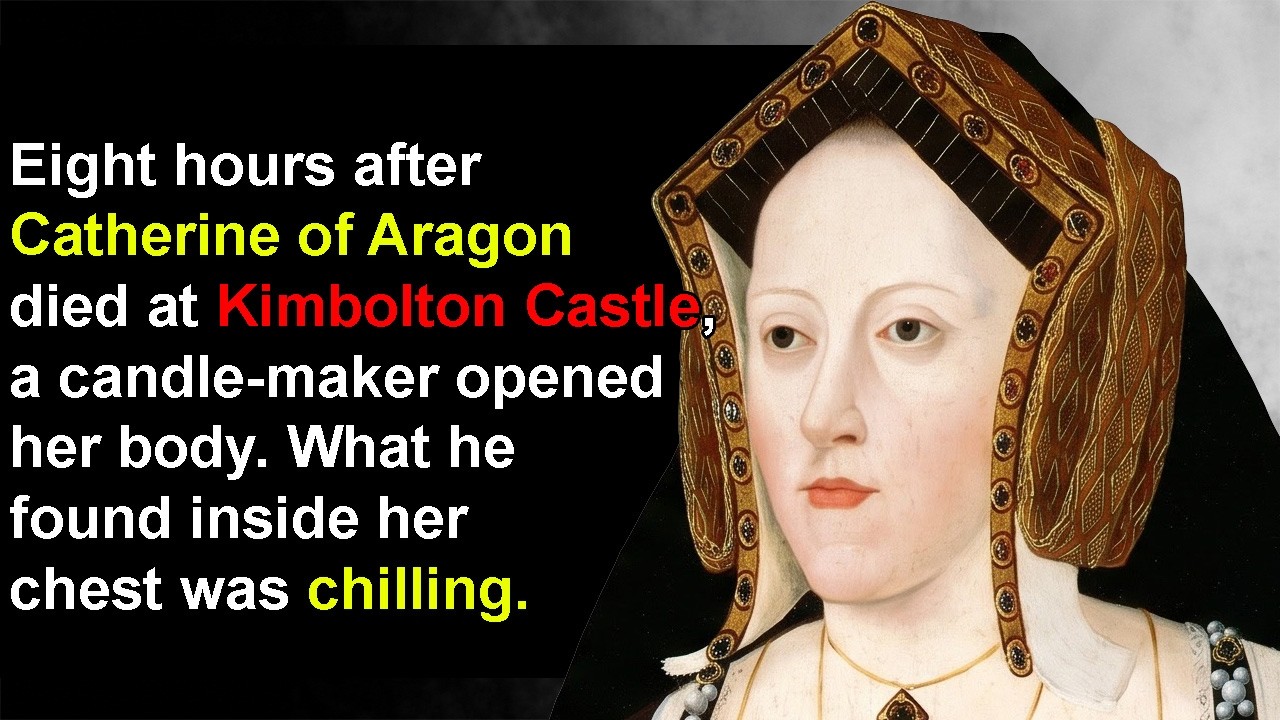
Most people remember her as the sad first wife who wept while Henry VIII moved on with his life. She was the most dangerous opponent he ever faced, and she forced him to tear down a thousand years of English religion rather than concede a single word. She was born on December 16, 1485, in the archbishop’s palace at Alcalá de Henares in Castile. Her name was Catalina.
She was the last living child of the two most powerful monarchs in Europe. Her father was Ferdinand of Aragon. Her mother was Isabella of Castile. And Isabella is the key to everything that followed.
Isabella did not stay home embroidering while the men fought wars. She ran the war. She organized the supply trains for the Granada campaign, funded the siege camps, and moved money, men, and artillery across the peninsula. Her daughters watched her do it.
The lesson Catalina absorbed before she turned ten had nothing to do with weeping. It had everything to do with logistics. She was raised for one specific purpose: Latin theology, canon law, and the management of a palace household. By the age of three, she was already promised in marriage to Arthur, Prince of Wales, under the Treaty of Medina del Campo.
She was a clause in a treaty, but a clause with a heartbeat. As her personal emblem she chose the pomegranate, the fruit of Granada, and in the symbolic language of her age it was a symbol of fertility. She chose it herself. It would become the cruelest joke of her life.
In October 1501, at fifteen years old, she arrived in England. She never saw Spain again. On November 14, 1501, she married Arthur in St Paul’s Cathedral. He was also fifteen.
They were sent west to Ludlow Castle on the Welsh border to learn the duties of a Prince and Princess of Wales. Arthur died in less than five months. He died on April 2, 1502. Contemporaries blamed the sweating sickness.
Others described it as some other sort of fever. The cause was never medically settled. Catherine caught whatever it was and survived. That left one question hanging over the rest of her life, a question that would eventually split the English Church in two.
Was the marriage consummated? She said no. She kept saying no for the next thirty-four years, under oath before a papal envoy, and in the face of the King of England. Her Spanish ladies supported her in this.
Arthur’s old servants later said otherwise, but they said so in 1529, at a time when saying otherwise was very useful to a career. No physical evidence exists for either side, and none will ever exist. What followed was seven years of nothing. Her father refused to pay the rest of her dowry.
Her father-in-law refused to fund her household until he got it. And so the widowed Princess of Wales remained in England, a hostage in a dispute between two kings, writing home about servants who were not being paid and dresses she could no longer replace. At some point, Henry VIII, himself recently widowed, raised the idea of marrying her. His dead teenage son’s widow.
The plan collapsed, and nobody in Europe found the proposal particularly strange, which says a great deal about the period. Then in 1503, to keep the English option alive, Pope Julius II issued a dispensation allowing Catherine to marry Arthur’s younger brother. The document covered the possibility that her first marriage had been consummated. One vague Latin word as a hedge.
Probably routine. It was insurance. It was filed and forgotten. Twenty-four years later, that single word would be used to dismantle her entire life.
Henry VII died on April 21, 1509, and everything changed within two months. On June 11, 1509, Catherine married the new king secretly at Greenwich. She was twenty-three. He was seventeen, five and a half years her junior, six foot two, athletic, and according to every surviving account, utterly infatuated with her.
On June 24, they were crowned together at Westminster. This is the period the textbook versions skip. For nearly two decades, they were an effective partnership. She was his queen, his regent, his diplomatic channel to the Emperor, and reportedly the person whose judgment he trusted most of anyone.
There is a strange physical footnote to this. In 2019, a metal detectorist named Charlie Clarke pulled a gold and enamel pendant in the shape of a heart from a field in Warwickshire. The British Museum announced it in February 2023. It bears a Tudor rose, a pomegranate, and the letters H and K tied with a ribbon.
Its purpose is still debated. One suggestion is a courtly pageant. But someone at the height of that marriage commissioned a gold heart with both their initials on it. A grim coincidence, given what a chandler would find inside her chest twenty-seven years later.
Because between 1510 and 1518, Catherine was pregnant at least six times on the record. On January 31, 1510, she gave birth to a stillborn daughter. The court hushed it up. Her belly remained swollen afterwards, and her physician told her a second child was still on the way.
There was no second child. On January 1, 1511, she gave birth to a son, Henry, Duke of Cornwall. Bonfires were lit, a tournament was held, England had an heir. He died on February 22.
He was fifty-two days old. Then a son in September 1513, stillborn or dead almost immediately. Then another son in November 1514, at about eight months. Then on February 18, 1516, Mary, who lived.
Then in November 1518, a daughter born dead at eight months. That was the last. Six pregnancies, one surviving child, and one son who breathed for fifty-two days. Higher numbers appear in some older accounts, but they blend in rumors that were never confirmed.
Henry would eventually argue that this record was God’s judgment on an illegitimate marriage. It is worth being blunt about this. She was not infertile. She conceived again and again.
Infertility was never a medical diagnosis in her case. It was a political talking point, and it came about twenty years late. In the middle of that devastating stretch, Catherine ran a war. In June 1513, Henry sailed for France to play the conqueror.
Before he left, letters patent dated June 30 made his wife governor of the realm and captain-general of the forces at home. This was not ceremonial. While Henry besieged small towns in Picardy, Scotland invaded, and James IV crossed the border with one of the largest armies Scotland ever raised. Catherine did what a daughter of Isabella had been trained to do.
She moved. Chamber accounts studied in the National Archives by Sean Cunningham, published in 2020, set out the precise details. Armor was shipped north in large numbers, around 1,500 light armor sets, with guns, gunpowder, and money, with figures worth £10,000 noted in the archival work. A reserve force gathered toward the Midlands in case the border collapsed.
On September 9, 1513, the English annihilated the Scots at Flodden. James IV was killed, along with much of the Scottish nobility. Figures from the period estimated around 10,000 Scottish dead and 4,000 English. Contemporary numbers, never verified by modern statistics.
The story that Catherine rode north in a suit of armor and addressed the troops is later embroidery. Thomas Howard, Earl of Surrey, commanded the battle. Catherine was the government behind him. She wanted to send Henry the dead king’s body as a trophy.
She wrote that English feeling would not permit it, that the hearts of her Englishmen would not bear it, and sent a piece of James’s bloodstained coat instead. Her husband had taken two provincial French towns. His wife had destroyed the Scottish crown. Twenty years later, he divorced her for failing to produce a male heir.
By the mid-1520s, the marriage had cooled and Henry was collecting mistresses. Elizabeth Blount had borne him a son in 1519, which he took as proof that the fault lay entirely on Catherine’s side. Then came Anne Boleyn, who refused to be a mistress at all. So Henry looked for a legal argument and found it in Leviticus.
The verse says a man who takes his brother’s wife will remain childless. Henry decided God had cursed this marriage. Although God had waited eighteen years, a coronation, and six pregnancies to mention it. The entire case rested on the single claim Catherine had spent her life denying, and on that vague word in the 1503 dispensation.
Cardinal Wolsey was ordered to pursue the annulment. He failed, and it destroyed him. That brings us to June 21, 1529, at the papal court at Blackfriars, to the most famous scene of her life. Catherine was summoned to respond.
Instead of sitting in her seat, she crossed the courtroom and knelt at Henry’s feet before the papal legate and the assembled nobility of England. She appealed to him as the chief justice of his kingdom. She told the court that she had come to him a virgin untouched by man, and she placed that claim directly before his conscience, publicly and on the record. Twice he tried to raise her up.
She would not rise. Then she stood, walked out, and kept walking when the court called her back. She never appeared in an English courtroom again. This scene was reported by George Cavendish, Wolsey’s own servant, who was standing in the room.
He wrote it down years later, and the surviving versions differ slightly in wording. The exact sentences are therefore approximations, not fully verbatim. What is beyond doubt is that she outmaneuvered the King of England in his own show trial, and everyone knew it. Henry stopped asking after that.
He pushed through the Submission of the Clergy. And the Act in Restraint of Appeals in 1533, which cut English legal appeals to Rome and made Henry the final court in his own marriage case. On May 23, 1533, Thomas Cranmer’s court at Dunstable declared the marriage void. Anne was crowned on June 1.
Elizabeth was born on September 7. Under English law, Catherine was now Arthur’s widow, the Dowager Princess of Wales. She refused the title. When official documents arrived bearing that word, she took a pen and struck it out, every single time.
Henry had rewritten the law of England and the authority of God himself. He could not force one woman to accept a new job title. He escalated in the only direction left to him. She was moved through a series of decaying houses: The More in Hertfordshire, then Buckden Towers, and from May 1534, Kimbolton Castle in the Huntingdonshire fens.
Damp, remote, and cold. Her household was pared down around her. Mary was taken from her. Mother and daughter were separated and kept apart for the rest of Catherine’s life.
Letters between them were intercepted or stopped. Better terms were offered to both of them, again and again. Comfort, contact, rehabilitation, on one condition: acknowledge Anne as queen. Neither of them ever did.
Not once. The image of Kimbolton as a dungeon is an exaggeration. She was not in a cell, and household records show provisions still arriving. What is documented is sadder in a quieter way.
She withdrew into two rooms and became convinced that her husband’s agents intended to poison her, so she cooked her own food in her own chamber over her own fire. A daughter of Isabella of Castile, cooking for herself because she believed the King of England wanted her dead. Later Catholic accounts added that she wore a hair shirt beneath her gowns. Those accounts were written by people trying to canonize a saint, so that detail remains doubtful.
But she kept sewing his shirts. Stripped of her title, cut off from her daughter, living in a castle in the fens, she kept making the king’s clothes and sending them to him. That fact sits in the state papers. She had lost the marriage, the crown, and her daughter.
She refused to give up the role of wife. By the autumn of 1535, she was dying. The pain began about five weeks before the end. Severe pain in the stomach.
She could no longer keep food down. The pain eased a little, then returned with force the day after Christmas 1535. Eustace Chapuys, the imperial ambassador, her chief defender, her intelligence channel, and the reason most of this is documented, obtained permission to travel and reached Kimbolton in the last days of December. He was allowed in for two hours at a time.
He reportedly brought a Spanish jester with him, hoping she might want to laugh one last time before the end. On January 5, María de Salinas arrived at the gates. She had crossed England in January weather without official permission, and had talked, argued, or outright lied her way past the guards. Accounts differ on exactly how she had come to England with Catherine in 1501, thirty-four years earlier.
She had never left again. Catherine rallied a little. She seemed strong enough that Chapuys turned back toward London on January 6. Around that same day, she wrote her will, legally awkward for a married woman whose husband was still alive, and in her own eyes she was still fully married.
It is a startlingly practical document. Wages and dowries for her servants. Two hundred pounds for the marriage of one of her ladies, and a gold necklace she had brought from Spain left to Mary. Burial among the Observant friars.
Five hundred masses. A pilgrimage offering to Walsingham. Almost none of it was carried out. Before dawn on January 7, she asked for communion.
Her own confessor gave her the sacrament and heard her confession. She received last rites at about ten in the morning. She died at about two that afternoon, Friday, January 7, 1536, at Kimbolton Castle. She was fifty years and twenty-two days old.
There is another famous document that needs a warning. The celebrated farewell letter to Henry, the one that ends with the line that her eyes longed for him above all things, signed “Catherine the Queen,” is quoted in nearly every account. It may not be genuine. Chapuys, who was on the spot days earlier and who reported her will and her appeal to the Emperor in detail, never mentioned it.
No official paper from 1536 contains it. It surfaced later, through centuries of historical retelling. Giles Tremlett regards it as almost certainly a fabrication. Other historians think it may well be genuine.
So the most moving sentence she ever wrote is one she may never have written. News reached court on Saturday. According to Chapuys, Henry’s first reaction was relief that England was now free of any suspicion of war with the Emperor. On Sunday he appeared dressed entirely in yellow, save for a white feather in his cap, and ordered two-year-old Elizabeth brought to mass to the sound of trumpets.
The chronicler Edward Hall later wrote that Anne wore yellow too, calling it mourning. Chapuys said nothing about Anne’s dress. The neat modern interpretation that yellow was simply Spanish mourning color, and therefore no insult was intended, is a later gloss, not from 1536. What is certain is that the court celebrated.
She was buried on January 29, 1536, at Peterborough Abbey, not as a queen but as the Dowager, Princess of Wales, beneath the arms of Wales, quartered with the arms of Spain, the identity Henry had spent seven years and a full religious Reformation trying to fix on her. Mary was forbidden to attend her mother’s funeral. Chapuys refused to attend a service that denied her rank as queen. And on that same day, Anne Boleyn miscarried a male child.
Whether the two events were connected is a link later writers made, not a documented one. The famous story that the fetus was malformed appeared decades later, in hostile propaganda. It appears in no source from 1536. Which brings the story back to the chandler.
Catherine was said to have asked that her body not be opened. It made no difference. She died more than twenty miles from Peterborough in January, and a body that must be transported and then preserved in lead is first embalmed. So about eight hours after her death, under orders from the men who were holding her body for the king, she was cut open.
Her confessor, the Bishop of Llandaff, was barred from the room. So was her own physician, Miguel de la Sá. The work was done by the household chandler, with one servant and one companion. Chapuys noted that they were not surgeons, though they had performed this task before.
The chandler passed what he found to the bishop in secret, treating it as information that could cost him his life. The information reached the physician, then the ambassador. The body was sound. Every organ was in the best possible state except the heart, which the report described as utterly black and horrifying.
They washed it three times. The color did not change. They cut it in half. It was black all the way through, and a separate round black mass clung to the outside.
De la Sá was asked whether this meant poison. He said it was too clear to need discussion. Chapuys had already recorded that her illness worsened after she drank Welsh ale around Christmas, and that her physician suspected something slow and hidden, precisely because he saw none of the usual signs of outright poison. A rumor also circulated that the poison came from Italy via a named envoy.
Chapuys reported it, then added that he did not believe it himself. For 350 years, that black heart was evidence to Europe that Henry VIII had murdered his first wife. Then in 1885, a pathologist named Norman Moore, demonstrator of morbid anatomy at St Bartholomew’s Hospital, read the description and compared it to hearts he had dissected himself. He concluded that no poison produced that appearance.
A melanotic tumor was what did that. J. J. Scarisbrick later described the account as practically conclusive evidence of cancer.
Giles Tremlett and Patrick Williams reached the same conclusion with modern medical advice. The problem is that this is a retrospective reading of a two-line description by a man who melted wax for a living, not a tissue diagnosis. And the black mass attached to the outside of the heart points to something worse. A cardiac tumor like that is usually secondary, which means the original tumor was somewhere else entirely in her body.
Somewhere a chandler holding a knife in a castle chapel would never have thought to look. Nobody has looked since. The grave has not been exhumed. No tissue samples have been taken.
No toxicology has been run. No scan of the coffin has been done. That organ has never been seen by a qualified pathologist. Everything the world knows about the inner organs of Catherine of Aragon amounts to a few sentences, whispered by a chandler to a frightened bishop in the dark.
And in all likelihood, we will never know more than that. Her allies took that black heart as proof of what Henry had ultimately done to her. The likelier answer is melancholy. Henry spent seven years, two cardinals, a papal court, and a national schism trying to remove Catherine of Aragon from her position, and he never succeeded.
She was still signing as queen in the week she died. Something growing inside her chest did the job for free. Whether Catherine’s refusal to yield was principle that preserved her daughter’s legitimacy and her own dignity, or a seven-year war of attrition she chose to fight and whose heaviest price fell on Mary, is a question the sources never answer. The blackened heart, carried in secrecy from the death chamber to the ambassador, remains the last word on her body.
And the woman who spent her life refusing to become anything less than queen lies at Peterborough beneath the arms of Wales and Spain, buried under the one title she spent her final years striking out of every document she touched.






